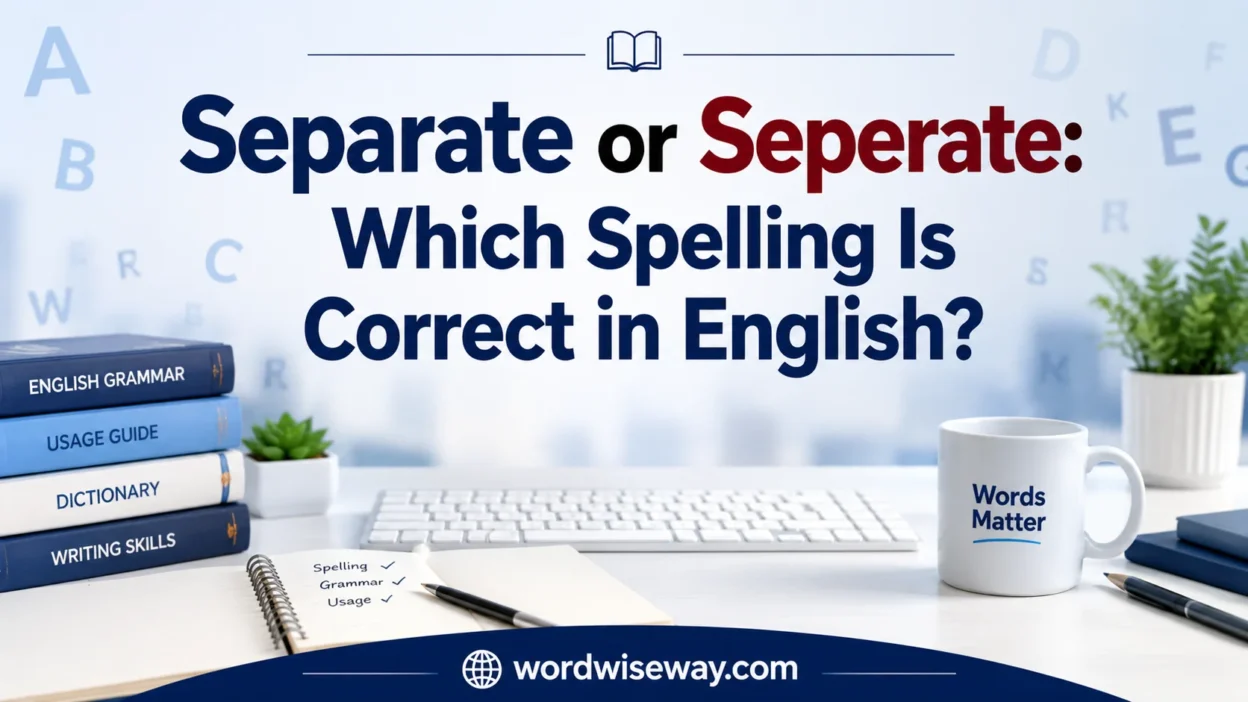
Separate or Seperate: Correct Spelling, Meaning, and Usage helps solve common spelling confusion in English words.
The correct spelling is separate, while seperate is a wrong version and a common mistake. Many students, writers, and professionals hesitate during writing because the pronunciation, middle sound, and “e” sound can feel unclear. This guide gives a quick answer and explains the English spelling rules behind the correct form.
The meaning and usage of separate connect with division, classification, and distinction. It is used in everyday conversation, formal writing, business report, and academic essay to show clear meaning and precise meaning.
Understanding the word difference improves communication, grammar, and helps readers understand ideas with better clarity and confidence.
Quick Answer:
Let’s get straight to the point.
The correct spelling is: separate
The spelling “seperate” is incorrect in standard English.
That’s it. One is valid. The other is a common mistake.
But here’s where things get interesting. Even though “separate” is correct, “seperate” appears everywhere—emails, essays, social posts, even business documents. Why? Because English pronunciation plays tricks on your brain.
Before we break that down, you need a solid understanding of what the correct word actually means.
Separate Meaning in English
The word separate works as both a verb and an adjective. Its core idea is always the same: to divide or keep things apart.
As a verb (action)
You use it when something is being divided.
- “Please separate the papers into two stacks.”
- “We should separate fact from opinion.”
- “The teacher separated the students during the test.”
As an adjective (description)
You use it when things are already apart.
- “They live in separate houses.”
- “These are separate issues.”
- “Keep your personal and work life separate.”
The meaning stays consistent: distance, division, or distinction.
Why People Write “Seperate” Instead of Separate
If “seperate” is wrong, why does it show up so often?
The answer is surprisingly human.
Pronunciation confusion
When people say the word out loud, it sounds like:
“sep-uh-rate”
That middle sound tricks the ear into hearing an “e” instead of “a”. So the brain writes what it hears, not what is correct.
Memory shortcuts gone wrong
English spelling is not always phonetic. So people guess based on patterns they already know. Words like “decorate” or “operate” reinforce the wrong assumption.
Fast typing habits
On phones and keyboards, speed beats accuracy. Once “seperate” gets typed a few times, muscle memory starts to accept it.
Autocorrect dependence
Modern devices often fix the mistake silently. That means people don’t even notice they’re making it repeatedly.
Word Structure Breakdown of Separate
Understanding structure helps you remember spelling more easily.
The word breaks like this:
sep-a-rate
Notice the middle vowel is “a”, not “e”.
Related word forms
| Base Word | Form | Example |
| separate | verb | Separate the files |
| separation | noun | The separation was difficult |
| separately | adverb | They arrived separately |
| separator | noun | Use a page separator |
Once you see the pattern, the spelling becomes more predictable.
Quick Fact About “Separate”
Here’s something interesting that helps memory:
The word comes from Latin roots:
- “separare” meaning “to set apart”
That original structure kept the “a” sound intact, which is why modern English also uses “a” in the middle.
Separate vs Seperate: Side-by-Side Comparison
Let’s make this crystal clear.
| Feature | Separate | Seperate |
| Spelling correctness | Correct | Incorrect |
| Standard usage | Formal + informal English | Not accepted |
| Dictionary presence | Yes | No (as correct form) |
| Usage in writing | Emails, essays, books | Common typo |
| Meaning | Divide or keep apart | No valid meaning |
This table alone can save you from repeated mistakes.
Memory Tricks to Spell Separate Correctly
Let’s make this stick in your mind permanently.
Trick 1: The “A in Apart” method
Think: separAte = keep things ApArt
The “A” connects both ideas.
Trick 2: Break it into chunks
Say it slowly in your head:
sep-a-rate
This slows down your mental spelling and reduces errors.
Trick 3: The “RAT in Separate” trick 🐀
Yes, it sounds funny, but it works.
There’s a “RAT” hiding in “sepARATE”.
That visual hook helps many learners remember the correct spelling.
Trick 4: Visual repetition
Write the word five times:
- separate
- separate
- separate
- separate
- separate
Repetition builds muscle memory faster than memorizing rules.
Real-Life Examples of Separate in Use
Let’s bring this word into real situations so it feels natural.
Everyday communication
- “Please keep these receipts separate.”
- “We should separate clean and dirty clothes.”
Workplace usage
- “The company keeps finances separate for each department.”
- “Separate reports are required for each project.”
Academic writing
- “The experiment uses separate control groups.”
- “Students were placed in separate categories for testing.”
Digital context
- “Create separate folders for each client.”
- “Keep personal and professional emails separate.”
You’ll notice something important: the word always shows division or distinction.
Where “Seperate” Shows Up Most Often
Even though it’s incorrect, “seperate” appears in predictable places.
Common environments:
- Social media posts
- WhatsApp or text messages
- Fast emails
- Online forms
- Student assignments
Why these places?
They share one thing: speed over accuracy
People type quickly and don’t double-check.
Case Study: A Small Spelling Error With Big Impact
Let’s look at a realistic scenario.
Situation:
A job applicant sends a resume with the sentence:
“I can manage separate projects efficiently.”
But they accidentally write:
“I can manage seperate projects efficiently.”
Outcome:
The recruiter notices the mistake immediately.
Even though the skill is valid, the typo creates doubt about attention to detail.
Lesson:
One small spelling error can affect perception in professional settings.
That’s why mastering words like separate matters more than it seems.
Why Correct Spelling Matters More Than You Think
Spelling isn’t just grammar. It affects perception.
Here’s what correct spelling does:
- Builds trust in writing
- Improves clarity
- Shows attention to detail
- Strengthens academic performance
- Enhances professional communication
Even small words matter because readers notice patterns, not just sentences.
Common Myths About Separate vs Seperate
Let’s clear up confusion quickly.
Myth 1: “Seperate is an alternative spelling”
No. It is not accepted in standard English.
Myth 2: “Both are fine in informal writing”
Incorrect. Only “separate” is valid.
Myth 3: “Spellcheck will always fix it”
Not always. Some tools may miss context errors or autocorrect inconsistently.
Quick Rules to Never Get It Wrong Again
Here are simple rules you can rely on:
- Only “separate” is correct
- Always use “a” in the middle
- Break the word into syllables when unsure
- Don’t trust pronunciation alone
- Double-check in formal writing
If you follow these, the mistake disappears over time.
Mini Practice Section
Try filling in the blanks:
- Please ______ the documents into folders.
- They live in ______ apartments.
- We should ______ work from personal life.
Answers:
- separate
- separate
- separate
If you got all three right, the word is already becoming second nature.
Read More: Really vs Realy:Correct Spelling, Meaning, and Usage
FAQs
Q1. What Is the Correct Spelling: Separate or Seperate?
The correct spelling is separate. The word seperate is a common spelling mistake and is not accepted as the standard English form.
Q2. Why Do People Commonly Write Seperate Instead of Separate?
Many people write seperate because the pronunciation makes the middle vowel sound unclear. The spoken sound can trick writers into choosing the wrong letter.
Q3. What Does the Word Separate Mean in English?
Separate means to divide, keep apart, or show that something is different from another thing. It can describe objects, ideas, groups, or situations.
Q4. How Can I Remember the Correct Spelling of Separate?
You can remember separate by focusing on its middle letters. Practicing the word in sentences also helps build a stronger spelling memory.
Q5. Is Seperate Ever Accepted as a Correct Spelling?
No, seperate is not considered a correct spelling in modern English. It is only a common spelling error.
Q6. How Is Separate Used in Everyday Sentences?
Separate is used when describing things that are divided or different. For example, people can have separate tasks, rooms, opinions, or responsibilities.
Q7. What Is the Difference Between Separate and Similar Spelling Mistakes?
Separate follows standard English spelling rules, while similar mistakes usually happen when writers depend on pronunciation instead of the correct written form.
Q8. Do British and American English Spell Separate the Same Way?
Yes, both British English and American English use the spelling separate. The word does not change between these two varieties.
Q9. Why Is Correct Spelling Important in Formal Writing?
Correct spelling improves clarity, professionalism, and communication. It helps readers understand the intended message without confusion.
Q10. Can Learning Word Usage Help Avoid Spelling Confusion?
Yes, understanding word meaning and usage makes it easier to remember the correct spelling and avoid common mistakes.
Conclusion
Understanding the difference between separate and seperate helps you avoid one of the most common English spelling mistakes. While both words may look similar, only separate is the correct spelling used in modern English. Learning its meaning, usage, and spelling pattern makes your writing clearer and more professional.
Whether you are writing an email, academic essay, business report, or everyday message, choosing the correct word improves communication. With regular practice and awareness of common spelling confusion, you can confidently use separate without hesitation and make your writing more accurate.

Amelia Sanders has spent 14 years in Harvard University’s English Department, helping students navigate literary analysis, interpretive theory, and narrative techniques. Her academic pursuits center on 18th-century British prose, romantic poetry, diasporic writing, and digital editing exploring how textual choices influence cultural perspectives. Amelia has spoken at major international meetings and contributed essays to respected academic volumes, demonstrating her dedication to thoughtful scholarship and effective teaching.