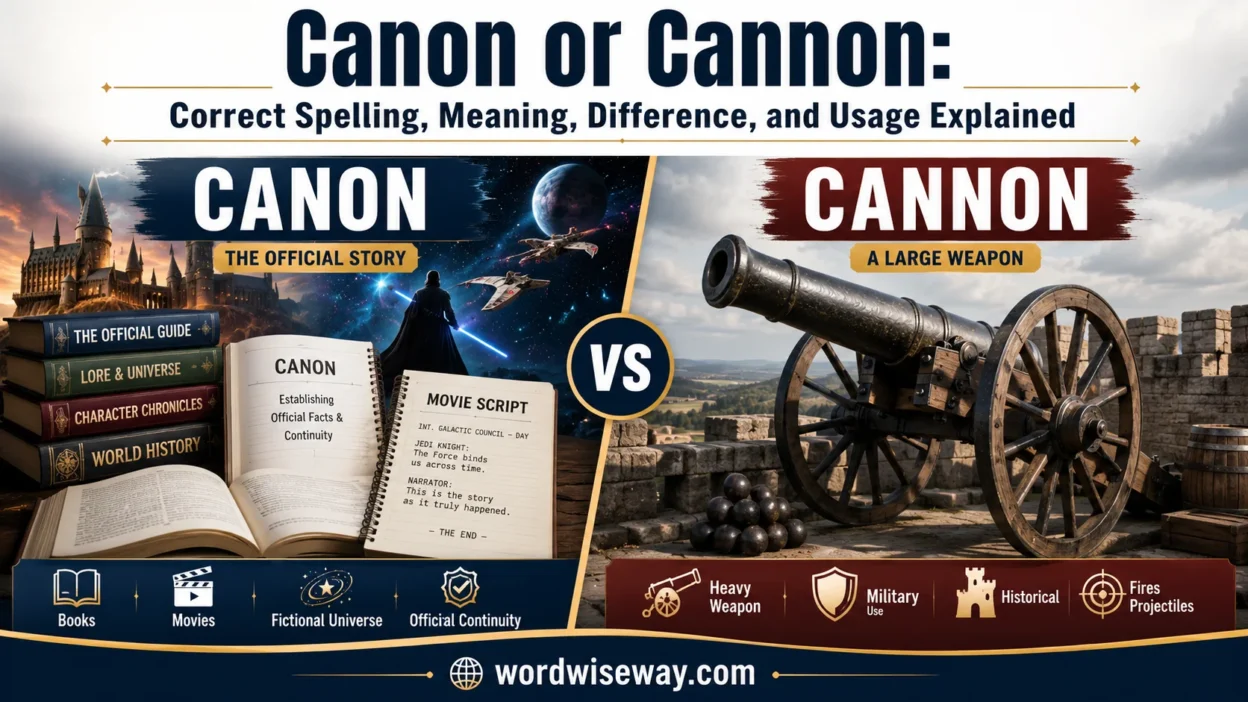
Canon or Cannon: Correct Spelling, Meaning, and Difference helps explain why these English pair words create confusion.
They have the same pronunciation, but their spelling and meanings are different. A cannon is a heavy gun with wheels that uses a projectile and ammunition. Its Latin roots connect to canna, meaning a reed or tube. A tee-shirt cannon and a Revolutionary War cannon are examples of this word’s usage.
A canon refers to accepted rules, traditions, or a collection of approved authors and books. It can describe a complete body of work, original content, or source material like Harry Potter.
Understanding the difference, definition, and meaning of these terms improves clear writing and prevents mistakes in emails, news articles, and academic papers.
Quick Answer:
The correct word depends on your meaning.
| Word | Correct Meaning | Example |
| Canon | An accepted collection of works, official story details, rules, or standards | The new series follows the original book canon. |
| Cannon | A large weapon that fires heavy projectiles | The museum displays an ancient cannon from the war. |
Canon is used for ideas, rules, stories, and official information.
Cannon is used for weapons and military equipment.
A simple way to remember:
- Canon = concepts, collections, and rules
- Cannon = combat weapon
What Does Canon Mean?
The word canon has several meanings, but they all connect to the idea of something being officially accepted, recognized, or established.
In modern English, people commonly use canon when talking about books, movies, television shows, and fictional worlds. It describes information that creators officially consider part of the story.
For example:
- A character’s background revealed in an official movie is part of the story canon.
- A fan-made theory is not considered canon unless the creator confirms it.
The term helps separate official information from opinions, guesses, and unofficial additions.
Canon Meaning in Fiction, Movies, and Books
One of the most common uses of canon today appears in entertainment.
When a fictional universe grows over many years, fans need a way to identify which events actually happened in the official timeline. That is where canon becomes useful.
For example:
- A superhero movie franchise may have dozens of films, comics, and spin-off stories.
- Some stories may be officially connected to the main timeline.
- Others may exist as alternate versions.
The official timeline is called the canon.
Examples of Canon in Fiction
| Situation | Correct Usage |
| An event officially happened in a movie series | That event is part of the canon. |
| A fan creates a different ending | That ending is not canon. |
| A studio confirms a character relationship | The relationship becomes canon. |
A simple example:
“The character’s origin story is canon because the creators confirmed it.”
This means the story detail is officially accepted.
Canon Meaning in Literature
The word canon also applies to important works in literature.
A literary canon refers to a collection of books that scholars, critics, or institutions consider significant. These works often influence culture, education, and the development of language.
Examples of literary canon discussions include:
- Classic novels studied in schools
- Influential poems
- Important plays
- Historical writings
The literary canon can change over time as societies discover new perspectives and recognize different voices.
Canon Meaning in Religion and History
Historically, canon also referred to officially accepted religious texts, rules, or writings.
For example, religious communities may use the term to describe texts that they recognize as authoritative.
The word originally came from an ancient Greek term meaning a rule or measuring standard. Over time, it developed into the modern meaning of an accepted collection or official guideline.
Canon as a Rule or Standard
Beyond stories and books, canon can describe an accepted principle or standard within a particular area.
Examples:
- Artistic canon
- Scientific canon
- Professional canon
In these situations, canon represents ideas that a group recognizes as important or foundational.
For example:
“The artist studied the canon of classical painting.”
This means the artist studied the established body of important works and principles in that field.
What Does Cannon Mean?
The word cannon refers to a large weapon designed to fire heavy objects over a distance.
Unlike canon, which represents ideas or accepted information, a cannon is a physical object.
Cannons played a major role in military history for hundreds of years. They changed warfare by allowing armies and ships to attack from greater distances.
Cannon Meaning in Military History
Before modern weapons developed, cannons were among the most powerful tools available to armies.
They were used for:
- Defending castles
- Attacking enemy walls
- Fighting naval battles
- Supporting ground forces
Large cannons could launch heavy projectiles that damaged buildings, ships, and defensive structures.
Common Types of Cannons
| Type of Cannon | Main Use |
| Naval cannon | Mounted on ships for sea battles |
| Field cannon | Used by armies on land |
| Siege cannon | Designed to attack strong defenses |
| Anti-aircraft cannon | Created to target aircraft |
Although traditional cannons are less common today, the word still appears in history books, museums, and military discussions.
Canon vs Cannon: Key Differences Explained
Although canon and cannon sound identical, their meanings are completely different.
They are examples of homophones, which are words that have the same pronunciation but different meanings and spellings.
Meaning Difference
| Feature | Canon | Cannon |
| Category | Idea or collection | Physical object |
| Meaning | Accepted rule, story, or group of works | Large firearm |
| Common Fields | Movies, books, religion, education | Military, history |
| Example | “This event is official canon.” | “The ship carried several cannons.” |
Spelling Difference
The extra n in cannon separates it from canon.
A helpful memory trick:
- Canon has one “n” because it represents one accepted idea or collection.
- Cannon has two “n’s” and looks heavier, matching its powerful weapon meaning.
Canon vs Cannon Pronunciation
Both words usually have the same pronunciation:
Canon: /ˈkænən/
Cannon: /ˈkænən/
Because they sound identical, you cannot determine the correct spelling by hearing the word alone.
You must understand the context.
For example:
- “The story is part of the official ___.”
Correct answer: canon - “The soldiers fired the large ___.”
Correct answer: cannon
Common Mistakes When Using Canon and Cannon
Many people confuse these words because spelling mistakes do not change the pronunciation.
Using Cannon for Fictional Stories
Incorrect:
“That character’s history is part of the movie cannon.”
Correct:
“That character’s history is part of the movie canon.”
When discussing official story information, always use canon.
Using Canon for Weapons
Incorrect:
“The army used a powerful canon.”
Correct:
“The army used a powerful cannon.”
A weapon always uses the spelling cannon.
Confusing Canon With Similar Words
Some writers also confuse canon with words like:
- Common
- Standard
- Official
- Collection
While these words may share similar ideas, they do not always replace canon.
For example:
“This book is part of the literary canon.”
You cannot always replace canon with “standard” because canon specifically refers to an accepted collection or established body of work.
How to Remember Canon vs Cannon Easily
A simple memory method can prevent mistakes.
Think about the first letters:
Canon = Creative Content
- Movies
- Books
- Stories
- Rules
Cannon = Combat
- Weapons
- Battles
- Military history
Another trick:
A cannon is heavy, so it has an extra “n.”
The additional letter gives the word a heavier appearance, which matches the powerful object it describes.
Canon vs Cannon in Modern Usage
The internet has made canon more popular than ever.
Online communities constantly discuss whether events, characters, and theories belong to official fictional universes.
Canon in Movies, Games, and Fan Communities
Fans often use phrases like:
- “That theory is not canon.”
- “This scene confirms the character’s canon.”
- “The sequel changed the canon.”
These conversations help people separate official stories from fan interpretations.
For example, a video game may include multiple endings. If the creators confirm one ending as the official continuation, that ending becomes canon.
Cannon in Modern Language
The word cannon appears less frequently in everyday conversation unless people discuss:
- Military history
- Museums
- Historical battles
- Weapons
However, it remains an important word because cannons influenced world history and warfare.
Real-World Examples of Canon and Cannon
Example 1: Movies
Incorrect:
“The new film changed the superhero cannon.”
Correct:
“The new film changed the superhero canon.”
The sentence discusses story continuity, so canon is correct.
Example 2: History
Incorrect:
“The castle had a large canon.”
Correct:
“The castle had a large cannon.”
The sentence describes a weapon, so cannon is correct.
Example 3: Education
Correct:
“The professor taught works from the scientific canon.”
The sentence refers to accepted important works, not a physical object.
Read More: Bellow or Below: Correct Spelling, Meaning and Correct Usage
FAQs
What is the main difference between canon and cannon?
The main difference is their meaning. Canon refers to rules, accepted works, traditions, or official content, while cannon is a large weapon that shoots projectiles.
Why do canon and cannon sound the same?
Canon and cannon sound the same because they are homophones. They have similar pronunciation but different spellings and meanings.
How can I remember the spelling of cannon?
A simple trick is that cannon has an extra n, just like it has extra power as a heavy gun used for firing ammunition.
What does canon mean in literature?
In literature, canon refers to a collection of accepted books, works, or ideas considered official within a particular field or community.
Is Harry Potter considered canon?
Yes, the original Harry Potter books are considered canon because they are official source material created by the author. Fan fiction based on them is not part of the official canon.
What is a loose cannon?
A loose cannon describes a person who behaves unpredictably or acts without thinking about the consequences.
Did canon and cannon come from the same origin?
No, they have different origins. Canon developed from ideas related to rules and church law, while cannon comes from roots connected to a tube or weapon.
Can canon be used outside of books?
Yes, canon can describe accepted ideas, traditions, rules, or official content in areas like movies, history, religion, and art.
What are common mistakes between canon and cannon?
The most common mistake is using cannon when talking about official stories, rules, or accepted works, or using canon when referring to a weapon.
Why is knowing the difference between canon and cannon important?
Knowing the difference helps writers choose the correct word, improve clarity, and avoid confusion in professional and academic writing.
Conclusion
Understanding the difference between canon and cannon makes your writing more accurate and easier to understand. Although these words sound identical, their meanings come from completely different areas. One connects with accepted works, rules, and traditions, while the other refers to a powerful weapon.
Learning small spelling differences like this improves your overall language skills. Whether you are writing an article, studying literature, or creating content online, choosing the right word helps your message stay clear and professional.

Emma Smith has dedicated 14 years to Princeton University’s English Department, mentoring students in textual interpretation, literary movements, and critical frameworks. Her research explores Shakespearean drama, Victorian serial fiction, postcolonial narrative theory, and manuscript studies and probing how literary forms evolve across cultures and centuries. Emma has delivered lectures at international humanities congresses and published findings in distinguished academic journals, underscoring her commitment to scholarly depth and vibrant teaching.