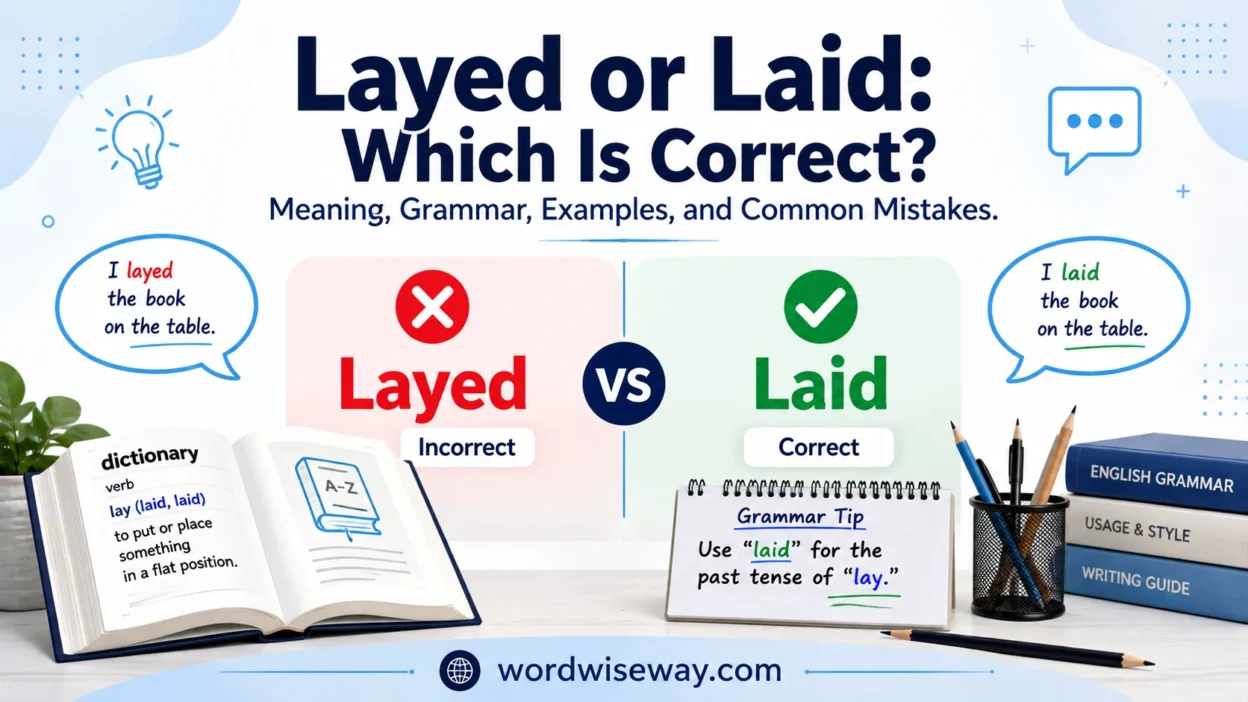
Layed or Laid: Correct Spelling, Meaning, and Correct Usage helps explain why laid is the correct past tense of the verb lay.
Many people have wondered about this because they are not alone in this confusion. The verb lay means to put or place something down. It is one of the English verbs with irregular forms, so it does not use adding -ed. Layed may look logical, but it is incorrect in standard English and should not be used.
Writers often make this common spelling mistake in writing and speaking because they assume past forms follow the same rules. The correct past tense and past participle of lay is laid.
Using the right spelling, meaning, and correct usage improves accurate grammar and clear communication in formal writing, academic writing, and everyday writing. For example, She laid the book on the table is a correct example.
Quick Answer:
Laid is the correct past tense and past participle of the verb lay.
Layed is not the standard past tense of lay and is considered a spelling mistake in modern English. The only rare exceptions involve proper names, brand names, or intentional stylized spellings rather than normal grammar.
Correct examples:
- I laid my phone on the desk.
- She laid the baby in the crib.
- They laid new tiles yesterday.
- The hen laid five eggs.
Incorrect examples:
- I layed my phone on the desk.
- She layed the baby in the crib.
- They layed new tiles yesterday.
Quick rule: If you’re talking about the past of lay, always write laid.
Layed vs. Laid at a Glance
| Feature | Laid | Layed |
| Correct spelling | ✅Yes | ❌ No |
| Past tense of lay | ✅ Yes | ❌ No |
| Past participle of lay | ✅ Yes | ❌ No |
| Accepted in formal writing | ✅ Yes | ❌ No |
| Found in standard dictionaries as the verb form | ✅ Yes | ❌ No |
| Common in everyday mistakes | ❌ No | ✅Yes |
Key Differences
| Word | Meaning | Correct? | Example |
| Laid | Past tense of lay | ✅ Yes | She laid the blanket on the bed. |
| Layed | Misspelling of laid in normal English | ❌ No | She layed the blanket. |
The difference is simple once you know the rule. Lay doesn’t follow the regular -ed pattern. Instead, it changes to laid, making it an irregular verb.
Why People Write “Layed”
Many people write layed because English teaches a familiar pattern early on:
- Walk → Walked
- Jump → Jumped
- Clean → Cleaned
- Paint → Painted
Following that pattern, it’s easy to assume:
- Lay → Layed
The problem is that lay doesn’t behave like a regular verb. Instead, it follows its own historical pattern.
English Has Many Irregular Verbs
Think about these common verbs:
| Present | Past |
| Go | Went |
| Buy | Bought |
| Bring | Brought |
| Think | Thought |
| Catch | Caught |
| Lay | Laid |
Each verb changes differently. That’s simply how English evolved over centuries.
The Similarity Between “Lay” and “Play”
Another reason people become confused is because verbs ending in -ay usually become -ayed.
Examples include:
- Play → Played
- Stay → Stayed
- Delay → Delayed
- Display → Displayed
Naturally, people expect:
- Lay → Layed
But lay is one of the exceptions. It existed in English long before many regular verb patterns developed, so its past tense remained laid.
Autocorrect Doesn’t Always Save You
Some writing apps fail to catch layed, especially if they treat it as a name or specialized spelling. That’s why proofreading still matters.
A simple grammar check can prevent this common mistake before you publish an article, send an email, or submit an assignment.
What Does “Laid” Mean?
The word laid is much more flexible than many people realize. While it’s best known as the past tense of lay, it also appears in dozens of everyday expressions and professional contexts.
Laid as the Past Tense of “Lay”
When you lay something somewhere, you place it down.
Examples:
- She laid the keys on the kitchen counter.
- I laid my notebook beside the laptop.
- We laid fresh grass in the backyard.
Each sentence shows someone placing an object somewhere.
Laid as the Past Participle
Laid also works with helping verbs.
Examples:
- The workers have laid new pavement.
- The carpet has been laid correctly.
- They had laid the plans before construction began.
Notice how laid stays the same after have, has, and had.
Common Meanings of “Laid”
Depending on the sentence, laid can describe several actions.
| Meaning | Example |
| Placed something down | She laid the book on the shelf. |
| Installed | The crew laid the pipes yesterday. |
| Produced eggs | The duck laid six eggs. |
| Established | They laid the foundation for success. |
| Prepared | The teacher laid out the schedule. |
Although the situations differ, the central idea remains the same. Something is being placed, set, arranged, or established.
Everyday Uses of “Laid”
You’ll encounter laid in many situations.
- At home
- Dad laid the groceries on the counter.
- Mom laid fresh towels in the bathroom.
2. At school
- The teacher laid the worksheets on every desk.
- Students laid their projects at the front of the classroom.
3. At work
- Engineers laid cables underground.
- Designers laid out the magazine pages.
The verb appears everywhere because placing things is such a common action.
Understanding the Verb “Lay”
To master laid, you first need to understand lay itself.
The verb lay means to put or place something down. Unlike lie, it always takes an object. In other words, something receives the action.
Examples:
- Lay the book on the table.
- Lay your phone beside the computer.
- Lay the blanket over the couch.
Notice that each sentence answers the question, “Lay what?”
Verb Forms of “Lay”
| Verb Form | Word |
| Base Form | Lay |
| Present Simple | Lay / Lays |
| Present Participle | Laying |
| Past Tense | Laid |
| Past Participle | Laid |
These are the only standard forms you should use in modern English.
Example Sentences for Every Verb Form
Present
- I lay the files on the desk every morning.
- She lays the plates before dinner.
Present Participle
- He is laying bricks for the new patio.
- They are laying fresh carpet today.
Past
- She laid the baby in the crib.
- I laid the letter on your desk yesterday.
Past Participle
- The workers have laid the flooring.
- The plans had been laid before construction began.
A Simple Memory Trick
Here’s an easy way to remember it:
Lay today. Laid yesterday. Laying right now.
If you’re talking about something that already happened, choose laid every time.
Another helpful phrase is:
If you placed something in the past, you laid it. Never layed it.
These quick reminders make the correct form much easier to remember when you’re writing or speaking.
Lay vs. Lie: Why They Cause Confusion
Many people confuse lay and lie because their verb forms overlap. To make matters worse, the past tense of lie is lay, which looks exactly like the present tense of lay. This unusual pattern has caused grammar mistakes for generations.
The easiest way to remember the difference is to focus on the object. If the verb acts on something, use lay. If no object follows and someone simply reclines or rests, use lie.
What Does “Lay” Mean?
Lay means to put or place something somewhere. It always needs an object.
Examples:
- Please lay the books on the shelf.
- She lays the baby in the crib every night.
- They laid new carpet last week.
Notice that each sentence answers the question “Lay what?”
What Does “Lie” Mean?
Lie means to recline, rest, or be in a horizontal position. It does not take an object.
Examples:
- I need to lie down.
- He lay on the couch all afternoon.
- She has lain awake for hours.
Lay vs. Lie Verb Forms
| Verb | Present | Past | Past Participle | Present Participle |
| Lay (put something down) | Lay | Laid | Laid | Laying |
| Lie (recline) | Lie | Lay | Lain | Lying |
This table explains why people often write layed. They see lay in different places and assume layed must exist. It doesn’t.
Quick Memory Trick
- Lay = Place something.
- Lie = Rest yourself.
If you can ask “What did you place?”, the answer is almost always lay and its past tense laid.
Correct Examples of “Laid”
Seeing laid in real sentences helps the rule stick.
Everyday Examples
- I laid my keys on the kitchen table.
- She laid the groceries on the counter.
- We laid the blankets outside for a picnic.
- Dad laid the tools back in the toolbox.
School Examples
- The teacher laid the quizzes on each desk.
- Students laid their science projects on display.
- The librarian laid the returned books on a cart.
Workplace Examples
- The manager laid the proposal before the board.
- Workers laid fresh concrete this morning.
- Engineers laid fiber-optic cables across the city.
Construction Examples
- Builders laid thousands of bricks.
- The crew laid a strong foundation.
- Contractors laid new flooring in every room.
Nature Examples
- The robin laid four eggs.
- The turtle laid her eggs near the shore.
- The hen laid an egg before sunrise.
Each sentence uses laid because the action happened in the past.
Incorrect Uses of “Layed”
Many writers accidentally use layed because it sounds logical. However, standard English grammar considers these spellings incorrect.
| Incorrect | Correct |
| I layed my phone on the desk. | I laid my phone on the desk. |
| She layed the baby down. | She laid the baby down. |
| They layed the bricks yesterday. | They laid the bricks yesterday. |
| The hen layed two eggs. | The hen laid two eggs. |
| We layed fresh sod. | We laid fresh sod. |
Why These Sentences Are Wrong
The verb lay is irregular. It doesn’t become layed in the past tense. Instead, it changes to laid, just as bring changes to brought and buy changes to bought.
Whenever you’re describing a completed action of placing something, choose laid.
Common Expressions with “Laid”
You’ll hear laid in many everyday expressions. These phrases appear in books, news articles, business writing, and conversations.
Laid the Foundation
This expression means started something important.
Example:
- The early research laid the foundation for future discoveries.
Laid the Groundwork
It refers to preparing for future success.
Example:
- Months of planning laid the groundwork for the project’s success.
Laid Eyes On
This phrase means saw someone or something for the first time.
Example:
- It was the first time she had laid eyes on the ocean.
Laid to Rest
It usually refers to a funeral or burial.
Example:
- The soldier was laid to rest with full honors.
Laid Down the Law
It means someone established strict rules.
Example:
- The coach laid down the law before the championship.
Laid Out
This expression has several meanings depending on the context.
It can mean:
- arranged carefully
- explained clearly
- knocked unconscious (informal)
Examples:
- She laid out the travel plans.
- The lawyer laid out the evidence.
- One punch laid him out during the match.
Grammar Rule to Remember
The easiest grammar rule is surprisingly short.
Lay places something. Its past tense is always laid.
Whenever lay describes a completed action, write laid.
Simple Formula
| Time | Correct Form |
| Present | Lay |
| Present Continuous | Laying |
| Past | Laid |
| Past Participle | Laid |
There is no standard English form called layed.
A Helpful Checklist
Before writing, ask yourself these questions:
- Did the action happen in the past?
- Did someone place something?
- Is there an object after the verb?
If the answer is yes, laid is almost certainly correct.
When Can “Layed” Ever Be Correct?
For everyday grammar, the answer is simple.
It isn’t.
However, there are a few unusual situations where you might see layed.
Proper Names
Some people use Layed as a surname or username.
Brand Names
Businesses occasionally choose unusual spellings to stand out. A company might intentionally spell a product or service Layed, even though it doesn’t follow standard grammar.
Creative Writing
Authors sometimes invent spellings for artistic reasons, dialogue, or fictional worlds. These are stylistic choices rather than accepted English grammar.
What Dictionaries Say
Major dictionaries recognize laid as the standard past tense and past participle of lay. They do not list layed as the normal verb form in modern English.
If you’re writing an essay, email, report, blog post, or professional document, always choose “laid.”
Layed or Laid in American and British English
A common question is whether American English and British English use different spellings. The answer is simple: both use “laid.”
Unlike words such as color/colour or center/centre, there is no regional spelling difference between laid and layed. Dictionaries and style guides on both sides of the Atlantic recognize laid as the only standard past tense and past participle of lay.
| English Variety | Correct Form | Incorrect Form |
| American English | Laid | Layed |
| British English | Laid | Layed |
| Canadian English | Laid | Layed |
| Australian English | Laid | Layed |
Whether you’re writing an academic paper, a business email, or a blog post, laid is the correct choice.
Common Mistakes Writers Make
Even experienced writers occasionally mix up lay, laid, and lie. Understanding the most frequent mistakes can help you avoid them.
Using “Layed” Instead of “Laid”
This is by far the most common error.
❌ I layed my backpack on the floor.
✅ I laid my backpack on the floor.
Confusing “Lay” and “Lie”
Remember that lay requires an object, while lie does not.
❌ I’m going to lay down for a nap.
✅ I’m going to lie down for a nap.
Mixing Up Verb Tenses
Many writers accidentally switch tenses in the same sentence.
❌ Yesterday I lay the package on the porch.
✅ Yesterday I laid the package on the porch.
Using “Laying” When “Lying” Is Correct
❌ The dog is laying on the rug.
✅ The dog is lying on the rug.
The dog isn’t placing something. It’s resting.
Quick Quiz
Test your understanding before moving on.
Question 1
Which sentence is correct?
A. I layed the notebook on the desk.
B. I laid the notebook on the desk.
Answer: B
Question 2
Choose the correct sentence.
A. The hen laid three eggs.
B. The hen layed three eggs.
Answer: A
Question 3
Fill in the blank.
Yesterday, the workers _____ new pavement.
A. layed
B. laid
Answer: B
Question 4
Which sentence uses lie correctly?
A. I’m going to lay on the couch.
B. I’m going to lie on the couch.
Answer: B
Question 5
Choose the correct verb.
She has _____ the documents on your desk.
A. laid
B. layed
Answer: A
If you answered all five correctly, you’ve mastered one of the most confusing verb pairs in English.
Key Takeaways
- Laid is the correct past tense and past participle of lay.
- Layed is almost always a spelling mistake.
- Lay means to place something and requires an object.
- Lie means to recline or rest and does not take an object.
- Both American English and British English use laid.
- Remember the phrase: Lay today. Laid yesterday.
“Good grammar isn’t about using difficult words. It’s about choosing the right ones.”
Read More: Afterward vs Afterwards: Differences, Meaning, and Correct Usage
FAQs
Is layed a correct spelling in English?
No, layed is not considered the correct spelling in standard English. The correct past tense and past participle of lay is laid.
What is the difference between layed and laid?
Laid is the correct past form of lay, which means to place something down. Layed is an incorrect form that should be avoided in writing.
Why do people confuse layed and laid?
Many people confuse these words because most English verbs form their past tense by adding -ed. However, lay is an irregular verb.
Can I use layed in casual writing?
It is better not to use layed even in casual writing because it is not accepted as a standard English form.
What is the meaning of laid?
Laid means that someone placed or put something down intentionally. For example, “She laid the book on the table.”
Is laid both a past tense and past participle?
Yes, laid works as both the past tense and past participle of the verb lay.
Is lay an irregular verb?
Yes, lay is an irregular verb because its past form changes to laid instead of following the usual -ed pattern.
How can I remember whether to use laid or layed?
Remember that laid is the only accepted past form of lay. If you are talking about something placed down in the past, use laid.
Is using layed a grammar mistake?
Yes, using layed is a grammar and spelling mistake in standard English. It can make professional or academic writing appear incorrect.
Why is learning the difference between laid and layed important?
Understanding the difference helps improve accurate grammar, writing quality, and clear communication in everyday, academic, and professional situations.
Conclusion
Knowing the difference between layed and laid makes English writing more accurate and easier to understand. Although layed may seem correct because of common verb patterns, laid is the proper form used in standard English.
Using laid correctly helps avoid spelling mistakes and improves communication in formal writing, academic work, and everyday conversations. Learning these small grammar rules builds stronger confidence when using English.