Choosing the right letter closing can make your message sound more professional. Yours Faithfully or Yours Sincerely: Which Is Correct? depends on your greeting and relationship with the recipient. Both expressions are common in formal writing, but each follows different traditional rules.
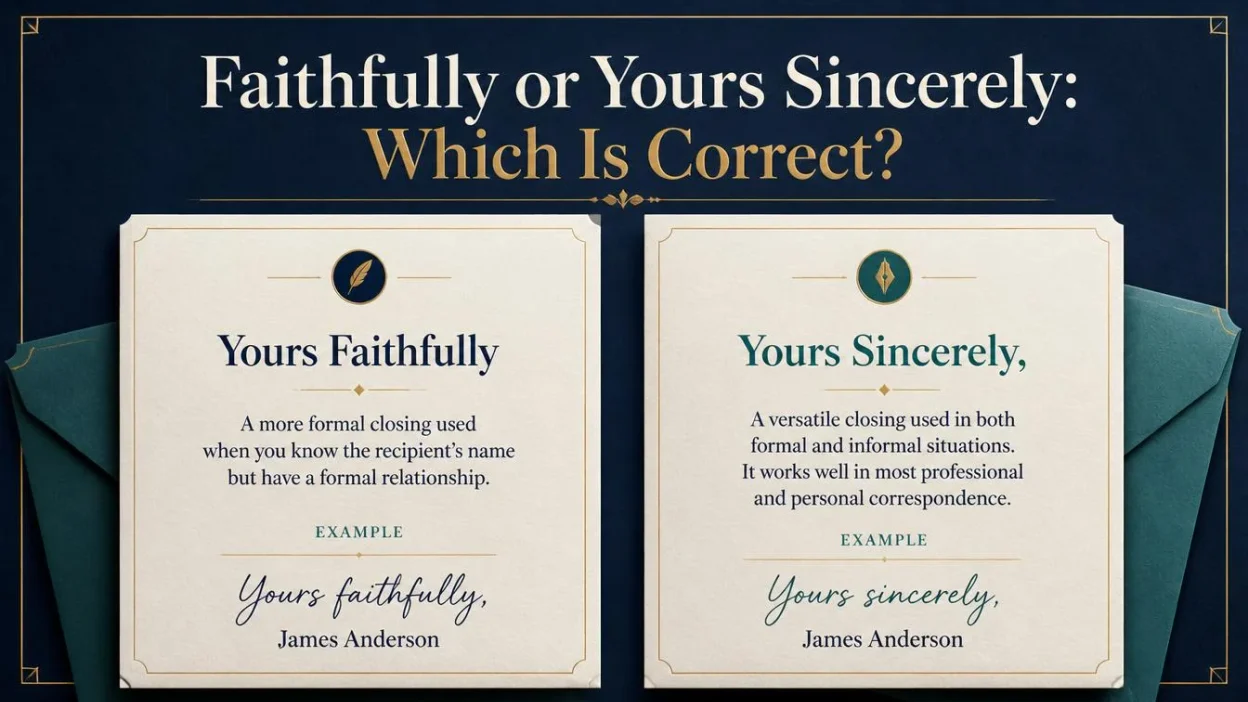
Use Yours Faithfully when you begin a formal letter with a general greeting, such as “Dear Sir or Madam.” Choose Yours Sincerely when you address the recipient by name, such as “Dear Mr. Smith.” These letter endings show respect and help maintain a consistent, appropriate tone.
These rules apply to business communication, official letters, and professional emails. Whether you arrange meetings, manage projects, or send confirmations, the correct sign-off makes your written message clearer. Avoid common mistakes by matching your closing to your greeting.
Understanding these differences improves your English usage and confidence. With practice, you can choose the best formal closing for different professional situations and communicate with clarity and respect.
Quick Answer:
In traditional British English, use “Yours faithfully” when you begin a formal letter with “Dear Sir or Madam” because you don’t name the recipient. Use “Yours sincerely” when you address the recipient by name, such as “Dear Mr. Smith.”
American English generally favors “Sincerely” or “Sincerely yours” in formal correspondence.
| Situation | Recommended closing |
| British English: “Dear Sir or Madam” | Yours faithfully |
| British English: “Dear Ms. Taylor” | Yours sincerely |
| American English: “Dear Mr. Smith” | Sincerely |
| American English: “Dear Hiring Manager” | Sincerely |
| Professional email to a known contact | Kind regards or Best regards |
| Informal message to a colleague | Best, Thanks, or another suitable sign-off |
These are conventional guidelines rather than universal rules. Workplace preferences, regional customs, and the type of correspondence can influence your choice.
What Does “Yours Faithfully” Mean?
Definition of “Yours Faithfully”
“Yours faithfully” is a traditional formal closing used in British English correspondence. It signals courtesy and respect at the end of a letter, especially when the writer doesn’t address a specific person by name.
The word faithfully doesn’t mean that the writer promises personal loyalty to the recipient. Instead, the phrase functions as a conventional sign-off that maintains a formal and respectful tone.
You’ll often encounter it in official letters, formal inquiries, complaints, and correspondence with organizations. Although its use has become less rigid in modern writing, it remains a useful choice when traditional formal-letter conventions apply.
When to Use “Yours Faithfully”
Choose “Yours faithfully” when your formal letter follows the traditional British convention of addressing an unnamed recipient.
Common situations include:
- Formal inquiries: When you contact an organization without knowing the name of the person handling your request.
- Complaint letters: When you write to a company or institution using a general salutation.
- Official correspondence: When you communicate with an office or department rather than a named individual.
- Job inquiries: When you cannot identify the hiring manager and use a general opening.
- Administrative requests: When you send a formal letter to an organization without a specific contact.
For example, suppose you want to ask a university about its admission requirements. You don’t know which staff member will read your letter, so you begin with “Dear Sir or Madam.” In traditional British English, “Yours faithfully” provides the conventional closing.
However, if the university provides the admissions officer’s name, you can address that person directly and use “Yours sincerely.”
Examples of “Yours Faithfully” in Formal Letters
Example: A formal inquiry
Dear Sir or Madam,
I am writing to request information about the application process for your upcoming academic session. I would appreciate details about the eligibility criteria and required documents.
Thank you for your time and assistance.
Yours faithfully,
Jordan Lee
Example: A complaint letter
Dear Sir or Madam,
I am writing to express my concern about a recent order that arrived with missing items. Please let me know how your team intends to resolve this issue.
I look forward to your response.
Yours faithfully,
Morgan Reed
Example: A general job inquiry
Dear Sir or Madam,
I would like to inquire about potential employment opportunities within your organization. Please let me know whether you are currently accepting applications for suitable positions.
Thank you for considering my inquiry.
Yours faithfully,
Alex Morgan
Notice the consistent pattern: each letter addresses an unnamed recipient. That detail explains why “Yours faithfully” fits the traditional British convention.
What Does “Yours Sincerely” Mean?
Definition of “Yours Sincerely”
“Yours sincerely” is a formal closing that expresses courtesy and sincerity toward the recipient. Traditional British English uses it when the writer addresses a specific person by name.
The phrase works well in business letters, job applications, academic correspondence, and other professional communications. It helps end a message politely without sounding overly familiar.
Despite its wording, “Yours sincerely” doesn’t require a personal relationship between the writer and recipient. You can use it when writing to someone you’ve never met, provided you know their name and follow the relevant convention.
When to Use “Yours Sincerely”
Use “Yours sincerely” when you address the recipient by name in traditional British English correspondence.
Typical examples include:
- Job applications: When your letter begins with “Dear Ms. Carter” or another named salutation.
- Academic correspondence: When you write to a professor, lecturer, or admissions officer by name.
- Business letters: When you contact a named client, manager, or colleague in a formal setting.
- Formal requests: When you ask a specific person for information, assistance, or approval.
- Professional follow-ups: When you write a formal letter to someone whose identity you know.
For instance, imagine you’re applying for a position and find the hiring manager’s name in the job advertisement. You can begin with “Dear Ms. Carter” and close with “Yours sincerely.”
The key distinction is straightforward: knowing the recipient’s name determines the traditional British choice, not how well you know that person.
Examples of “Yours Sincerely” in Formal Letters
Example: A job application
Dear Ms. Carter,
I am writing to apply for the junior content writer position advertised by your company. My writing experience and attention to detail have prepared me to contribute effectively to your team.
Thank you for considering my application. I look forward to hearing from you.
Yours sincerely,
Taylor Morgan
Example: An academic request
Dear Professor Williams,
I am writing to ask whether you could provide further information about the research opportunities available in your department. I would appreciate any guidance you can offer.
Thank you for your time.
Yours sincerely,
Jamie Wilson
Example: A business letter
Dear Mr. Davis,
Thank you for discussing the proposed project with me earlier this week. I am writing to confirm the next steps and request your feedback on the revised timeline.
I look forward to your response.
Yours sincerely,
Casey Brown
Each example addresses a specific person. That makes “Yours sincerely” appropriate under the traditional British convention.
Key Differences
Although both expressions close formal correspondence, their traditional uses differ. Understanding those differences helps you choose the right phrase without second-guessing yourself.
Difference in Meaning
“Yours faithfully” traditionally accompanies a formal letter addressed to an unnamed recipient. “Yours sincerely” traditionally accompanies a formal letter addressed to a named recipient.
Neither expression is inherently more respectful than the other. Both communicate professional courtesy, and the choice usually reflects the opening salutation rather than the writer’s feelings.
Difference in Usage
The opening salutation provides the simplest way to distinguish these expressions in British English.
Consider these two examples:
- Dear Sir or Madam → Yours faithfully
- Dear Dr. Wilson → Yours sincerely
The first letter doesn’t identify its recipient. The second names the person receiving it.
Modern organizations may accept either closing in some circumstances. However, following the traditional pairing remains a sensible choice when you need to write a conventional formal letter.
Difference in Formality
Both expressions belong to the formal register, so neither automatically makes a letter more professional.
The context determines whether the closing sounds appropriate. “Yours faithfully” fits a traditional letter addressed to an unidentified recipient, while “Yours sincerely” suits a letter addressed to a named person.
In a routine professional email, either expression may sound more formal than necessary. “Kind regards” or “Best regards” may feel more natural when you regularly communicate with the recipient.
Difference Between British and American English
British and American English differ in their customary formal-letter closings. Applying the British rule everywhere can make your writing sound less natural in an American setting.
| Feature | British English | American English |
| Formal letter to an unnamed recipient | Yours faithfully | Sincerely or Sincerely yours |
| Formal letter to a named recipient | Yours sincerely | Sincerely or Sincerely yours |
| Formal business correspondence | Both traditional closings are used according to context | Sincerely is widely used |
| Professional email | Yours sincerely, Yours faithfully, Kind regards | Sincerely, Best regards, Kind regards |
| General preference | The salutation traditionally influences the closing | Sincerely commonly works for both named and unnamed recipients |
These patterns describe common conventions rather than strict rules for every organization. American writers may use “Yours sincerely,” and British writers may choose alternative closings.
If you’re writing for a specific employer, institution, or publication, follow its preferred style.
Comparison Table: Yours Faithfully vs. Yours Sincerely
| Feature | Yours faithfully | Yours sincerely |
| Traditional British use | After an unnamed salutation | After a named salutation |
| Formality | Formal | Formal |
| Common context | Official inquiries and general correspondence | Job applications and letters to named individuals |
| Indicates greater respect? | No | No |
| Suitable for all emails? | Not necessarily | Not necessarily |
| Common American alternative | Sincerely | Sincerely |
The easiest way to remember the difference is to check the name in your greeting before choosing your closing.
How to Choose Between Yours Faithfully and Yours Sincerely
Check Whether You Know the Recipient’s Name
Start by looking at the greeting. This small detail usually resolves the question when you’re following traditional British English conventions.
If you don’t know the person’s name, you might write “Dear Sir or Madam” or “Dear Admissions Officer.” The traditional closing is “Yours faithfully.”
If you know the person’s name, you might write “Dear Ms. Ahmed” or “Dear Professor Brown.” The traditional closing is “Yours sincerely.”
You don’t need to know the recipient personally. A name is enough to establish the traditional pairing.
Consider Your Country and Writing Convention
Before choosing a sign-off, consider where your letter will be read.
For a formal letter following British English conventions, use the named-versus-unnamed distinction. For correspondence following American English conventions, “Sincerely” is a common option regardless of whether the greeting names the recipient.
This distinction matters when writing job applications, academic letters, official requests, and business correspondence across countries.
Match the Closing to Your Letter’s Tone
Your closing should fit the message rather than sound more elaborate than necessary.
For example:
- A formal complaint may call for “Yours faithfully” or “Yours sincerely,” depending on the salutation and regional convention.
- A job application may call for “Yours sincerely” in traditional British English.
- An ongoing professional email exchange may suit “Kind regards.”
- A brief message to a colleague may work well with “Best” or “Thanks.”
The aim is to sound respectful and natural. A formal closing cannot compensate for an unclear or poorly organized message.
Follow the Organization’s Preferred Style
Some organizations publish writing guidelines that specify how employees should address recipients and sign off correspondence.
If you’re writing to a university, government department, employer, or professional association, check whether it provides a preferred format. Following its guidance removes uncertainty and helps your letter match the expected style.
When no guidance exists, use the conventions appropriate to your audience.
Correct Examples
Examples make the distinction easier to remember because you can see how the opening and closing work together.
Formal Letter Beginning With “Dear Sir or Madam”
Use “Yours faithfully” when following the traditional British convention for an unnamed recipient.
Example:
Dear Sir or Madam,
I am writing to request a copy of your current service brochure. Please send the relevant information to the mailing address provided below.
Thank you for your assistance.
Yours faithfully,
Robin Taylor
Why it works: The greeting doesn’t identify a particular person, so the traditional British closing is “Yours faithfully.”
Formal Letter Addressed to a Named Person
Use “Yours sincerely” when the recipient’s name appears in the greeting.
Example:
Dear Dr. Thompson,
I am writing to request an appointment to discuss the research opportunities available in your department. Please let me know which dates would be convenient for you.
Thank you for your consideration.
Yours sincerely,
Robin Taylor
Why it works: The greeting identifies the recipient by name, which makes “Yours sincerely” the traditional British choice.
Job Application to an Unknown Hiring Manager
Job applications often create confusion because applicants may not know who will review their documents.
If you’re following traditional British English conventions, you can use “Dear Sir or Madam” followed by “Yours faithfully.” However, a more specific greeting, such as “Dear Hiring Manager,” may sound more natural when the person’s name isn’t available.
If you use a job title instead of a name, modern organizational guidance may accept either closing. Follow the employer’s preferred style when available.
Example:
Dear Hiring Manager,
I am writing to apply for the administrative assistant position advertised by your organization. My organizational skills and attention to detail would help me support your team’s daily operations.
Thank you for reviewing my application.
Yours faithfully,
Robin Taylor
This example follows the traditional unnamed-recipient convention, although modern practices allow some flexibility.
Business Email to a Known Contact
Professional emails often use shorter sign-offs than traditional printed letters. When you regularly communicate with a colleague or client, “Kind regards” or “Best regards” may sound more natural.
Example:
Dear Ms. Patel,
Thank you for sharing the revised project schedule. I’ve reviewed the proposed dates and can confirm that the new deadline works for our team.
Please let me know if you need any additional information.
Kind regards,
Robin Taylor
The closing fits a professional email without sounding unnecessarily ceremonial. If the message were a traditional formal letter following British conventions, “Yours sincerely” would also be appropriate.
Common Mistakes
Even experienced writers sometimes mix up these expressions. Most mistakes happen when people overlook the salutation or apply one country’s conventions to another.
Using “Yours Faithfully” After a Named Salutation
In traditional British English, “Yours faithfully” generally follows an unnamed salutation rather than a greeting that identifies the recipient.
Less conventional pairing:
Dear Mr. Johnson,
Thank you for reviewing my application.
Yours faithfully,
Traditional pairing:
Dear Mr. Johnson,
Thank you for reviewing my application.
Yours sincerely,
The second version follows the conventional British pattern. However, modern writing practices aren’t always rigid, so the first version isn’t necessarily unacceptable in every setting.
Using “Yours Sincerely” After “Dear Sir or Madam”
The reverse mistake occurs when a writer uses “Yours sincerely” after a general salutation.
Traditional pairing:
Dear Sir or Madam,
I am writing to request further information about your services.
Yours faithfully,
This combination follows the traditional British convention because the greeting doesn’t identify a specific person.
Nevertheless, some organizations accept “Yours sincerely” even when the recipient’s name is unknown. If you’re completing a formal writing examination, follow the rule taught by your course.
Applying British Rules to Every English-Speaking Country
English doesn’t have one universal convention for formal correspondence. British and American English differ in their customary sign-offs.
For example, an American business letter can begin with “Dear Hiring Manager” and end with “Sincerely.” The writer doesn’t need to switch to “Yours faithfully” simply because the greeting omits a personal name.
Remember: Identify your audience before choosing a formal closing.
Assuming These Closings Are Required in Every Email
Not every professional email needs a traditional formal sign-off.
If you’re exchanging routine messages with a colleague, “Best regards,” “Thanks,” or “Best” may be more suitable. The right choice depends on your relationship with the recipient, the purpose of the message, and workplace expectations.
A highly formal closing can sound stiff in an otherwise friendly exchange. Choose language that fits the situation.
Mixing Formal and Informal Language
Your greeting, message, and closing should work together.
Consider this example:
Dear Professor Adams,
Hey! Just wanted to ask if you could send me those documents whenever you get a chance.
Yours faithfully,
The greeting and closing suggest a formal letter, but the body sounds casual. That mismatch can make the message feel awkward.
A more consistent version would read:
Dear Professor Adams,
I am writing to ask whether you could share the relevant documents at your convenience.
Thank you for your assistance.
Yours sincerely,
The second version maintains a consistent professional tone throughout.
Alternatives to Yours Faithfully and Yours Sincerely
Traditional closings remain useful, but they’re not the only options. Modern correspondence often uses shorter expressions that sound professional without being overly formal.
“Sincerely”
“Sincerely” is widely used in American business letters, cover letters, and formal emails. It works with greetings that identify the recipient and with general greetings such as “Dear Hiring Manager.”
For example:
Dear Hiring Manager,
Thank you for considering my application. I look forward to discussing my qualifications with you.
Sincerely,
Morgan Lee
This is a practical choice when writing for an American audience.
“Sincerely Yours”
“Sincerely yours” is another conventional American closing. It expresses courtesy and works well in formal business correspondence.
For example:
Dear Ms. Davis,
I appreciate your time and consideration. Please contact me if you need any additional information.
Sincerely yours,
Morgan Lee
Both “Sincerely” and “Sincerely yours” can work in American correspondence. The best choice depends on the organization’s preferred style and the tone you want to convey.
“Kind Regards” and “Best Regards”
These expressions are common in professional emails and routine business communication.
- Kind regards: Polite and professional, with a slightly warm tone.
- Best regards: Professional and friendly, especially when communicating with clients or colleagues.
For example:
Dear Alex,
I’ve attached the updated schedule for your review. Please let me know if you’d like any changes.
Best regards,
Morgan Lee
These closings work particularly well when you already have an established professional relationship with the recipient.
“Yours Truly”
“Yours truly” appears in some American formal and business correspondence. Its tone can vary according to the context and the writer’s preferences.
For example:
Dear Customer Service Manager,
Thank you for reviewing my request. I appreciate your assistance and look forward to your response.
Yours truly,
Morgan Lee
Although the phrase remains valid, “Sincerely” is often a straightforward choice for modern American business letters.
“Best Wishes”
“Best wishes” expresses a warmer, more personal tone than traditional formal closings. It’s useful when you want to remain polite without sounding overly formal.
For example:
Dear Jamie,
Thank you for your help with the project. I appreciate the time you’ve spent working through the details with me.
Best wishes,
Morgan Lee
This closing works best when the relationship and situation allow a friendly tone. For a highly formal complaint or official request, a more conventional sign-off may be preferable.
Read More: Nicholas’ or Nicholas’s? Difference, Meaning, and Examples
FAQs
1. Is “Yours Faithfully” or “Yours Sincerely” correct?
Both are correct expressions used to end formal letters. The right choice depends on your greeting. Traditionally, use “Yours Faithfully” when you don’t know the recipient’s name and “Yours Sincerely” when you address them by name.
2. When should you use “Yours Faithfully” in a letter?
Use “Yours Faithfully” when your letter begins with a general greeting, such as “Dear Sir or Madam.” This closing is common in traditional British English business correspondence when you don’t know the recipient personally.
3. When is “Yours Sincerely” the better choice?
Choose “Yours Sincerely” when you address someone by name, such as “Dear Mr. Smith” or “Dear Ms. Jones.” It works well for professional emails, job applications, business letters, and other formal messages.
4. Can you use “Yours Faithfully” in an email?
Yes, you can use “Yours Faithfully” in a formal email, especially when you don’t know the recipient’s name. However, many modern workplace emails use simpler closings, such as “Kind regards” or “Best regards.”
5. Should “Yours Faithfully” and “Yours Sincerely” be capitalized?
Capitalization depends on the style guide you follow. Traditionally, both words in these closings may begin with capital letters. Modern business writing often uses sentence case, writing them as “Yours faithfully” and “Yours sincerely.”
6. Is “Yours Sincerely” appropriate for a job application?
Yes, “Yours Sincerely” is appropriate when you address the hiring manager by name. If you begin with “Dear Hiring Manager” or another general greeting, follow the conventions required by your region or organization.
7. What is the difference between “Yours Faithfully” and “Yours Sincerely”?
The main difference is the greeting that comes before the closing. In traditional British English, “Yours Faithfully” follows a greeting without the recipient’s name, while “Yours Sincerely” follows a greeting that uses their name.
8. Can you end a letter with “Yours Sincerely” if you don’t know the recipient personally?
Yes. You don’t need to know someone personally to use “Yours Sincerely.” If you know their name and address them by it, this closing is generally appropriate in traditional British English.
9. Are “Yours Faithfully” and “Yours Sincerely” used in American English?
American English generally favors “Sincerely” or “Sincerely yours” for formal correspondence. “Yours faithfully” is more closely associated with British English and may sound less natural in typical American business writing.
10. What are some alternatives to “Yours Faithfully” and “Yours Sincerely”?
You can use “Kind regards,” “Best regards,” “Regards,” or “Respectfully” depending on your message and audience. For everyday professional emails, “Kind regards” and “Best regards” are versatile choices. For highly formal correspondence, “Sincerely” is often suitable.
Conclusion
Choosing between “Yours Faithfully” and “Yours Sincerely” becomes easier when you understand the greeting that comes before it. In traditional British English, use “Yours Faithfully” when you don’t know the recipient’s name, and choose “Yours Sincerely” when you address them by name. Both are correct, but the situation determines which one fits best.
Before sending your letter or email, check your greeting, consider your audience, and make sure your closing matches the tone of your message. For job applications, business correspondence, and official requests, these small details can make your writing look more polished and professional. Remember that American English often follows slightly different conventions, so consider your reader’s location and expectations.
Ultimately, good letter writing isn’t about choosing the fanciest words. It’s about communicating clearly and respectfully. Once you become familiar with these traditional rules, you’ll find it easier to write formal messages with confidence. When in doubt, follow the recipient’s preferred style or your organization’s writing guidelines.

Amelia Sanders has spent 14 years in Harvard University’s English Department, helping students navigate literary analysis, interpretive theory, and narrative techniques. Her academic pursuits center on 18th-century British prose, romantic poetry, diasporic writing, and digital editing exploring how textual choices influence cultural perspectives. Amelia has spoken at major international meetings and contributed essays to respected academic volumes, demonstrating her dedication to thoughtful scholarship and effective teaching.