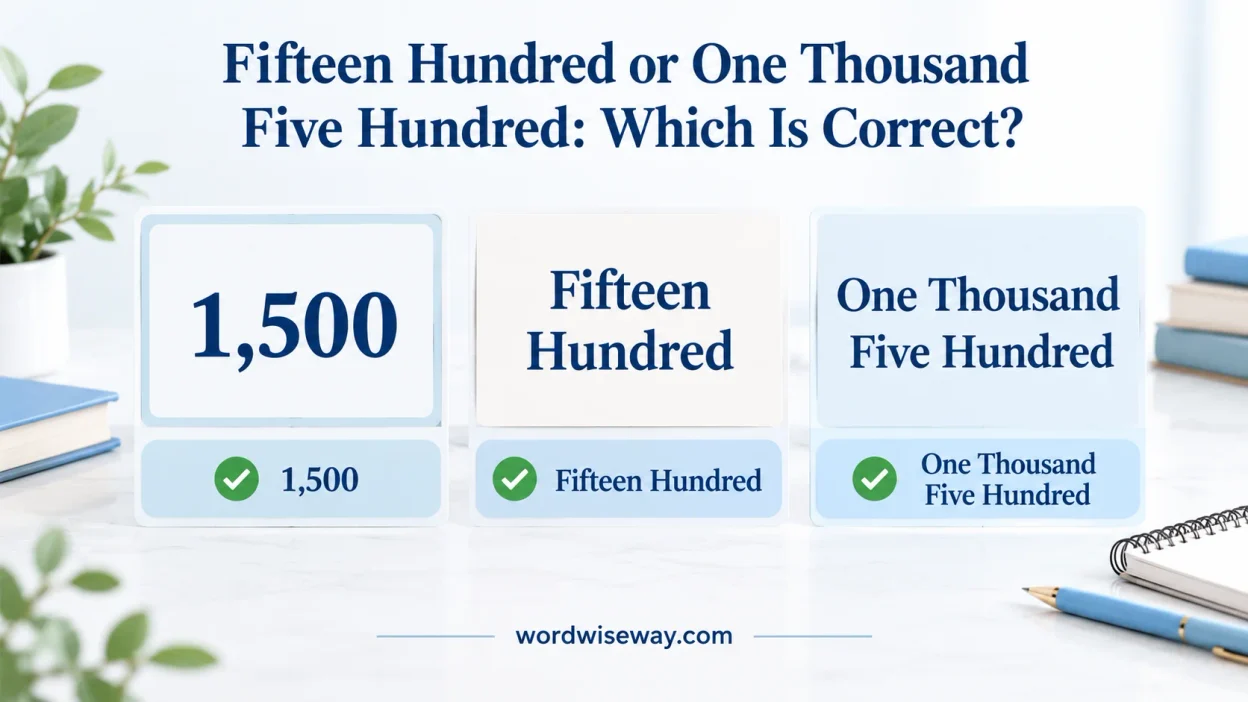
Fifteen Hundred or One Thousand Five Hundred: Which Is Correct? Both forms are correct, but your choice depends on the context, audience, and writing style.
When writing or saying 1500, you can use fifteen hundred or one thousand five hundred. Both expressions represent the same numerical value, but their usage may vary between everyday conversations and formal documents. Understanding number names, written numbers, and spoken numbers helps you choose the most suitable form.
In spoken English, fifteen hundred often sounds natural and conversational. However, one thousand five hundred clearly expresses the quantity in formal writing and explanations. Both forms follow accepted English conventions.
Consider your sentence context, audience, and personal preference when choosing between them. Understanding number spelling, pronunciation, and numerical formatting helps you communicate quantities accurately and naturally.
Quick Answer:
Both “fifteen hundred” and “one thousand five hundred” are correct ways to write the number 1,500 in words. They have exactly the same numerical value, so neither expression changes the amount being described.
- Fifteen hundred: A shorter, conversational way to express 1,500.
- One thousand five hundred: A more explicit way to express the same number by stating its thousands and hundreds.
- Numerical form: 1,500, with a comma separating the thousands from the hundreds in standard US English number formatting.
- Hyphenation: Neither expression normally requires a hyphen.
For example, “The laptop costs fifteen hundred dollars” and “The laptop costs one thousand five hundred dollars” communicate the same price. You can use either sentence when the context makes the amount clear.
What Does Fifteen Hundred Mean?
“Fifteen hundred” means fifteen groups of one hundred. When you multiply 15 by 100, you get 1,500.
The expression combines two number words: fifteen and hundred. Instead of naming the thousands and hundreds separately, it treats fifteen hundred as one complete quantity.
This construction is common in spoken English because it keeps numbers short and easy to say. People frequently use it when discussing prices, salaries, distances, populations, quantities, and measurements.
Consider a business owner who orders 1,500 notebooks. During a conversation, the owner might say, “We ordered fifteen hundred notebooks for the new school year.” The listener understands the quantity without needing a longer explanation.
Examples of Fifteen Hundred in Sentences
Here are several examples showing how the expression works in everyday situations.
- Money: Fifteen hundred dollars covered the cost of the new computer.
- Education: Fifteen hundred students attended the annual school event.
- Distance: The village sits fifteen hundred feet above sea level.
- Shopping: The store received fifteen hundred new products this week.
- Employment: The company received fifteen hundred applications for its graduate program.
- Travel: The driver covered fifteen hundred miles during the road trip.
In each sentence, “fifteen hundred” represents exactly 1,500. The surrounding words identify what the number measures or counts.
Is Fifteen Hundred One Word or Two?
“Fifteen hundred” consists of two separate words. You should not combine them into one word or insert a hyphen between them in ordinary English writing.
The standard forms are:
- Correct: fifteen hundred
- Correct: 1,500
- Incorrect in standard usage: fifteen-hundred
- Incorrect in standard usage: fifteenhundred
A useful distinction appears when you compare “fifteen hundred” with “fifteen-hundred-dollar budget.” In the second example, the words form a compound modifier before the noun budget. A hyphen may help connect that compound modifier, although many editors prefer the simpler construction “a $1,500 budget.”
Therefore, the expression itself normally remains open, while surrounding grammatical structures can affect punctuation.
What Does One Thousand Five Hundred Mean?
“One thousand five hundred” expresses 1,500 by naming its thousands and hundreds separately. The phrase consists of one, thousand, five, and hundred.
You can understand its structure through a simple addition problem:
1,000 + 500 = 1,500
This wording makes the number’s place values more explicit. It can be especially helpful when teaching mathematics, explaining quantities, or spelling out amounts in contexts where readers benefit from seeing the complete number name.
For example, a teacher might explain that 1,500 contains one thousand and five additional hundreds. Writing “one thousand five hundred” reinforces that relationship.
However, the longer expression isn’t limited to formal situations. People use it in ordinary conversations, business discussions, educational materials, and written explanations.
Examples of One Thousand Five Hundred in Sentences
The following examples demonstrate how the full expression works across different contexts.
- Business: The project requires one thousand five hundred dollars to cover its initial expenses.
- Education: The library contains one thousand five hundred books.
- Research: The survey collected one thousand five hundred responses.
- Manufacturing: The factory produced one thousand five hundred units during the first week.
- Community services: The organization distributed one thousand five hundred food packages.
- Event planning: The organizers prepared one thousand five hundred invitations.
Each example communicates the same quantity. The longer expression simply spells out the numerical value in greater detail.
Is One Thousand Five Hundred More Formal?
Some writers prefer “one thousand five hundred” because it spells out the complete number. Nevertheless, the expression isn’t automatically more formal or grammatically superior than “fifteen hundred.”
The appropriate choice depends on the document, audience, and applicable style rules.
For instance, an employee might write, “The repair will cost fifteen hundred dollars” in an informal email. In a report, the employee could write, “The estimated repair cost is $1,500.” Both sentences work, although the second uses numerals rather than spelling out the number.
The key point is that formality doesn’t depend on word count alone. Consistency, clarity, and the document’s conventions matter just as much.
Key Differences
Although the expressions share the same meaning, their structures create small differences in tone and presentation.
“Fifteen hundred” offers a compact way to express the quantity. “One thousand five hundred” states the components more explicitly, which can help readers who are learning English or studying place value.
Neither expression changes the amount. The choice concerns how you communicate it.
Comparison Table: Fifteen Hundred vs. One Thousand Five Hundred
| Feature | Fifteen Hundred | One Thousand Five Hundred |
| Numerical value | 1,500 | 1,500 |
| Meaning | 15 groups of 100 | 1,000 plus 500 |
| Grammatical correctness | Correct | Correct |
| Number of words | 2 | 4 |
| Everyday conversation | Common | Also common |
| Formal writing | Acceptable | Acceptable |
| Mathematical explanation | Correct | Often useful for explaining place value |
| Hyphenation | Normally unnecessary | Normally unnecessary |
| Numerical notation | 1,500 | 1,500 |
The table highlights the central distinction: both expressions describe the same number, but they present it differently.
Does One Expression Sound More Natural?
Naturalness often depends on the sentence and situation. In casual conversation, “fifteen hundred dollars” may sound direct and familiar. However, “one thousand five hundred dollars” can sound equally natural when someone wants to emphasize the full amount.
Imagine two friends discussing a used bicycle.
One says, “The seller wants fifteen hundred dollars for it.”
The other replies, “That’s a lot for a bicycle costing one thousand five hundred dollars.”
Both statements are understandable, although the second speaker may sound more deliberate because the number takes longer to say.
Neither version is inherently better. The surrounding conversation determines which wording fits comfortably.
When Should You Use Fifteen Hundred?
Use “fifteen hundred” when you want a concise, natural expression for the number 1,500. It works particularly well in everyday conversation and informal writing.
The phrase appears frequently in discussions involving prices, quantities, distances, salaries, and measurements. It allows you to communicate a relatively large number without listing every place value separately.
For example, a person discussing a renovation might say, “The contractor quoted fifteen hundred dollars for the work.” The expression communicates the estimated price clearly and efficiently.
However, always consider your audience. If readers might misunderstand the number or if a document requires a specific format, follow the relevant instructions.
Using Fifteen Hundred for Money
People commonly use “fifteen hundred” when discussing money because the phrase is easy to say and understand.
Examples include:
- The used phone costs fifteen hundred dollars.
- She saved fifteen hundred dollars for her vacation.
- The repair shop charged fifteen hundred dollars for the replacement parts.
- Our monthly project budget is fifteen hundred dollars.
These examples work because the currency appears alongside the number. Without that information, “fifteen hundred” identifies the amount but doesn’t tell readers whether it represents dollars, pounds, rupees, or another currency.
In financial writing, numerical notation can be even clearer. For example, $1,500 identifies the amount and currency symbol at a glance.
When writing amounts in Pakistani rupees, you might use “fifteen hundred rupees” or “PKR 1,500,” depending on the document’s conventions.
Using Fifteen Hundred for Quantities and Measurements
The expression also works for countable objects and measurable amounts.
Consider these examples:
- The warehouse stores fifteen hundred boxes.
- The research team examined fifteen hundred samples.
- The road extends fifteen hundred feet beyond the bridge.
- The event attracted fifteen hundred visitors.
Each sentence uses the same number for a different purpose. The noun or measurement unit supplies the necessary context.
For technical reports, scientific writing, and engineering documents, numerals may be easier to scan and compare. A report listing several measurements might use 1,500 feet, 2,400 feet, and 3,100 feet instead of spelling out every value.
The best format depends on the document’s purpose. Consistency matters more than choosing the shorter expression every time.
When Should You Use One Thousand Five Hundred?
Use “one thousand five hundred” when spelling out the complete number helps readers understand the quantity or when a task specifically requires number words.
This form is useful in educational explanations, language-learning exercises, and prose that focuses on the meaning of numbers. It also works in formal communication when the writer wants to express the amount entirely in words.
For example, an arithmetic lesson might explain, “One thousand five hundred equals fifteen hundreds.” That sentence directly connects the number to its place-value structure.
However, don’t assume that formal writing always requires spelling out large numbers. Many professional documents use numerals because they make financial amounts, statistics, and measurements easier to locate.
Using One Thousand Five Hundred in Formal Documents
Formal documents often follow established rules for presenting numbers. These rules may come from an organization’s style guide, a legal requirement, a publication’s editorial policy, or the document’s purpose.
For example, a business report might state:
“The department spent $1,500 on replacement equipment during September.”
A written exercise might instead require:
“The department spent one thousand five hundred dollars on replacement equipment during September.”
Both sentences communicate the same information. The appropriate version depends on the instructions governing the document.
When preparing contracts, invoices, checks, or other financial records, follow the applicable requirements rather than relying on a general preference. Some documents require amounts in both numerals and words to reduce ambiguity.
Writing One Thousand Five Hundred in Academic and Educational Contexts
Teachers often spell out numbers when explaining how the decimal number system works. The complete wording can help students connect each digit to its place value.
For example, the number 1,500 contains:
- 1 thousand: 1,000
- 5 hundreds: 500
- 0 tens: 0
- 0 ones: 0
Adding these values produces 1,500.
The expanded wording, “one thousand five hundred,” makes the thousands and hundreds visible in the number’s name. Meanwhile, “fifteen hundred” shows that the same quantity can also be expressed as fifteen groups of one hundred.
Both forms are valuable in education because they demonstrate different ways to understand the same numerical value.
How to Write 1,500 in Words
The number 1,500 can be written as either “fifteen hundred” or “one thousand five hundred.” Both forms are correct in standard English.
To understand the conversion, separate the number into its place values:
| Place value | Digit | Amount |
| Thousands | 1 | 1,000 |
| Hundreds | 5 | 500 |
| Tens | 0 | 0 |
| Ones | 0 | 0 |
| Total | 1,500 |
The expanded form is 1,000 + 500. You can express this total in words by naming the thousands and hundreds or by grouping the quantity into fifteen hundreds.
The number is written as 1,500 in standard US English numerical notation. The comma separates the thousands group from the hundreds group, making the number easier to read.
Is Fifteen Hundred Grammatically Correct?
Yes. “Fifteen hundred” is a grammatically correct expression for 1,500.
English commonly uses number combinations such as “two hundred,” “seven hundred,” and “fifteen hundred.” In each case, the first number indicates how many hundreds the expression represents.
For example:
- Two hundred = 200
- Seven hundred = 700
- Fifteen hundred = 1,500
- Twenty hundred = 2,000
The last example is mathematically understandable, although “two thousand” is generally the more conventional expression for 2,000.
Remember that correctness and naturalness aren’t always identical. A numerical expression can make sense mathematically without being the most common way to express that amount.
Is One Thousand Five Hundred Grammatically Correct?
Yes. “One thousand five hundred” is also grammatically correct.
The expression follows a standard English pattern for naming numbers. It combines the thousands component with the remaining hundreds component.
Here are some related examples:
- One thousand two hundred = 1,200
- One thousand three hundred = 1,300
- One thousand five hundred = 1,500
- One thousand eight hundred = 1,800
These forms make the numerical structure easy to follow. They can be especially helpful when explaining calculations, writing educational material, or learning English number names.
Should You Hyphenate Fifteen Hundred?
No. You normally write “fifteen hundred” without a hyphen.
Standard English uses hyphens in certain compound numbers, particularly numbers from twenty-one through ninety-nine when they appear as words. For example, “twenty-one,” “thirty-five,” and “ninety-nine” require hyphens in their standard written forms.
However, “fifteen hundred” doesn’t follow that pattern. It consists of two separate number words and doesn’t need a hyphen.
The same principle applies to “one thousand five hundred.” Keep the words separate unless a particular compound construction or editorial rule calls for different punctuation.
Common Mistakes
Both expressions are straightforward, yet several mistakes can create confusion. Understanding these issues will help you write numbers more accurately.
Mistake: Treating the expressions as different amounts.
“Fifteen hundred” and “one thousand five hundred” both mean 1,500. The wording changes, but the numerical value remains identical.
Mistake: Adding an unnecessary hyphen.
Write “fifteen hundred,” not “fifteen-hundred,” when using the expression on its own. A hyphen may be appropriate in certain compound modifiers, but it isn’t normally part of the number name.
Mistake: Assuming the longer expression is always more formal.
Formal writing may use either wording, depending on its style requirements. Many professional documents prefer numerals, such as 1,500, instead.
Mistake: Leaving out the unit.
The phrase “fifteen hundred” doesn’t identify what the number measures. Add a clear noun when needed, such as dollars, books, meters, or students.
Mistake: Switching formats without a reason.
A document containing several numerical amounts should follow a consistent style unless the context justifies a change. Consistency helps readers compare figures without distraction.
Mistake: Confusing number names with numerical notation.
The words “fifteen hundred” and “one thousand five hundred” spell out the number. The notation 1,500 represents it using digits. Each format serves a different purpose.
Examples in Real-Life Contexts
Real-world examples make the distinction easier to understand. In every example below, both expressions refer to the same quantity, but the surrounding context may influence which form a writer chooses.
Fifteen Hundred vs. One Thousand Five Hundred in Money and Business
Imagine a small business planning to purchase equipment for a new employee.
The owner might say, “We have fifteen hundred dollars available for the purchase.”
In a detailed financial report, the same amount might appear as “The equipment budget is $1,500.”
If the report requires the amount to be spelled out, the writer could use “one thousand five hundred dollars.” The important detail is that the stated budget remains unchanged.
For a business document, consider these practical guidelines:
- Use numerals when readers need to compare several financial amounts quickly.
- Spell out the number when the instructions specifically request number words.
- Include the currency whenever the amount could be ambiguous.
- Follow the same formatting rules throughout the document.
These habits improve clarity without treating either expression as grammatically superior.
Fifteen Hundred vs. One Thousand Five Hundred in Education and Counting
Suppose a school organizes an event attended by 1,500 students.
A short news update might state, “Fifteen hundred students attended the event.”
A mathematics worksheet could instead ask students to write 1,500 in words. One accepted answer would be “one thousand five hundred,” while another would be “fifteen hundred” if the exercise permits either form.
Teachers should consider the specific learning objective. If students are practicing place value, the expanded expression may help them identify the thousands and hundreds. If they are learning equivalent ways to express quantities, both forms provide useful examples.
The context determines which wording best supports the lesson.
Fifteen Hundred vs. One Thousand Five Hundred in Dates and Historical References
Numbers used for years require special attention because people don’t always pronounce them like ordinary quantities.
For example, the year 1500 may be read as “fifteen hundred” in a historical discussion. The same words can describe a quantity of 1,500 objects, but the context tells listeners whether the speaker means a year or an amount.
Consider these sentences:
- “The museum displays artifacts from the year fifteen hundred.”
- “The museum catalog contains fifteen hundred artifacts.”
The first sentence refers to a year. The second describes a quantity.
Although both sentences use the same number words, they communicate different information. When discussing historical dates, follow the usual conventions for saying years rather than assuming every year should be read as a standard quantity.
Read More: 5 Words for a Person Who Finds Fault in Everything
FAQs
1. Is Fifteen Hundred or One Thousand Five Hundred Correct?
Both forms are correct in English. They represent the same number, 1500, so you can use either depending on your sentence and audience.
2. Is Fifteen Hundred Grammatically Correct?
Yes, fifteen hundred is grammatically correct. People commonly use it in everyday conversations, especially when discussing prices, quantities, and years.
3. Is One Thousand Five Hundred More Formal?
It can sound more formal and explicit because it spells out the complete number. This form works well in educational writing, explanations, and situations where clarity matters.
4. How Do You Write 1500 in Words?
You can write 1500 as fifteen hundred or one thousand five hundred. Both spellings are accepted, and the meaning remains the same.
5. Should I Use Fifteen Hundred in Formal Writing?
Yes, you can use fifteen hundred in formal writing. However, follow your organization’s style guide and choose the wording that fits the document.
6. How Do Americans Usually Say 1500?
Americans commonly say fifteen hundred in everyday speech. They also use one thousand five hundred, particularly when they want to emphasize the full numerical value.
7. Is Fifteen Hundred the Same as 1,500?
Yes, fifteen hundred equals 1,500. The number contains fifteen groups of one hundred, which gives a total of one thousand five hundred.
8. Which Form Is Better for Academic Writing?
Both forms can work in academic writing. The best choice depends on the institution’s formatting rules, the subject, and whether the number appears in words or numerals.
9. Can I Use Fifteen Hundred When Talking About Money?
Yes, you can say fifteen hundred dollars to describe $1,500. This expression sounds natural in everyday conversations about prices, payments, and budgets.
10. Do Fifteen Hundred and One Thousand Five Hundred Mean Different Things?
No, they have exactly the same numerical value. The difference lies in how you express the number, not in its meaning or mathematical value.
Conclusion:
Choosing between fifteen hundred and one thousand five hundred is easier once you understand that both forms are correct. They represent the same number, 1500, and neither changes the actual quantity. The main difference lies in how naturally each expression fits your sentence, audience, and purpose.
In everyday conversations, fifteen hundred often feels shorter and more natural. On the other hand, one thousand five hundred spells out the complete number, making it a useful choice when you want to emphasize clarity. Both expressions work in spoken English and written communication, provided you use them consistently and follow any relevant style guidelines.
Ultimately, let your context guide your decision. Whether you’re discussing money, explaining a quantity, or preparing a formal document, choose the expression that communicates your meaning clearly. You don’t need to memorize a complicated rule because fifteen hundred and one thousand five hundred are simply two correct ways to express the same numerical value.