Openning or Opening: Correct Spelling, Meaning, and Usage is easier to understand when you know that opening is the correct English spelling, while openning is incorrect. This spelling mistake can confuse students, writers, and English learners because the sound makes the extra consonant seem natural.
The English spelling rules for verbs can feel inconsistent. Some verbs double the final consonant before adding -ing, such as run becoming running, but open becomes opening. This pattern explains why writers may guess wrong, but learning the grammar rule helps you avoid this mistake.
Using the right word spelling matters in emails, essays, business writing, social media posts, and school work. Real examples, common errors, and tricky doubling rules can make the meaning, usage, and context clearer. The same spelling applies in British English and American English.
Quick Answer:
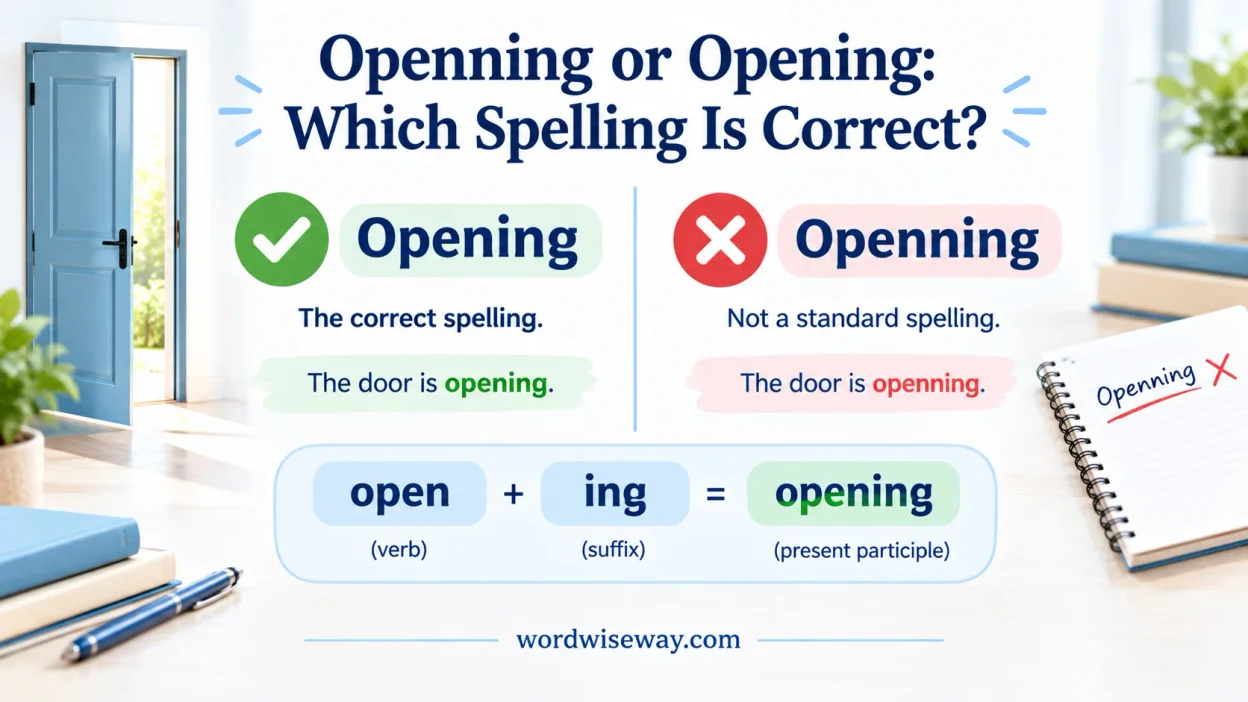
Opening is the correct spelling. Openning is a misspelling.
The word comes from the verb open combined with the suffix -ing:
open + ing = opening
You don’t add another n.
| Spelling | Correct? | Example |
| Opening | ✅ Yes | The store is opening tomorrow. |
| Openning | ❌ No | The store is openning tomorrow. |
The word opening can have several meanings. It may describe the beginning of something, a physical gap, an event, or an available opportunity such as a job.
So, whenever you’re choosing between openning vs. opening, use opening.
Why Is “Opening” Correct?
The easiest way to understand the spelling is to start with the base word open.
Add -ing directly:
open + ing → opening
The final n doesn’t double.
This differs from verbs that follow a consonant-doubling pattern:
- run → running
- sit → sitting
- stop → stopping
- plan → planning
- swim → swimming
Those examples can make openning seem logical. However, spelling rules depend on the structure of the individual word. You can’t simply double the final consonant of every verb before adding -ing.
Compare these forms:
- open → opening
- visit → visiting
- listen → listening
- happen → happening
- enter → entering
The pattern becomes much easier once you stop treating every -ing word the same way.
Why Is “Openning” Incorrect?
Openning contains an unnecessary second n.
The standard formation is:
OPEN + ING = OPENING
Not:
OPEN + N + ING = OPENNING
That extra letter often appears because writers remember the consonant-doubling pattern from words like running or stopping.
For example, you might correctly write:
The athlete is running toward the finish line.
Then you may assume:
The store is openning tomorrow.
But that second spelling doesn’t follow the established form of open.
The correct sentence is:
The store is opening tomorrow.
The meaning remains obvious when someone writes openning, but obvious meaning doesn’t make the spelling correct.
Opening: Meaning and Definition
Opening has several meanings depending on how you use it.
First, it can refer to the beginning of something.
The opening of the story immediately creates suspense.
It can also mean a gap, hole, or space that allows access or movement.
We found a small opening in the fence.
In another context, opening can refer to the start of an event, business, performance, or facility.
The store’s opening attracted a large crowd.
The word can also describe an available opportunity, especially an available job.
The company has an opening for a graphic designer.
These meanings look different on the surface, but they all connect to the idea of something beginning, becoming accessible, or becoming available.
How to Use “Opening” in a Sentence
Opening can serve different grammatical functions. Its role depends on the sentence around it.
Opening as a Verb Form
As a verb form, opening describes the action of making something accessible or starting something.
Examples:
- She is opening the package.
- They are opening a new restaurant.
- The company is opening another branch.
- We are opening the meeting with a short speech.
- The school is opening its doors to new students.
In these examples, opening describes an action.
Opening as a Noun
As a noun, opening can describe a beginning, gap, event, or opportunity.
Examples:
- The opening of the store went smoothly.
- There is a small opening in the wall.
- The movie has a powerful opening.
- We attended the opening of the new gallery.
- The company advertised a job opening.
Here, opening names something rather than describing an action directly.
Opening as an Adjective
Opening can also describe something connected with the beginning of an event or activity.
Common examples include:
- opening ceremony
- opening remarks
- opening statement
- opening scene
- opening night
- opening day
For example:
The host delivered the opening remarks before the presentation began.
The word opening tells you that the remarks came at the beginning.
Open vs. Opening vs. Opened
The words open, opening, and opened belong to the same word family, but they don’t always work in the same places.
| Word | Function | Example |
| Open | Base verb or adjective | Please open the door. |
| Opening | -ing form, noun, or adjective | They are opening the store. |
| Opened | Past tense or past participle | She opened the door. |
Consider how the meaning changes:
Please open the window.
This gives an instruction.
They are opening the window.
This describes an action in progress.
They opened the window.
This describes an action that already happened.
Understanding these forms can help you avoid more than just the openning spelling mistake.
Common “Opening” Phrases
You encounter opening in many common English expressions. Learning these phrases also helps you recognize the correct spelling naturally.
Opening Ceremony
An opening ceremony marks the official beginning of an event, facility, competition, or other occasion.
The school held an opening ceremony for its new building.
Opening Hours
Opening hours refer to the times when a business or service operates.
Check the store’s opening hours before you visit.
Opening Statement
An opening statement introduces the main argument or subject of a speech, discussion, or legal case.
The lawyer began with a brief opening statement.
Opening Remarks
Opening remarks are introductory comments made at the beginning of a meeting, presentation, or event.
The manager gave a few opening remarks.
Opening Day
Opening day refers to the first day of operation, performance, competition, or another activity.
The restaurant was crowded on opening day.
Opening Scene
An opening scene is the first scene in a movie, play, or similar work.
The opening scene establishes the main conflict.
Job Opening
A job opening means an available position that someone can apply for.
The company announced a new job opening.
Grand Opening
A grand opening is a public event celebrating the launch of a new business, location, or facility.
The bakery is planning its grand opening this weekend.
Side-by-Side Comparison
The difference becomes obvious when the two spellings appear together.
| Feature | Openning | Opening |
| Standard spelling | ❌ Incorrect | ✅ Correct |
| Base word | Open | Open |
| Suffix | -ing | -ing |
| Extra “n” | ❌ Yes | ❌ No |
| Standard English form | ❌ No | ✅ Yes |
| Suitable for formal writing | ❌ No | ✅ Yes |
| Example | The shop is openning. | The shop is opening. |
The entire difference comes down to that unnecessary second n.
Examples of Correct and Incorrect Usage
Seeing the word in real sentences makes the distinction easier to remember.
Correct Examples
- The new restaurant is opening next week.
- We attended the opening ceremony.
- The opening scene was unforgettable.
- There’s a job opening in the marketing department.
- The museum’s opening attracted many visitors.
- She delivered the opening remarks.
- What are the store’s opening hours?
- The company is opening a new office.
Incorrect Examples
- The new restaurant is openning next week.
- We attended the openning ceremony.
- The openning scene was unforgettable.
- There’s a job openning in the marketing department.
- She delivered the openning remarks.
- What are the store’s openning hours?
In every incorrect example, replace openning with opening.
Why Do People Spell “Opening” as “Openning”?
The mistake makes sense when you look at familiar English spelling patterns.
Words such as running, planning, and swimming contain doubled consonants before -ing. Your brain may notice that pattern and apply it to open.
That’s where the extra n sneaks in.
However, not every verb doubles its final consonant.
Compare the following groups:
| Base Verb | Correct -ing Form |
| run | running |
| sit | sitting |
| stop | stopping |
| plan | planning |
| open | opening |
| visit | visiting |
| listen | listening |
| enter | entering |
This comparison shows why memorizing a simple rule such as “double the final consonant” can create problems. English spelling requires you to consider the word itself and its established form.
A Simple Trick to Remember the Correct Spelling
The easiest memory trick is surprisingly simple:
Open + ing = Opening
Start with open.
Then attach -ing.
You get:
opening
Don’t insert another n.
You can also break the word into its letters:
O-P-E-N-I-N-G
The n from open stays where it is. The suffix begins with i, not another n.
This tiny spelling check works especially well when you’re writing quickly.
Related Words From “Open”
Learning the complete word family can reinforce the correct form.
| Word | Form | Example |
| Open | Base form | Please open the door. |
| Opens | Third-person singular | The store opens at nine. |
| Opened | Past tense | She opened the box. |
| Opening | -ing form | They are opening a new store. |
| Openness | Noun | His openness encouraged discussion. |
| Openly | Adverb | She spoke openly about the problem. |
Notice that opening fits naturally into this family. There is no standard form openning.
Opening in American English
In US English, the standard spelling is opening.
The spelling doesn’t change when you use the word in American English. You can use opening in business writing, school assignments, websites, emails, articles, and everyday conversation.
Common American English examples include:
- opening hours
- opening ceremony
- opening day
- opening scene
- job opening
- grand opening
- opening statement
Whether you’re talking about a new restaurant or the first scene of a movie, the spelling stays the same.
A Practical Case Study: Choosing the Right Spelling
Imagine that a local bakery is preparing a promotional announcement.
A first draft says:
Our new bakery is openning this Saturday.
The sentence communicates the intended meaning, but the spelling needs correction.
Start with the base word:
open
Add the suffix:
-ing
The result is:
opening
So the corrected announcement becomes:
Our new bakery is opening this Saturday.
Now consider a different sentence:
We have a job openning for a graphic designer.
Again, the same correction applies:
We have a job opening for a graphic designer.
The context changes, but the spelling rule stays consistent.
Common Mistakes
Several errors can appear around this word.
Adding an Extra N
❌ openning
✅ opening
This is the main spelling mistake.
Confusing Opening With Opened
These forms aren’t interchangeable.
❌ The store is opened tomorrow.
✅ The store is opening tomorrow.
But opened works when you’re describing a completed action:
The store opened yesterday.
Confusing Opening With Open
The base verb doesn’t always fit where the -ing form belongs.
❌ The company is open a new branch next month.
✅ The company is opening a new branch next month.
The sentence needs opening because it describes an action that is happening or planned.
Read More: Good or Bad: What’s the Real Difference and When to Use Each?
FAQs
Is “openning” a correct spelling?
No. Openning is a common spelling mistake. The correct spelling is opening, with only one “n” before “-ing.”
Why is “opening” spelled with one “n”?
The verb open doesn’t meet the conditions that require doubling its final consonant before adding “-ing.” Therefore, it becomes opening, not openning.
Is “opening” a verb or a noun?
Opening can be both. As a verb, it describes the action of making something accessible. As a noun, it can refer to a beginning, an available position, or an opportunity.
Why do people write “openning” by mistake?
People often remember words such as running and planning, where the final consonant doubles. This pattern can make openning look correct even though the spelling rule doesn’t apply.
Does “openning” appear in British English?
No. Opening is the standard spelling in both British English and American English. The extra “n” is not a recognized standard spelling.
How can I remember the spelling of “opening”?
Think of the base word first: open + ing = opening. Remembering the base word can help you avoid adding an unnecessary second “n.”
Can “opening” be used as a noun?
Yes. For example, opening can describe the beginning of an event, a gap that allows access, or an available job position.
Is “opening” pronounced differently from “openning”?
The incorrect spelling openning doesn’t represent a standard alternative pronunciation. The standard word is opening, and its pronunciation follows the normal pronunciation of the word.
What are some common phrases with “opening”?
Common phrases include opening ceremony, opening hours, opening statement, opening sentence, and opening paragraph. The spelling remains opening in each phrase.
What is the easiest way to avoid writing “openning”?
Check the base verb open before adding -ing. Since you don’t double the final “n” in this case, the correct form is always opening.
Conclusion
The difference between opening and openning comes down to a simple spelling rule. Opening is the correct form, while openning is a common mistake caused by applying consonant-doubling patterns where they don’t belong. Once you recognize how open changes when you add -ing, the spelling becomes much easier to remember.
You’ll see opening in everyday writing, from emails and school assignments to business documents and social media posts. It can describe the act of making something accessible, the beginning of an event, or an available opportunity. Its spelling stays the same in both British and American English.
When you’re unsure, return to the base word open and add -ing without doubling the final consonant. A quick mental check can save you from an unnecessary spelling error and help your writing look clear, polished, and professional.

Emma Smith has dedicated 14 years to Princeton University’s English Department, mentoring students in textual interpretation, literary movements, and critical frameworks. Her research explores Shakespearean drama, Victorian serial fiction, postcolonial narrative theory, and manuscript studies and probing how literary forms evolve across cultures and centuries. Emma has delivered lectures at international humanities congresses and published findings in distinguished academic journals, underscoring her commitment to scholarly depth and vibrant teaching.