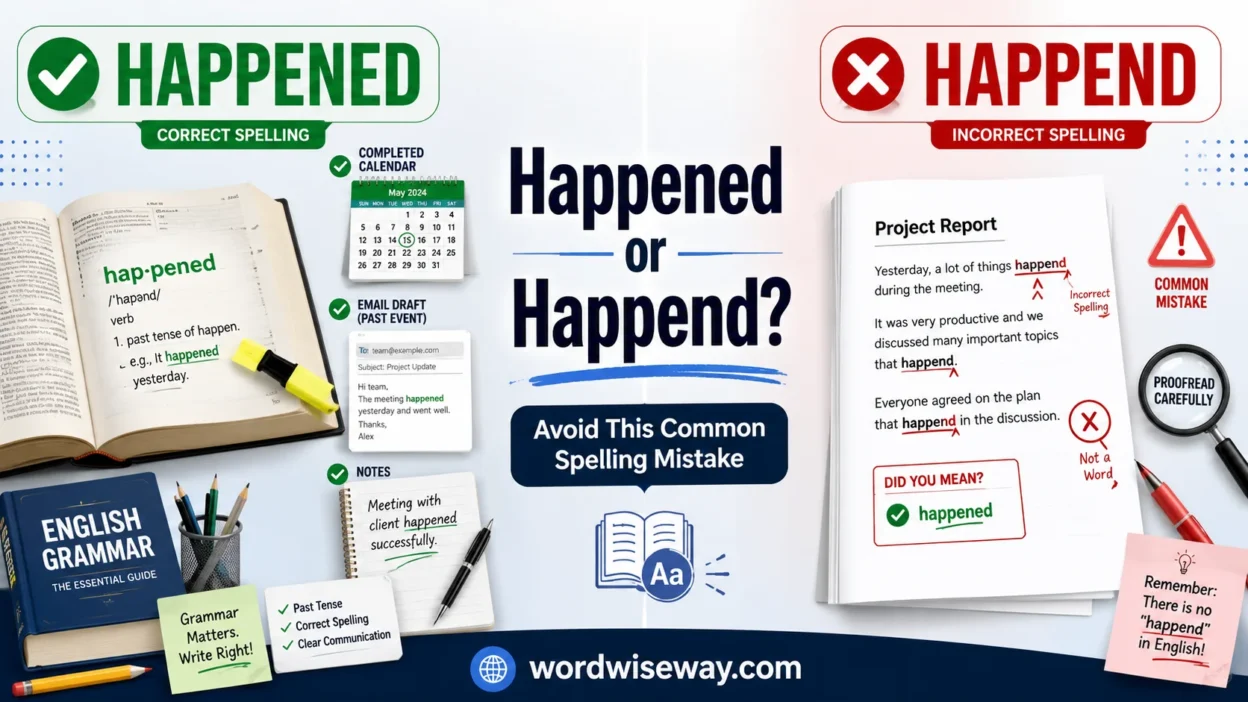
Have you ever typed a message, email, essay, or social media post and suddenly paused to ask yourself: Is it “happened” or “happend”? You’re not alone. This spelling confusion is surprisingly common, especially when people type quickly or rely on pronunciation rather than spelling rules.
Many English learners and even fluent speakers mistakenly write “happend” instead of “happened.” Since both words sound similar when spoken, it’s easy to assume they are spelled the same way. However, only “happened” is the correct past tense form of the verb “happen.” The spelling “happend” is a common error that appears in emails, text messages, social media posts, academic writing, and professional documents.
Understanding the difference between happened and happend is important for clear and professional communication. Even a small spelling mistake can affect readability and make your writing appear less polished. Whether you’re a student, professional, content creator, or someone learning English, knowing the correct form will help you write with greater confidence.
In this guide, you’ll learn the correct spelling, meaning, pronunciation, grammar rules, and real-life examples of happened. We’ll also explore why people commonly misspell the word, review frequent mistakes, and share simple tips to help you remember the correct form. By the end of this article, you’ll never have to wonder whether to write “happened” or “happend” again.
Quick Answer:
Let’s settle it immediately:
Happened is correct ✅
Happend is incorrect ❌
That’s the core rule. No exceptions in standard English.
But here’s where things get interesting. Most people don’t make this mistake because they don’t know English. They make it because English spelling doesn’t always match pronunciation.
And that mismatch creates confusion.
Why “Happened” Is the Only Correct Form
The word happen is a regular verb. Regular verbs in English follow a simple transformation rule:
Base verb + “-ed” = past tense
So:
- happen → happened
- open → opened
- start → started
- call → called
The structure stays stable even if pronunciation shifts.
In speech, “happened” often sounds like “hap-uhnd”, where the middle vowel becomes soft or disappears. That’s exactly where the mistake begins.
Writers rely on sound instead of structure.
English, however, cares more about spelling consistency than phonetic accuracy.
Why People Accidentally Write “Happend”
This mistake is surprisingly common, even among fluent speakers. Let’s break down the real causes.
Fast typing and mental shortcuts
When typing quickly, the brain prioritizes speed over accuracy. It trims “extra” letters it doesn’t hear clearly.
Sound-based spelling
English is not phonetic. What you hear is not always what you write. “Happened” contains a silent or reduced vowel sound that gets lost in pronunciation.
Mobile keyboard influence
Phones sometimes autocorrect obvious errors but miss subtle ones like missing vowels in familiar words.
Second-language interference
Learners often simplify spelling patterns based on how words sound in their native language, not English spelling rules.
Breaking Down the Word “Happened”
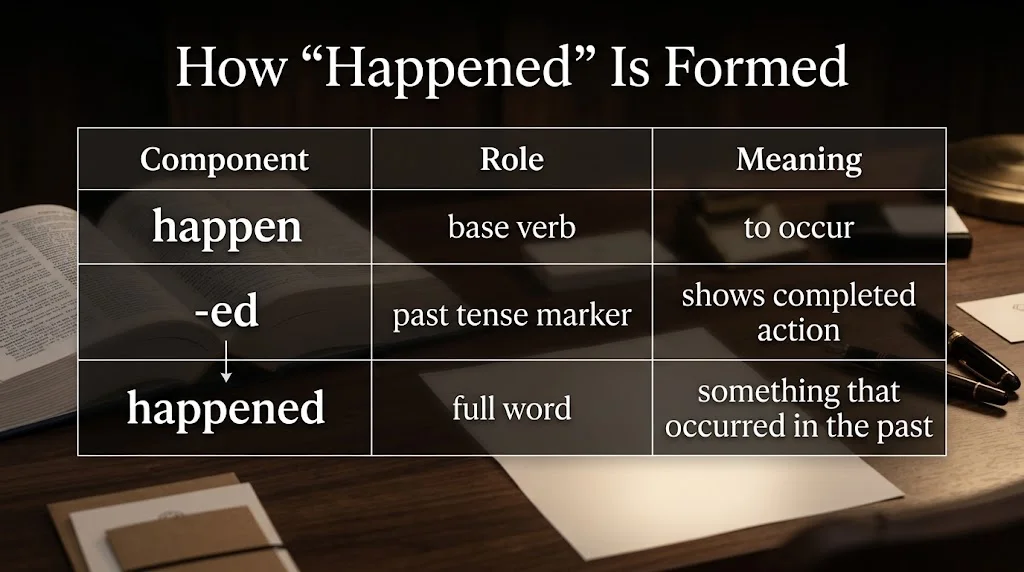
Let’s dissect it like a mechanic opening an engine.
| Component | Role | Meaning |
| happen | base verb | to occur |
| -ed | past tense marker | shows completed action |
| happened | full word | something that occurred in the past |
Even if pronunciation compresses it, spelling preserves structure.
That’s a key rule in English:
Spelling protects meaning, even when sound changes.
A Simple Memory Trick That Actually Works
Here’s a trick used by language trainers:
If the verb is regular, always add -ed, not just “-d.”
So you get:
- happen → happened
- open → opened
- clean → cleaned
- finish → finished
Now compare with incorrect versions:
- happend ❌
- opend ❌
- clean’d ❌
- finishd ❌
Your brain starts noticing the missing vowel automatically after repetition.
How “Happened” Is Used in Real Life
Let’s move from rules to reality. Here’s how native speakers actually use it:
- What happened here last night?
- I don’t know what happened after that call.
- Something strange happened during the meeting.
- The accident happened near the bridge.
- Nothing interesting happened today.
Notice something important:
It always describes a completed event in the past.
Common Confusions Around “Happened”
Even if you know the spelling, related confusion still shows up.
Confusion with tense timing
Some writers mix up present and past forms:
- Wrong: It happen yesterday
- Correct: It happened yesterday
Confusion with continuous form
Another common mix-up:
- Wrong: It was happened suddenly
- Correct: It happened suddenly
English does not use “was happened” because “happen” does not take passive structure in that context.
Real-World Writing Impact of This Mistake
You might think one missing letter doesn’t matter. In casual texting, maybe it doesn’t.
But in professional writing, spelling affects perception.
Let’s compare:
| Version | Reader Impression |
| “What happend in the report?” | careless, unedited |
| “What happened in the report?” | clear, professional |
Recruiters, teachers, and clients often associate spelling accuracy with attention to detail.
That doesn’t mean perfection is required. It means consistency matters.
Case Study: Small Error, Big Difference
A student submitted a scholarship essay with repeated spelling errors, including “happend.”
The content was strong. The ideas were solid. But evaluators flagged it as “poorly edited.”
After revision, fixing only spelling issues, the same essay scored significantly higher.
What changed?
Not ideas. Just presentation.
This shows something important:
Writing is not only about meaning. It’s also about trust.
Why English Keeps This “Silent Structure”
English spelling often preserves history rather than sound.
Words like:
- knight
- listen
- happened
All keep letters that are not fully pronounced.
Why?
Because English evolved from multiple languages—Old English, Latin, French—and spelling systems didn’t fully simplify over time.
So we get a hybrid system:
- What we say
- What we write
- What we inherit historically
“Happened” fits perfectly into this pattern.
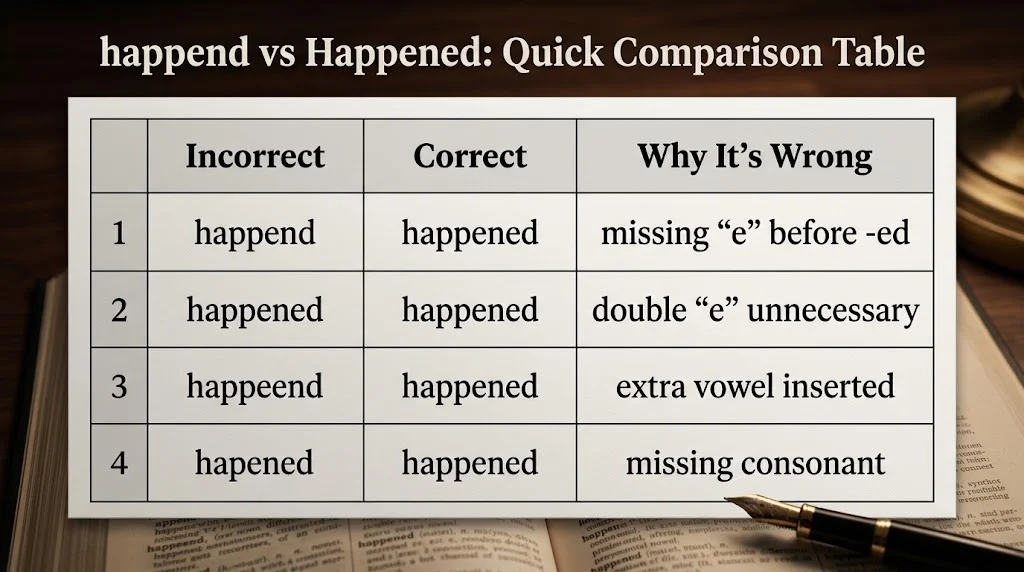
Quick Comparison Table: Common Errors
| Incorrect | Correct | Why it’s wrong |
| happend | happened | missing “e” before -ed |
| happened | happened | double “e” unnecessary |
| happeend | happened | extra vowel inserted |
| hapened | happened | missing consonant |
One small detail, many possible mistakes.
That’s why this word appears so often in grammar corrections.
Pronunciation vs Spelling: The Core Problem
Let’s break down how it sounds:
- Spoken: hap-uhnd
- Written: happened
The middle vowel becomes weak in speech. Linguists call this vowel reduction.
But English spelling does not remove reduced vowels in regular verb forms.
That gap between sound and writing is where mistakes are born.
How to Never Misspell “Happened” Again
Here’s a practical system you can actually use:
Step 1: Recognize the verb
If it’s “happen,” think past tense immediately.
Step 2: Apply the rule
Add “-ed” without deleting internal letters.
Step 3: Double-check mentally
Ask: “Did I remove an ‘e’ I shouldn’t have?”
Step 4: Slow down slightly
Even one extra second reduces spelling errors significantly.
Mini Practice Section
Try correcting these:
- What happend yesterday?
- Nothing unusual happend at school.
- Something strange happend last night.
Correct answers:
- What happened yesterday?
- Nothing unusual happened at school.
- Something strange happened last night.
Once you fix it a few times, your brain starts auto-correcting internally.
Read More: Hoodie or Hoody: Meaning, Spelling and Differences Explained
Interesting Linguistic Insight
English has two competing forces:
- Sound efficiency (how we speak quickly)
- Spelling stability (how we write consistently)
“Happened” sits right in the middle of that tension.
We reduce it in speech but preserve it in writing.
That’s why it confuses people—it lives in two slightly different worlds.
My Personal Experience
I remember using happend in my writing without realizing that I had made a mistake. Because I was typing quickly, I rarely stopped to examine each word closely. One day, while checking an old piece of my work, I noticed that happend looked strange. I checked it and learned that happened was the correct form. That small discovery made me more careful whenever I wrote the word.
After that, I started remembering happened through its connection with happen + ed. This simple habit helped me avoid repeating the same mistake. I also became more attentive when editing my writing instead of trusting the way a word sounded in my head. My experience with happened and happend taught me that even a tiny spelling detail can be easy to overlook, but a quick review can catch it before it reaches the final version.
Key Takeaways
Let’s compress everything into clear points:
- “Happened” is always correct
- “Happend” is always incorrect
- The rule is simple: verb + “-ed”
- Pronunciation often hides letters, but spelling keeps them
- Most mistakes come from speed, not ignorance
- Consistency improves credibility in writing
Practice:
Choose the correct spelling in each sentence:
- What (happened / happend) yesterday?
- Something strange (happened / happend) at school.
- I don’t know what (happened / happend) next.
- Nothing unusual (happened / happend) during the meeting.
- The same thing (happened / happend) last week.
Answers:
- happened
- happened
- happened
- happened
- happened
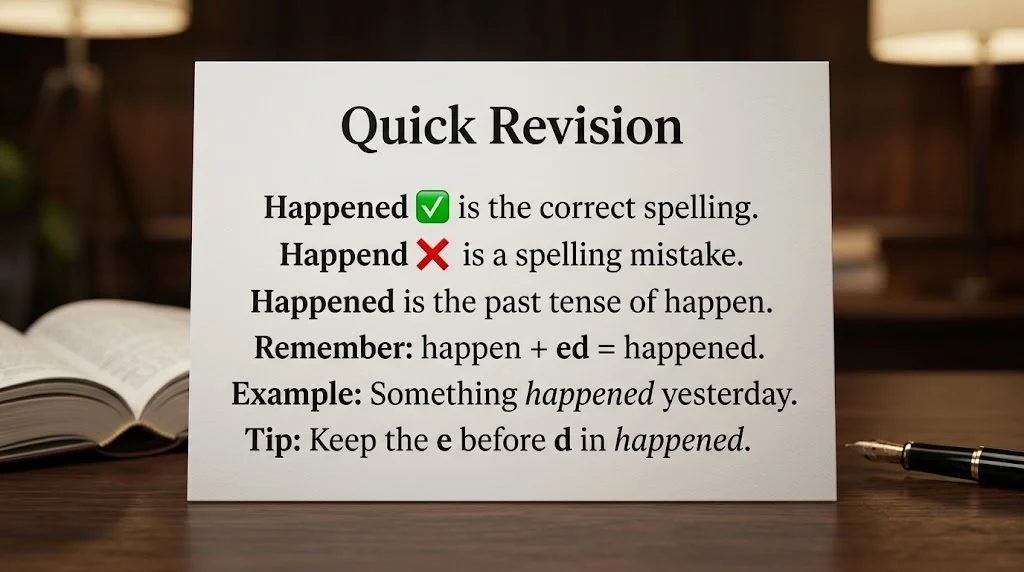
Quick Revision:
- Happened ✅ is the correct spelling.
- Happend ❌ is a spelling mistake.
- Happened is the past tense of happen.
- Remember: happen + ed = happened.
- Example: Something happened yesterday.
- Tip: Keep the e before d in happened.
FAQs
1. What Is the Correct Spelling: Happend or Happened?
The correct spelling is happened. Happend is a common spelling mistake and isn’t a standard English word.
2. Why Do People Write Happend Instead of Happened?
People often leave out the second “e” because they type quickly or spell the word based on how it sounds. Remembering the correct spelling can help you avoid this mistake.
3. Is Happend a Real English Word?
No. Happend isn’t a correct English word. The correct spelling is always happened when you’re using the past tense of happen.
4. Why Does Happened Have an “E”?
Happened comes from the verb happen. When you add the past-tense ending -ed, the word becomes happened, keeping the final e from the base word.
5. Does Spelling Affect Meaning?
Yes. A spelling mistake may not always change the intended meaning, but it can make your writing look unclear or less polished. Using happened helps keep your writing correct and professional.
6. Where Is This Mistake Most Common?
The mistake happend can appear in texting, emails, essays, social media posts, and other informal writing. Fast typing often leads to simple spelling errors.
7. Is It Okay to Use Happend in Casual Writing?
No. Happend is still incorrect in casual writing. Whether you’re writing a text, email, or school assignment, use happened.
8. How Can I Stop Making This Mistake?
A simple trick is to remember happen + ed = happened. Slow down when typing the word and check that you haven’t accidentally dropped the final e.
9. Do Native Speakers Also Make This Mistake?
Yes. Native English speakers can also make spelling mistakes, especially when typing quickly. However, happend remains an incorrect spelling.
10. What Is the Easiest Way to Remember the Correct Spelling?
Think of the word as happen + ed = happened. Keep the final e before adding -ed, and you’ll get the correct spelling.
Conclusion
The confusion between happened and happend is small but very common in everyday writing. The mistake usually happens because people write quickly and rely more on sound than spelling rules. However, English spelling needs careful attention, especially in formal writing.
By remembering the simple rule “happen + ed = happened”, you can avoid this error easily. With practice, your writing becomes clearer, more accurate, and more professional across messages, emails, and all forms of communication.
Learning the difference between happened and happend may seem minor, but it can strengthen your everyday writing. Once you recognize the correct form, you’ll be less likely to repeat the same error when writing quickly. A few simple checks can make the correct spelling feel natural over time.
The next time you hesitate between happened and happend, remember that happened is the form you need. Keep practicing it in your own sentences, and this once-confusing spelling will soon become much easier to remember.

Amelia Sanders has spent 14 years in Harvard University’s English Department, helping students navigate literary analysis, interpretive theory, and narrative techniques. Her academic pursuits center on 18th-century British prose, romantic poetry, diasporic writing, and digital editing exploring how textual choices influence cultural perspectives. Amelia has spoken at major international meetings and contributed essays to respected academic volumes, demonstrating her dedication to thoughtful scholarship and effective teaching.