Nicholas’ or Nicholas’s? Difference, Meaning, and Examples explains how to form the possessive of names ending in S. Both spellings can be correct, depending on the writing conventions you follow.
The difference lies in apostrophe placement. Nicholas’ uses an apostrophe after the final S, while Nicholas’s adds apostrophe S. Both forms express ownership, so their meaning remains the same. For example, you can write “Nicholas’ book” or “Nicholas’s book” to show that the book belongs to Nicholas.
When choosing between these possessive forms, consider your preferred writing style and remain consistent. Understanding apostrophe placement makes grammar easier to follow and helps you avoid common punctuation mistakes. With the right approach, you can write possessive names clearly and confidently.
Quick Answer:
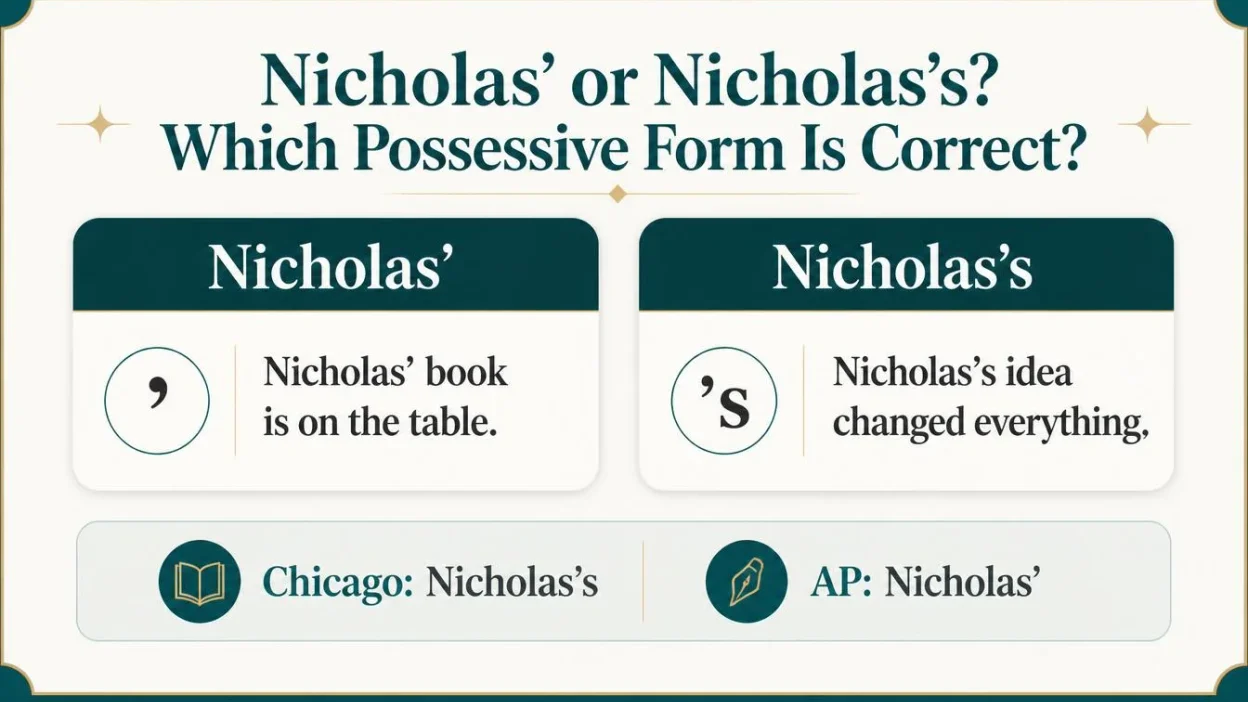
Both Nicholas’ and Nicholas’s can be correct possessive forms of the singular name Nicholas. Many general and book-publishing styles, including Chicago style, add an apostrophe and s to a singular name ending in s. For example, you would write Nicholas’s jacket.
Associated Press (AP) style generally uses an apostrophe alone for singular proper names ending in s. Under this convention, you would write Nicholas’ jacket.
Here’s the simple rule:
- Nicholas’s: Use this form when following Chicago style or another guide that adds ’s to singular names ending in s.
- Nicholas’: Use this form when following AP style or another guide that recommends an apostrophe alone.
- When no style guide applies: Choose one form and use it consistently.
In either case, the meaning remains the same. The jacket belongs to Nicholas or is associated with him.
What Does Nicholas’ Mean?
Nicholas’ is a possessive form of the singular name Nicholas. The apostrophe after the final s indicates ownership, a relationship, or another association.
This form follows a convention that avoids adding another s after a name already ending in that letter. Some writers prefer it because the spelling looks shorter and cleaner.
Consider these examples:
- Nicholas’ car needs new tires.
- We met at Nicholas’ apartment.
- The manager praised Nicholas’ work.
- Nicholas’ explanation helped the class understand the problem.
- The teacher reviewed Nicholas’ assignment before the deadline.
In each sentence, the apostrophe signals a possessive relationship. The form doesn’t mean several people named Nicholas own the item. It refers to one person unless the surrounding context indicates otherwise.
For example, Nicholas’ car identifies a car associated with Nicholas. The same construction works for belongings, ideas, responsibilities, and personal relationships.
However, remember that this spelling follows a particular style convention. Some editors will change it to Nicholas’s to match their preferred rules.
What Does Nicholas’s Mean?
Nicholas’s is another possessive form of the singular name Nicholas. It follows the common grammatical rule of adding ’s to a singular noun, even when that noun already ends in s.
Many writers prefer this form because it makes the possessive construction clear. It also follows the conventions of several major style guides.
Here are some examples:
- Nicholas’s car needs new tires.
- We met at Nicholas’s apartment.
- The manager praised Nicholas’s work.
- Nicholas’s explanation helped the class understand the problem.
- The teacher reviewed Nicholas’s assignment before the deadline.
Notice that the extra s doesn’t change the name itself. The person’s name remains Nicholas. The apostrophe and additional s simply mark possession.
This pattern applies to other singular names ending in s, too. Depending on the style guide, you might see James’s book, Charles’s office, or Chris’s phone.
The key is to distinguish the person’s name from its possessive form. You aren’t renaming Nicholas. You’re showing that something belongs to or relates to him.
What Is the Difference?
The main difference between Nicholas’ and Nicholas’s is style, not meaning. Both forms can show that something belongs to Nicholas or relates to him.
The spelling you should choose depends on the rules used by the publication, school, organization, or editor you’re writing for.
Chicago Style: Nicholas’s
The Chicago Manual of Style generally forms the possessive of a singular noun by adding an apostrophe and s. This rule also applies to most singular personal names ending in s.
Under this convention, you would write:
- Nicholas’s desk was covered with papers.
- Nicholas’s notes helped him prepare for the exam.
- Nicholas’s opinion changed after the discussion.
- Nicholas’s presentation impressed the audience.
This approach is common in book publishing and many forms of general prose.
If your assignment requires Chicago style, use Nicholas’s unless a specific exception applies. The same general rule applies to other singular names ending in s.
AP Style: Nicholas’
Associated Press style generally forms the possessive of a singular proper name ending in s by adding an apostrophe alone.
Under this convention, you would write:
- Nicholas’ desk was covered with papers.
- Nicholas’ notes helped him prepare for the exam.
- Nicholas’ opinion changed after the discussion.
- Nicholas’ presentation impressed the audience.
This convention is common in news writing and publications that follow AP style.
However, don’t assume that every publication follows the same rule. Some organizations have their own house styles, which may differ from both conventions.
Which Form Should You Choose?
Choosing between the two forms becomes easy when you know your writing requirements.
| Writing situation | Recommended form |
| Chicago style | Nicholas’s |
| AP style | Nicholas’ |
| School assignment with a required style guide | Follow the assigned guide |
| Workplace writing | Follow the organization’s style guide |
| General writing without a specified guide | Choose one accepted form and remain consistent |
Consistency helps readers focus on your message instead of noticing changes in punctuation.
For example, using Nicholas’s office in one paragraph and Nicholas’ office in another may look like an editing mistake. Unless you’re discussing the difference between styles, stick to one form throughout your document.
How to Use Nicholas’ and Nicholas’s in Sentences
Both possessive forms work in the same grammatical situations. The examples below show how the spelling changes according to style while the meaning stays the same.
Examples With Nicholas’
- Ownership: Nicholas’ phone rang during the meeting.
- Location: We celebrated at Nicholas’ house on Saturday.
- Schoolwork: The teacher praised Nicholas’ essay.
- Performance: The coach discussed Nicholas’ performance after the game.
- Ideas: Nicholas’ suggestion gave the team a fresh direction.
- Responsibilities: Nicholas’ duties include preparing the weekly report.
Each sentence uses Nicholas’ to connect a person with an object, place, action, or idea.
Examples With Nicholas’s
- Ownership: Nicholas’s phone rang during the meeting.
- Location: We celebrated at Nicholas’s house on Saturday.
- Schoolwork: The teacher praised Nicholas’s essay.
- Performance: The coach discussed Nicholas’s performance after the game.
- Ideas: Nicholas’s suggestion gave the team a fresh direction.
- Responsibilities: Nicholas’s duties include preparing the weekly report.
These sentences express the same relationships as the previous examples. Only the possessive spelling changes.
Writing tip: When proofreading, check the style guide before correcting every occurrence. A form that looks unfamiliar to you may still be correct under the required convention.
Nicholas’ or Nicholas’s for Different Types of Possession
Possessives do more than show ownership. They can also express relationships, associations, responsibilities, and connections between people and ideas.
Ownership
Use a possessive form when an object belongs to Nicholas.
For example:
Nicholas’s bicycle is parked outside.
The sentence connects Nicholas with the bicycle. If you’re following AP style, you would write Nicholas’ bicycle is parked outside instead.
Other examples include Nicholas’s laptop, Nicholas’s backpack, and Nicholas’s keys.
Family and Personal Relationships
Possessives can also describe relationships between people.
For example:
Nicholas’s sister works nearby.
This sentence identifies the relationship between Nicholas and his sister. It doesn’t suggest that he owns another person. Possessives often express family connections rather than literal ownership.
Other examples include:
- Nicholas’s parents arrived early.
- Nicholas’s cousin studies engineering.
- Nicholas’s friend recommended the restaurant.
Under AP style, each possessive would generally use an apostrophe alone after the final s in Nicholas.
Ideas, Work, and Opinions
Abstract nouns can also take possessives. These constructions identify the person associated with an idea, decision, or piece of work.
Consider these examples:
- Nicholas’s proposal was approved.
- The editor considered Nicholas’s argument carefully.
- Nicholas’s decision surprised the team.
- Everyone appreciated Nicholas’s honesty.
These examples don’t involve physical objects. Instead, the possessive connects Nicholas with an idea, action, or personal quality.
Places and Organizations
A possessive can identify a place associated with someone.
For example:
We met at Nicholas’s studio.
The possessive tells readers which studio the sentence refers to. Similar expressions include Nicholas’s office, Nicholas’s workshop, and Nicholas’s classroom.
However, not every phrase containing a name needs an apostrophe. If a name appears in an official business title, building name, or organization label, check its established spelling before changing it.
Nicholas’ vs. Nicholas’s vs. Nicholases’: A Comparison
The forms Nicholas’, Nicholas’s, and Nicholases’ may look similar, but they serve different purposes.
The first two are singular possessives. The third is a plural possessive formed from Nicholases, the regular plural when referring to multiple people named Nicholas.
| Form | Grammatical use | Example | Meaning |
| Nicholas | Singular name | Nicholas arrived early. | One person named Nicholas |
| Nicholas’ | Singular possessive in some styles | Nicholas’ coat is blue. | The coat is associated with one Nicholas |
| Nicholas’s | Singular possessive in many styles | Nicholas’s coat is blue. | The coat is associated with one Nicholas |
| Nicholases | Plural | Two Nicholases attended. | More than one person named Nicholas |
| Nicholases’ | Plural possessive | The Nicholases’ seats were together. | Something associated with the people named Nicholas |
The plural Nicholases may look unusual because names don’t often appear in the plural. However, it can be useful when several people share the same name.
For example, imagine that two students named Nicholas attend the same school. You might write:
Two Nicholases joined the science club.
If you want to describe something associated with both students, you could write:
The Nicholases’ science projects won awards.
The apostrophe follows the plural ending because the possessive relationship involves multiple people.
How to Avoid Confusing Singular and Plural Possessives
Keep these distinctions in mind:
- Nicholas: One person’s name.
- Nicholas’s: Something associated with one Nicholas under styles that add ’s.
- Nicholas’: The same singular possessive under styles that use an apostrophe alone.
- Nicholases: More than one person named Nicholas.
- Nicholases’: Something associated with multiple people named Nicholas.
Understanding these forms helps you avoid punctuation errors and makes your meaning easier to follow.
Common Mistakes to Avoid
Even a small apostrophe can change how a sentence reads. Fortunately, most mistakes involving Nicholas’ and Nicholas’s are easy to prevent.
Switching Between Nicholas’ and Nicholas’s
Using both forms in the same article can make your writing look inconsistent.
For example:
* Nicholas’s car was parked outside. Nicholas’ keys were on the table.*
The sentences aren’t necessarily ungrammatical, but switching conventions without a reason can distract readers.
Better approach: Choose the form required by your style guide and use it throughout the document.
Adding Two Apostrophes
Forms such as Nicholas’s’ and Nicholas’’ aren’t standard ways to form the singular possessive.
Use either Nicholas’ or Nicholas’s, depending on the style you follow. You don’t need to add another apostrophe after either form.
Confusing a Possessive With a Plural
Nicholas’s normally refers to one person’s possession or association. It doesn’t mean several people named Nicholas.
Compare these examples:
- Singular: Nicholas’s backpack is missing.
- Plural: Two Nicholases joined the club.
- Plural possessive: The Nicholases’ backpacks were in the hallway.
Each form serves a different grammatical purpose.
Using an Apostrophe to Make a Plural
Apostrophes don’t normally form the plurals of names.
If you’re referring to several people named Nicholas, write Nicholases, not Nicholas’.
For example:
Incorrect: Two Nicholas’ attended the meeting.
Correct: Two Nicholases attended the meeting.
The apostrophe belongs in a possessive construction, not in an ordinary plural.
Ignoring the Required Style Guide
A form can be accepted in one publication but conflict with another publication’s rules.
For example, a Chicago-style editor may change Nicholas’ to Nicholas’s. An AP-style editor may make the opposite change.
Neither edit necessarily means the original writer misunderstood possession. The editor may simply be enforcing a specific style convention.
Read More: Rose or Risen: Difference, Meaning, and Examples
FAQs
1. Is Nicholas’ or Nicholas’s correct?
Both Nicholas’ and Nicholas’s can be correct. The choice depends on the writing style you follow. Both forms show that something belongs to Nicholas.
2. What is the difference between Nicholas’ and Nicholas’s?
The difference is the placement of the apostrophe and the additional S. Nicholas’ places the apostrophe after the final S, while Nicholas’s adds another S after the apostrophe.
3. Does Nicholas’s mean the same as Nicholas’?
Yes, both forms express possession. For example, “Nicholas’s car” and “Nicholas’ car” both mean that the car belongs to Nicholas.
4. How do you write the possessive form of Nicholas?
You can write Nicholas’s or Nicholas’, depending on your chosen style guide. Both forms are used in English writing.
5. Should I add an apostrophe to Nicholas?
Yes, when you want to show possession. You can write “Nicholas’s phone” or “Nicholas’ phone” to indicate that the phone belongs to Nicholas.
6. Is Nicholas’s grammatically correct?
Yes, Nicholas’s is a grammatically accepted possessive form. It adds apostrophe S to the name, even though the name already ends in S.
7. Is Nicholas’ correct for formal writing?
Yes, Nicholas’ is acceptable in formal writing when it follows the chosen style guide. The important thing is to use the same convention consistently.
8. How do you make a sentence with Nicholas’s?
You can write, “Nicholas’s presentation impressed the entire class.” The apostrophe S indicates that the presentation belongs to Nicholas.
9. Do all names ending in S follow the same possessive rule?
No, writing conventions can vary by style guide. Some recommend adding apostrophe S, while others use only an apostrophe after the final S. Follow the rules required for your writing.
10. How can I remember whether to use Nicholas’ or Nicholas’s?
Remember that both forms can show possession. Choose the version required by your style guide, and use it consistently throughout your document.
Conclusion
Choosing between Nicholas’ and Nicholas’s becomes much easier once you understand how possessive apostrophes work. Both forms show ownership, so the main difference lies in how you write them. One uses an apostrophe after the final S, while the other adds another S after the apostrophe.
For example, “Nicholas’ jacket” and “Nicholas’s jacket” both indicate that the jacket belongs to Nicholas. Neither form changes the meaning of the sentence. However, your preferred writing style or the requirements of a particular assignment may determine which version you should use.
The best approach is to choose one form and use it consistently throughout your writing. Pay attention to apostrophe placement, especially when working with names that already end in S. Once you understand this simple rule, you can write possessive names more confidently and avoid unnecessary grammar mistakes.

Emma Smith has dedicated 14 years to Princeton University’s English Department, mentoring students in textual interpretation, literary movements, and critical frameworks. Her research explores Shakespearean drama, Victorian serial fiction, postcolonial narrative theory, and manuscript studies and probing how literary forms evolve across cultures and centuries. Emma has delivered lectures at international humanities congresses and published findings in distinguished academic journals, underscoring her commitment to scholarly depth and vibrant teaching.