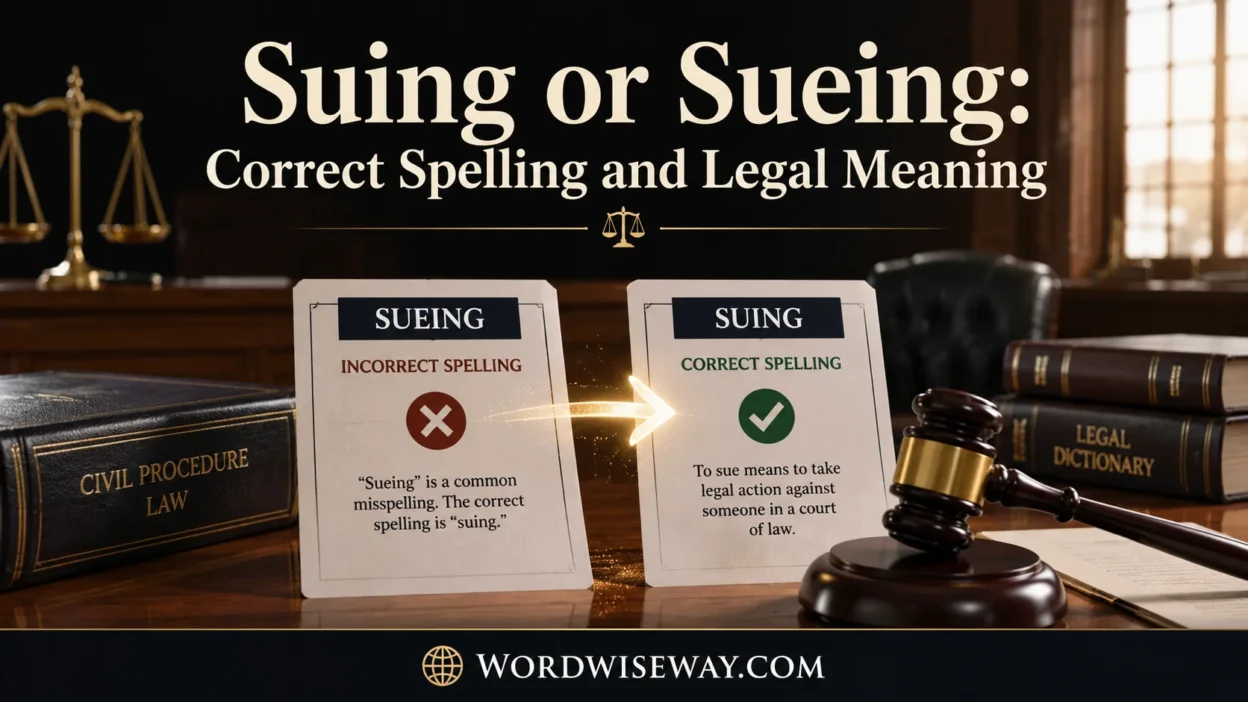
Mastering the guide on “Suing or Sueing: Correct Spelling, Legal Meaning, Process, and Real-World Guide” clarifies complex court terminology. When people are talking about taking legal action, they often get confused between suing and sueing. In everyday contexts, the difference is simple but incredibly important for clear writing and formal communication. The correct spelling is “suing,” while using the form with an extra “e” is a common mistake.
Gaining a solid understanding of how this verb functions helps you write accurately to avoid basic grammar errors. I remember reviewing a contract draft where a colleague paused mid-sentence, caught in a spelling dilemma. This confusion frequently pops up in emails, contracts, and professional documents where every single word impacts your clarity and credibility.
In business, structural accuracy matters deeply whether you are drafting agreements, managing meetings, coordinating scheduling, or updating a calendar for project management. Sloppy typos erode professionalism, causing unnecessary confusion in our fast-paced digital workplace where online booking, broadcasting, and official correspondence demand precise language to protect your time and true intent.
As this article highlights, regional preferences and style guides across US and UK English maintain strict standards for a polished, sound presentation. In actual law practice, a civil lawsuit begins when an individual, company, or organization initiates a case in court to seek justice or financial compensation. This occurs across many specialized litigation cases, including a personal injury contract, property disputes, or the recovery of damages.
For students, writers, and academic professionals, masterfully searching for the right guidance, rules, and vocabulary prevents critical mistakes. The distinction is clear: the accepted documentation rules for filing lawsuits, managing judicial processes, and navigating court procedures do not tolerate non-standard spellings.
The Correct Spelling Explained Clearly
Let’s settle this once and for all.
Correct spelling: Suing
Incorrect spelling: Sueing
The confusion comes from the base word “sue.”
When you add -ing, English grammar usually drops the silent “e.”
Quick rule that explains it
When a verb ends in a silent e, remove the e before adding -ing.
Examples you already know
| Base word | Correct -ing form | Incorrect form |
| sue | suing | sueing ❌ |
| make | making | makeing ❌ |
| argue | arguing | argueing ❌ |
| drive | driving | driveing ❌ |
So the correct legal term is always suing, never sueing.
A simple way to remember it:
You are “pursuing a case,” not “pursueing it.”
Read More: Privilege vs Priviledge: Correct Meaning and Common Mistakes
What Suing Actually Means in Law
The word suing has a very specific meaning in law.
Plain definition
Suing means starting a legal case in court against another person or organization to resolve a dispute or seek compensation.
It is not about revenge. It is about legal resolution.
Core purpose of suing
People usually sue for three main reasons:
- To recover money (called damages)
- To enforce rights under law or contracts
- To stop harmful actions or behavior
Who can sue?
Almost any legal “person” can sue:
- Individuals
- Businesses
- Nonprofit organizations
- Government bodies (with legal limits)
Who can be sued?
- Individuals
- Companies
- Employers
- Property owners
- Government agencies (under specific conditions)
Important legal idea
A lawsuit is not just a complaint. It is a structured legal process controlled by courts.
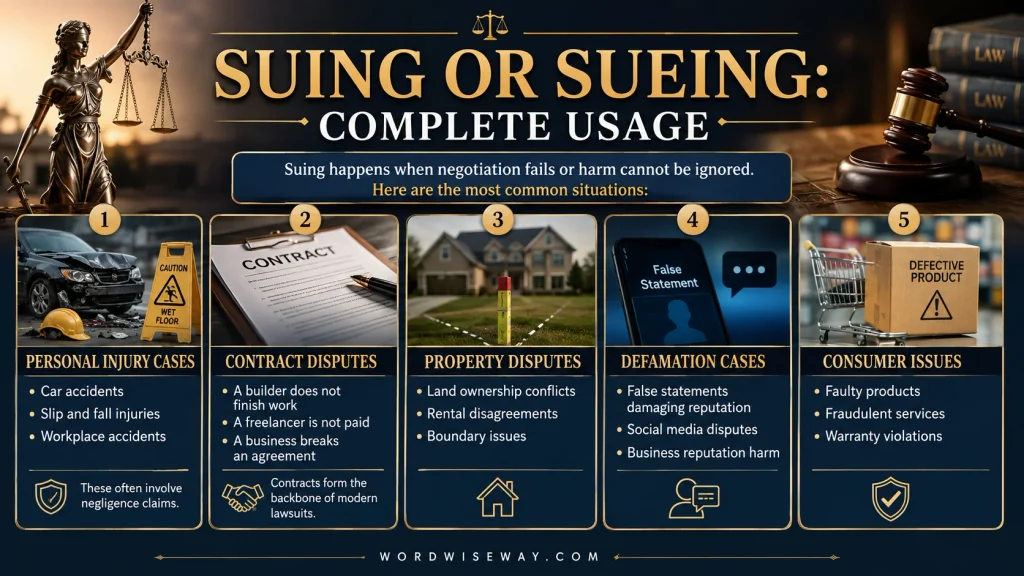
Common Real-Life Situations Where People End Up Suing
Suing happens when negotiation fails or harm cannot be ignored.
Here are the most common situations:
Personal injury cases
- Car accidents
- Slip and fall injuries
- Workplace accidents
These often involve negligence claims.
Contract disputes
- A builder does not finish work
- A freelancer is not paid
- A business breaks an agreement
Contracts form the backbone of modern lawsuits.
Property disputes
- Land ownership conflicts
- Rental disagreements
- Boundary issues
Defamation cases
- False statements damaging reputation
- Social media disputes
- Business reputation harm
Consumer issues
- Faulty products
- Fraudulent services
- Warranty violations
How the Legal Process of Suing Actually Works
The legal system does not run on emotion. It runs on structure.
Here is how suing usually unfolds step by step.
Step: Identifying the legal issue
Before anything else, you must confirm:
- Is there a legal violation?
- Or just a personal disagreement?
Not everything unfair is illegal.
Step: Collecting evidence
Evidence is the backbone of every case.
Common types include:
- Contracts and written agreements
- Emails and messages
- Photographs or videos
- Witness statements
- Bills or receipts
Without evidence, even strong claims can collapse.
Step: Sending a legal notice (if required)
In many systems, a formal notice is sent first.
This usually:
- Warns the other party
- Requests resolution
- Avoids court in some cases
Many disputes end here.
Step: Filing the lawsuit
If the issue is not resolved:
- A complaint is filed in court
- Fees are paid
- Case documents are submitted
This officially starts the lawsuit.
Step: Court proceedings begin
This stage includes:
- Arguments from both sides
- Presentation of evidence
- Cross-examinations
- Legal interpretations
It can take months or even years depending on complexity.
Step: Judgment or settlement
The case ends in one of two ways:
- Court decision (judgment)
- Mutual agreement (settlement)
Most civil cases actually settle before trial.
Key Mistakes People Make When Thinking About Suing
Many people misunderstand lawsuits completely.
Here are the most common mistakes:
Mistake 1: Thinking every problem is a legal case
Not every disagreement belongs in court. Many are personal or contractual misunderstandings.
Mistake 2: Ignoring evidence requirements
Strong feelings do not replace proof.
Mistake 3: Missing deadlines
Legal claims have time limits called statutes of limitation. If you miss them, your case may be dismissed.
Mistake 4: Expecting fast results
Legal systems are slow by design. Speed is not the priority. Accuracy is.
Mistake 5: Underestimating costs
Even simple lawsuits can include:
- Lawyer fees
- Court fees
- Documentation costs
Why People Still Type “Sueing” Online
Even though it is incorrect, “sueing” is extremely common in searches.
Reasons behind the mistake
- People pronounce “sue” and assume spelling follows pronunciation
- Auto-typing habits
- Lack of grammar awareness in legal terms
- Search engine autocorrect reliance
What search engines do with it
Search engines automatically:
- Correct it to “suing”
- Show legal content for both variations
- Treat them as the same intent
So even wrong spelling still leads to correct information.
Easy Memory Tricks to Never Spell It Wrong Again
Here are simple tricks that actually work:
Trick 1: Drop the “e” rule
If a word ends in silent “e,” remove it before adding “ing.”
Trick 2: Think of similar words
- sue → suing
- argue → arguing
- drive → driving
Trick 3: Say it in your head
“I am suing a company.”
Not “sueing.”
Short mental repetition builds habit
Case Study: A Simple Contract Dispute Example
Let’s break down a realistic situation.
Scenario
A freelance designer agrees to create a website for $1,000. The client refuses to pay after completion.
What happens next?
- Designer sends payment reminder
- No response
- Legal notice is issued
- Case is filed in civil court
Outcome possibilities
- Court orders payment if contract is proven
- Case settles if client agrees to pay before judgment
- Case dismissed if contract evidence is weak
Key takeaway
Even simple contracts can lead to lawsuits if ignored.
Case Study: Personal Injury Claim Example
Scenario
A customer slips in a store due to a wet floor with no warning sign.
Legal question
Was the store negligent?
Process
- Medical records are collected
- Surveillance footage is reviewed
- Witnesses are interviewed
Possible outcome
If negligence is proven, the store may be required to pay damages for:
- Medical bills
- Lost wages
- Pain and suffering
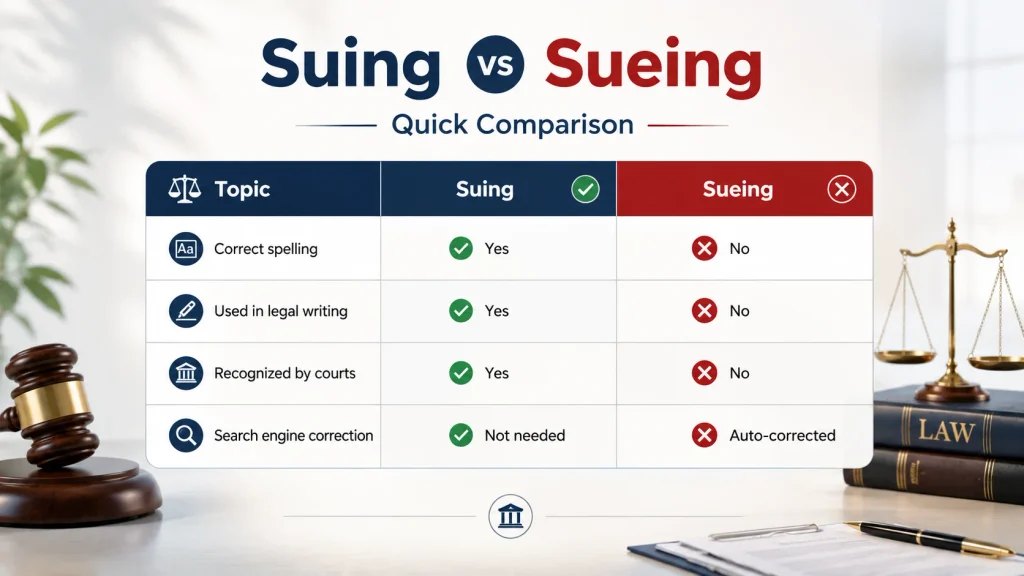
Quick Comparison Table: Suing vs Sueing Concept
| Topic | Suing | Sueing |
| Correct spelling | Yes | No |
| Used in legal writing | Yes | No |
| Recognized by courts | Yes | No |
| Search engine correction | Not needed | Auto-corrected |
Why Understanding “Suing” Matters Beyond Grammar
At first glance, this looks like a spelling issue. But it goes deeper.
Knowing the correct term helps you:
- Communicate clearly in legal situations
- Search accurate legal information
- Avoid confusion in documents
- Understand court discussions better
Language shapes understanding. In law, precision matters even more.
My Personal Experience
As a language consultant, I once sat across from a small business owner who had spent an afternoon drafting a formal letter to a former contractor. She showed me her draft, proud of its assertive tone, and there it was in the second paragraph: she was threatening to take him to court by “sueing” him for the unfinished work.
I paused before pointing it out. She’d built her entire case with conviction, but that single misplaced letter undercut the seriousness of her message. In formal or legal writing, a reader’s trust in your competence often hinges on details like this one. I explained the simple pattern behind it: verbs ending in a silent vowel typically shed that vowel when a suffix beginning with a vowel is attached. Once she saw it laid out that way, she never repeated the error again.
That afternoon stuck with me because it captured something I see constantly in my work. People aren’t lacking intelligence or effort when they stumble over a term like this; they’re relying on how a word sounds rather than how English spelling conventions actually operate. Pronunciation and orthography frequently diverge, and nowhere does that gap matter more than in formal correspondence, contracts, or anything meant to carry authority.
I’ve since made it a habit, whenever I’m reviewing someone’s writing, to flag this particular slip early, because it tends to recur once a person has learned it wrong. The fix takes seconds to teach but saves a document from looking careless. My client’s letter went out corrected, and the matter with her contractor was resolved without ever reaching a courtroom. But the lesson about precision in language stayed with both of us long after that dispute ended.
Key Insights
- Sound versus spelling often clash. People tend to write “suing” the way they hear it, which is why the incorrect form keeps showing up even among careful writers.
- One misplaced letter can weaken credibility. In a formal letter about suing someone, a small spelling slip can distract a reader from the substance of an otherwise strong argument.
- The underlying rule is simple. Verbs ending in a silent “e” — like “sue” becoming “suing” — usually lose that letter before adding “-ing.” Once seen clearly, the pattern is easy to retain.
- Errors repeat until corrected. A mistake learned early tends to resurface again and again unless someone points it out and explains the reasoning behind the fix.
- Precision reflects professionalism. Careful language use signals competence and seriousness, especially in documents discussing something as serious as suing another party.
- Small corrections have outsized impact. A quick fix, taught in moments, can prevent a document from looking careless and can shape how the reader perceives the writer’s judgment overall.
Practice Section:
Test your understanding with these quick exercises.
Fill in the Blanks
Choose suing or sueing:
- The company is considering ______ the contractor.
- She threatened to start ______ after the dispute.
- The lawyer explained the risks of ______ another business.
- The correct spelling is always ______.
- The customer is ______ the company for damages.
Correct the Mistakes
Rewrite each sentence using the correct spelling:
- He is sueing his former employer.
- They discussed sueing the property owner.
- She plans on sueing the company.
Quick Challenge
Complete this rule:
sue + ing = ______
Remember: When sue takes -ing, the silent e is removed, giving suing, not sueing.
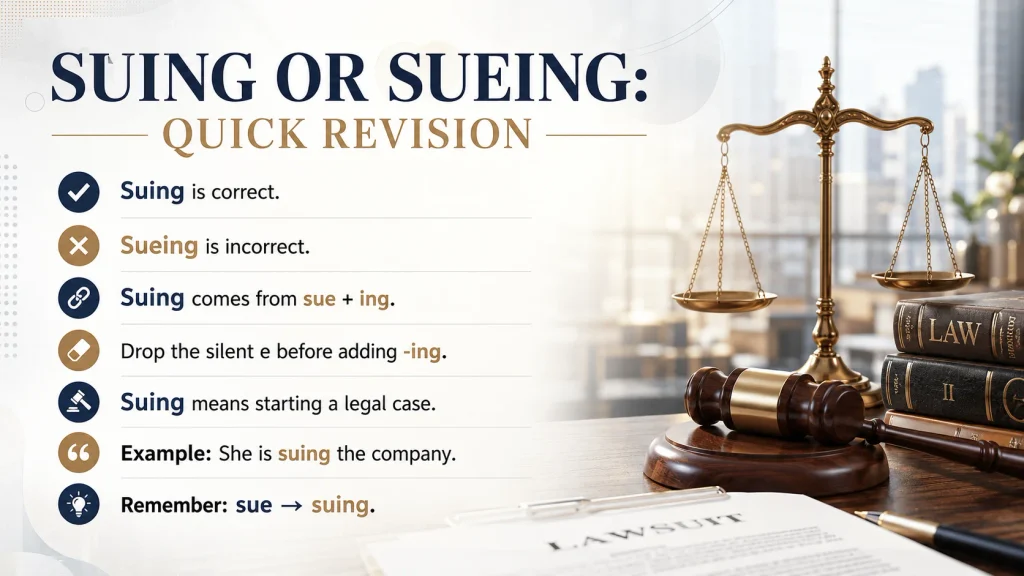
Quick Revision
- Suing is correct.
- Sueing is incorrect.
- Suing comes from sue + ing.
- Drop the silent e before adding -ing.
- Suing means starting a legal case.
- Example: She is suing the company.
- Remember: sue → suing.
FAQs
1. Is it spelled “suing” or “sueing”?
The correct spelling is suing. The incorrect form “sueing” is a common grammatical error and is not accepted in professional, academic, or legal writing.
2. Why do people get confused between the two spellings?
The confusion happens because of English spelling rules. Typically, when adding “-ing” to a verb that ends in a silent “e” (like sue), the “e” is dropped. Many people mistakenly leave the “e” intact.
3. What does it actually mean to sue someone?
To sue means to initiate a civil lawsuit in a court of law. It is a formal legal process where one party (the plaintiff) claims that another party (the defendant) caused them harm, a financial loss, or breached a contract.
4. What is the difference between a civil lawsuit and a criminal case?
A civil lawsuit involves disputes between individuals, companies, or organizations, usually over money, property, or contracts. A criminal case involves the government prosecuting someone for breaking a law, which can result in jail time.
5. Can you sue someone without a lawyer?
Yes, an individual can represent themselves in court, which is known as appearing pro se. However, legal procedures can be highly technical, so seeking professional legal advice is usually recommended.
6. What are the most common reasons for a lawsuit?
Common grounds for civil lawsuits include breach of contract, property damage, personal injury (like car accidents), and business or financial disputes.
7. What is a “breach of contract”?
A breach of contract occurs when one party fails to fulfill their agreed-upon obligations under a legally binding agreement, causing a negative impact or financial loss to the other party.
8. What does “damages” mean in a legal context?
In a lawsuit, “damages” refers to the financial compensation awarded to the winning party to make up for the losses, injuries, or harm they suffered.
9. Do all lawsuits go to a court trial?
No, a vast majority of civil cases are settled out of court through negotiations, mediation, or arbitration before reaching a full trial.
10. Do major style guides accept regional variations for this word?
No. Both American English (US) and British English (UK), along with major professional style guides, universally recognize suing as the only correct spelling.
Conclusion:
Maintaining accuracy in written communication whether you are drafting high-stakes legal contracts or everyday business emails is essential for protecting your professional credibility.
As demonstrated, the debate between “suing” and “sueing” has a definitive answer: suing is the only correct, grammatically accepted spelling across all major regional variations and formal style guides. Dropping the silent “e” when adding the suffix aligns with foundational English spelling patterns, and using it correctly ensures that your legal documentation remains polished and free of costly misunderstandings.
By mastering these precise linguistic standards, professionals, writers, and students alike can communicate with absolute clarity and confidence in any legal or corporate landscape.