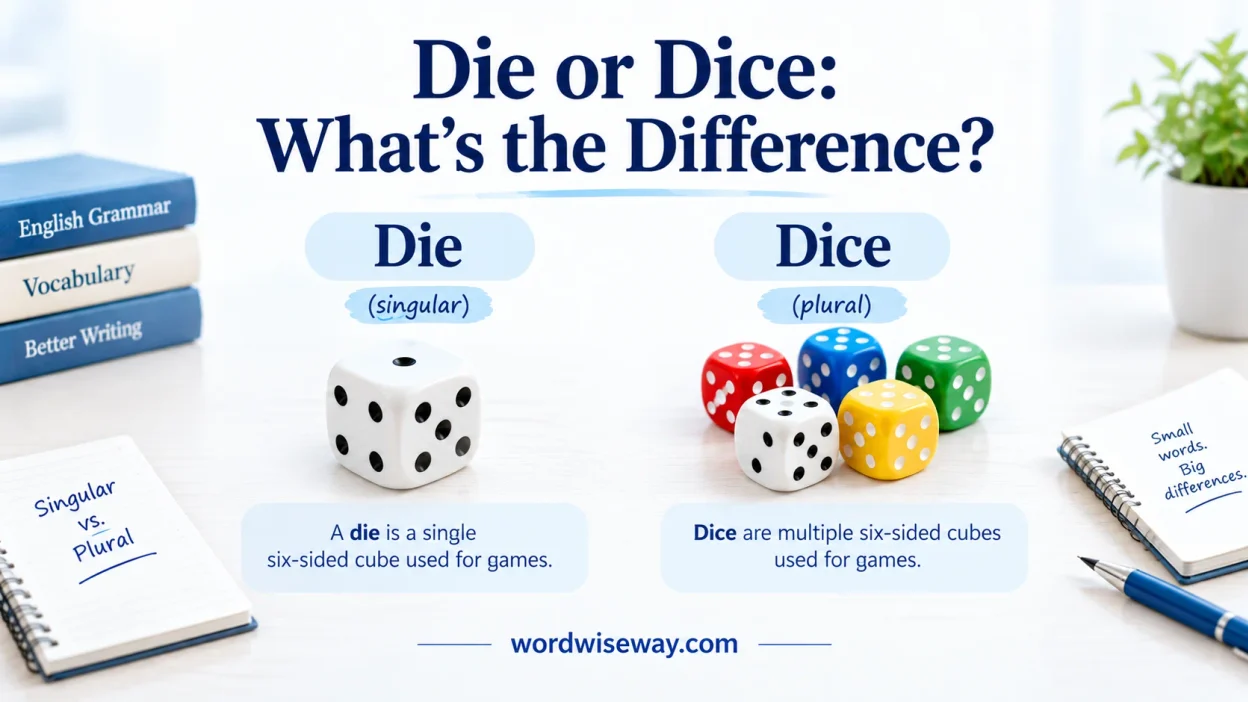
Die or Dice: Correct Spelling, Meaning, and Difference becomes easier when you know the basic grammar rule. In everyday writing and speech, die means one cube, while dice means two or more. This simple distinction helps you avoid common mistakes in English.
In American and British English, usage can vary, but the traditional rule remains a useful guide. Examples from games, math, daily life, and ordinary conversation can make the distinction clearer. Comparison tables and FAQs can also answer common questions.
Understanding the correct form helps you write confidently in formal communication, social media, and professional settings. Modern language trends may blur the traditional boundary, but knowing the standard forms gives you a clear starting point.
Quick Answer:
The traditional rule is simple:
- Die = one gaming piece
- Dice = two or more gaming pieces
For example:
- “Roll one die.”
- “Roll two dice.”
- “The game uses one die.”
- “The game uses three dice.”
So, if you’re writing according to traditional English usage, remember:
One die, two or more dice.
There is one modern variation worth knowing. Dice can also be used as a singular noun in contemporary English. You may therefore encounter phrases such as “a dice” in everyday writing or conversation. Still, a die remains the traditional singular form.
What Does Die Mean?
In gaming, die refers to one small object with marked faces that you roll to produce a number or result.
A standard die usually has six sides. Each side traditionally displays a number from one through six using dots called pips.
For example:
- “She rolled a die.”
- “The die landed on four.”
- “Move your piece after rolling the die.”
- “One die fell off the table.”
The word doesn’t only belong to the world of games, though. Die has several unrelated meanings in English.
Die as a Verb
As a verb, die means to stop living.
For example:
- “Plants can die without enough water.”
- “Some insects die shortly after reproduction.”
- “The flowers began to die in the heat.”
This meaning has nothing to do with dice used in games. The spelling happens to be identical, so context tells you which meaning a sentence intends.
Die as a Manufacturing Term
Die also has a technical meaning in manufacturing. It can refer to a specialized tool used to cut, shape, form, or process material.
For example:
- “The machine uses a metal die.”
- “The manufacturer replaced the damaged die.”
- “Several dies are used during production.”
This meaning becomes particularly important when discussing the plural dies, because dies can be correct when referring to manufacturing tools.
What Does Dice Mean?
Traditionally, dice is the plural form of die when you’re talking about gaming pieces.
If you have more than one gaming die, you can call them dice.
For example:
- “He rolled two dice.”
- “The dice landed beside the board.”
- “She picked up the dice.”
- “The game requires three dice.”
The traditional pattern is therefore:
one die → two dice
one die → three dice
one die → several dice
The plural doesn’t take the ordinary -s ending. That’s what makes the word easy to confuse with regular English nouns.
Dice as a Verb
Dice can also function as a verb. In cooking, it means to cut food into small cubes.
For example:
- “Dice the onions before cooking.”
- “She diced the potatoes.”
- “He dices the carrots into small pieces.”
Here, dices is a perfectly normal verb form. It isn’t the traditional plural of the gaming noun die.
That distinction matters:
dice as a gaming noun = traditionally more than one die
dices as a verb = cuts something into small cubes
Singular and Plural
The traditional distinction can be summarized in one table:
| Word | Traditional Number | Meaning | Example |
| Die | Singular | One gaming piece | “Roll one die.” |
| Dice | Plural | Two or more gaming pieces | “Roll two dice.” |
This pattern differs from regular nouns.
Consider:
- one book → two books
- one game → two games
- one die → two dice
The word changes internally instead of simply adding -s.
Why Is Dice an Irregular Plural?
Die → dice is an irregular plural because the plural form doesn’t follow the usual English pattern.
English contains many older irregular plurals. Some change their internal spelling rather than adding a standard ending.
For example:
- man → men
- woman → women
- mouse → mice
- tooth → teeth
- child → children
Die → dice belongs to this broader group of irregular plural patterns.
Its unusual form comes from the long history of the word in English and related languages. The modern spelling reflects an older plural form rather than a recently created English ending.
Is Dice Singular or Plural?
Traditionally, dice is plural.
If you’re following the conventional gaming distinction, you’d write:
“I rolled a die.”
Then:
“I rolled two dice.”
However, dice can also function as a singular noun in modern English. You’ll encounter this usage in casual speech, gaming discussions, and some contemporary writing.
That doesn’t erase the traditional form.
Instead, English now has some variation:
| Usage | Singular | Plural |
| Traditional | die | dice |
| Modern variation | dice | dice |
The traditional pattern remains especially useful when you want to make the number of gaming pieces immediately clear.
Is Die the Singular of Dice?
Yes, traditionally.
When referring to gaming pieces, the conventional relationship is:
die → dice
For example:
“One die is missing.”
If you find another:
“Now we have two dice.”
The noun changes because the number changes.
This is the simplest way to understand the distinction without getting tangled in modern variations.
Is “One Dice” Correct?
Under traditional English usage, one die is the preferred form.
So:
- Traditional: “I rolled one die.”
- Modern variation: “I rolled one dice.”
The first sentence follows the established singular-plural distinction.
The second reflects the modern use of dice as a singular noun. You may hear or read it, but if you’re learning the conventional form or writing carefully, one die is the safer choice.
A useful rule is:
When you want traditional grammatical precision, use die for one gaming piece.
Is “Two Dice” Correct?
Yes.
Two dice is the traditional plural form.
Examples include:
- “Roll two dice.”
- “I found two dice under the table.”
- “Both dice landed on six.”
- “The game requires two dice.”
You can also say a pair of dice when you’re specifically referring to two pieces.
For example:
“The game comes with a pair of dice.”
The phrase pair of dice makes the quantity especially clear.
Is “Two Dies” Correct?
Not when you’re talking about gaming pieces.
For games, the traditional forms are:
- one die
- two dice
- three dice
So this would not follow traditional gaming usage:
“I rolled two dies.”
Instead, write:
“I rolled two dice.”
However, dies can be correct when die has another meaning.
For example, manufacturing may involve several metal dies.
This gives you two different plural patterns based on meaning:
Gaming: one die → two dice
Manufacturing: one die → two dies
Context is the key.
Die vs. Dice vs. Dies
These three words look deceptively similar, but their uses aren’t interchangeable.
| Word | Meaning | Example |
| die | One gaming piece | “Roll one die.” |
| dice | Multiple gaming pieces | “Roll two dice.” |
| dies | More than one die in another sense, such as manufacturing | “The factory uses metal dies.” |
There’s also die as a verb meaning to stop living.
So the sentence around the word matters.
Consider these examples:
“The player rolled the die.”
Here, die is a gaming noun.
“The factory replaced the die.”
Here, die refers to a manufacturing tool.
“The factory replaced several dies.”
Here, dies is the plural of the manufacturing noun.
“The player rolled several dice.”
Here, dice is the traditional plural gaming noun.
The spelling may look related, but the meanings create different grammatical patterns.
Die or Dice in Common Sentences
Context makes the distinction much easier to remember.
Examples With Die
- “Roll the die.”
- “The die landed on three.”
- “I need one die.”
- “She picked up a die from the floor.”
- “The game uses a single die.”
Examples With Dice
- “Roll the dice.”
- “The dice landed on different numbers.”
- “I need two dice.”
- “She shook the dice before rolling them.”
- “The game uses three dice.”
Examples With Dies
- “The factory uses several metal dies.”
- “The damaged dies were replaced.”
- “Manufacturers use specialized dies to shape materials.”
These examples reveal an important principle: don’t choose the word by spelling alone. Identify the meaning first.
Die or Dice in Gaming
Gaming provides the clearest environment for understanding the difference.
Suppose a board game uses one six-sided gaming piece. You can say:
“The game uses one die.”
If the game uses two:
“The game uses two dice.”
If it uses four:
“The game uses four dice.”
Common gaming phrases include:
- roll a die
- roll the dice
- throw the dice
- a pair of dice
- one six-sided die
- two six-sided dice
- loaded dice
- a roll of the dice
The phrase roll the dice can also have a figurative meaning. It can describe taking a chance or accepting an uncertain outcome.
For example:
“Starting the new business felt like a roll of the dice.”
Here, nobody is necessarily holding gaming pieces. The phrase uses dice as a metaphor for uncertainty and risk.
A Simple Die and Dice Case Study
Imagine you’re playing a board game with two six-sided gaming pieces.
At the beginning, you might say:
“I have two dice.”
You roll them and one falls off the table.
Now you can say:
“One die is still on the table.”
Once you find the missing piece, you have:
“Both dice are back.”
This short example shows the traditional pattern naturally:
one = die
more than one = dice
There’s no complicated formula to memorize.
Common Mistakes
“One Dice”
Traditional usage calls for one die.
Traditional:
“I rolled one die.”
Modern variation:
“I rolled one dice.”
If you’re writing for school, formal content, or a grammar-focused audience, one die provides the clearest conventional form.
“Two Die”
Use two dice for traditional gaming terminology.
Correct:
“She rolled two dice.”
“Two Dies”
Use two dice when you’re talking about gaming pieces.
Correct:
“He rolled two dice.”
But remember that dies can be correct for other meanings of die, particularly manufacturing tools.
“Two Dices”
Dices isn’t the traditional plural of the gaming noun die.
The conventional plural is:
dice
However, dices can appear when dice functions as a verb.
For example:
“She dices the vegetables.”
Here, dices means “cuts into small cubes.”
Which One Should You Use?
The choice becomes easy if you follow the traditional pattern.
Use die when you mean one gaming piece.
Use dice when you mean two or more gaming pieces.
Use dies when you’re dealing with another meaning of die that takes that plural form, such as manufacturing.
You may encounter singular dice in modern English. It isn’t necessary to treat every occurrence as a mistake. Language changes through everyday use, and dictionaries now record this variation.
Still, if precision matters, the traditional pattern leaves little room for confusion:
one die
two dice
three dice
Die or Dice in American English
In contemporary US English, both traditional and modern forms appear.
The traditional form remains straightforward:
- “one die”
- “two dice”
- “three dice”
At the same time, singular dice appears in some informal and specialized contexts.
This variation is similar to many other situations where everyday English gradually develops alongside older grammatical conventions. A form can exist in real usage without being the clearest choice for every situation.
For formal writing, educational material, or situations where you want to make the number unmistakable, die for one and dice for more than one remains a dependable convention.
How to Remember
A simple memory trick can save you from second-guessing the words.
Think:
DIE = one
DICE = more than one
Then attach a visual image to the rule.
Imagine a single cube sitting on a table. That’s a die.
Now imagine three cubes scattered across the board. Those are dice.
The spelling follows the quantity.
| Number | Traditional Word | Example |
| 1 | die | “Roll one die.” |
| 2 | dice | “Roll two dice.” |
| 3 | dice | “Roll three dice.” |
| 4 | dice | “Roll four dice.” |
| 5 | dice | “Roll five dice.” |
Once that pattern becomes familiar, die vs. dice stops being a guessing game.
Quick Facts
- Die is traditionally the singular noun for one gaming piece.
- Dice is traditionally the plural noun for multiple gaming pieces.
- One die is the conventional singular phrase.
- Two dice is the conventional plural phrase.
- Dice can also function as a singular noun in modern English.
- Dies can be the plural of die in other meanings.
- Dices is commonly a verb form meaning “cuts into small cubes.”
- A standard gaming die commonly has six sides.
- The spots on a die are called pips.
- Roll the dice can describe taking a chance in a figurative sense.
Read More: Carries or Carrys: Correct Spelling, Meaning, and Usage
FAQs
Is die singular or plural?
Die is the singular form when you’re talking about one of these numbered cubes.
Is dice singular or plural?
Traditionally, dice is the plural form of die and refers to two or more cubes.
Can dice be used for one object?
Yes. In modern casual English, many speakers use dice for both one and multiple objects, although die remains the traditional singular form.
What is the difference between die and dice?
The main difference is quantity. Die traditionally means one object, while dice traditionally means more than one.
Why do people confuse die and dice?
The words look and sound closely related, and modern usage sometimes treats dice as both singular and plural. This makes the traditional distinction less obvious.
Which word should I use in formal writing?
For formal writing, using die for one object and dice for more than one follows the traditional grammatical distinction.
Is die used in American English?
Yes. Die is used as the singular form in American English, particularly when precise or formal language is preferred.
Is dice acceptable as a singular noun?
Yes, dice can be used as a singular noun in modern casual usage. However, die is still the traditional singular form.
What is the plural of die?
The traditional plural of die is dice. For example, you can refer to one die and several dice.
How can I remember when to use die or dice?
A simple way to remember it is: one die, two or more dice. This rule works well for formal writing and helps you avoid common mistakes.
Conclusion
Understanding die and dice doesn’t have to be complicated. The traditional rule is straightforward: die refers to one object, while dice refers to two or more. Once you connect each word with its quantity, the difference becomes much easier to remember.
Modern English adds a small wrinkle because many speakers use dice for both singular and plural in casual situations. Even so, die remains useful when you want to follow traditional grammar, especially in formal writing, educational material, or professional communication.
When you’re unsure, think about the number of objects you mean before choosing the word. For one, use die; for more than one, use dice. That simple habit can help you write naturally while avoiding one of those small English distinctions that often causes unnecessary confusion.

Emma Smith has dedicated 14 years to Princeton University’s English Department, mentoring students in textual interpretation, literary movements, and critical frameworks. Her research explores Shakespearean drama, Victorian serial fiction, postcolonial narrative theory, and manuscript studies and probing how literary forms evolve across cultures and centuries. Emma has delivered lectures at international humanities congresses and published findings in distinguished academic journals, underscoring her commitment to scholarly depth and vibrant teaching.