When you’re searching online to protect your family after you’re gone, Trust or Will: Difference and Which Word Should You Use? may help you understand two common terms.
You may feel confused because a trust and a will both help with passing assets, but they work in different ways. They aren’t the same, and one isn’t always better.A will is often simple and common, while a trust can provide more control and privacy. Your legal and financial choice depends on your needs, assets, and goals.
Understanding these differences can also help you avoid legal problems and save time.When choosing, use a clear guide to explain your options and help you decide with greater confidence. This can help you protect loved ones and organize your financial plans.
Vtrust or will appears to be a typo, not a standard legal term, so use the correct wording for estate planning.
Quick Answer
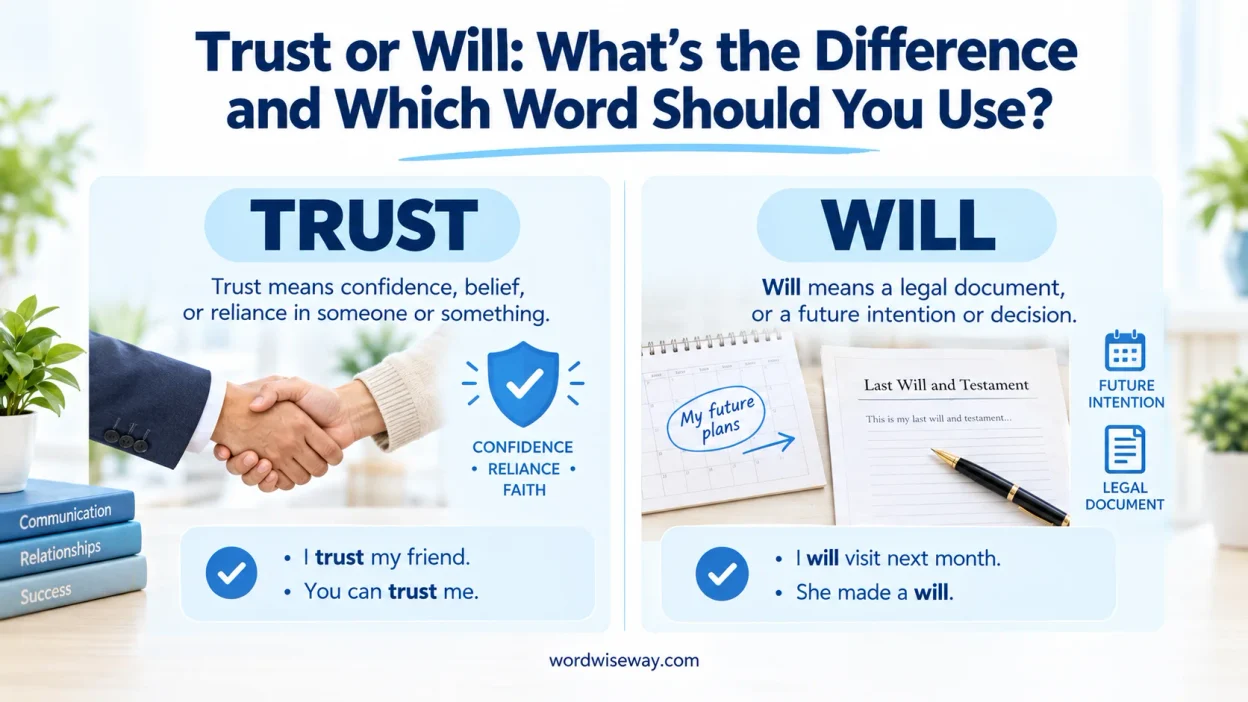
Use trust when you mean confidence, reliance, or belief that someone or something is dependable.
Use will when you mean future action, intention, willingness, determination, or a legal document that expresses someone’s wishes after death.
| Word | Main Meaning | Common Context | Example |
| Trust | Confidence or reliance | Relationships, decisions, reliability | I trust my sister. |
| Trust | Legal arrangement | Estate planning | The property is held in a trust. |
| Will | Future action or intention | Everyday English | I will call you tomorrow. |
| Will | Determination or desire | Personal qualities | She has a strong will. |
| Will | Legal document | Estate planning | He wrote a will. |
A simple memory trick works well: trust concerns confidence or reliance, while will often concerns intention, future action, or legal wishes.
What Does Trust Mean?
The word trust has several related meanings, but its everyday sense centers on confidence.
When you trust someone, you believe that person is honest, dependable, capable, or unlikely to deliberately let you down. You can also trust information, advice, a system, or your own judgment.
For example:
- I trust my teacher.
- You can trust this information.
- She trusts her instincts.
- We trust him to finish the project.
In each sentence, trust involves some form of confidence or reliance.
Trust as a Verb
As a verb, trust means to believe that someone or something is reliable or dependable.
The structure can change depending on what you want to express.
Trust + person
I trust Sarah.
This means you have confidence in Sarah.
Trust + thing
I trust your judgment.
Here, the speaker relies on the other person’s judgment.
Trust + person + to + verb
They trust him to handle the money.
This construction means they believe he can be relied upon to perform the action.
Trust + someone + with + something
She trusted me with her secret.
This means she believed I would treat the secret responsibly.
The noun and verb forms are closely connected, which makes trust unusually flexible in everyday English.
Trust as a Noun
As a noun, trust means confidence in someone’s honesty, ability, or reliability.
Consider this sentence:
Trust takes time to build.
Here, trust isn’t an action performed by one person. It refers to the confidence that exists within a relationship.
Common expressions include:
- build trust
- earn trust
- gain trust
- lose trust
- break someone’s trust
- place your trust in someone
- mutual trust
- blind trust
These expressions all revolve around confidence and reliance.
For example, a new employee might gradually earn the trust of a manager by consistently meeting deadlines. The trust develops through repeated behavior rather than appearing instantly.
Trust in Legal and Financial Contexts
The word trust has another important meaning in law and finance.
A trust can be a legal arrangement in which one party holds and manages property or assets for the benefit of another person or group. The exact rules depend on the jurisdiction and the terms of the trust.
Several roles commonly appear in a trust arrangement:
- Settlor or grantor: The person who creates the trust.
- Trustee: The person or institution responsible for managing trust property.
- Beneficiary: The person or people who receive benefits from the trust.
- Trust property: The assets placed into the trust.
This legal meaning has little to do with simply saying, “I trust you.”
For example, someone might say:
The family placed the property in a trust.
Here, trust refers to a legal structure rather than personal confidence.
What Does Will Mean?
The word will has several distinct grammatical and legal uses.
In everyday English, will commonly works as a modal auxiliary verb. It can express future actions, predictions, decisions, promises, or willingness.
As a noun, will can mean intention, determination, or desire. In legal language, a will is a document that sets out a person’s wishes concerning their estate and other matters after death.
That makes will a remarkably versatile word.
Will as a Modal Verb
When will functions as a modal auxiliary verb, it usually comes before the base form of another verb.
For example:
- I will study tonight.
- She will arrive tomorrow.
- They will help us.
- We will discuss it later.
Notice that the verb after will stays in its base form.
You say:
She will go.
Not:
She will goes.
This grammatical pattern remains consistent across subjects.
Will can also express willingness.
I will help you.
Depending on context, this can mean that the speaker intends to help or is willing to help.
It can also appear in questions:
Will you join us?
The exact meaning depends on context, tone, and the situation.
Will as a Noun
As a noun, will can refer to someone’s intention, desire, or determination.
For example:
He has a strong will.
This means he has strong determination.
Another example is:
She did it of her own free will.
Here, free will refers to the ability to make choices voluntarily rather than being forced.
Common expressions include:
- strong will
- willpower
- free will
- against your will
- by force of will
- where there’s a will, there’s a way
These uses don’t refer to a legal document.
Will as a Legal Document
In legal contexts, a will is a document that expresses a person’s wishes concerning their estate and other matters after death.
A will can address matters such as:
- Who should receive certain property
- Who should inherit assets
- Who should serve as an executor
- Guardianship provisions for minor children, where applicable
- Funeral or other personal wishes, depending on local law
The exact legal effect of a will varies by jurisdiction. A will also generally needs to satisfy specific legal requirements to be valid.
For example:
Maria wrote a will before her death.
Here, will refers to the legal document.
This meaning is completely different from:
Maria will visit tomorrow.
In the first sentence, will is a noun. In the second, it functions as a modal auxiliary verb.
Key Differences
The easiest way to distinguish trust and will is to identify what the sentence actually means.
Trust or Will: Meaning
Trust usually communicates confidence or reliance.
I trust you.
The speaker believes the other person is reliable.
Will often communicates future action or intention.
I will help you.
The speaker expresses an intention or willingness to help.
The words therefore perform very different jobs in ordinary conversation.
Trust or Will: Part of Speech
Trust can work as both a noun and a verb.
Examples:
- Noun: Trust is important in friendship.
- Verb: I trust my friend.
Will can also work as both a noun and a modal auxiliary verb.
Examples:
- Noun: He has a strong will.
- Modal: He will arrive soon.
- Legal noun: She signed her will.
Understanding the grammatical role often makes the correct meaning obvious.
Trust or Will: Context
Context provides the strongest clue.
1.If you’re discussing reliability, confidence, or dependence, you probably need trust.
2.If you’re discussing future events, intentions, willingness, or determination, will may be the appropriate choice.
3.If you’re discussing estate planning, both words can appear, but they describe different legal concepts.
Trust or Will: Time and Action
Will frequently points toward something expected or intended in the future.
We will meet next week.
Trust, however, doesn’t inherently describe future time.
I trust her judgment.
The sentence describes the speaker’s current confidence in her judgment.
This distinction gives you a useful shortcut when you’re writing quickly.
Trust or Will in Everyday Sentences
The surrounding words usually reveal which term belongs in a sentence.
When to Use Trust
Use trust when you want to express confidence in someone or something.
Examples:
I trust my parents.
You can trust this source.
We trust her judgment.
He trusted his friend with the responsibility.
Don’t trust every message you receive online.
The common thread is reliability.
Even when the object changes, the underlying meaning stays similar. You might trust a person, an idea, a process, information, or your own instincts.
When to Use Will
Use will when you’re talking about future actions, decisions, predictions, or willingness.
Examples:
I will finish the assignment tonight.
The store will open at nine.
She will probably arrive soon.
We will help you.
Will you come with us?
Here, will connects to an action or situation that is expected, intended, predicted, or offered.
Trust or Will in Legal Writing
The distinction becomes particularly important in estate planning.
A will and a trust aren’t simply two names for the same legal document.
A will generally takes effect at death and can direct how a person’s estate should be handled. A trust can hold property under terms established by its creator and may operate during the creator’s lifetime, after death, or both, depending on its structure.
A trust may also provide management of assets under specified conditions. A will can serve functions that a trust doesn’t necessarily replace.
Trust vs. Will at a Glance
| Feature | Trust | Will |
| Basic legal concept | Arrangement for holding and managing property | Legal document expressing post-death wishes |
| Can operate during life? | Yes, depending on the trust | Generally concerned with what happens after death |
| Can hold property? | Yes | A will can direct distribution of estate property |
| Has a trustee? | Typically | No trustee is created merely by having a will |
| Has beneficiaries? | Commonly | Can name beneficiaries or heirs |
| Legal rules | Depend on jurisdiction and trust type | Depend on jurisdiction and applicable law |
This table describes broad concepts rather than universal legal rules. Estate law differs considerably between jurisdictions.
Common Mistakes
Because both words have multiple meanings, mistakes often come from focusing on the word rather than the context.
Confusing Trust With Belief
Trust and believe overlap, but they aren’t always interchangeable.
I believe his story.
This usually means I accept the story as true.
I trust him.
This means I consider him reliable or dependable.
You can believe what someone says without necessarily trusting that person.
For example, you might believe someone made a particular mistake while still questioning whether that person can safely handle the same task again.
Using Will for Present Confidence
You wouldn’t normally use will to express confidence in someone’s reliability.
Incorrect in this meaning:
I will you.
Natural:
I trust you.
However, will can express willingness:
I will help you.
The difference lies in what the speaker wants to communicate.
Confusing a Trust With a Will
In estate planning, treating a trust and a will as identical can create confusion.
A will is a legal document. A trust is a legal arrangement involving property, duties, and beneficiaries.
Their functions can overlap in estate planning, but they aren’t interchangeable terms.
Misusing Will as a Main Verb
When will expresses the future, it works as a modal auxiliary.
Correct:
I will study.
Correct:
She will leave.
Incorrect:
She will leaves.
The verb following will takes its base form.
Examples
The following examples show how context changes the correct choice.
| Sentence | Correct Word | Why? |
| I ___ you with this information. | Trust | The sentence expresses confidence. |
| I ___ call you tomorrow. | Will | It describes future action. |
| She ___ her brother to handle the task. | Trusts | She relies on her brother. |
| He ___ help us later. | Will | It refers to future action or willingness. |
| They have lost our ___. | Trust | The sentence refers to confidence. |
| She left a legal ___. | Will | It refers to an estate document. |
| He has a strong ___. | Will | It means determination. |
| The assets are held in a ___. | Trust | It refers to a legal arrangement. |
A Simple Case Study
Imagine two siblings, Emma and Daniel, discussing their grandfather.
Emma says:
“I trust Daniel to manage the family business.”
Here, trust expresses confidence in Daniel’s reliability and ability.
Later, Daniel says:
“I will manage the business responsibly.”
Now will expresses his intention or willingness.
Their grandfather also created a legal document:
“The grandfather’s will leaves certain assets to his children.”
In this example, the same conversation contains both words, yet each carries a distinct meaning.
The lesson is simple: look at the job the word performs in the sentence.
Trust and Will in Related Expressions
Both words appear in many common expressions.
Common Expressions With Trust
- Earn someone’s trust: gain someone’s confidence through reliable behavior.
- Build trust: develop confidence in a relationship or organization.
- Lose trust: cause someone to stop relying on you.
- Break someone’s trust: act in a way that damages someone’s confidence.
- Trust yourself: have confidence in your own judgment.
- Blind trust: confidence given without sufficient evidence or questioning.
- Mutual trust: confidence shared between people or groups.
Common Expressions With Will
- Willpower: the ability to control your actions and persist toward a goal.
- Free will: the capacity to make voluntary choices.
- Strong will: firm determination.
- Against your will: without your consent or choice.
- Last will and testament: a traditional legal expression referring to a person’s will.
- Where there’s a will, there’s a way: a saying suggesting that determination can help someone find a solution.
These expressions show why memorizing isolated definitions isn’t enough. Learning words in context gives you a much stronger grasp of their actual use.
Read More: May or Might: Difference and When Should You Use Each?
FAQs
What is the main difference between a trust and a will?
A will explains how you want your assets handled after your death, while a trust can manage assets according to terms you establish.
Is a trust the same as a will?
No. Although both can be part of an estate plan, they serve different purposes and operate in different ways.
Is a will easier to create than a trust?
A will is generally simpler to create and understand. A trust can involve more planning because its structure and management depend on your specific goals.
Can a will protect my family?
A will can help communicate your wishes and identify who should receive your assets. It can also name guardians for minor children where applicable.
Does a trust provide more control over assets?
A trust can provide ongoing instructions for how certain assets should be managed or distributed, depending on its terms.
Does a trust offer more privacy than a will?
In some jurisdictions, a properly structured trust may offer greater privacy because certain trust arrangements can avoid the public probate process. The exact rules vary by location.
Should I choose a trust or a will?
The appropriate option depends on your assets, family circumstances, financial goals, and local laws. Some people use both rather than choosing only one.
Can I have both a trust and a will?
Yes. An estate plan can include both. They may serve different functions and work together as part of an overall plan.
What happens if I die without a will?
If you die without a valid will, local intestacy laws generally determine how your assets are distributed. The result may not match your personal wishes.
When should I consider professional estate-planning advice?
Consider getting advice when your assets, family situation, business interests, or estate-planning goals are complicated. A qualified professional can explain the rules that apply to your situation.
The Easy Way to Remember the Difference
Here’s the simplest mental shortcut:
Trust = confidence or reliance.
Will = future action, intention, determination, willingness, or legal wishes.
When you see a sentence containing trust, ask:
“Is this about confidence or reliability?”
If the answer is yes, trust probably fits.
When you see will, ask:
“Is this about the future, intention, determination, willingness, or a legal document?”
If so, will may be the right choice.
The legal meanings deserve one extra distinction. A trust generally involves property being held or managed under particular terms, while a will communicates a person’s wishes that take effect at death under applicable law.
Conclusion
Choosing between a trust and a will starts with understanding what each one is designed to do. A will can clearly state your wishes for your assets and family, while a trust can provide different levels of control over how certain assets are managed and distributed.
Your circumstances matter when making an estate-planning decision. Think about your assets, family situation, privacy preferences, and long-term goals. In some cases, using both a trust and a will may make sense rather than treating them as competing choices.
Estate planning can seem complicated at first, but understanding the basic difference makes the process easier to navigate. If your situation involves significant assets or complex family arrangements, consider speaking with a qualified estate-planning professional who understands the laws in your area.

Amelia Sanders has spent 14 years in Harvard University’s English Department, helping students navigate literary analysis, interpretive theory, and narrative techniques. Her academic pursuits center on 18th-century British prose, romantic poetry, diasporic writing, and digital editing exploring how textual choices influence cultural perspectives. Amelia has spoken at major international meetings and contributed essays to respected academic volumes, demonstrating her dedication to thoughtful scholarship and effective teaching.