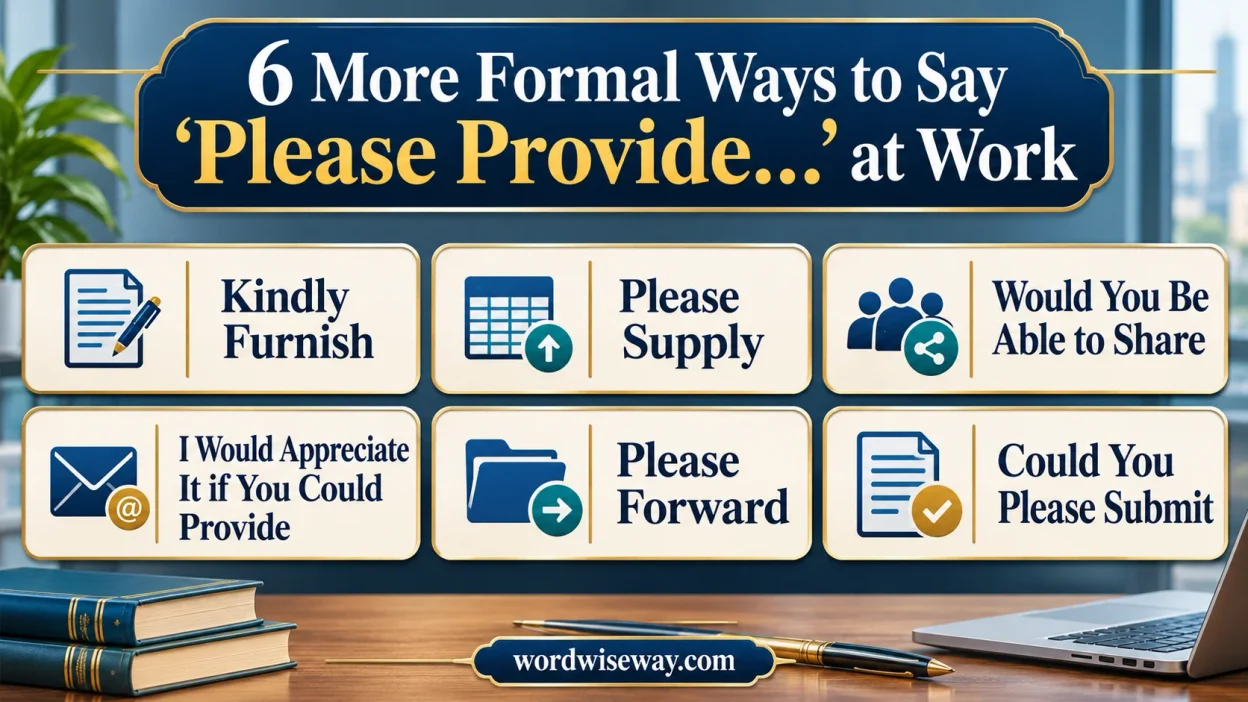
6 More Formal Ways to Say “Please Provide” With Examples helps you write clearer, more respectful requests in professional emails. Although “Please Provide” is common in business communication, repeating it can sound stiff. Alternatives such as “kindly send,” “could you share,” and “please share at your earliest convenience” create a more natural, polite tone.
These expressions work well when requesting documents, asking for information, collecting feedback, or communicating with colleagues and clients. Choosing suitable wording improves clarity, professionalism, and workplace communication. It also helps you maintain a courteous tone while encouraging cooperation and reducing misunderstandings.
Whether you are writing emails, coordinating meetings, managing projects, or sharing updates, consider your audience and the urgency of your request. Simple, thoughtful language makes professional messages easier to understand and helps build trust in everyday business interactions.
Quick Answer:
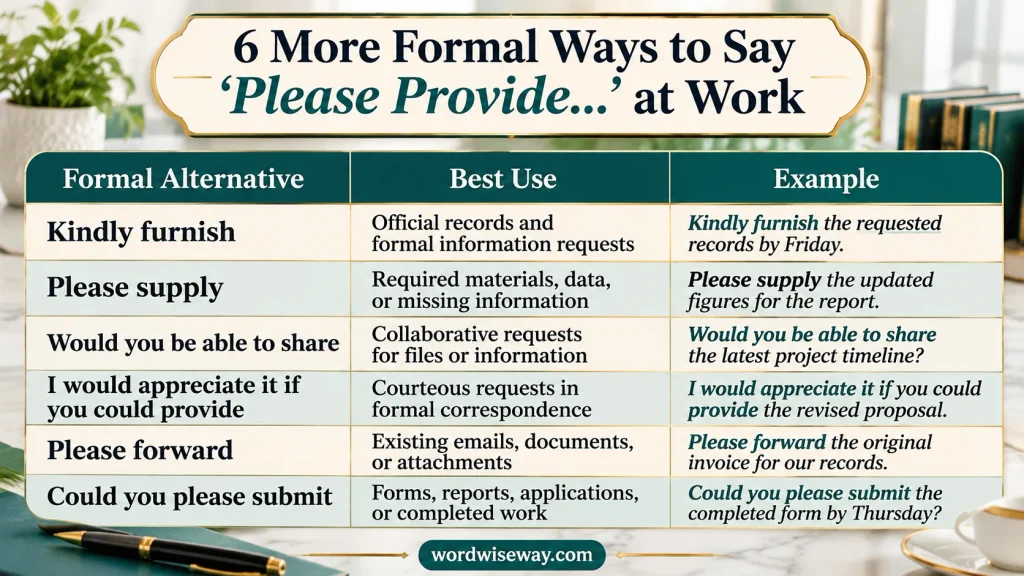
Here are six formal alternatives to “please provide” that you can use in professional emails, workplace messages, and official correspondence.
| Formal alternative | Best use | Example |
| Kindly furnish | Official records and formal information requests | Kindly furnish the requested records by Friday. |
| Please supply | Required materials, data, or missing information | Please supply the updated figures for the report. |
| Would you be able to share | Collaborative requests for files or information | Would you be able to share the latest project timeline? |
| I would appreciate it if you could provide | Courteous requests in formal correspondence | I would appreciate it if you could provide the revised proposal. |
| Please forward | Existing emails, documents, or attachments | Please forward the original invoice for our records. |
| Could you please submit | Forms, reports, applications, or completed work | Could you please submit the completed form by Thursday? |
Each phrase serves a slightly different purpose. Some emphasize formality, while others highlight cooperation or a specific action. Choosing the right expression makes your request easier to understand and act upon.
Why Use Alternatives to “Please Provide” at Work?
“Please provide” is a standard business expression because it communicates a request directly while maintaining a polite tone. However, the phrase can become repetitive when you use it throughout the same email or across multiple messages.
Consider this example:
“Please provide the updated report. Please provide the supporting documents. Please provide your comments before the meeting.”
Every sentence is understandable, but the repeated wording makes the message feel mechanical. A few carefully chosen alternatives create a more natural rhythm.
For example:
“Could you please share the updated report? Please forward the supporting documents and send your comments before the meeting.”
The revised version varies the language while keeping each request clear.
Using different expressions also helps you distinguish between actions. Sharing a file is not always the same as submitting a report or supplying missing information. When your wording reflects the actual task, colleagues can understand their responsibilities more quickly.
However, variety should never become the main goal. Clarity matters more than using an impressive or complicated expression. A simple request often works better than an elaborate sentence filled with unnecessary formalities.
Kindly Furnish
“Kindly furnish” is a highly formal alternative to “please provide.” It commonly appears in official correspondence, administrative requests, and institutional communication.
The verb furnish means to supply or provide something, especially information, evidence, or documentation. When you combine it with kindly, the expression signals a courteous request within a formal setting.
When to Use “Kindly Furnish”
Choose this phrase when requesting official records, supporting documents, detailed information, or other materials for a formal process.
It may work particularly well when communicating with administrative departments, external institutions, or organizations that follow traditional business conventions.
For example, you might write:
- “Kindly furnish the requested records by Friday.”
- “Kindly furnish the details required to complete the review.”
- “Kindly furnish the supporting documents for our assessment.”
- “Kindly furnish the relevant information for the official report.”
These examples identify the requested material and, where appropriate, explain the purpose or deadline.
When “Kindly Furnish” May Not Be Appropriate
Although the phrase sounds formal, it can feel stiff or old-fashioned in everyday workplace communication.
Imagine asking a teammate for a presentation before a meeting. Writing “Kindly furnish the presentation” may sound unnecessarily ceremonial. “Could you please share the presentation before the meeting?” feels more natural.
Use “kindly furnish” when the situation genuinely calls for formal language. Otherwise, choose a simpler alternative that suits your relationship with the recipient.
Practical tip: If you want your email to sound professional rather than bureaucratic, reserve “furnish” for official or documentation-heavy requests.
Please Supply
“Please supply” is a direct, professional alternative when you need materials, data, resources, or missing information.
The word supply emphasizes making something available or providing something that another person needs. It often fits requests involving business operations, procurement, reporting, and administrative processes.
When to Use “Please Supply”
Use this phrase when the recipient must provide something necessary to complete a task or move a process forward.
For example:
- “Please supply the updated figures for the quarterly report.”
- “Please supply the missing documentation before processing the request.”
- “Please supply the product specifications for our review.”
- “Please supply the information required to finalize the proposal.”
These sentences work because they identify the specific items the recipient needs to deliver.
The phrase can also be useful when communicating with vendors or service providers. If a supplier must send product details or required documentation, “please supply” communicates the request directly.
When “Please Supply” May Not Be Appropriate
“Supply” can sound transactional when you ask a colleague for a simple favor or a quick update.
For example, “Please supply your thoughts on the presentation” sounds less natural than “Could you share your thoughts on the presentation?”
The difference comes down to context. Supply generally suits something needed for a task or process, while share often works better for ideas, opinions, and collaborative information.
Practical tip: Use “please supply” when the recipient needs to deliver specific materials, figures, or information. Choose a more conversational expression for informal collaboration.
Would You Be Able to Share
“Would you be able to share” is a polite, collaborative alternative to “please provide.” It works especially well when requesting files, project updates, feedback, or information from colleagues.
Rather than sounding like a direct instruction, this expression frames the request as a considerate question. It can be useful when the recipient has competing priorities or when you want to maintain a friendly professional tone.
When to Use “Would You Be Able to Share”
Choose this phrase when you need information that someone already has or can readily access.
For example:
- “Would you be able to share the latest project timeline?”
- “Would you be able to share your feedback on the revised proposal?”
- “Would you be able to share the meeting notes with the team?”
- “Would you be able to share the latest sales figures before our discussion?”
The expression is suitable for communication with teammates, managers, clients, and other professional contacts.
It is particularly useful when requesting information that supports collaboration. Asking someone to share a document or an opinion can sound more natural than asking them to provide it.
When to Use a More Direct Alternative
Polite questions are useful, but they can make urgent or mandatory requests less direct than necessary.
Suppose your team must submit a report before a fixed deadline. Asking whether someone would be able to share it may suggest that the action is optional.
In that situation, consider writing:
“Could you please send the report by 3 p.m. Thursday?”
This version remains courteous while making the expected action and deadline clear.
Practical tip: Use “would you be able to share” for collaborative requests. When a task is mandatory, pair a clear action with a specific deadline.
I Would Appreciate It if You Could Provide
“I would appreciate it if you could provide” is a courteous and formal expression that works well in business emails. It acknowledges the recipient’s cooperation while clearly stating what you need.
This phrase can be particularly helpful when writing to clients, senior colleagues, external partners, or people with whom you do not communicate regularly.
When to Use “I Would Appreciate It if You Could Provide”
Use this expression when requesting information, documents, explanations, or feedback in a formal setting.
For example:
- “I would appreciate it if you could provide the revised budget by Thursday.”
- “I would appreciate it if you could provide further details about the proposed changes.”
- “I would appreciate it if you could provide the supporting documents for our review.”
- “I would appreciate it if you could provide an update on the approval process.”
Each example communicates the request politely without relying on overly complicated vocabulary.
This expression also works well when the requested information requires some effort. If a colleague needs to review records or prepare a detailed explanation, acknowledging their cooperation can help maintain a respectful tone.
How to Keep This Phrase Concise
The wording is relatively long, so it may become repetitive if you use it several times in one message.
For a shorter alternative, write:
“I would appreciate your feedback on the revised proposal.”
You could also say:
“Could you please provide the revised budget by Thursday?”
Both versions preserve a professional tone while reducing unnecessary words.
Practical tip: Use the longer expression when courtesy is especially important. For routine requests, a shorter sentence often communicates the same message more efficiently.
Please Forward
“Please forward” is the right choice when you want someone to send existing information or correspondence to you or another recipient.
Unlike “provide,” which has a broad meaning, forward describes a more specific action. It usually means passing along an email, message, attachment, or document that already exists.
When to Use “Please Forward”
Use this phrase when requesting copies of previous communications, existing files, invoices, reports, or other materials.
For example:
- “Please forward the original invoice for our records.”
- “Please forward the email containing the client’s revised requirements.”
- “Please forward the meeting invitation to the project team.”
- “Please forward the latest version of the agreement for review.”
These requests are clear because the recipient knows that they need to send something already available.
The expression can also help reduce confusion in busy workplaces. Instead of asking someone to provide information that they may interpret as requiring a new document, you specify that they should forward the existing material.
When “Please Forward” Is Not the Right Choice
Use a different verb when the recipient must create something new or prepare information from scratch.
For example, if you need a colleague to write a project summary, “please forward the project summary” suggests that the summary already exists.
A better request would be:
“Could you please prepare a brief project summary for the meeting?”
Similarly, use “please share” when requesting access to a collaborative document rather than asking someone to forward it.
Practical tip: Choose “please forward” for existing correspondence and documents. If the recipient must create, revise, or collect information, select a verb that describes that task accurately.
Could You Please Submit
“Could you please submit” is a formal alternative that works when someone must officially deliver a document, report, application, or completed task.
The verb submit implies that the material is being presented for review, approval, processing, or recordkeeping. It therefore carries a more procedural meaning than share or send.
When to Use “Could You Please Submit”
Use this phrase when requesting completed paperwork or deliverables that must enter a formal process.
For example:
- “Could you please submit your expense report by the end of the week?”
- “Could you please submit the completed application for approval?”
- “Could you please submit the revised proposal before Friday’s review?”
- “Could you please submit the final report through the designated system?”
These examples work in workplaces where employees follow established procedures or submit materials for approval.
The phrase is also helpful when a request involves accountability. If a report must reach a manager or department by a certain date, “submit” clearly communicates that the recipient needs to complete a required step.
When to Choose a Different Expression
“Submit” may sound unnecessarily formal when you only need a colleague to send a file for an informal discussion.
For example, “Could you please submit the presentation?” may sound like an official requirement. If the recipient simply needs to send you a draft, “Could you please share the presentation?” is more natural.
Practical tip: Use “submit” when the material must be formally delivered for review, approval, or processing. Use “send” or “share” for ordinary file exchanges.
How to Choose the Right Alternative to “Please Provide”
Choosing the right phrase becomes easier when you consider the requested action before writing your email. Formality matters, but accuracy matters just as much.
Consider What You Are Requesting
Start by identifying exactly what the recipient needs to do.
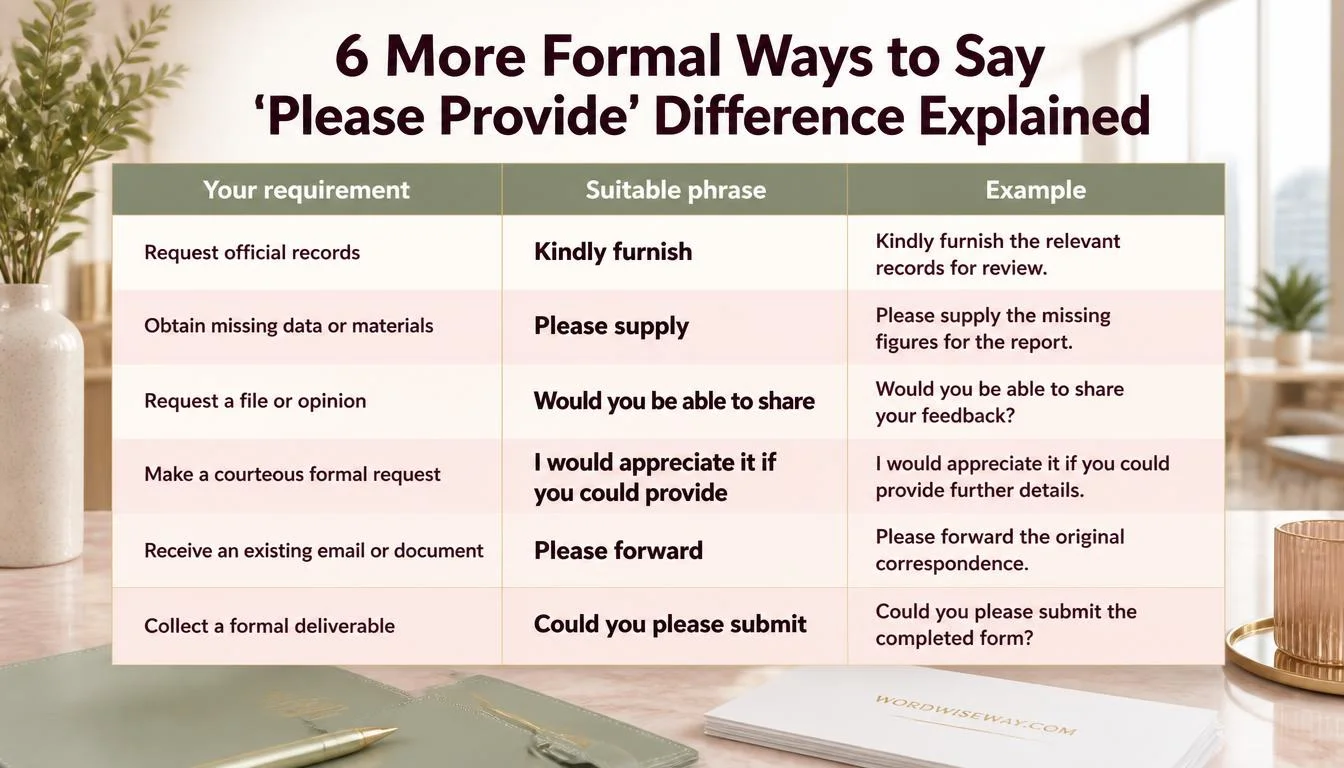
| Your requirement | Suitable phrase | Example |
| Request official records | Kindly furnish | Kindly furnish the relevant records for review. |
| Obtain missing data or materials | Please supply | Please supply the missing figures for the report. |
| Request a file or opinion | Would you be able to share | Would you be able to share your feedback? |
| Make a courteous formal request | I would appreciate it if you could provide | I would appreciate it if you could provide further details. |
| Receive an existing email or document | Please forward | Please forward the original correspondence. |
| Collect a formal deliverable | Could you please submit | Could you please submit the completed form? |
Notice that the verbs are not interchangeable in every situation. A request to forward an existing email differs from a request to submit a completed application.
Matching the verb to the task reduces ambiguity and makes your instructions easier to follow.
Consider Your Audience
The person receiving your message also influences your wording.
When emailing a close teammate, “Could you share the latest figures?” may be sufficient. When requesting official records from an external institution, “Kindly furnish the requested documentation” may better match the setting.
However, job titles alone should not determine your tone. You do not need to use elaborate language simply because someone holds a senior position.
Instead, consider your existing relationship, the organization’s communication style, and the purpose of your request.
For example:
- To a colleague: “Could you please share the updated spreadsheet?”
- To a manager: “Would you be able to provide feedback on the revised plan?”
- To a client: “I would appreciate it if you could provide the requested details.”
- To an administrative department: “Kindly furnish the relevant records for processing.”
The goal is to remain respectful without making ordinary communication unnecessarily complicated.
Consider the Deadline
A professional request should communicate urgency when timing matters. Yet adding vague phrases such as “as soon as possible” may leave the recipient unsure about your actual expectations.
Compare these examples:
Less specific: “Could you please provide the report soon?”
More specific: “Could you please provide the report by 3 p.m. Thursday?”
The second sentence gives the recipient a clear target. It also helps them prioritize the task alongside other responsibilities.
When appropriate, briefly explain why the deadline matters:
“Could you please submit the revised budget by Thursday afternoon? We need it for Friday’s planning meeting.”
This sentence identifies the action, deadline, and reason. Those details make the request easier to understand without adding unnecessary formality.
Balance Politeness With Clarity
Politeness should support your message rather than hide its purpose.
For example, this request is unnecessarily indirect:
“I was wondering whether it might possibly be convenient for you to consider sharing the report whenever you have an opportunity.”
A clearer version is:
“Could you please share the report by Wednesday?”
The shorter sentence remains courteous and communicates the expected action immediately.
Remember that professional language does not require long sentences. A direct request can sound respectful when it uses appropriate wording and acknowledges the recipient’s time.
Formal vs. Natural Alternatives: Which Phrase Works Best?
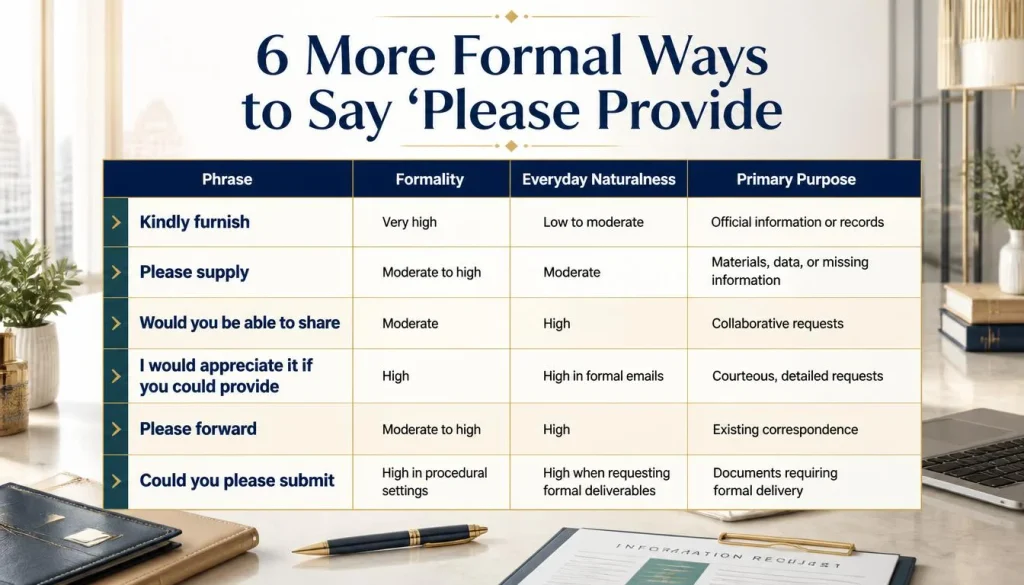
Each alternative has a different level of formality and a different purpose. The following comparison can help you select wording that fits everyday workplace communication.
| Phrase | Formality | Everyday naturalness | Primary purpose |
| Kindly furnish | Very high | Low to moderate | Official information or records |
| Please supply | Moderate to high | Moderate | Materials, data, or missing information |
| Would you be able to share | Moderate | High | Collaborative requests |
| I would appreciate it if you could provide | High | High in formal emails | Courteous, detailed requests |
| Please forward | Moderate to high | High | Existing correspondence |
| Could you please submit | High in procedural settings | High when requesting formal deliverables | Documents requiring formal delivery |
No single phrase is best for every situation. The right choice depends on whether you need information, an existing file, missing materials, or a formal submission.
For routine workplace communication, “could you please share” and “could you please provide” are often straightforward choices. For official records, “kindly furnish” may fit the context. When requesting a completed form for approval, “could you please submit” communicates the task more precisely.
The most professional wording is the wording that makes your request clear while respecting the recipient.
Common Mistakes
Even a polite phrase can create confusion when it does not match the situation. Avoiding a few common mistakes will help you write clearer business emails.
Using Overly Formal Language for Simple Requests
Long, elaborate expressions can make everyday communication feel distant.
For example, “Kindly furnish the presentation at your earliest convenience” sounds unnecessarily formal when asking a teammate for a routine file.
A simpler alternative works better:
“Could you please share the presentation before our meeting?”
Use formal language when the situation calls for it, not merely to make your message sound important.
Choosing a Verb That Does Not Match the Action
Different verbs describe different tasks. Using the wrong one can leave the recipient uncertain about what you expect.
Consider these distinctions:
- Provide: Give the requested information or material.
- Supply: Deliver something needed for a task or process.
- Share: Make information, files, or ideas available.
- Forward: Send existing correspondence or material.
- Submit: Formally deliver something for review or processing.
For example, if you need someone to create a new report, asking them to forward it may imply that the report already exists.
Instead, write, “Could you please prepare the report by Friday?”
Leaving Out Important Details
A vague request can lead to unnecessary follow-up messages.
For example, “Please provide the figures” does not identify which figures you need. The recipient may have to ask for clarification before completing the task.
A more useful request would be:
“Please provide the March sales figures for the regional performance report.”
If the recipient also needs a deadline, include it in the same sentence.
“Please provide the March sales figures for the regional performance report by Thursday afternoon.”
Specific requests save time because they reduce guesswork.
Making a Request Sound Like a Demand
Direct language is useful, but unnecessarily forceful wording can damage professional relationships.
Compare these examples:
Abrupt: “Send me the updated document immediately.”
Professional: “Could you please send me the updated document by noon?”
The second version communicates a clear expectation without adding hostility.
If a deadline is urgent, explain the reason when appropriate. You do not need to bury the request under excessive apologies or lengthy expressions of gratitude.
Using Vague Deadlines
Phrases such as “soon,” “when possible,” and “at your earliest convenience” can work when timing is flexible. However, they are less useful when a task has a firm deadline.
Instead of writing “Please submit the form soon,” specify the required date:
“Could you please submit the form by October 29?”
A precise deadline helps the recipient plan their work and reduces uncertainty about priorities.
Read More: Wore or Worn: Meaning, Difference and Correct Usage
FAQs
1. What is a more formal way to say “Please Provide”?
You can say “Kindly provide,” “Please share,” or “Could you send me” to make a request sound professional. Choose the phrase that best fits your message and relationship with the recipient.
2. How can I politely ask someone to provide information?
You can write, “Could you please share the information when you have a moment?” This wording is polite, clear, and suitable for most workplace emails.
3. Is “Kindly Provide” more professional than “Please Provide”?
Both expressions are professional and widely understood. However, “Kindly provide” may sound more formal in some contexts, while “Please provide” feels direct and neutral.
4. How do I ask a colleague to send documents professionally?
Try saying, “Could you please send me the documents when they’re ready?” If you have a deadline, mention it clearly so your colleague understands when you need them.
5. What can I say instead of “Please Provide the Details”?
You could write, “Could you share the details?” or “Please send over the relevant information.” Both options sound natural and work well in professional messages.
6. How do I request information without sounding demanding?
Use considerate wording, explain what you need, and include a reasonable timeframe if necessary. For example, “When convenient, could you share the updated report?” sounds respectful without making your request unclear.
7. Is “Could You Share” appropriate for formal emails?
Yes, “Could you share” is suitable for many professional emails. It sounds courteous and conversational, making it useful when requesting information, files, feedback, or updates from colleagues and clients.
8. How can I ask someone to provide something by a deadline?
State your request and deadline directly but politely. For example, “Could you please send the completed form by Thursday afternoon?” gives the recipient a clear expectation without sounding unnecessarily harsh.
9. What is the difference between “Please Send” and “Please Provide”?
“Please send” usually emphasizes delivering or transmitting something, such as a file or email attachment. “Please provide” is broader and can refer to supplying information, documents, resources, or other requested items.
10. How can I avoid repeating “Please Provide” in workplace communication?
Vary your wording according to the situation. Use phrases such as “Could you share,” “Please forward,” “Would you send,” or “I’d appreciate it if you could provide.” This keeps your emails natural while maintaining a professional tone.
Conclusion
Choosing the right alternative to “Please Provide” can make your workplace communication clearer, more polite, and more natural. Phrases like “Kindly send,” “Could you share,” and “I’d appreciate it if you could provide” help you request information without sounding repetitive or overly formal. The best choice depends on what you need and how you communicate with the recipient.
Before sending a professional email, consider your audience, the purpose of your request, and any deadline involved. A friendly message to a colleague may need different wording than a formal request to a client or manager. Clear language and a courteous tone help prevent misunderstandings and make it easier for others to respond.
You don’t need complicated words to sound professional. Focus on being respectful, specific, and direct. By using these alternatives naturally, you can strengthen your business writing, build better working relationships, and make everyday requests easier for everyone to understand.

Evelyn Shaw has spent 14 years at Yale University’s English Department, leading students through close readings, genre studies, and interpretive methodologies. Her scholarly interests include Renaissance drama, gothic fiction, feminist literary criticism, and archival research and examining how texts generate meaning across historical periods. Evelyn has presented at major academic conferences and published essays in peer-reviewed journals, reflecting her passion for rigorous analysis and student-centered learning.