Labelling or Labeling: Correct Spelling, Meaning, and Usage explains why Labelling vs Labeling creates a common spelling question among students, writers, content writers, and professionals.
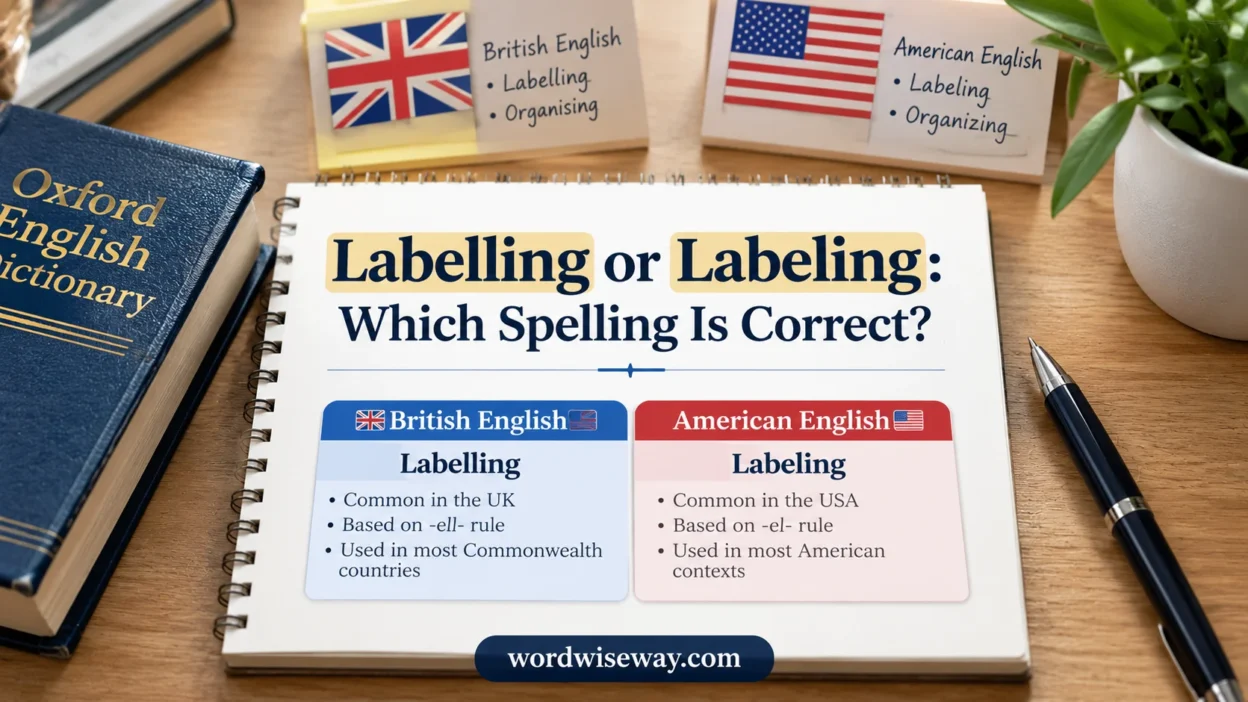
Both are correct spelling forms, but the difference depends on British spelling and American spelling conventions. Labelling uses a double l, while Labeling uses one l or a single L. The meaning, usage, and action remain unchanged despite this visible spelling difference.
From my writing practice, editing, and proofreading experience, many native English speakers confuse these forms and consider one a spelling mistake. The correct spelling choice depends on your audience, regional usage, and style guide. Understanding spelling variations, language rules, and correct usage improves writing clarity, professional communication, and document consistency.
Whether you follow British English or American English, maintaining consistency helps create clear and accurate writing.
Quick Answer:
Both spellings are correct. The real difference comes from regional English standards.
- Labeling is used in American English
- Labelling is used in British English, Canadian English, Australian English, and most Commonwealth regions
The meaning never changes. Only the spelling system does.
So instead of asking which is correct, the better question is:
Which audience are you writing for?
That answer decides the right choice every time.
Why There Are Two Spellings in the First Place
English did not evolve in a controlled way. It spread across countries, cultures, and publishing systems, and each region developed its own standards.
A major turning point came in the 18th and 19th centuries when American English started separating itself from British English spelling conventions.
One key figure in this shift was Noah Webster, who pushed for simplified American spelling. His goal was straightforward: make English easier to learn and more consistent.
This led to changes like:
- colour → color
- centre → center
- labelling → labeling
British English, meanwhile, kept older structures intact.
That’s how the split began.
Why American English Uses “Labeling”
American English follows a simple spelling rule when adding suffixes like -ing:
Do not double the final consonant unless pronunciation requires it.
This creates a predictable pattern.
Examples include:
- label → labeling
- travel → traveling
- cancel → canceling
- signal → signaling
The logic is consistency and simplicity. Fewer exceptions make the language easier to learn and use.
In real-world applications, you’ll see this spelling in official U.S. systems such as:
- FDA food labeling rules
- American packaging laws
- Academic writing in U.S. universities
The spelling is standardized, not optional.
Why British English Uses “Labelling”
British English takes a more traditional approach. It often preserves the structure of words even when adding suffixes.
So instead of simplifying, it keeps the double consonant:
- label → labelling
- travel → travelling
- cancel → cancelling
- model → modelling
The reasoning is tied to consistency and historical spelling patterns.
The double “l” helps maintain a visual and structural connection between word forms:
- label
- labelled
- labelling
In practice, you’ll see “labelling” in:
- UK government regulations
- British academic writing
- Commonwealth publishing standards
- EU-related documentation influenced by British English
It is the standard form, not a stylistic preference.
Side-by-Side Comparison
| Feature | Labeling | Labelling |
| English type | American English | British English |
| Letter pattern | Single “l” | Double “l” |
| Region | United States | UK, Canada, Australia, NZ |
| Example usage | product labeling | product labelling |
| Style approach | simplified spelling | traditional spelling |
| Common sources | FDA, US media | UK government, Oxford style |
Both versions are fully correct within their systems.
Why Both Versions Still Exist Today
English never became a single standardized global system. Instead, it developed into multiple accepted versions.
This continues today because:
- Education systems differ by region
- Governments set their own language standards
- Media and publishing industries follow regional style guides
- Global English adapts instead of replacing local forms
So both spellings survived because both are deeply embedded in real institutions.
Common Mistakes Writers Make
Even experienced writers make errors when switching between English types.
One common mistake is mixing both forms in the same document:
Example:
- The product labeling must follow safety rules.
- The packaging labelling must include ingredients.
This feels inconsistent and reduces writing quality.
Another mistake is relying too heavily on autocorrect tools. Many tools default to one version and silently change your spelling.
A third mistake is assuming one form is incorrect. That’s false. Both are standard.
How to Choose the Right Spelling Every Time
You don’t need complex grammar rules. You just need a simple decision process.
Start by identifying your audience:
- If your readers are in the United States → use labeling
- If your readers are in the UK or Commonwealth countries → use labelling
Next, check your platform or publication style guide. Many organizations already define this clearly.
For example:
- APA Style uses American spelling → labeling
- Oxford Style uses British spelling → labelling
Finally, stay consistent. Once you choose a form, use it throughout your entire content.
Real-World Applications
This spelling difference appears in many industries.
product packaging:
- US products use “labeling”
- UK products use “labelling”
government regulations:
- FDA uses “labeling”
- UK Food Standards Agency uses “labelling”
education:
- American textbooks use labeling
- British textbooks use labelling
In software interfaces:
- US users see “Label settings”
- UK users see “Labelling settings”
These differences improve clarity for local users.
Case Study: Global Brand Localization
A global food brand once used a single spelling across all markets.
At first, they used “labeling” everywhere.
This caused subtle issues:
- UK customers noticed unfamiliar spelling
- regulatory documents required adjustments
- brand consistency felt weaker in some regions
So the company adapted:
- US packaging → labeling
- UK packaging → labelling
After this change:
- customer trust improved
- regulatory compliance became smoother
- brand perception became more localized and professional
This shows that even small spelling choices influence real outcomes.
Quick Memory Trick
Here’s a simple way to remember the difference:
- US English simplifies → labeling
- UK English doubles letters → labelling
Think of it like this:
- America trims spelling for speed
- Britain keeps structure for tradition
Once you see this pattern, it sticks easily.
Final Takeaway
The debate between labelling and labeling is not about correctness. It is about context.
- Both are valid. 2. Both are widely used. 3. Both follow official standards.
The only real rule is this:
Write for your reader, not for the dictionary.
When you understand that, the confusion disappears completely.
Read More: Omelet or Omelette: Correct Spelling, Meaning, and Usage
FAQs
What is the difference between Labelling and Labeling?
Labelling and Labeling have the same meaning, but the spelling difference comes from regional English rules. Labelling is preferred in British English, while Labeling is common in American English.
Is Labelling the correct spelling?
Yes, Labelling is a correct spelling. It follows British spelling conventions where the final consonant is usually doubled before adding suffixes like “-ing.”
Is Labeling wrong in English?
No, Labeling is not wrong. It is the accepted spelling in American English and is widely used in the United States and many international contexts.
Why does Labelling have two Ls?
Labelling has two Ls because British spelling rules often double the final consonant before adding “-ing” when the word ends with a single consonant after a vowel.
Why do Americans write Labeling with one L?
American English usually keeps the single L in words like Labeling. This follows American spelling conventions that differ from British spelling patterns.
Can I use Labelling and Labeling in the same document?
It is better to choose one spelling style and use it consistently. Mixing Labelling and Labeling in the same document may make your writing appear inconsistent.
Which spelling should content writers use: Labelling or Labeling?
Content writers should choose according to their target audience. Use Labelling for British audiences and Labeling for American audiences to maintain professional communication.
Does Labelling vs Labeling change the meaning?
No, both words have the same meaning. They describe the process of attaching labels, identifying items, or adding information to something.
Where are Labeling and Labelling commonly used?
These terms appear in many fields, including product labeling, data labeling, scientific labeling, packaging, technology, research, and business communication.
How can I remember the correct spelling of Labelling or Labeling?
Remember the audience you are writing for. British English usually prefers Labelling with double L, while American English commonly uses Labeling with one L.
Conclusion
Understanding Labelling or Labeling: Correct Spelling, Meaning, and Usage helps writers avoid confusion and make better spelling choices. Both forms are accepted, but the preferred version depends on British English and American English conventions. Labelling with a double l is common in British usage, while Labeling with one l is preferred in American writing. The important thing is not choosing one as universally correct but using the selected form consistently.
Whether you are creating content writing, academic writing, professional communication, or everyday documents, knowing these spelling variations improves writing clarity and accuracy. By understanding regional usage, language rules, and correct usage, you can confidently choose the right spelling for your audience and maintain professional-quality writing.