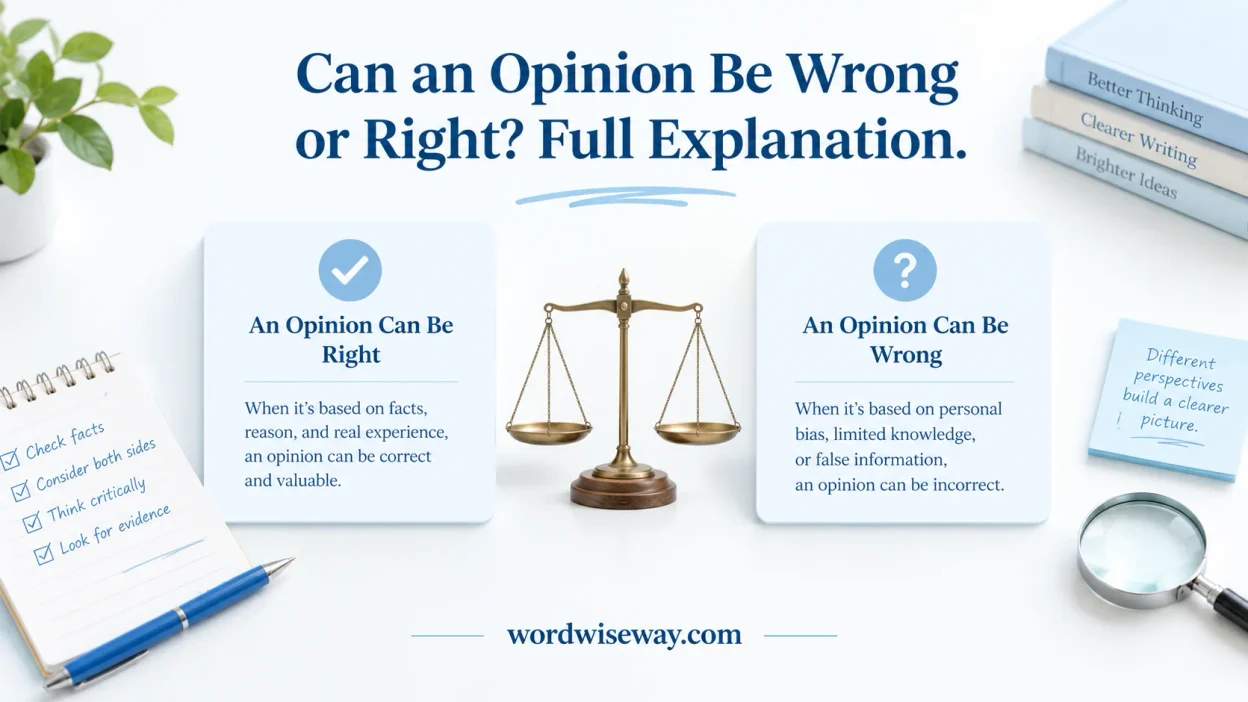
Opinions influence how we think, communicate, and make decisions. Can an Opinion Be Wrong or Right? Full Explanation explores the difference between personal beliefs, facts, and evidence. Understanding this distinction helps you express your views clearly and evaluate different perspectives without unnecessary arguments.
An opinion reflects a personal belief, idea, or viewpoint about a subject. Some opinions express personal preferences, such as preferring tea over coffee. These subjective choices are neither right nor wrong because they reflect individual tastes. However, opinions based on factual claims can be challenged when evidence contradicts them.
A correct opinion relies on reliable evidence, logical reasoning, and accurate information. An incorrect opinion may ignore facts or depend on weak assumptions. Critical thinking helps you examine different viewpoints, ask useful questions, and communicate confidently in everyday conversations, academic discussions, and professional settings.
Quick Answer:
Yes, an opinion can be right or wrong depending on what it expresses and how you evaluate it. Personal preferences, such as liking chocolate over vanilla, generally don’t have one objectively correct answer. However, opinions based on false information, faulty reasoning, or inaccurate assumptions can be mistaken.
For example:
- Personal preference: “I prefer reading novels to watching movies.” This expresses individual taste rather than a factual claim.
- Evidence-based judgment: “Regular exercise can improve cardiovascular health.” This is a judgment supported by scientific evidence, although the precise effects depend on the activity and individual.
- Factually mistaken opinion: “The Earth is closer to the Sun in summer everywhere on the planet.” This claim is incorrect because Earth’s seasons primarily result from its axial tilt, and the two hemispheres experience opposite seasons.
- Moral opinion: “People should treat others fairly.” This expresses a value judgment that requires ethical reasoning rather than a simple measurement.
The key is to distinguish personal taste, factual accuracy, and value judgments. Once you recognize these differences, you can evaluate opinions more carefully without assuming that every disagreement has a single winner.
What Is an Opinion?
An opinion is a person’s belief, judgment, interpretation, or evaluation of a subject. It may come from personal experience, emotions, cultural influences, available information, or careful reasoning.
Unlike a straightforward factual claim, an opinion often involves how someone interprets information or decides what matters. Two people can examine the same situation and reach different conclusions because they have different priorities or experiences.
For example, one student might consider online learning more convenient than classroom learning. Another might prefer face-to-face lessons because direct interaction helps them understand difficult concepts. Both opinions can be reasonable because the students value different benefits.
However, opinions aren’t always based on reliable information. Someone might believe a particular teaching method works best because of one memorable experience, even though broader evidence suggests a more complicated picture.
Definition of an Opinion
An opinion expresses what someone thinks, believes, prefers, or judges about something. It doesn’t automatically establish that the statement is true.
Consider these examples:
- “Blue is the most beautiful color.” This expresses an aesthetic preference.
- “The school should extend its library hours.” This expresses a recommendation based on particular needs or priorities.
- “The new policy will improve student performance.” This predicts an outcome that can be evaluated using evidence.
- “The meeting started at 9 a.m.” This makes a factual claim that can be checked against records.
Notice that opinions can involve different kinds of statements. Some express preferences, others recommend actions, and some make predictions that can later be tested.
An opinion tells you what someone thinks, not automatically whether that thought is accurate.
Examples of Opinions in Everyday Life
Opinions appear in ordinary conversations, classrooms, workplaces, and public discussions. Understanding their different forms helps you decide whether evidence can settle a disagreement.
| Opinion | Type | Can it be objectively evaluated? |
| “Pizza tastes better than burgers.” | Personal preference | Not universally; individual tastes differ. |
| “This book has a confusing ending.” | Literary judgment | Partly, using textual details and reader interpretation. |
| “The school needs longer library hours.” | Practical recommendation | Yes, partly, by examining student needs, costs, and usage. |
| “This medicine works for every patient.” | Evidence-dependent claim | Yes, the universal claim can be tested and may be disproved by evidence. |
| “Honesty is important in friendships.” | Moral judgment | It can be examined through ethical reasoning, though people may disagree about specific cases. |
The table illustrates an important point: not every opinion can be evaluated using the same standard. Preferences require a different approach from medical claims, predictions, or moral judgments.
Can an Opinion Be Wrong or Right?
An opinion can be reasonable, well-supported, or mistaken. However, whether it can be called objectively right or wrong depends on the type of statement and the standards used to evaluate it.
A personal preference usually describes an individual’s experience. An opinion about a factual matter, by contrast, may depend on evidence that supports or contradicts its underlying assumptions.
For instance, someone might believe that a particular study technique improves exam performance. If reliable research supports that conclusion, the opinion has a stronger foundation. If the person bases it on a misunderstanding of the research, the conclusion may be mistaken.
Three distinctions are especially useful:
- Accuracy: Does the opinion rely on correct information?
- Reasonableness: Does the conclusion follow from the available evidence and assumptions?
- Subjectivity: Does the judgment depend on individual preferences or values?
These standards overlap, but they aren’t identical. An opinion can be reasonable given the information available at the time and still turn out to be inaccurate when new evidence appears.
When an Opinion Can Be Right
An opinion becomes more defensible when reliable evidence supports its factual assumptions and logical reasoning connects that evidence to the conclusion.
Suppose a student believes that reviewing material regularly is more effective than studying everything the night before an exam. Research on learning and memory supports spaced practice as a useful learning strategy. The student’s opinion therefore has a credible evidential basis.
However, this doesn’t mean that every detail of the opinion is automatically correct. The best study schedule can vary depending on the subject, the student’s prior knowledge, and the time available.
An opinion may be well-supported when it:
- Uses accurate and relevant information.
- Draws reasonable conclusions from that information.
- Recognizes important limitations and exceptions.
- Considers credible evidence that challenges the conclusion.
- Remains open to revision when circumstances change.
A well-supported opinion isn’t merely something that sounds convincing. Its strength comes from the quality of its reasoning and evidence.
When an Opinion Can Be Wrong
An opinion can be mistaken when it rests on false assumptions, incomplete information, or reasoning that doesn’t support its conclusion.
Imagine someone believes that every successful entrepreneur became wealthy simply by working harder than everyone else. The opinion overlooks other relevant factors, including access to capital, market conditions, education, timing, and social networks.
Hard work can contribute to success, but it doesn’t guarantee wealth. The original opinion turns one possible influence into a universal explanation.
Common reasons opinions become mistaken include:
- Misinformation: Accepting inaccurate claims without checking them.
- Faulty reasoning: Drawing conclusions that don’t logically follow from the evidence.
- Confirmation bias: Favoring information that supports an existing belief while dismissing conflicting evidence.
- Overgeneralization: Treating one experience as proof of a universal rule.
- Unsupported assumptions: Accepting a claim without sufficient evidence.
For example, a person might try one unfamiliar food, dislike it, and conclude that nobody could enjoy it. Their personal preference is genuine, but the broader conclusion about everyone else’s tastes doesn’t follow.
The lesson is simple: being sincere about an opinion doesn’t guarantee that its reasoning or factual assumptions are correct.
When an Opinion Cannot Be Judged Simply as Right or Wrong
Some opinions express personal preferences rather than claims about an external fact. These opinions often don’t have a single objectively correct answer.
Imagine someone says, “Autumn is the best season.” Another person prefers spring because they enjoy warmer weather and blooming flowers. Their disagreement reflects different experiences and preferences, not necessarily a factual mistake.
Similar examples include:
- Preferring tea over coffee.
- Enjoying quiet weekends rather than busy social events.
- Finding a particular style of music relaxing.
- Choosing handwritten notes over digital notes.
You can discuss the reasons behind these preferences, but evidence generally can’t establish that one person’s favorite must be everyone’s favorite.
Still, subjective opinions can contain factual claims. Someone might say, “Autumn is the best season because every country experiences cooler weather in October.” The preference remains subjective, but the explanation contains a factual generalization that can be challenged.
This is why separating the preference from its supporting argument matters. A personal preference may not be objectively wrong, but the factual explanation attached to it can be.
The Difference Between an Opinion and a Fact
Facts and opinions serve different purposes. A fact describes something that can be checked against evidence, while an opinion expresses a belief, interpretation, preference, or judgment.
The distinction isn’t always obvious because people often combine both in a single sentence. For example, “The library closes at 5 p.m., so it should remain open later” contains a checkable statement followed by a recommendation.
The first part concerns the library’s actual closing time. The second expresses a judgment about what the library should do.
What Is a Fact?
A factual claim describes something that can be assessed using observations, records, measurements, or other relevant evidence.
Examples include:
- Water freezes at approximately 0°C under standard atmospheric pressure.
- A particular book contains 12 chapters.
- A meeting began at 10 a.m., according to its recorded start time.
- The Earth orbits the Sun.
Facts can be misunderstood, and evidence can sometimes be incomplete. Nevertheless, whether a factual claim is accurate doesn’t depend solely on how strongly someone believes it.
For example, if a timetable shows that a train departed at 8:15 a.m., someone cannot change the recorded departure time simply by holding a different opinion.
What Makes an Opinion Different From a Fact?
An opinion usually involves personal evaluation, interpretation, preference, or a recommendation. It may rely on facts, but the judgment itself doesn’t automatically become a fact.
Consider the statement, “This is the best university in the country.” The claim sounds definite, yet the word best needs a standard. Does it mean the highest graduation rate, the strongest research output, the lowest tuition, or the best student experience?
Different standards can produce different conclusions. Once you define a measurable criterion, you can evaluate some parts of the claim more objectively. However, choosing which criterion matters most may still involve personal or institutional priorities.
| Feature | Fact | Opinion |
| Main purpose | Describes or asserts something about reality | Expresses a belief, judgment, or preference |
| Evaluation | Checked against relevant evidence | Evaluated through evidence, reasoning, values, or personal experience |
| Personal preference required? | No | Often, but not always |
| Can disagreement settle it? | No; evidence is needed | No; the appropriate standard depends on the opinion |
| Example | “The class has 25 students.” | “The class is too large.” |
The distinction is useful, but it isn’t a perfect division between two completely separate categories. Some opinions contain factual assertions, and some facts are relevant to judgments without determining them entirely.
Examples of Facts and Opinions
Compare the following statements to see how small wording changes can affect meaning.
Example one: Weather
- Fact: “The temperature is 30°C.”
- Opinion: “The weather is too hot.”
- Mixed statement: “The weather is 30°C, so outdoor activities should be postponed.”
The temperature can be measured. Whether it feels too hot depends partly on personal comfort and conditions. Whether activities should be postponed also depends on safety, humidity, duration, and other relevant factors.
Example two: Education
- Fact: “The exam contains 50 questions.”
- Opinion: “The exam is difficult.”
- Mixed statement: “The exam contains 50 questions, so students need more time.”
The first statement can be checked directly. The second reflects an evaluation that may be supported by evidence about question complexity and student performance. The third combines a fact with a recommendation that requires further reasoning.
Example three: Movies
- Fact: “The movie runs for two hours.”
- Opinion: “The movie is too long.”
- Mixed statement: “The movie runs for two hours, so it should have fewer scenes.”
The runtime is measurable, but the judgment about length depends on the story, pacing, and viewer expectations. A two-hour film can feel engaging or unnecessarily long.
These examples show why you should examine each part of a statement instead of labeling an entire sentence as either fact or opinion.
Three Types of Opinions and How to Evaluate Them
Opinions don’t all work in the same way. Classifying them helps you choose an appropriate standard for judging their accuracy and strength.
Subjective Opinions
Subjective opinions depend heavily on personal tastes, feelings, experiences, or preferences. They describe how someone evaluates something rather than establishing a universal truth.
Examples include:
- “Classical music is more enjoyable than pop music.”
- “Blue looks better than red.”
- “Reading fiction is more relaxing than watching television.”
These statements can be meaningful without having one objectively correct answer for everyone.
However, subjective doesn’t mean meaningless or impossible to discuss. Someone can explain why they prefer a particular musical style, and another person can understand the reasoning without sharing the preference.
The important distinction is between expressing personal taste and claiming that everyone must share it.
Evidence-Based Opinions
Evidence-based opinions use observations, research, reliable records, and logical reasoning to reach a conclusion. They’re common in education, science, business, public health, and everyday decision-making.
For example, a teacher might believe that short practice sessions spread across several days help students remember information better than one long session immediately before an exam. Evidence about spaced learning can support that judgment.
Still, evidence-based opinions require careful interpretation. Research findings may have limitations, and a result observed in one setting might not apply equally to every situation.
A strong evidence-based opinion should identify:
- The evidence supporting the conclusion.
- The assumptions connecting evidence to the judgment.
- The limits of the available information.
- The circumstances under which the conclusion might change.
Such opinions are often more defensible than unsupported claims, but they aren’t automatically infallible.
Moral and Ethical Opinions
Moral opinions concern what people should do, what counts as fair, and which responsibilities matter. They often involve values such as honesty, compassion, freedom, equality, and respect.
For example, someone might believe that students should receive equal opportunities regardless of their family income. This judgment reflects a value about fairness.
Ethical questions can involve factual evidence, but facts alone don’t always settle them. Evidence might show that a particular policy reduces costs, for instance, yet people may disagree about whether those savings justify its effects on different groups.
To evaluate a moral opinion, consider:
- The values supporting the judgment.
- Whether the reasoning is consistent.
- How the decision affects other people.
- Whether the same principle applies in similar situations.
- Which competing values or responsibilities deserve consideration.
Moral disagreement doesn’t mean that every position is equally reasonable. Some arguments contain contradictions or ignore relevant consequences. However, evaluating ethical questions often requires more than checking a single fact.
Can Two Opposing Opinions Both Be Right?
Yes, two opposing opinions can both be reasonable when they reflect different preferences, priorities, experiences, or interpretations. However, two directly contradictory factual claims cannot both be true in the same sense and under the same conditions.
The difference depends on what the opinions actually assert.
When Two Different Opinions Can Both Be Valid
Imagine two students choosing how to prepare for an exam. One prefers studying alone because a quiet environment helps maintain concentration. The other prefers a study group because discussing ideas reveals gaps in understanding.
Both approaches can work. Their effectiveness depends on the students’ needs, the subject, and how they use their study time.
Other examples include:
- One person prefers living in a large city, while another enjoys a small town.
- One reader values detailed descriptions, while another prefers fast-paced storytelling.
- One employee prefers flexible working hours, while another prefers a fixed schedule.
These opinions differ because people don’t always pursue the same goals. A method that suits one person’s circumstances may not suit another’s.
Different doesn’t automatically mean wrong. Sometimes people disagree because they’re answering slightly different questions or using different standards.
When Two Opposing Opinions Cannot Both Be Correct
Consider two statements about the same event:
- “The meeting started at 9 a.m.”
- “The meeting did not start at 9 a.m.”
If both statements refer to the same meeting, date, time zone, and meaning of started, they contradict each other. They cannot both accurately describe what happened.
Evidence, such as an official recording or reliable attendance log, can help establish which claim is correct.
However, not every apparent contradiction is genuine. One person might say a restaurant is expensive while another says it is affordable. Both judgments could be reasonable because they have different budgets or expectations.
To evaluate opposing opinions, ask whether they contradict each other about a verifiable fact or merely reflect different standards.
Why People Disagree About the Same Issue
People interpret the world through different experiences, information, priorities, and assumptions. Even when they agree on the basic facts, they may disagree about what those facts mean or what action should follow.
For example, two residents might agree that a city needs more housing. One might prioritize affordability, while the other worries about traffic and pressure on public services. Their disagreement may concern competing priorities rather than the underlying need for housing.
Common sources of disagreement include:
- Different levels of knowledge.
- Conflicting personal experiences.
- Different interpretations of the same evidence.
- Different cultural or ethical values.
- Different expectations about possible outcomes.
- Different definitions of words such as fair, successful, or reasonable.
Understanding these differences makes disagreements easier to examine. Instead of immediately deciding that someone is wrong, identify the specific claim, assumption, or value on which the disagreement rests.
How to Determine Whether an Opinion Is Right or Wrong
You don’t need to accept every opinion you hear, but you shouldn’t dismiss one merely because it conflicts with your own beliefs. A better approach is to examine its evidence, reasoning, assumptions, and limitations.
Check the Facts Behind the Opinion
Start by separating the factual claims from the judgment. Then examine whether the relevant information is accurate and complete.
Suppose someone claims that a certain learning app guarantees higher exam scores. Before accepting the opinion, investigate what evidence supports the claim.
Ask yourself:
- Does reliable research support the claimed benefit?
- Were the results measured or merely reported by users?
- Does the evidence apply to students in similar circumstances?
- Are important limitations or alternative explanations missing?
Anecdotes can provide useful clues, but one person’s experience rarely establishes a universal rule.
Examine the Reasoning
Even accurate facts can lead to a weak opinion when someone connects them incorrectly.
Imagine a student receives a high grade after listening to music while studying. The student concludes that music always improves academic performance.
The experience supports a narrower conclusion: the student performed well while listening to music on that occasion. It doesn’t establish that music caused the result or that the same method benefits every student.
To evaluate reasoning, check whether the conclusion follows from the evidence. Look for unsupported assumptions, contradictions, and broad claims based on limited examples.
Consider Alternative Perspectives
An opinion becomes more credible when it can withstand serious examination. Looking at alternative explanations helps you identify weaknesses that confirmation alone might miss.
For instance, if you believe online education is always better than classroom learning, examine situations where face-to-face instruction offers advantages. Practical training, immediate feedback, and access to specialized equipment may matter in some subjects.
Considering alternatives doesn’t require abandoning your original opinion. Instead, it helps you understand where your conclusion applies and where it needs qualification.
Recognize Bias and Emotional Influence
Personal experiences and emotions can influence judgment. Someone who has had a bad experience with one company might assume every company in the same industry behaves similarly.
That reaction is understandable, but the conclusion goes beyond the available evidence.
Confirmation bias can also lead people to search for information that supports their existing views while overlooking credible counterevidence.
To reduce these effects, ask yourself whether you’d evaluate the same evidence differently if it supported the opposite conclusion. This question can reveal assumptions that deserve closer attention.
Be Willing to Revise Your Opinion
Changing your mind doesn’t necessarily mean your original reasoning was careless. Sometimes new evidence reveals information you didn’t have before.
A student might initially believe that rereading notes is the best way to prepare for exams. After trying retrieval practice and comparing the results, the student may discover a more effective approach.
A reasonable opinion should remain open to correction when better evidence becomes available.
The goal isn’t to defend every belief forever. It’s to develop conclusions that reflect the best information and reasoning available.
Can an Opinion Be Wrong Even If Someone Believes It Is Right?
Yes. Belief and accuracy are separate matters.
Someone can honestly believe something that isn’t true because they received misleading information, misunderstood an event, or relied on an unreliable source. Strong confidence doesn’t guarantee that a conclusion matches reality.
Imagine a person who believes that a particular product is the best available option because several friends recommend it. Their opinion may be sincere, but they might not know about important differences in price, reliability, or performance.
The same principle applies to more serious claims. A person may feel certain about a historical event or scientific explanation while relying on outdated or incorrect information.
Consider three separate questions:
- Sincerity: Does the person genuinely believe the opinion?
- Justification: Do they have good reasons or evidence for holding it?
- Accuracy: Does the opinion correctly describe the matter being discussed?
These questions aren’t interchangeable. Someone can sincerely hold a poorly supported opinion, and a reasonable conclusion can occasionally turn out to be wrong.
Recognizing this distinction encourages intellectual humility. Instead of treating confidence as proof, examine the reasons behind the belief.
Is Every Opinion Equally Valid?
Every person can have personal preferences and express judgments, but that doesn’t mean every opinion has equal evidential support or logical strength.
For example, two people may disagree about whether a particular medical treatment works. One bases the opinion on well-designed clinical research, while the other relies entirely on an unverified online story. Their views deserve evaluation according to the evidence, not simply equal acceptance.
This distinction matters because respecting a person doesn’t require accepting every claim they make.
An opinion’s strength often depends on several factors:
- Evidence: Does reliable information support the conclusion?
- Logic: Does the argument follow from its premises?
- Relevance: Does the evidence address the actual question?
- Consistency: Does the reasoning avoid contradictions?
- Transparency: Does the person acknowledge uncertainty and limitations?
However, evidence isn’t the only consideration in every disagreement. Questions about taste may depend on personal preference, while ethical questions may require examining competing values.
The appropriate standard depends on the claim.
Respecting opinions means allowing room for disagreement, not pretending that evidence and reasoning never matter.
Common Misconceptions About Opinions
Several common misunderstandings make it harder to distinguish reasonable disagreement from factual error.
“Everyone Is Entitled to Their Own Opinion, So Nobody Can Be Wrong”
People can hold different opinions, but that doesn’t make every factual assumption accurate.
Someone can believe that a historical event occurred in a particular year. If reliable historical records establish a different date, the belief can be mistaken.
The freedom to hold an opinion doesn’t change the evidence relevant to its factual claims.
“An Opinion Is Always Subjective”
Some opinions express personal taste, but others involve evidence-based judgments or predictions.
For example, someone might believe that a particular transport system will reduce commuting time. That opinion makes a prediction that can be evaluated using travel data and other evidence.
The conclusion may involve uncertainty, but it isn’t merely a matter of taste.
“If an Opinion Is Based on Facts, It Becomes a Fact”
Facts can support an opinion without turning the judgment itself into a factual statement.
A report might establish that a school has limited library hours. The conclusion that the school should extend those hours remains a recommendation based on that fact and additional considerations.
Evidence strengthens the reasoning, but the distinction between description and evaluation remains important.
“Disagreeing With Someone Means Their Opinion Is Wrong”
Disagreement alone doesn’t establish that either person has made a mistake.
Two people may prioritize different goals, interpret ambiguous information differently, or have preferences that cannot be ranked objectively. Before deciding who is wrong, identify the precise claim and the standard used to assess it.
“Strong Belief Makes an Opinion More Accurate”
Confidence describes how certain someone feels, not whether the opinion matches reality.
A person can express a mistaken belief with complete confidence. Another person may have a well-supported conclusion but acknowledge uncertainty because the evidence has limitations.
A thoughtful judgment depends on reasons and evidence, not simply on how forcefully someone presents it.
Case Study: How One Opinion Can Be Partly Right and Partly Wrong
Consider a student who says, “Studying at night is the best way to prepare for every exam because I always concentrate better after sunset.”
This statement combines a personal observation with a broad conclusion.
What may be right?
The student may genuinely concentrate better at night. Their experience provides a reasonable basis for choosing evening study sessions, provided those sessions fit their schedule and allow adequate rest.
What may be wrong?
The phrase every exam turns a personal experience into a universal claim. Other students may concentrate better in the morning, and the same student may perform differently depending on sleep, workload, or the subject.
How could the opinion improve?
A more defensible statement would be: “I concentrate better when I study at night, so evening sessions work well for me.”
The revised opinion stays close to the available evidence. It expresses a personal preference without making an unsupported claim about everyone.
This example illustrates a useful principle: an opinion doesn’t always have to be entirely right or entirely wrong. One part may accurately describe an experience while another part overstates what that experience proves.
Read More: 6 Words for Someone Who Loves Music: Meanings and Examples
FAQs
1. Can an opinion be wrong?
Yes, an opinion can be wrong when it includes factual claims that reliable evidence disproves. However, personal preferences, such as liking tea over coffee, usually cannot be judged as right or wrong.
2. Can an opinion be right?
Yes, an opinion can be reasonable or well-supported when it agrees with available facts, evidence, and logical reasoning. Still, a well-supported opinion may change when new information becomes available.
3. What is the difference between an opinion and a fact?
A fact is a statement that can be checked against evidence. An opinion expresses someone’s belief, interpretation, or preference. For example, water freezes at approximately 32°F under standard atmospheric pressure, while calling winter the best season expresses a personal preference.
4. Are personal opinions always correct?
No, personal opinions aren’t always correct. People can misunderstand information, rely on assumptions, or overlook important evidence. Thinking carefully and checking reliable sources can help you recognize mistakes.
5. Can two different opinions both be right?
Yes, two opinions can both be reasonable when they reflect different preferences, experiences, or perspectives. For example, one person may prefer studying in the morning, while another works better in the evening.
6. How can you tell whether an opinion is wrong?
Examine the reasons behind the opinion and compare its factual claims with reliable evidence. Look for contradictions, unsupported assumptions, and inaccurate information before deciding whether the opinion needs reconsideration.
7. Should you challenge someone’s opinion?
You can challenge an opinion respectfully when you have a genuine reason to question it. Ask thoughtful questions, explain your reasoning, and listen to the other person’s perspective instead of turning the discussion into an argument.
8. Can an opinion become a fact?
An opinion itself doesn’t automatically become a fact. However, a belief about something may turn out to be accurate when evidence supports its factual claims. Evidence helps establish what is true, rather than personal confidence alone.
9. Why do people disagree about opinions?
People may disagree because they have different experiences, values, knowledge, preferences, or interpretations of information. Sometimes they also rely on different sources or misunderstand the facts involved.
10. Why is it important to distinguish opinions from facts?
Distinguishing opinions from facts improves critical thinking, communication, and decision-making. It helps you evaluate information fairly, avoid spreading inaccurate claims, and express your views more clearly in personal, academic, and professional situations.
Conclusion
An opinion can be right or wrong, depending on what it claims and the evidence behind it. Personal preferences, such as enjoying a particular food or choosing a favorite season, are usually subjective. However, opinions that involve factual claims can be evaluated through reliable information, logical reasoning, and careful interpretation. Understanding this difference helps you recognize when an opinion expresses personal taste and when it makes a claim that needs checking.
You don’t have to agree with everyone, and disagreement doesn’t automatically make someone wrong. Instead, consider the reasons behind each viewpoint, examine the available evidence, and remain open to new information. A thoughtful discussion can reveal mistakes, strengthen reasonable beliefs, and help people understand different perspectives without unnecessary conflict.
Ultimately, learning to distinguish opinions from facts improves your critical thinking, communication, and everyday decision-making. Whether you’re discussing grammar, sharing ideas at work, or participating in an academic debate, support your views with sound reasoning whenever possible. A strong opinion isn’t simply one you believe in deeply; it’s one you’re willing to examine honestly.

Evelyn Shaw has spent 14 years at Yale University’s English Department, leading students through close readings, genre studies, and interpretive methodologies. Her scholarly interests include Renaissance drama, gothic fiction, feminist literary criticism, and archival research and examining how texts generate meaning across historical periods. Evelyn has presented at major academic conferences and published essays in peer-reviewed journals, reflecting her passion for rigorous analysis and student-centered learning.