The question Trys or Tries: Which Spelling Is Correct? and Usage creates confusion for many students, content writers, ESL learners, and native speakers.
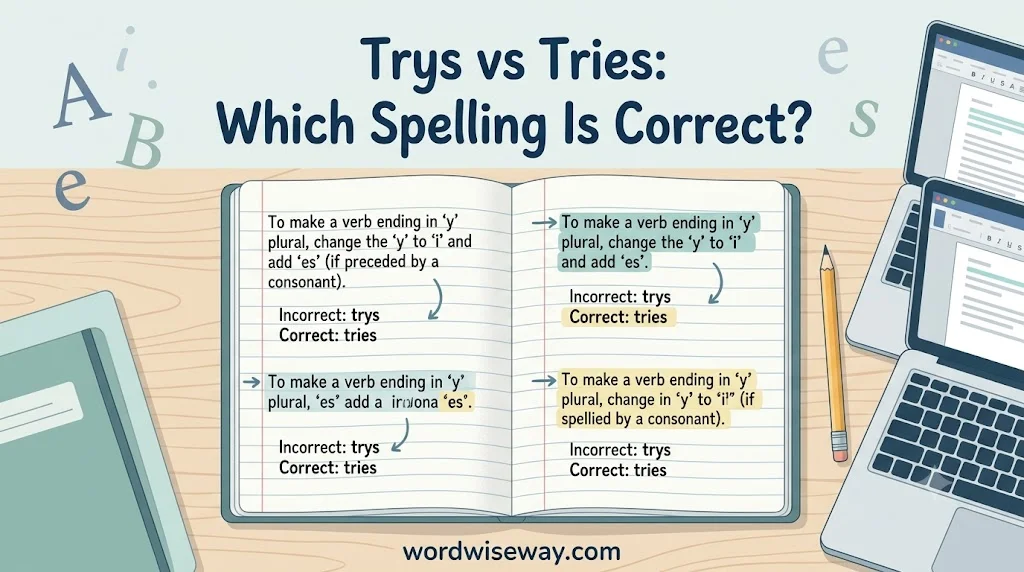
The correct form is tries, which is the third person singular form of the verb try. In standard English, Trys is incorrect because verbs that end in y follow special spelling rules. The letter y changes before we add s, making tries the right choice.
I once wrote “he trys hard” in an email and my grammar tools highlighted the mistake. After reviewing grammar rules and practicing examples daily, I understood the difference clearly. This guide explains the correct spelling, usage, and real-life examples in a simple way so every student, blogger, and professional writer can write with confidence.
It also covers British usage, American usage, and real world usage to help you use the word correctly in emails, essays, exams, and everyday conversation.This guide makes the Trys or Tries difference easier to understand with clear rules, practical examples, and simple explanations for better writing.
Quick Answer
In modern English grammar, only one form is accepted:
- Tries ✔ (Correct spelling)
- Trys ✘ (Incorrect spelling)
Quick summary table:
| Form | Usage | Example |
| Try | base form | I try daily |
| Tries | present singular | She tries daily |
| Tried | past tense | She tried yesterday |
Example in real sentences:
- She tries to finish her homework early. ✔
- He tries his best every morning. ✔
- He trys to finish his homework early. ✘
That second version might look right at first glance, especially when typing quickly. However, English spelling follows a specific pattern for words ending in “y”, and that’s where the confusion begins.
Quick Reference Table: Trys vs Tries at a Glance
| Feature | Tries | Trys |
| Correct spelling | ✔ Yes | ✘ No |
| Grammar rule | y → ies | No rule |
| Standard English | Yes | No |
| Academic use | Accepted | Incorrect |
| Informal use | Common | Common but wrong |
Why “Trys” Looks Right but Isn’t Correct
English is full of traps like this. “Trys” feels natural because your brain focuses on sound, not structure.
When we say “tries,” the pronunciation doesn’t clearly show the spelling change. So your fingers may default to just adding an “s.”
But English spelling is rule-based in this case, not sound-based.
Here’s what actually happens:
- Base word: try
- Rule applied: change “y” to “i” and add “es”
- Result: tries
A simple truth:
English doesn’t always follow pronunciation. It follows patterns.
And once you see the pattern, this mistake disappears.
The Grammar Rule Behind “Trys vs Tries” (Y to I Rule Explained)
This is the heart of the topic.
The Y-to-I Rule (Core Grammar Principle)
When a word ends in consonant + y, you:
Drop the “y” and add “ies”
Examples:
- try → tries
- carry → carries
- study → studies
- worry → worries
- reply → replies
This rule applies in:
- Present tense (he/she/it)
- Plural forms (in many cases)
- Third-person singular verbs
But there’s a twist: Not all “y” words change
If the letter before “y” is a vowel, the rule changes completely.
Vowel + Y Rule
You simply add “s”, not “ies”.
Examples:
- play → plays
- stay → stays
- enjoy → enjoys
- pray → prays
Simple comparison table:
| Word Type | Rule | Example |
| Consonant + y | change y → i + es | try → tries |
| Vowel + y | add s | play → plays |
This is the exact rule that separates “tries” from the incorrect “trys.”
Why People Mistype “Trys” So Often
Even if you know the rule, mistakes still happen. Here’s why:
1. Fast typing habits
On phones or keyboards, people often skip mental grammar checks.
2. Autocorrect assumptions
Some apps don’t always correct “trys,” especially in casual messaging.
3. Sound-based spelling
English pronunciation doesn’t always reflect spelling changes.
4. Informal online writing
Social media encourages speed over accuracy.
5. Learning confusion
New learners often apply the simple “just add s” rule incorrectly.
Trys vs Tries in Real-Life Usage
Let’s make this practical. Here’s how “tries” actually appears in everyday English.
Present tense usage
- She tries to wake up early every day.
- The machine tries to restart automatically.
Third-person singular usage
- He tries very hard in exams.
- The dog tries to open the door.
Habitual actions
- My brother tries new games every weekend.
- The company tries different marketing strategies.
Common Related Grammar Forms
To fully understand “tries,” you also need to see the full verb system.
Try (base form)
Used for:
- I try
- They try
- We try
Tries (present singular)
Used for:
- He tries
- She tries
- It tries
Tried (past tense)
Used for:
- He tried
- She tried
- They tried
Common Mistakes With “Trys vs Tries” in Real Writing
Let’s look at how this error actually shows up in the real world.
Social media posts
- “He trys so hard 😂” ✘
- “He tries so hard 😂” ✔
School assignments
- “The student trys again.” ✘
- “The student tries again.” ✔
Work emails
- “She trys to respond quickly.” ✘
- “She tries to respond quickly.” ✔
Case Study: How One Small Spelling Error Changes Perception
Let’s look at a real-world learning scenario.
Student A (incorrect usage)
A student writes:
“He trys his best in class.”
Teacher feedback:
- The idea is correct
- But spelling signals weak grammar control
Student B (correct usage)
Another student writes:
“He tries his best in class.”
Teacher feedback:
- Clear understanding of verb rules
- Strong grammatical foundation
Key takeaway:
Even small spelling errors like “trys” can affect how writing is perceived, especially in academic or professional settings.
Memory Tricks to Never Confuse “Trys vs Tries” Again
Let’s make this stick in your brain.
Trick 1: The “IES swap rule”
Think:
“When y meets a consonant, it transforms into ies.”
Trick 2: The sound clue
If you hear “tries,” remember:
English already changed the spelling for you.
Trick 3: The mental checklist
Before writing “trys,” ask:
- Does the word end in consonant + y?
- Is it he/she/it form?
If yes → use tries
Other Words That Follow the Same Pattern
Understanding related words makes the rule automatic.
Examples:
- fly → flies
- cry → cries
- hurry → hurries
- carry → carries
- apply → applies
Pattern insight:
Once you master “try → tries,” you’ve unlocked a whole category of English verbs.
Why “Trys” Still Appears Online
You’ll still see “trys” in:
- Comments
- Text messages
- Forums
- Casual writing
Why it survives:
- People type quickly
- Grammar isn’t always checked
- Informal communication ignores strict rules
But here’s the key:
Informal use does not make it correct grammar.
Expert Grammar Insight: Why English Uses “Tries”
English spelling tries to preserve structure and clarity.
The “ies” ending:
- Keeps pronunciation consistent
- Maintains grammatical clarity
- Matches other verb patterns
Without it, words like “tries” would blend awkwardly with words like “trys,” creating inconsistency in written English.
Read More: Kindergarten or Kindergarden:Correct Spelling, and Usage
FAQs
Is “trys” a correct spelling in English?
No, trys is not correct in standard English. The correct spelling is tries, which is the third person singular form of the verb try.
Why is “tries” correct but “trys” wrong?
The spelling changes because English verbs ending in consonant + y usually change the y into i before adding -es. Therefore, try becomes tries.
What does the word “tries” mean?
Tries means making an attempt or putting effort into doing something. It shows that someone is trying to achieve a goal or complete an action.
Can we use “he trys” in casual writing?
No, he trys is still incorrect, even in informal writing. The correct phrase is he tries.
What is the difference between try and tries?
Try is used with I, you, we, and they, while tries is used with he, she, and it. The meaning stays similar, but the verb form changes according to the subject.
Do British and American English use “tries” differently?
No, both British English and American English use tries as the correct spelling. The grammar rule remains the same in both varieties.
Why do people often confuse trys and tries?
Many people confuse these words because several English verbs simply add s in the third person form. However, verbs ending in y follow a special spelling pattern.
How can I easily remember the spelling of tries?
You can remember it by using the rule: if a verb ends with consonant + y, replace y with i and add -es. This changes try into tries.
Can grammar tools detect the mistake in trys?
Yes, grammar tools can identify trys as an incorrect spelling and suggest tries. Still, learning the grammar rule helps you avoid the mistake naturally.
Where can we use the word tries?
You can use tries in everyday writing, emails, essays, exams, and conversations whenever you talk about someone making an effort.
Conclusion
The difference between trys and tries becomes simple once you understand the spelling rule behind verbs ending in y. Although trys may look correct at first glance, it does not follow standard English grammar. The correct form is always tries when using the third person singular form of try.
By remembering the y to ies spelling pattern, you can write with more confidence and avoid common mistakes. Whether you are a student, blogger, or professional writer, understanding this small grammar rule will help you improve accuracy in everyday English usage.

Emma Smith has dedicated 14 years to Princeton University’s English Department, mentoring students in textual interpretation, literary movements, and critical frameworks. Her research explores Shakespearean drama, Victorian serial fiction, postcolonial narrative theory, and manuscript studies and probing how literary forms evolve across cultures and centuries. Emma has delivered lectures at international humanities congresses and published findings in distinguished academic journals, underscoring her commitment to scholarly depth and vibrant teaching.