The guide Authorized or Authorised: Correct Spelling, Meaning, and Usage helps English learners understand spelling choices across places today.
Many writers feel confused when they see authorized and authorised in different locations because both spellings are correct. In professional writing, people often use these words in emails, documents, blogs, exams, and official writing. Both words have the same meaning and are technically correct, but the right choice depends on your audience and the form of the English language you follow.
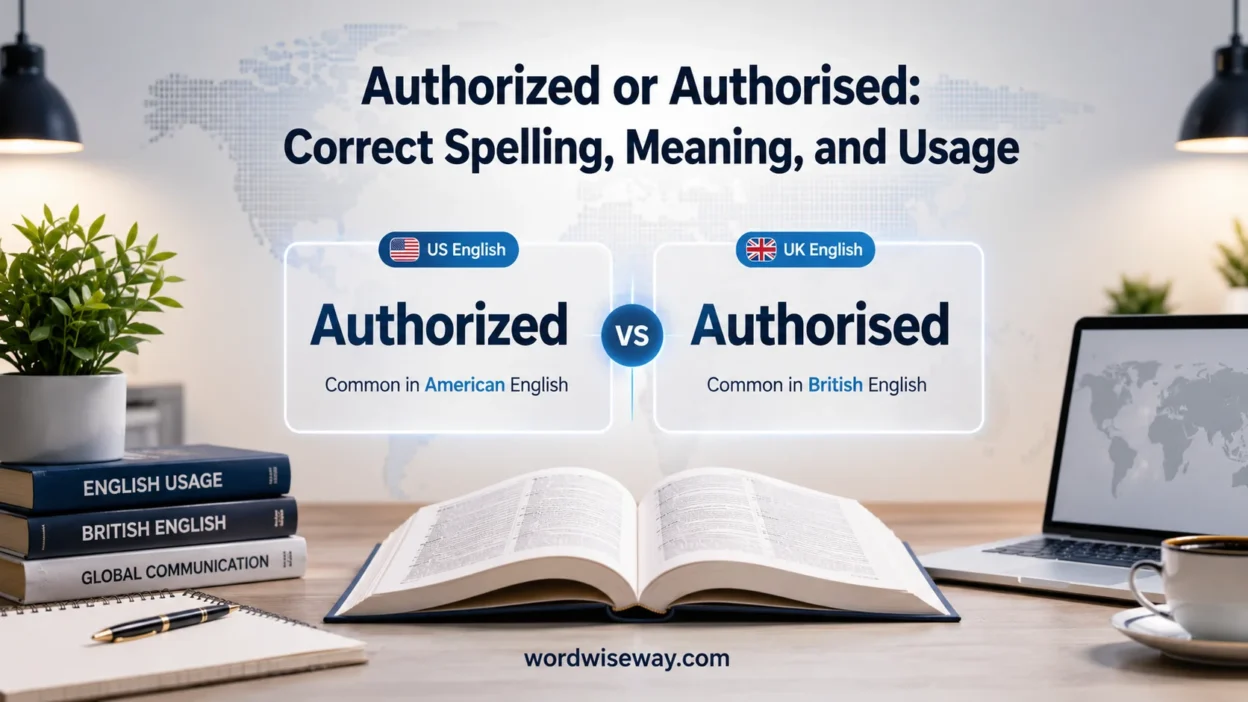
The main reason these versions exist comes from historical spelling differences and regional spelling patterns. In American English, authorized is preferred, while British English uses authorised. This guide explains the origin, rules, and common mistakes from start to finish. If you have typed “authorized or authorised” mid-sentence and felt doubt, you are not alone. These words can be used interchangeably in most contexts because both describe official permission or approval.
The main difference is only spelling, not meaning, and understanding the proper word improves language usage and word choice.
Quick Answer
Let’s get straight to the point.
- Authorized → American English
- Authorised → British English and most Commonwealth countries
Both spellings are correct. The only difference is regional preference.
There is no grammar error in either form. The meaning stays identical in every context.
So instead of asking “Which one is correct?” the better question is:
“Which version matches my audience?”
That small shift changes everything.
What Does Authorized or Authorised Mean? (Simple Definition)
Before diving into spelling differences, let’s lock in the meaning.
The word authorize / authorise means:
To give official permission or legal power to someone or something.
It often appears in formal, legal, financial, and administrative contexts.
Common real-world meanings:
- Giving permission
- Approving actions
- Granting access
- Legally empowering someone
Everyday examples:
- A bank authorizes a transaction
- A manager authorizes a refund
- A system authorizes user access
- A government authorises an operation
The meaning never changes. Only the spelling shifts depending on location.
Authorized vs Authorised: The Real Difference Explained
The difference is not about correctness. It is about English variation systems.
Think of English like two large toolkits:
- One toolkit is used in the United States
- The other is used in the UK and many Commonwealth countries
Both build the same language structure, but some tools look slightly different.
Core difference:
- -ize ending → American English preference
- -ise ending → British English preference
This applies not only to “authorize/authorise” but many similar verbs.
Why Do Two Spellings Exist? (Simple Linguistic History)
The story goes back centuries.
English absorbed words from Greek, Latin, and French. During this evolution, spelling was not standardized. Different regions adapted their own preferences.
American English simplification
When English spread to America, language reformers pushed for simpler spelling patterns.
They preferred:
- organize instead of organise
- recognize instead of recognise
- authorize instead of authorise
The idea was clarity and efficiency.
British English tradition
British English retained more traditional forms influenced by French spelling patterns.
So it kept:
- organise
- recognise
- authorise
The key takeaway:
This difference is historical, not grammatical.
No version is “more correct.” They just evolved differently.
Authorized vs Authorised: Side-by-Side Comparison
Here is a clear breakdown you can actually use in writing.
| Feature | Authorized | Authorised |
| English type | American English | British English |
| Verb form | authorize | authorise |
| Past tense | authorized | authorised |
| Meaning | Official permission granted | Official permission granted |
| Common usage regions | USA | UK, Australia, India, Canada |
| Example sentence | The bank authorized the loan | The bank authorised the loan |
Everything matches except spelling style.
Where Each Spelling Is Used in Real Life
Understanding usage is more useful than memorizing rules.
American English usage (Authorized)
You’ll see “authorized” in:
- US government documents
- American banking systems
- Tech platforms based in the US
- Corporate policies in US companies
Example:
“The system only allows authorized users to log in.”
British English usage (Authorised)
You’ll see “authorised” in:
- UK legal documents
- Australian and New Zealand institutions
- Indian English formal writing
- Commonwealth government policies
Example:
“Only authorised personnel may access this area.”
Global companies
International companies pick one style guide and stick to it.
For example:
- Some choose American English for global consistency
- Others choose British English for historical branding
Consistency matters more than geography here.
Common Mistakes People Make with Authorized / Authorised
Even experienced writers slip up sometimes.
Here are the most common errors:
Mixing both spellings in one document
This creates inconsistency and looks unprofessional.
Bad example:
The system is authorized. Only authorised users may access it.
Thinking one version is wrong
Both are correct. Context decides usage.
Switching spelling mid-article
This often happens when writers copy from different sources.
Ignoring audience expectations
Using “authorised” for a US audience can feel off, and vice versa.
How to Choose the Right Spelling Every Time
You don’t need to memorize anything complicated. Just follow this simple decision system.
Step 1: Identify your audience
Ask:
- Are my readers mostly from the US?
- Or from the UK or Commonwealth countries?
Step 2: Check your style guide
Many institutions already define spelling rules.
Step 3: Stay consistent
Once you choose one version, stick to it throughout.
Simple rule:
Audience first. Consistency always.
Real-World Sentence Examples
Let’s see how both versions work naturally in context.
Business context
- US: “The manager authorized the payment release.”
- UK: “The manager authorised the payment release.”
Legal context
- US: “Only authorized representatives may sign this contract.”
- UK: “Only authorised representatives may sign this contract.”
Technology context
- US: “The app is not authorized to access this file.”
- UK: “The app is not authorised to access this file.”
Same meaning. Same intent. Different spelling skin.
Other Words That Follow the Same Pattern
This spelling difference is not unique. Many words follow the same rule.
| American English | British English |
| organize | organise |
| recognize | recognise |
| legalize | legalise |
| finalize | finalise |
| apologize | apologise |
| authorize | authorise |
Pattern rule:
- American English prefers -ize
- British English prefers -ise
But even here, exceptions exist depending on style guides.
What Style Guides Say About Authorized vs Authorised
Style guides shape professional writing standards.
AP Stylebook (US)
- Prefers authorized
- Common in journalism and media
Chicago Manual of Style (US)
- Supports authorized
- Used in publishing and academic writing
Oxford Style (UK)
- Prefers authorised
- Common in British publishing
Important insight:
Even rules depend on the system you choose.
Case Study: Why Consistency Matters in Real Writing
Let’s look at a practical scenario.
Scenario: Global SaaS company website
A software company publishes documentation for users worldwide.
Version A (inconsistent spelling)
- Home page: “authorized users”
- Help guide: “authorised accounts”
- API docs: mixed usage
Result:
- Confusion
- Reduced trust
- Perception of low-quality writing
Version B (consistent spelling)
- Entire site uses “authorized” (US standard)
Result:
- Clear tone
- Professional appearance
- Better user trust
Lesson:
Consistency builds credibility faster than perfection.
Quick Memory Trick to Never Forget the Difference
Here’s a simple mental shortcut:
- Z = USA → Authorized
- S = UK → Authorised
Think:
- “Z looks sharper, like American efficiency”
- “S flows smoothly, like British spelling tradition”
Read More: Offense or Offence: Correct Spelling, Meaning, and Usage
FAQs
What is the difference between authorized and authorised?
The difference is only in spelling. Authorized is the preferred spelling in American English, while authorised is commonly used in British English. Both words have the same meaning and refer to having official permission or approval.
Is authorized the correct spelling?
Yes, authorized is a correct spelling. It is the standard form used in the United States and is widely accepted in international communication, especially when following American English rules.
Is authorised wrong or incorrect?
No, authorised is not wrong. It is the British English spelling and is commonly used in the UK, Australia, New Zealand, and other regions that follow British spelling conventions.
Why do authorized and authorised have different spellings?
The spelling difference developed because American and British English evolved different spelling patterns over time. Some words kept different forms while maintaining the same meaning.
Can I use authorized and authorised interchangeably?
Yes, you can use both words interchangeably when the meaning is clear. However, it is better to match the spelling style of your audience, location, or organization.
Which spelling should I use in professional writing?
Choose the spelling based on your target readers. Use authorized for American audiences and authorised for British audiences to maintain consistent professional writing.
Do exams accept both authorized and authorised?
Acceptance depends on the exam board and its preferred English style. Many exams accept both forms, but students should follow the spelling rules provided by their institution.
What does authorized mean?
Authorized means officially allowed, approved, or given permission to do something. It often appears in legal, business, security, and official contexts.
What are common mistakes with authorized and authorised?
A common mistake is mixing American and British spelling styles in the same document. Writers should choose one spelling system and use it consistently.
How can I remember the difference between authorized and authorised?
A simple way is to remember that American English usually removes extra letters in some words, while British English often keeps traditional spellings with forms like -ise.
Conclusion
Understanding authorized vs authorised becomes easier when you know that both spellings are correct and carry the same meaning. The choice depends mainly on your audience, location, and the type of English you are using. Recognizing this small spelling difference can help you create clearer emails, documents, and professional content.
Whether you choose authorized or authorised, consistency matters most. Once you understand the spelling rules and usage patterns, you can confidently select the right version for any writing situation.