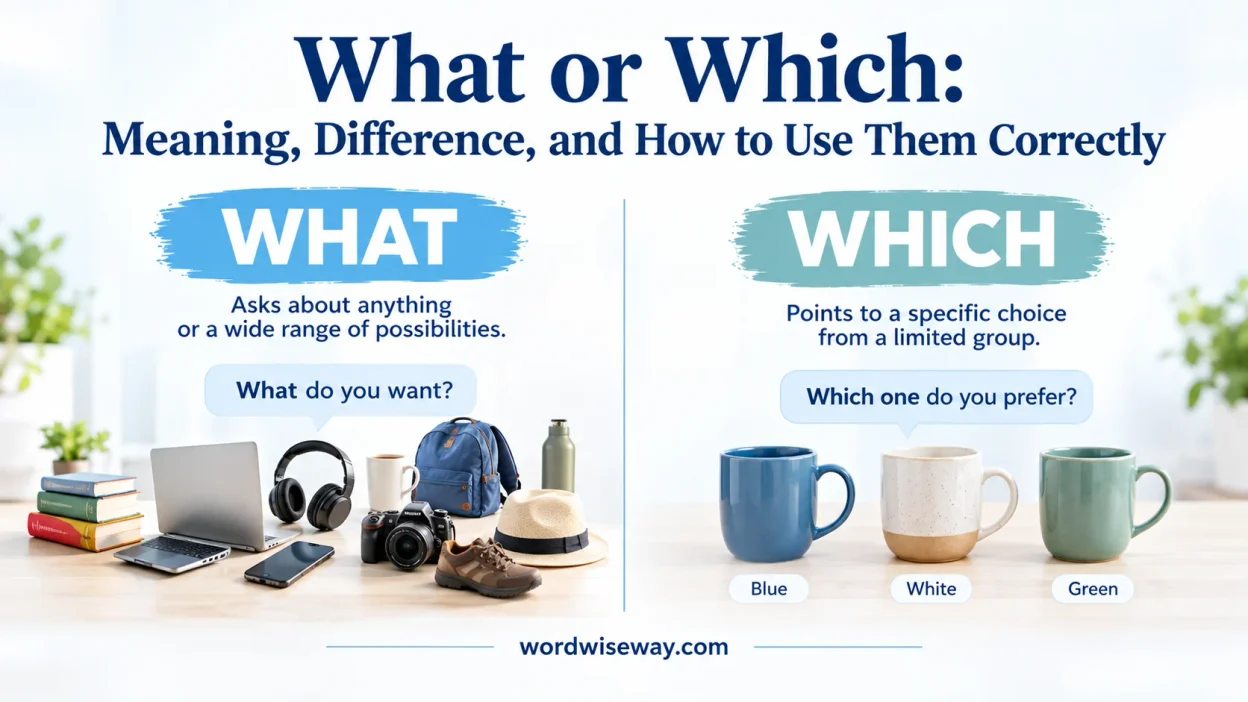
What or Which: Meaning, Difference, and Correct Usage helps English learners understand question words, meaning, difference, and use.
Many learners confuse what and which because both introduce questions, yet they aren’t always interchangeable. In English grammar, what usually works when the possible choices are broad or unknown, while which is more suitable when you have a limited set of options.
For example, “What color” do you like leaves the choices open, whereas “Which color” do you like suggests known choices. Understanding when to use each word helps you create a sentence that sounds natural and clear.This guide provides a quick answer, detailed explanations, examples, and comparison tables to make the distinction easier to remember.
You can learn to use both words correctly in everyday speaking, emails, exams, professional writing, and business writing, along with school assignments, social media posts, and conversations. Practical usage tips also help you recognize common mistakes and develop greater confidence when choosing between these two question words.
Quick Answer
What usually works for an open-ended or broadly defined question, while which usually works when you’re choosing from a specific, limited, or understood group.
Compare these examples:
| Question | Typical meaning |
| What color do you like? | Any color could be an answer. |
| Which color do you like, blue or green? | The choices are limited to blue and green. |
| What movie should we watch? | The speaker isn’t identifying a particular selection. |
| Which movie should we watch, the comedy or the thriller? | The available choices are known. |
| What book are you reading? | The question asks generally about the book. |
| Which book are you reading from these three? | The question identifies a specific group. |
However, the rule isn’t simply “what means many choices and which means two choices.” That’s one of the most common misconceptions.
Which can refer to three, ten, or even hundreds of known possibilities. Likewise, what can sometimes appear when only a few realistic answers exist. Context determines how the speaker frames those possibilities.
What Does What Mean?
What is a question word that commonly asks for information about an unidentified person, thing, action, characteristic, or choice.
It can work as a determiner before a noun:
- What book are you reading?
- What subject do you study?
- What kind of music do you enjoy?
- What time does the store open?
It can also work as a pronoun, standing by itself:
- What happened?
- What do you need?
- What did she say?
- What is that?
The broad nature of what makes it useful when the speaker hasn’t established a particular set of possible answers.
Imagine walking into a library and asking someone, “What book should I read?” You haven’t identified a shelf, genre, or shortlist. You’re opening the entire library as a possibility.
What as a Determiner
When what comes directly before a noun, it helps identify the type of information you want.
For example:
What career do you want to pursue?
The listener could answer with hundreds of possibilities: teacher, engineer, designer, programmer, researcher, writer, or something else entirely.
Similarly:
What language do you speak?
The question doesn’t establish a particular group of languages. The answer could be English, Spanish, Arabic, Urdu, French, Japanese, or another language.
What as a Pronoun
What can also stand alone without a noun.
For example:
What do you want?
Here, what represents the thing the speaker wants to identify.
Another example is:
What happened?
The speaker isn’t selecting an event from a predefined list. They want information about an event that they don’t yet know.
What Does Which Mean?
Which usually asks someone to identify or select something from a defined range of possibilities.
Like what, it can act as a determiner:
- Which book should I buy?
- Which route should we take?
- Which phone belongs to you?
- Which subject did you choose?
It can also work as a pronoun:
- Which do you prefer?
- Which is yours?
- Which should we choose?
The important point is that the choices don’t always have to appear in the sentence.
For example, imagine three phones sitting on a table. Someone asks:
Which one is yours?
The question doesn’t list the phones by name. Still, the physical situation creates a clear, limited set.
That’s why which depends heavily on context.
Which Does Not Mean Only Two
A surprisingly common mistake is thinking that which applies only to two choices.
That’s incorrect.
You can ask:
Which of these five books do you want?
You can also say:
Which country would you like to visit from this list?
The number of choices doesn’t determine whether you need which. What matters is whether the choices form a specific or identifiable set.
The Main Difference
The clearest way to understand what or which is to imagine two different landscapes.
What generally opens a wide field. The speaker asks you to identify something without presenting a particular selection.
Which puts a frame around the choices. The speaker expects you to select or identify something within that frame.
| What | Which |
| Usually introduces a broader question | Usually introduces a defined selection |
| The possible answers aren’t specifically identified | The possible answers are known or understood |
| Often seeks general information | Often seeks identification or selection |
| Can refer to a very wide range | Can refer to two or many options |
| Example: “What food do you like?” | Example: “Which food on this menu do you want?” |
Consider this pair:
What laptop should I buy?
This sounds like you’re asking for a general recommendation. The listener might suggest any suitable laptop.
Now change it:
Which laptop should I buy, the 14-inch one or the 16-inch one?
The choices are clearly defined. You’re no longer asking about the entire laptop market.
That’s the heart of the distinction.
When to Use What
Use what when you want information without restricting the answer to a clearly identified set.
Use What for Open-Ended Questions
An open-ended question allows a broad range of answers.
For example:
- What do you want for dinner?
- What movie do you like?
- What career interests you?
- What city would you like to visit?
- What books do you enjoy?
- What skills are you learning?
Suppose someone asks:
What should I study after high school?
The answer could involve dozens of fields. Nothing in the question limits the choices.
Now compare that with:
Which subject should I choose, computer science or mathematics?
The second question creates a defined selection.
Use What When the Options Aren’t Defined
Sometimes you know that several possibilities exist, but you haven’t created a particular group for the listener to choose from.
For example:
What restaurant should we try tonight?
This question could refer to every suitable restaurant in the area.
If you’ve already narrowed the options down, which becomes more natural:
Which restaurant should we try, the Italian place or the Thai restaurant?
The distinction isn’t about the restaurant itself. It comes from how the speaker presents the choices.
Use What for General Information
What frequently appears when you’re simply asking someone to provide information.
Examples include:
- What is your name?
- What happened?
- What does this word mean?
- What time is the meeting?
- What caused the problem?
- What are you doing?
These questions don’t normally ask the listener to pick an item from a previously established group.
When to Use Which
Use which when the listener can identify the relevant choices from the sentence, conversation, situation, or surrounding context.
Use Which for Specific Choices
Consider:
Which shirt should I wear?
If you’re standing in front of your closet with several shirts laid out, which makes sense because the choices are physically present.
Another example:
Which route should we take?
If you have already discussed three routes, the listener knows the selection you’re talking about.
Use Which When the Options Are Stated
You can make the restricted choice explicit:
Which dessert do you want, the cake or the pie?
Here, which clearly signals selection.
You could also say:
Which color should we use, blue, green, or white?
There are three options, yet which still works perfectly.
Use Which When the Options Are Known From Context
The choices don’t need to appear in the same sentence.
Imagine two people looking at two jackets.
One asks:
Which jacket do you prefer?
Both people can see the jackets. The context supplies the missing information.
This is why rigid rules based only on the number of choices often fail. Natural English pays attention to the shared context between speakers.
What vs. Which in Questions
The difference becomes especially noticeable when both words can grammatically fit the same sentence.
Consider:
What train are you taking?
This can sound like a general request for information about your train.
Now consider:
Which train are you taking?
This often suggests that there are several relevant trains and the speaker wants you to identify the particular one.
Both questions can be correct. The intended context determines which sounds more natural.
What Book vs. Which Book
This is one of the easiest pairs to understand.
What book are you reading?
The speaker simply wants to know the book.
Which book are you reading?
The speaker may have a specific collection or selection in mind.
For example, if five books sit on a desk, which book fits naturally.
If you’re talking generally about someone’s reading habits, what book may sound more natural.
What Movie vs. Which Movie
The same pattern appears with movies.
What movie did you watch last night?
This asks for information about the movie.
Which movie should we watch tonight?
This can imply that you’re choosing from movies already available or previously discussed.
The boundary can be subtle. Native speakers often choose between these words based on conversational context rather than consciously applying a grammar formula.
What or Which With Singular and Plural Nouns
Neither what nor which is restricted to one grammatical number.
Both can appear with singular nouns:
- What book did you buy?
- Which book did you buy?
Both can also appear with plural nouns:
- What books do you recommend?
- Which books do you recommend?
The noun’s singular or plural form doesn’t determine the answer.
Instead, ask yourself whether you’re dealing with a broad question or a defined selection.
Compare:
What books do you like?
This could include books from any genre, author, or period.
Which books do you want to take from this shelf?
The second question identifies a particular group.
The shelf creates the boundary.
What or Which With “One” and “Ones”
Which one is particularly common when you’re selecting from identifiable choices.
For example:
Which one do you want?
If several objects sit on a table, the meaning is immediately clear.
For multiple objects, you can use which ones:
Which ones are yours?
The plural form ones replaces a previously understood plural noun.
You may occasionally hear what one, but it doesn’t generally carry the same natural selection-focused meaning as which one.
In ordinary questions about choosing from a known set, which one is usually the clearer construction.
What or Which for People
Both words can occur in questions about people, but they can express different ideas.
Consider:
Which person called you?
This normally identifies someone from a known group.
Perhaps five people called earlier. The speaker wants to know which individual made the call.
Now consider:
What kind of person is she?
This isn’t asking you to select her from a group. It asks about her character, personality, behavior, or general type.
Another useful contrast is:
- Which teacher taught you mathematics? → Identify one teacher from a known group.
- What kind of teacher is she? → Describe the teacher’s characteristics or approach.
That distinction becomes particularly important with phrases such as what kind of.
What or Which in Everyday English
Real conversations provide the best way to understand the difference.
Choosing Clothes
Imagine you’re shopping.
You might ask:
What clothes should I pack for the trip?
You’re asking generally what types of clothing you need.
After packing several items, you might ask:
Which jacket should I take?
Now you’re selecting from a particular group.
Ordering Food
At a restaurant, you might ask:
What do you recommend?
You’re requesting a general recommendation.
If the server has just described two specials, you might ask:
Which one would you recommend?
Now the choices are defined.
Choosing a Route
You could ask:
What route should we take?
This leaves the possibilities open.
If a map shows three routes you’ve already considered:
Which route should we take?
The question focuses on those known options.
Choosing a School Subject
A broad question might be:
What subject do you enjoy most?
The answer could be history, biology, mathematics, art, computer science, or another subject.
But if a student has already narrowed the decision to two subjects:
Which subject should I choose, physics or chemistry?
The selection is clearly defined.
Can What and Which Be Used Interchangeably?
Sometimes, yes. However, the nuance can change.
Consider:
What car do you drive?
This usually asks for general information about the car.
Now:
Which car do you drive?
This can sound as though several cars are relevant to the conversation.
Perhaps a family owns three cars. The speaker wants to know which particular one you drive.
The two questions aren’t necessarily opposites. Instead, they place the listener’s attention on different aspects of the answer.
What tends to identify the answer without emphasizing a particular set.
Which tends to identify the answer within a particular set.
That’s why context matters more than memorizing a mechanical rule.
Common Mistakes
Understanding the most frequent errors can make the distinction much easier.
Mistake: Thinking Which Means Exactly Two Choices
This is incorrect.
You can use which with:
- Two options
- Three options
- Five options
- A larger known group
For example:
Which of these six designs do you prefer?
The number six doesn’t create a problem.
Mistake: Thinking What Always Means Unlimited Choices
That’s also too rigid.
A speaker may use what even when only a few answers seem realistic because the speaker isn’t presenting them as a defined selection.
For example:
What time is it?
There are only 24 hours in a day, yet we don’t normally think of the question as selecting from a list of 24 choices.
The purpose and framing of the question matter.
Mistake: Choosing Based on Singular or Plural Nouns
Don’t use noun number as your deciding factor.
Both forms work:
- What books do you like?
- Which books do you like?
- What book did you buy?
- Which book did you buy?
Instead, consider the scope of the choices.
Mistake: Treating the Rule as Absolute
The open-ended versus limited-choice distinction provides a useful guide. It isn’t an iron gate.
English speakers can use either word in situations where the boundary between general information and selection isn’t sharp.
For that reason, context should always get the final vote.
Detailed Examples
The following examples show how changing the question word can shift the implied meaning.
| What | Which | Difference |
| What phone do you use? | Which phone do you use? | The first asks generally; the second can imply known phones. |
| What book did you buy? | Which book did you buy? | The second suggests a defined selection. |
| What color do you want? | Which color do you want? | Which can imply available colors. |
| What movie should we watch? | Which movie should we watch? | Which suggests a shortlist or known options. |
| What route should we take? | Which route should we take? | Which often points to known routes. |
| What dessert do you want? | Which dessert do you want? | Which can imply desserts already displayed or discussed. |
| What subject do you prefer? | Which subject do you prefer? | Which may refer to a particular set of subjects. |
| What country would you visit? | Which country would you visit? | What sounds broad; which can imply a defined list. |
Notice that none of these examples depends solely on the noun. The surrounding situation changes the meaning.
A Simple Way to Remember
Think of what as opening a door and which as pointing toward doors that are already marked.
Use what when you’re asking:
“Tell me what the answer is.”
Use which when you’re asking:
“Tell me which option in this group is the answer.”
A quick mental checklist can help:
- Are the choices broad or undefined? Use what.
- Are the choices specific or understood? Use which.
- Have you already mentioned the options? Which is often appropriate.
- Are you simply requesting general information? What is often appropriate.
- Are there only two choices? Either word may work depending on context.
- Are there more than two choices? Which can still work perfectly.
The trick isn’t counting possibilities. It’s identifying how the speaker frames them.
Quick Decision Guide
When you’re unsure, follow this three-step approach.
Look at the Scope
Ask whether the question covers a broad field.
What career interests you?
This leaves the answer wide open.
Look for a Defined Group
If the speaker has already identified the choices, which often fits better.
Which career interests you more, engineering or design?
The question now contains a clear selection.
Check the Context
Finally, consider what both speakers already know.
If five books are lying on a desk, which book naturally points toward that group.
If you’re casually asking someone about their favorite books, what books can sound more natural.
Read More: Bolder or Boulder: Correct Spelling, Meaning, and Difference
FAQs
What is the main difference between what and which?
What usually asks about an open range of possibilities, while which generally asks you to choose from a limited or known set of options.
Can what and which be used interchangeably?
Not always. Although both can introduce questions, the choice depends on whether the possible answers are open-ended or limited.
When should you use what in a question?
Use what when you don’t have a specific group of choices in mind. For example, “What do you want to eat?” allows many possible answers.
When should you use which in a question?
Use which when you’re choosing from specific or understood options. For example, “Which jacket do you want?” suggests that the available jackets are known.
Is “what color” or “which color” correct?
Both are correct, but they suggest different situations. What color asks openly, while which color usually refers to a set of available colors.
Can which be used without naming the choices?
Yes. You can use which when the choices are understood from the context, even if you don’t state them directly.
Does what always mean there are unlimited choices?
No. What often suggests an open choice, but the exact meaning can depend on the context and the way the question is phrased.
Which word sounds more natural in everyday conversations?
Both what and which sound natural when used in the right situation. The context determines which question word fits better.
How can you avoid mistakes with what and which?
First, consider whether you’re asking about a broad range or choosing from a limited group. This simple distinction can help you select the correct word.
Is choosing between what and which important in formal writing?
Yes. Using the appropriate question word can make your writing clearer and more precise, especially in professional writing, business writing, and school assignments.
Conclusion
The difference between what and which becomes much easier once you pay attention to the choices behind the question. What generally leaves the possibilities open, while which usually points to a limited or known group. Keeping this basic distinction in mind can help you choose the right question word without overthinking every sentence.
With regular practice, you’ll start noticing the difference in everyday speaking, conversations, emails, and other forms of writing. Try creating your own questions and changing the context from an open choice to a limited one. This simple exercise can make the rule feel more natural and help you avoid common grammar mistakes.
Whether you’re working on school assignments, professional writing, or social media posts, accurate word choice makes your message clearer. Once you understand when to use what and when to use which, you can express questions with greater precision and confidence.

Amelia Sanders has spent 14 years in Harvard University’s English Department, helping students navigate literary analysis, interpretive theory, and narrative techniques. Her academic pursuits center on 18th-century British prose, romantic poetry, diasporic writing, and digital editing exploring how textual choices influence cultural perspectives. Amelia has spoken at major international meetings and contributed essays to respected academic volumes, demonstrating her dedication to thoughtful scholarship and effective teaching.