If you’ve ever started a new job, freelanced online, or worked with a U.S. company, you’ve likely searched for “W-2 or 1099.” This keyword is popular because many people face one big question: Am I an employee or an independent contractor? The answer can affect your taxes, benefits, paycheck, and legal rights.
Many workers don’t know whether they should receive a W-2 form or a 1099 form at tax time. Some think it’s just paperwork, but it can actually change how much tax you owe, who pays Social Security, and whether you receive benefits such as health insurance or paid leave. Employers can also become confused and sometimes classify workers incorrectly.
This article clears up that confusion. You’ll get a quick answer, real-life examples, and simple explanations without complicated tax jargon. Whether you’re a U.S. employee, freelancer, or remote worker working for an American company, this guide will help you understand W-2 or 1099, determine which classification fits your situation, and avoid costly mistakes.
Quick Answer:
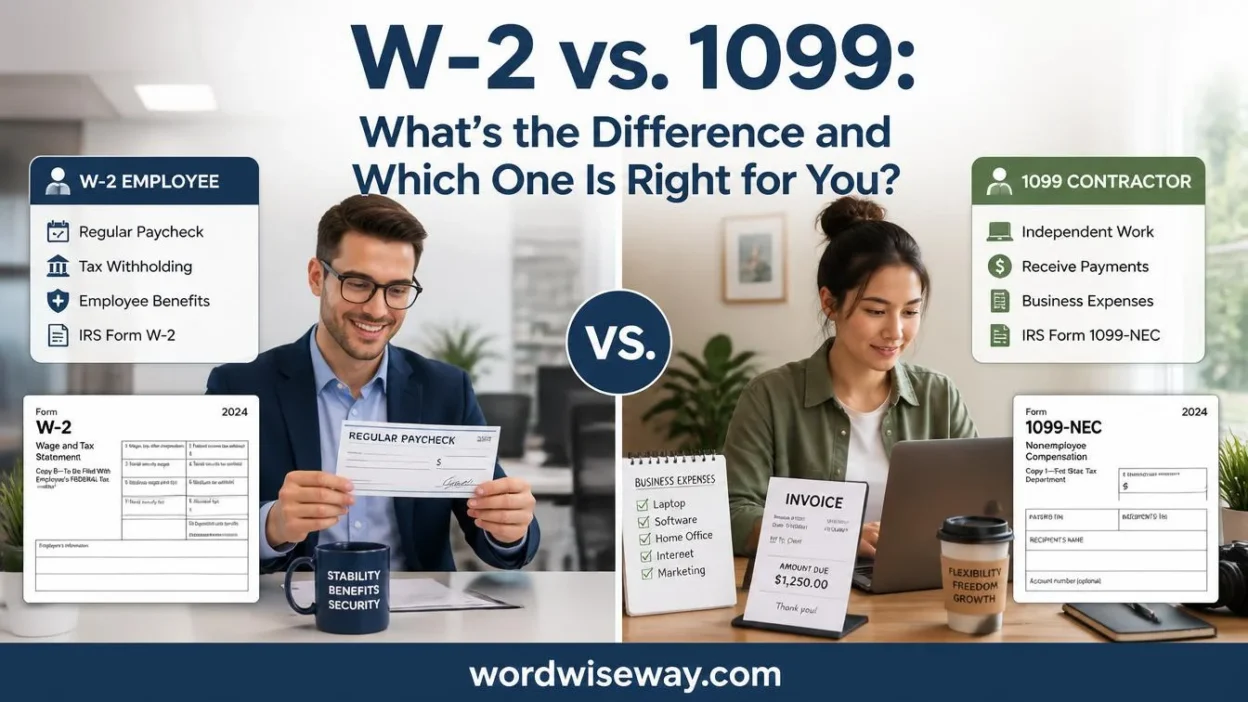
A W-2 employee generally works as part of an employer’s business. The employer typically handles payroll, withholds applicable federal income and payroll taxes, and may provide benefits.
A 1099 independent contractor generally operates independently and provides services to a business without being treated as its employee. The contractor typically receives payments without ordinary employee payroll withholding and handles applicable tax responsibilities.
Here’s the basic difference:
| W-2 Employee | 1099 Independent Contractor |
| Receives Form W-2 for employee wages | May receive Form 1099-NEC for qualifying nonemployee compensation |
| Employer generally handles payroll withholding | Contractor generally handles their own tax payments |
| Employer usually controls more aspects of the job | Contractor generally has greater independence |
| May receive employee benefits | Usually doesn’t receive employee benefits from the client |
| May receive overtime protections under applicable law | Generally isn’t covered by employee overtime protections |
| Works within an employer’s business structure | Generally operates an independent business or service activity |
| Employer handles employer-side payroll taxes | Contractor generally pays applicable self-employment tax |
The key point is simple: W-2 vs. 1099 isn’t merely a tax-form choice. It’s connected to the nature of the working relationship.
What Is a W-2 Employee?
A W-2 employee is someone a business treats as an employee for employment and tax purposes. The employer reports the employee’s wages on Form W-2 and generally handles required payroll withholding.
Your W-2 summarizes important information from your employment, including wages and certain taxes withheld during the year. Your employer uses payroll systems to calculate and withhold applicable amounts from your paycheck.
That means you usually don’t have to calculate every payroll tax yourself each time you get paid. The machinery runs behind the scenes.
How W-2 Employment Usually Works
Imagine you work for a marketing company as a staff designer.
The company gives you projects, establishes deadlines, provides instructions, and pays you through payroll. You might work a regular schedule and use company systems. Depending on the employer, you could also receive health insurance, retirement benefits, paid time off, or other benefits.
That arrangement generally looks very different from an independent contractor who runs a design business and serves several clients.
The IRS considers factors involving behavioral control, financial control, and the type of relationship when determining whether someone is an employee or independent contractor.
W-2 Taxes and Payroll Withholding
One major advantage of W-2 employment is convenience.
Your employer generally withholds applicable amounts from your paycheck, including:
- Federal income tax
- Social Security tax
- Medicare tax
- Applicable state and local taxes
The employer also generally has its own payroll-tax responsibilities.
This doesn’t mean W-2 workers never have additional tax obligations. Your overall tax situation depends on your income, deductions, credits, other income, and where you live.
Still, payroll withholding makes the process more automatic.
What Is a 1099 Worker?
The phrase “1099 worker” is common, but technically it can oversimplify things.
A 1099 is not one single form. There are several types of 1099 forms for different kinds of payments. For independent contractors, Form 1099-NEC is the form commonly associated with reportable nonemployee compensation.
The IRS explains that businesses generally use Form 1099-NEC to report qualifying payments to people who aren’t their employees. For 2026 payments, the IRS says businesses generally must report $2,000 or more in qualifying nonemployee compensation.
Does Receiving a 1099 Make You an Independent Contractor?
Not automatically.
This is one of the most important facts in any W-2 vs. 1099 discussion.
If a company gives you a 1099-NEC, it means the payer treated the payment as nonemployee compensation. It doesn’t magically settle every worker-classification question.
The IRS specifically notes that a person can receive a 1099-NEC for services without necessarily having a formal business entity.
Likewise, the Department of Labor evaluates the actual employment relationship under the laws it enforces. Its classification analysis isn’t based solely on what a contract or tax form calls the worker.
The Biggest Differences
The differences become clearer when you look beyond the paperwork.
Taxes and Withholding
For a W-2 employee, the employer generally withholds applicable payroll taxes from wages.
For an independent contractor, regular payments generally don’t have ordinary employee payroll withholding. That means the contractor needs to plan for income taxes and applicable self-employment taxes.
The IRS states that self-employment tax is generally 15.3%, consisting of the Social Security and Medicare portions, although the actual calculation has important rules, adjustments, and income limits.
That 15.3% figure shouldn’t be interpreted as “every 1099 worker simply loses 15.3% of every dollar.” The calculation applies to qualifying net earnings from self-employment and interacts with other tax rules.
Benefits
W-2 employees may receive benefits because they’re employees.
Depending on the employer, those benefits could include:
- Health insurance
- Retirement plans
- Paid vacation
- Paid sick leave
- Employer contributions
- Life insurance
- Other workplace benefits
However, W-2 status doesn’t guarantee every benefit. Employers offer different packages, and federal, state, or local laws can create additional requirements.
Independent contractors generally don’t receive employee benefits from the client merely because they provide services to that company.
Instead, they typically manage their own business arrangements.
Control Over Your Work
Control is one of the most important classification concepts.
Suppose a company tells you exactly when to work, where to work, what process to follow, and how to complete each task. Those facts may point toward an employee relationship.
Now consider a freelance photographer hired for a specific project. The photographer may decide how to perform the work, use their own equipment, manage their schedule, and serve other clients.
That arrangement has characteristics associated with independent contracting.
The IRS examines behavioral and financial control when analyzing classification.
Business Expenses
Independent contractors may have legitimate business expenses related to earning income.
Depending on the facts and applicable tax rules, these could include certain:
- Equipment costs
- Software expenses
- Professional services
- Business insurance
- Advertising costs
- Office expenses
- Travel expenses
A deduction isn’t free money. It reduces qualifying taxable income rather than reimbursing the entire purchase.
W-2 employees generally don’t operate under the same business-expense structure because they aren’t running that activity as an independent contracting business.
W-2 vs. 1099 Tax Example
Consider two workers who each receive $60 per hour.
One worker is a W-2 employee. The other works as an independent contractor.
At first glance, both appear to earn the same amount.
They don’t necessarily have the same financial situation.
The W-2 employee may have payroll withholding, employer-provided benefits, paid time off, and employer-paid portions of payroll taxes.
The contractor may receive the full invoice amount without ordinary employee withholding. However, the contractor may need to set aside money for taxes, purchase their own insurance, cover business expenses, and handle periods without client work.
So comparing only the hourly rate can create a misleading picture.
A $60 hourly W-2 position and a $60 hourly contractor arrangement aren’t economically identical.
How Do You Know if You’re W-2 or 1099?
Don’t start with the form.
Start with the actual relationship.
The IRS uses three broad categories when determining whether someone is an employee or independent contractor:
Behavioral Control
This looks at whether the business controls or has the right to control how the worker performs the job.
Questions can include:
- Does the company provide detailed instructions?
- Does it provide training?
- Does it control the worker’s schedule?
- Does it determine the methods used to complete the work?
More control can point toward an employee relationship.
Financial Control
This examines the business side of the relationship.
Relevant considerations can include:
- How the worker is paid
- Whether the worker has unreimbursed expenses
- Whether the worker can realize a profit or loss
- Whether the worker invests in equipment or facilities
- Whether the worker offers services to other businesses
These factors help distinguish someone operating an independent business from someone economically tied to an employer.
Type of Relationship
The IRS also considers the relationship itself.
Relevant details may include:
- Written contracts
- Employee benefits
- Permanency of the relationship
- Whether the work is a key part of the company’s regular business
- Other facts showing how both parties understand and operate the relationship
No single factor automatically decides every case. The complete picture matters.
W-2 vs. 1099 and Worker Classification in 2026
Worker-classification rules deserve special attention in 2026 because the federal landscape is changing.
On February 26, 2026, the U.S. Department of Labor proposed a new rule that would rescind its 2024 independent-contractor rule and replace it with a streamlined economic-reality analysis. As of August 2026, this is a proposed rule, not something that should be presented as a finalized replacement.
The proposed DOL framework would examine five non-exhaustive factors:
- Nature and degree of control
- Opportunity for profit or loss
- Amount of skill required
- Permanence of the relationship
- Whether the work is part of an integrated unit of production
The proposal identifies control and opportunity for profit or loss as “core” factors with greater weight in the proposed analysis.
There’s another important wrinkle: the DOL itself explains that its proposed rule would not change classification standards under every other law. For example, the IRS applies tax-law standards, while states can have their own rules.
That means there’s no universal magic test that answers every classification question everywhere.
Can an Employer Make You 1099 Instead of W-2?
An employer can’t simply transform an employee into an independent contractor by changing the label.
Calling someone a contractor doesn’t automatically make the relationship legitimate.
For example, imagine a company hires someone as a “contractor,” but the person works a fixed schedule, follows detailed company instructions, performs the company’s core work, and has little meaningful control over how the work gets done.
The label alone doesn’t settle the issue.
The IRS states that businesses can become liable for employment taxes when they incorrectly treat employees as nonemployees.
The Department of Labor also emphasizes that workers cannot simply waive employee status when the law considers them employees under the FLSA.
Employee Protections
The classification can affect workplace protections.
Under the federal Fair Labor Standards Act, covered employees may receive protections involving minimum wage and overtime. Independent contractors generally aren’t covered by those employee protections under the FLSA.
The Department of Labor explains that classification depends on the economic reality of the relationship rather than merely the wording used by the parties.
However, don’t assume one federal standard applies to every workplace law. Different laws can use different tests.
That’s why worker classification can become complicated quickly.
Pros and Cons
Advantages of W-2 Employment
A W-2 arrangement can offer:
- Simpler payroll administration
- Regular paycheck withholding
- Potential employee benefits
- Potential overtime protections under applicable law
- Greater integration into a company’s workplace structure
- Less responsibility for calculating employment taxes yourself
Disadvantages of W-2 Employment
You may have:
- Less control over your schedule
- Less control over how you perform assigned work
- Payroll withholding that reduces each paycheck
- Less flexibility than a genuine independent business arrangement
Advantages of 1099 Work
Independent contracting can offer:
- Greater control over how you provide services
- Potential scheduling flexibility
- Ability to serve multiple clients
- Opportunity to operate an independent business
- Potential deductions for qualifying business expenses
Disadvantages of 1099 Work
You may need to handle:
- Estimated tax payments
- Self-employment tax obligations
- Business expenses
- Insurance
- Retirement planning
- Unpaid time off
- Fluctuating income
- Client acquisition and administration
Flexibility can be valuable. It also comes with a larger backpack of responsibilities.
W-2 vs. 1099 for Employers
The distinction matters just as much to businesses.
Employers generally use Form W-2 to report employee wages. For qualifying nonemployee compensation, businesses may need to use Form 1099-NEC.
Businesses also need to consider:
- Payroll tax obligations
- Withholding requirements
- Benefits
- Wage-and-hour rules
- Worker classification
- Information reporting
- Recordkeeping
- State and local requirements
Misclassification can create tax and employment-law problems.
It can also become expensive when a company should have withheld employment taxes or complied with employee wage protections but didn’t.
Simple Case Study
Consider a small software company that hires a developer.
Scenario A: W-2 Employee
The company sets the developer’s working hours. It provides training, assigns daily tasks, requires the developer to follow internal procedures, and pays through payroll.
The developer receives a W-2 at year-end.
This arrangement has several classic employee characteristics.
Scenario B: Independent Contractor
The company hires a separate development business to build a specific application.
The contractor decides how to complete the project, uses its own systems, manages its workers, negotiates project pricing, and serves other clients.
The business may receive a 1099-NEC when reporting requirements apply.
The important distinction isn’t simply the paperwork. The working relationship looks fundamentally different.
Read More: Vulkan vs DX12: Which Is Better for Gaming and Development?
Is It Better to Be W-2 or 1099?
There isn’t one universal winner.
A W-2 arrangement may suit you if you value predictable payroll, employee benefits, and a more structured employment relationship.
A legitimate independent-contractor arrangement may suit you if you genuinely operate an independent business and value control, flexibility, and the ability to work with multiple clients.
Your tax situation matters, too.
Don’t compare the two solely by looking at gross pay. Consider the entire package.
| Consideration | W-2 | 1099 |
| Payroll withholding | Generally handled through employer payroll | Generally not ordinary employee withholding |
| Benefits | May be available | Usually not provided as employee benefits |
| Work flexibility | Often more structured | Often greater independence |
| Business expenses | Different employee rules apply | Qualifying business expenses may be relevant |
| Tax administration | Generally simpler for the worker | Greater responsibility for tax planning |
| Employment protections | May apply under relevant laws | Generally fewer employee protections |
| Business risk | Generally lower | Generally greater |
| Multiple clients | Often restricted by employment arrangement | Common in genuine independent businesses |
FAQs
What Is the Main Difference Between a W-2 and a 1099?
A W-2 generally applies to employees who work for an employer, while a 1099 is commonly used for independent contractors and freelancers. The classification affects how taxes are handled and whether the worker receives employer-provided benefits.
The difference goes beyond the tax form itself. Employees may receive benefits and have taxes withheld from their paychecks, while independent contractors usually handle their own tax obligations and business expenses.
Is a W-2 or 1099 Better for Workers?
Neither option is automatically better because it depends on your work arrangement, income, expenses, and priorities. A W-2 position may provide more stability and benefits, while 1099 work can offer greater flexibility and independence.
Before deciding, look beyond the amount shown on your paycheck. Consider taxes, health coverage, paid time off, retirement benefits, and other costs that could affect your overall earnings.
Do W-2 Employees Pay Social Security Taxes?
Yes. W-2 employees generally contribute to Social Security and Medicare through payroll taxes. Their employer also contributes its share, while the employee’s portion is typically withheld from each paycheck.
This automatic withholding makes tax payments more straightforward for many employees. Your W-2 form later reports important wage and tax information that you can use when preparing your tax return.
Do 1099 Workers Have to Pay Their Own Taxes?
Generally, yes. Independent contractors usually don’t have an employer withholding federal income taxes from their payments. They may need to set aside money for taxes and make estimated tax payments when required.
Contractors can also have self-employment tax responsibilities. Because tax situations vary, keeping accurate income and expense records can make tax preparation much easier.
Can a Person Receive Both a W-2 and a 1099?
Yes, it is possible to receive both during the same tax year. For example, someone might work as an employee for one company while earning separate income as a freelancer or independent contractor.
Each form represents income from a different work arrangement. You’ll need to report the applicable income on your tax return and follow the tax rules that apply to each type of earnings.
How Do I Know If I Am an Employee or Independent Contractor?
Your job title alone doesn’t determine your classification. The actual working relationship matters, including factors such as who controls your work, how you perform your duties, and the nature of the relationship with the business.
If a company treats you like an employee but incorrectly classifies you as a contractor, it can create tax and legal complications. When you’re unsure, reviewing the applicable rules or seeking professional tax advice can help.
Do 1099 Workers Get Health Insurance or Paid Vacation?
Independent contractors generally don’t receive employee benefits such as employer-sponsored health insurance or paid vacation simply because they provide services to a company. They typically arrange these benefits themselves.
Some contracts may include specific perks or payments, but that doesn’t automatically make a contractor an employee. Always review the terms of your agreement and the actual working relationship.
Can a Freelancer Choose to Receive a W-2 Instead of a 1099?
Not usually. Your tax form should reflect your actual worker classification rather than your personal preference. If you’re genuinely an independent contractor, you generally shouldn’t simply choose a W-2 because it seems more convenient.
Likewise, a business shouldn’t classify someone as an independent contractor just to avoid payroll responsibilities. The correct classification depends on the facts of the working relationship.
What Happens If an Employer Gives Me the Wrong Tax Form?
Receiving the wrong form can create confusion when you prepare your taxes. If you believe your worker classification is incorrect, first discuss the issue with the employer and review the circumstances of your work relationship.
Don’t simply change the information on a tax form without understanding the consequences. If the issue isn’t resolved, consider getting guidance from a qualified tax professional or the appropriate tax authority.
Which Is Better for Freelancers: W-2 or 1099?
For genuine freelancers, 1099 work is generally associated with independent contracting and offers more control over how and when they work. However, that flexibility also comes with additional responsibilities, including managing taxes, records, and business expenses.
A W-2 job may provide more predictable pay and employee benefits. The better choice depends on your goals, financial situation, desired flexibility, and the actual terms of the work rather than simply choosing the form with the bigger number.
Conclusion
Understanding W-2 vs. 1099 can make your working arrangement much easier to navigate. A W-2 generally points to an employee relationship, while a 1099 commonly relates to independent contracting. The distinction can affect taxes, benefits, Social Security contributions, recordkeeping, and how you manage your income throughout the year.
Before accepting a job or freelance contract, look at the complete picture rather than focusing only on the advertised pay. Consider taxes, benefits, flexibility, expenses, and your responsibilities. When the classification doesn’t match the way you actually work, getting professional guidance can help you avoid an expensive surprise later.