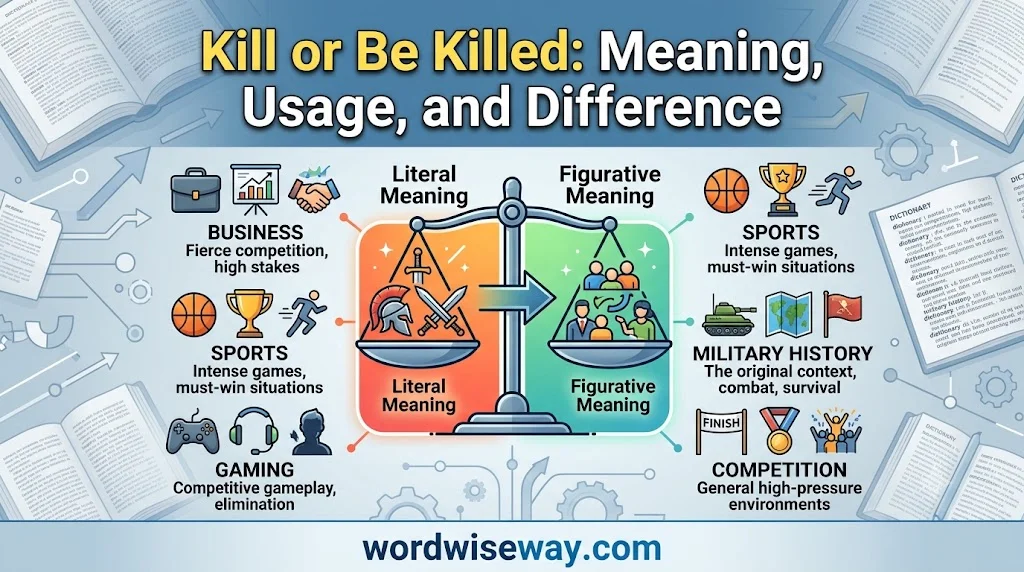
The guide explores Kill or Be Killed: Meaning, Usage, and Difference to help readers understand its meaning, context, and correct use clearly.
Many people have heard the phrase “Kill or Be Killed” and felt unsure about what it means. When readers search for clarity or look up this expression in movies, books, and news articles, they often face confusion because the wording sounds strong, intense, and dramatic. This idiom has both a literal meaning and a figurative meaning. The literal idea connects kill and be killed with real danger, while the figurative or metaphorical meaning describes survival, pressure, and fierce competition. This type of dramatic language often appears in writing, essays, blogs, and discussions, where the context changes the interpretation.
The way you use kill or be killed depends on the situation and purpose. In competitive talk, sports, sports talk, business, and business blogs, this phrase can describe a competitive environment where people face competition and try to perform well. However, using it the wrong way can confuse a reader because the violent tone may sound harsh or exaggerated. A guide that explains the origin and history of this descriptive phrase helps you understand its correct usage.
The right settings allow the expression to fit perfectly, while some situations shouldn’t use it because the contextual meaning and comparison between ideas matter.
What Does “Kill or Be Killed” Mean?
The expression kill or be killed describes a situation where survival, success, or victory depends on defeating an opponent before they defeat you.
Simple Definition
Kill or be killed means:
A situation where a person, group, or organization must act aggressively to survive, win, or avoid defeat.
The phrase can have two meanings:
| Meaning Type | Explanation | Example |
| Literal | Actual life-and-death survival | A soldier in combat may face a kill-or-be-killed situation. |
| Figurative | Intense competition or struggle | The smartphone industry is often described as kill or be killed. |
Literal Meaning
The original meaning relates to survival. Throughout history, people in wars, battles, and dangerous situations sometimes faced moments where immediate action determined life or death.
For example:
- Soldiers in combat.
- Wild animals hunting prey.
- Self-defense situations.
- Ancient battles.
In these cases, the phrase describes a genuine survival instinct.
Figurative Meaning
Today, most uses are metaphorical.
People use kill or be killed to describe:
- Tough business competition.
- High-pressure sports.
- Political rivalries.
- Competitive gaming.
- Fierce job markets.
For example:
The technology sector can feel like a kill-or-be-killed environment where companies constantly innovate to stay ahead.
No actual violence is implied. The phrase simply emphasizes intense competition.
Why the Expression Is So Powerful
The phrase works because it creates a clear image:
- Act or lose.
- Compete or fall behind.
- Adapt or fail.
It turns complex situations into a memorable expression, much like a survival story compressed into four words.
Kill or Be Killed Difference: Is There Actually a Difference?
Many readers search for kill or be killed difference, but the phrase itself does not have multiple official meanings.
The confusion usually comes from comparing:
- Literal vs figurative use.
- Similar idioms.
- Different contexts.
Literal vs Figurative Difference
| Literal Use | Figurative Use |
| War | Business competition |
| Survival situations | Sports |
| Self-defense | Politics |
| Hunting | Video games |
For example:
Literal:
The soldiers trained for kill-or-be-killed combat situations.
Figurative:
The market became so competitive that companies described it as kill or be killed.
Context changes the interpretation.
Origin of “Kill or Be Killed”
The phrase has ancient roots because survival has always been part of human history.
Early Survival Context
Humans lived in dangerous environments for thousands of years:
- Hunting animals.
- Defending territories.
- Fighting wars.
- Protecting communities.
The idea behind the phrase existed long before the exact wording appeared.
Military Influence
Military culture strongly shaped the modern expression.
Armies throughout history emphasized:
- Quick decisions.
- Self-defense.
- Survival.
- Tactical advantage.
The phrase became more widely known through military books, films, and historical accounts.
Popular Culture Expansion
Movies, novels, television, and video games later spread the phrase into everyday language.
Examples include:
- Action films.
- Survival stories.
- War dramas.
- Competitive reality shows.
As a result, many people now use the expression without any connection to actual violence.
When to Use “Kill or Be Killed”
Context matters.
The phrase works best when describing highly competitive situations.
Business
Examples:
Startups often enter a kill-or-be-killed market where innovation determines survival.
Retail competition during holiday seasons can feel kill or be killed.
Sports
Examples:
The final playoff game became a kill-or-be-killed battle for the championship.
The team played with a kill-or-be-killed mindset.
Politics
Examples:
Elections sometimes create a kill-or-be-killed atmosphere.
Entertainment
Examples:
Survival movies often revolve around kill-or-be-killed scenarios.
Gaming
Examples:
Many battle royale games use a kill-or-be-killed concept.
When You Should Avoid the Phrase
Although common, this expression can sound aggressive.
Avoid using it in:
- Medical discussions.
- Sensitive personal situations.
- Professional emails.
- Academic writing.
- Peace-building conversations.
Instead, choose alternatives such as:
- Highly competitive.
- Intense environment.
- Tough competition.
- Survival mindset.
Kill or Be Killed Examples in Sentences
Literal Examples
- The soldiers faced a kill-or-be-killed situation during battle.
- Wild predators often live in a kill-or-be-killed environment.
Business Examples
- The streaming industry has become kill or be killed.
- Companies must innovate in a kill-or-be-killed market.
Sports Examples
- The championship game felt kill or be killed.
- The team adopted a kill-or-be-killed mentality.
Gaming Examples
- Battle royale games often use kill-or-be-killed mechanics.
- Players quickly adapt in a kill-or-be-killed environment.
Everyday Conversations
Workplace Example
Ali: Why is everyone working so hard?
Sara: The industry is very competitive. Sometimes it feels kill or be killed.
Sports Example
Ahmed: How important is this match?
Bilal: It is practically kill or be killed for the team.
Gaming Example
Player 1: Why do people enjoy survival games?
Player 2: Because the kill-or-be-killed atmosphere creates excitement.
Similar Expressions
English contains many phrases with related meanings.
| Expression | Meaning |
| Dog-eat-dog | Ruthless competition |
| Survival of the fittest | Strongest succeed |
| Sink or swim | Succeed independently |
| Do or die | Critical effort needed |
| Winner takes all | Only one victor |
| Every man for himself | Self-interest first |
Dog-Eat-Dog
This phrase emphasizes ruthless competition.
Example:
The fashion industry can be dog-eat-dog.
Survival of the Fittest
This expression comes from evolutionary theory and describes adaptation.
Example:
Businesses survive through innovation and adaptation.
Opposite Expressions
Not every situation requires intense competition.
| Expression | Meaning |
| Live and let live | Tolerance |
| Win-win | Mutual benefit |
| Cooperation | Working together |
| Peaceful coexistence | Harmony |
These expressions highlight collaboration instead of conflict.
Kill or Be Killed in Popular Culture
Popular culture helped turn this expression into a common phrase.
Movies
Action and war films often use the concept to create tension.
Examples include:
- War dramas.
- Survival films.
- Adventure movies.
Television
Reality competitions frequently use language that suggests intense rivalry.
Video Games
Games such as battle royales rely on survival mechanics that resemble the phrase.
Literature
Classic and modern novels use survival themes to create dramatic stories.
Case Study: Business Competition
One of the best examples of a figurative kill-or-be-killed environment is the smartphone industry.
Major companies invest billions of dollars each year in:
- Research.
- Software.
- Marketing.
- New technologies.
According to industry reports, global smartphone shipments often exceed 1 billion units annually. Companies compete fiercely for market share, customer loyalty, and innovation leadership.
No actual violence exists, of course. The phrase simply describes strong competition.
Case Study: Sports Competition
Championship tournaments often create all-or-nothing moments.
Examples:
- World Cup knockout rounds.
- Olympic finals.
- Championship games.
Athletes train for years because a single performance can decide success or failure.
This is why commentators sometimes use expressions like:
“It is a kill-or-be-killed game.”
Common Misconceptions
It Always Means Violence
False.
Most modern uses are metaphorical.
It Is Always Appropriate
False.
Context matters.
It Encourages Aggression
Not necessarily.
People usually use the phrase to describe competition rather than promote harmful actions.
Common Mistakes
| Mistake | Problem | Better Approach |
| Taking it literally every time | Creates misunderstanding | Check context |
| Using it in formal writing | Sounds aggressive | Use neutral terms |
| Using it in sensitive situations | May offend people | Choose gentler language |
Quick Comparison Table
| Feature | Kill or Be Killed |
| Type | Idiomatic expression |
| Tone | Strong, dramatic |
| Literal Meaning | Survival |
| Figurative Meaning | Intense competition |
| Common Uses | Business, sports, gaming, politics |
| Formality | Informal to semi-formal |
| Origin | Survival and military contexts |
Interesting Facts
- The phrase appears frequently in war films and survival stories.
- Modern business articles often use it metaphorically.
- Competitive gaming communities use similar expressions regularly.
- The idea behind the phrase is ancient, even though modern wording is relatively recent.
Quote
“In highly competitive environments, adaptation often matters more than strength.”
This idea reflects the figurative meaning of kill or be killed: success often depends on learning, improving, and responding quickly.
Read More: Abley or Ably: Correct Spelling, Meaning, Usage, and Difference
FAQs
What does “kill or be killed” mean?
“Kill or be killed” means a situation where someone must act strongly to survive, succeed, or avoid failure. It can have a literal meaning related to danger, but people often use it in a figurative way to describe competition, pressure, or difficult situations.
Is “kill or be killed” always about violence?
No. Although the words sound violent, the phrase is often used metaphorically. In business, sports, and everyday discussions, it usually refers to intense competition rather than actual harm.
Where is the phrase “kill or be killed” commonly used?
You can find this phrase in movies, books, news articles, sports discussions, business conversations, and essays. Writers often use it to describe situations involving survival, struggle, or strong competition.
Is “kill or be killed” an idiom?
Yes, “kill or be killed” is an idiomatic expression. Its meaning often goes beyond the literal words and depends on the context where someone uses it.
Can I use “kill or be killed” in formal writing?
You can use it in formal writing when the context supports its meaning. However, you should consider your audience because the phrase can sound intense or harsh in some situations.
What is the difference between the literal and figurative meanings of “kill or be killed”?
The literal meaning refers to a real situation involving life and danger. The figurative meaning describes a struggle where someone must compete, adapt, or work hard to succeed.
Why do people use “kill or be killed” in business?
People use this phrase in business to describe highly competitive environments. It suggests that companies or individuals must perform well, improve, and adapt to survive.
Can “kill or be killed” sound negative?
Yes, depending on the tone and situation. Because the wording is aggressive, it may sound too harsh or exaggerated if used in a casual or sensitive conversation.
What are some alternatives to “kill or be killed”?
Depending on the context, alternatives include “survival of the fittest,” “compete to succeed,” “fight to survive,” or “do whatever it takes to win.” The best choice depends on the message you want to express.
How can I use “kill or be killed” correctly?
Use the phrase when you want to describe a situation involving strong pressure, competition, or survival. Always consider the context, audience, and tone before using it.
Conclusion
The phrase “kill or be killed” carries a powerful meaning that changes depending on the situation. While its literal meaning connects to danger, its common modern use is usually figurative, describing competition, pressure, and the need to survive difficult circumstances.
Understanding the context helps you use this expression correctly. Whether it appears in sports, business, literature, or everyday speech, the phrase can communicate a strong message when used carefully. However, because of its intense wording, choosing the right setting and tone is important to avoid confusion.

Emma Smith has dedicated 14 years to Princeton University’s English Department, mentoring students in textual interpretation, literary movements, and critical frameworks. Her research explores Shakespearean drama, Victorian serial fiction, postcolonial narrative theory, and manuscript studies and probing how literary forms evolve across cultures and centuries. Emma has delivered lectures at international humanities congresses and published findings in distinguished academic journals, underscoring her commitment to scholarly depth and vibrant teaching.