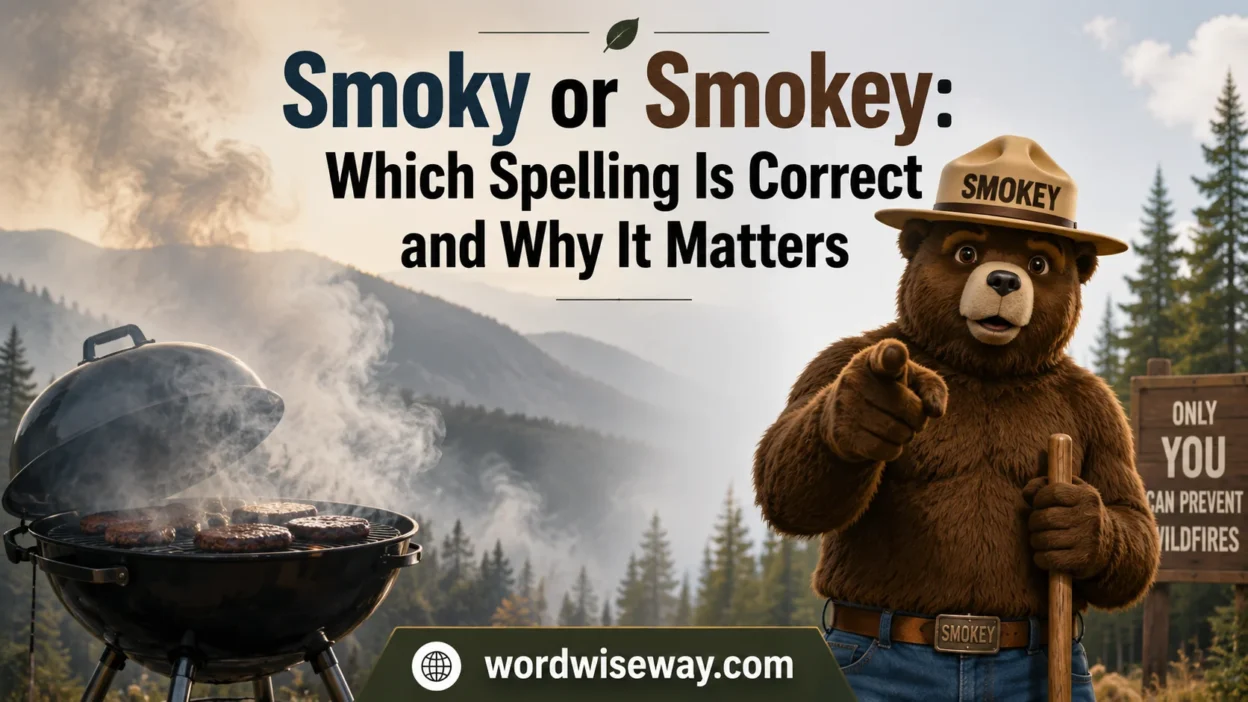
Smoky or Smokey: Which Spelling Is Correct and Why It Matters is a common confusion in writing where only smoky is accepted in dictionaries, formal writing, and academic contexts, while smokey is often an informal variant used mainly as a name and not considered correct in professional usage.
This difference matters because spelling controls clarity, meaning, and trust in communication across different writing environments. In everyday use, many English words have multiple spellings, and writers often pick one form without realizing the importance of consistency.
Some people choose one version, others choose another, and readers may or may not notice the difference or care about it. Still, language systems exist to guide proper usage and keep writing standardized for understanding.
In professional situations, the spelling smoky is the standard spelling used in formal writing, academic contexts, and recognized dictionaries. It is widely accepted as the correct form because it follows established language rules. Using this version helps maintain accuracy in essays, reports, and professional communication where correctness is important.
In contrast, smokey appears occasionally as an informal variant, often seen in names or casual usage rather than structured writing. While it may be used creatively or stylistically, it is not considered correct in strict language standards. This separation shows how context decides whether a spelling is accepted or not.
Overall, understanding this distinction helps writers choose the correct form depending on context. Using smoky ensures alignment with formal rules and accepted standards, while recognizing smokey helps identify informal or non-standard usage in different situations.
Quick Answer First
Let’s not drag this out.
- Smoky → correct adjective used for describing smoke, flavor, atmosphere, or appearance
- Smokey → mostly used as a proper noun (names, branding, characters)
So if you’re describing something, you almost always want smoky, not “smokey.”
A simple rule works every time:
If it describes something, it’s smoky.
If it names something, it might be Smokey.
What “Smoky” Actually Means in English
The word smoky is an adjective. It comes from the noun “smoke,” and it describes something that contains smoke or has characteristics of smoke.
Core meanings of smoky
Here’s how the word is actually used in real English:
- Filled with visible smoke
- Having the smell of smoke
- Tasting like smoke (especially food)
- Looking hazy or foggy like smoke
Real-world examples
- The kitchen turned smoky after the grill caught fire.
- The room had a smoky smell from the fireplace.
- That barbecue sauce has a smoky flavor.
- The sky looked smoky after the wildfire.
Food language loves “smoky”
Food writing almost treats “smoky” like a superstar adjective. Chefs and food bloggers use it constantly.
Examples:
- Smoky paprika chicken
- Smoky chipotle sauce
- Smoky grilled steak
A small detail: in culinary writing, “smoky” often signals depth and complexity of flavor, not actual smoke.
What “Smokey” Really Means
Now we step into different territory.
Smokey is not a standard adjective. It is usually a name or branding choice.
Where “Smokey” appears
- Personal nicknames
- Brand identities
- Cultural characters
Famous example
- Smokey Bear – the U.S. wildfire prevention mascot
His name is intentionally spelled “Smokey,” not “Smoky.” That spelling is part of his identity, not grammar.
Key takeaway
“Smokey” survives mainly because names don’t follow strict grammar rules. They follow identity, tradition, or branding choices.
Side-by-Side Comparison
To make things clearer, here’s a direct comparison:
| Feature | Smoky | Smokey |
| Word type | Adjective | Proper noun |
| Usage | Description | Names/branding |
| Grammar correctness | Standard form | Context-dependent |
| Example use | smoky air, smoky flavor | Smokey Bear |
| Formal writing | Always correct | Only if it’s a name |
This table alone clears up 90% of confusion.
Why People Confuse?
If this mistake feels common, that’s because it is. There are real linguistic reasons behind it.
1. They sound identical
Both words are pronounced the same way:
/ˈsmoʊ.ki/
So your ears give you zero help. You’re spelling purely from memory.
2. English loves “-y” and “-ey” endings
Words like:
- happy
- funny
- valley
- honey
and names like:
- Joey
- Mikey
- Smokey
train your brain to treat both endings as interchangeable.
3. Pop culture influence
Most people meet “Smokey” before they learn “smoky.”
For example:
- Smokey Bear campaigns
- Smokey Robinson (musician)
These strong cultural anchors override grammar instincts.
4. Visual similarity bias
When two spellings look almost identical, the brain tends to store them as interchangeable even when they are not.
Grammar Rule You Should Actually Follow
Here is the clean rule used in professional writing:
Use “smoky” when describing something
- smoky sky
- smoky taste
- smoky atmosphere
- smoky smell
Use “Smokey” only for names
- Smokey Bear
- Smokey Robinson
- Smokey (nickname)
A simple decision flow:
- Are you describing something? → smoky
- Are you referring to a specific name? → Smokey
Real-Life Usage
Let’s look at real-world contrasts.
Correct vs incorrect examples
| Sentence Type | Correct | Incorrect |
| Food | The ribs taste smoky | The ribs taste smokey |
| Weather | The air feels smoky | The air feels smokey |
| Name | Smokey Bear is famous | Smoky Bear is famous |
| Atmosphere | The club was smoky | The club was smokey |
The pattern is consistent. Descriptions always lean toward smoky.
Case Study: Smokey Bear vs Smoky Mountains
This is where things get interesting.
Smokey Bear (branding identity)
Smokey Bear is a U.S. Forest Service mascot created during World War II. His name is intentionally “Smokey,” not “Smoky.”
Why?
- It sounds friendly and approachable
- It behaves like a nickname
- It stands out as a brand identity
Smoky Mountains (geography)
The Great Smoky Mountains are named for the natural haze that often covers them.
Why “smoky”?
- The name describes a physical phenomenon
- The haze comes from vegetation releasing volatile compounds
- It is not a character or identity
Comparison insight
- Smokey Bear → identity → spelling is flexible
- Smoky Mountains → description → grammar rules apply
Common Mistakes People Make
Even strong writers slip here. These are the most frequent errors:
Mistake list
- Writing “smokey flavor” in food blogs
- Using “smokey air” in descriptions
- Assuming both spellings are interchangeable
- Overcorrecting names into “smoky”
Why these mistakes happen
- Fast typing habits
- Autocorrect interference
- Memory confusion from branding
- Lack of grammar awareness in adjectives
Read More: Good Morning or Goodmorning: Which is correct?
Memory Tricks That Actually Work
Let’s make this easier to remember.
Trick 1: The “Y = You describe it” rule
- smoky → you describe something
- smokey → you name someone
Trick 2: Think of identity vs description
- smoky = texture of reality
- smokey = label on a person or character
Trick 3: One-line memory hook
“Smoky describes. Smokey names.”
Short. Sticky. Effective.
Linguistic Insight: Why “Smoky” Won Out
Modern English tends to simplify adjective endings.
Historically, “smokey” existed as a variation in older texts, but over time:
- Dictionaries standardized smoky
- Style guides preferred consistency
- Academic and journalistic writing adopted “smoky” exclusively
Today, major references like Oxford and Merriam-Webster list smoky as the primary adjective form.
FAQs
1. What is the correct spelling: smoky or smokey?
Ans: The correct standard spelling is smoky, especially in dictionaries, formal writing, and academic contexts.
2. Is “smokey” ever correct?
Ans: Smokey is generally an informal variant and is not correct in professional writing, except when used as a name.
3. Why do people get confused between smoky and smokey?
Ans: People get confused because both forms look similar and are used in everyday language, but only one follows standard spelling rules.
4. Where is “smoky” commonly used?
Ans: It is used in academic contexts, formal writing, and widely accepted dictionaries.
5. Is “smokey” used in dictionaries?
Ans: Most standard dictionaries prefer smoky as the correct spelling, while smokey appears rarely as a variant or name.
6. Can I use “smokey” in essays?
Ans: No, in essays or professional situations, you should use smoky for correct grammar and formal accuracy.
7. Why is “smoky” considered standard spelling?
Ans: Because it is the version widely accepted in formal writing and established linguistic rules.
8. Does spelling really matter in this case?
Ans: Yes, spelling matters because it affects clarity, correctness, and professionalism in communication.
9. Is “smokey” completely wrong?
Ans: It is not “wrong” in casual naming or branding, but it is not considered correct in formal usage.
10. How can I remember the correct spelling?
Ans: Remember that smoky is the standard form used in dictionaries and professional writing.
Conclusion
The distinction between smoky and smokey may look small, but it plays an important role in writing accuracy. In formal writing, academic contexts, and dictionaries, only smoky is considered correct, while smokey remains an informal or stylistic variant mostly used in names or casual usage. Understanding this difference helps improve clarity, professionalism, and correctness in everyday communication.

Emma Smith has dedicated 14 years to Princeton University’s English Department, mentoring students in textual interpretation, literary movements, and critical frameworks. Her research explores Shakespearean drama, Victorian serial fiction, postcolonial narrative theory, and manuscript studies and probing how literary forms evolve across cultures and centuries. Emma has delivered lectures at international humanities congresses and published findings in distinguished academic journals, underscoring her commitment to scholarly depth and vibrant teaching.