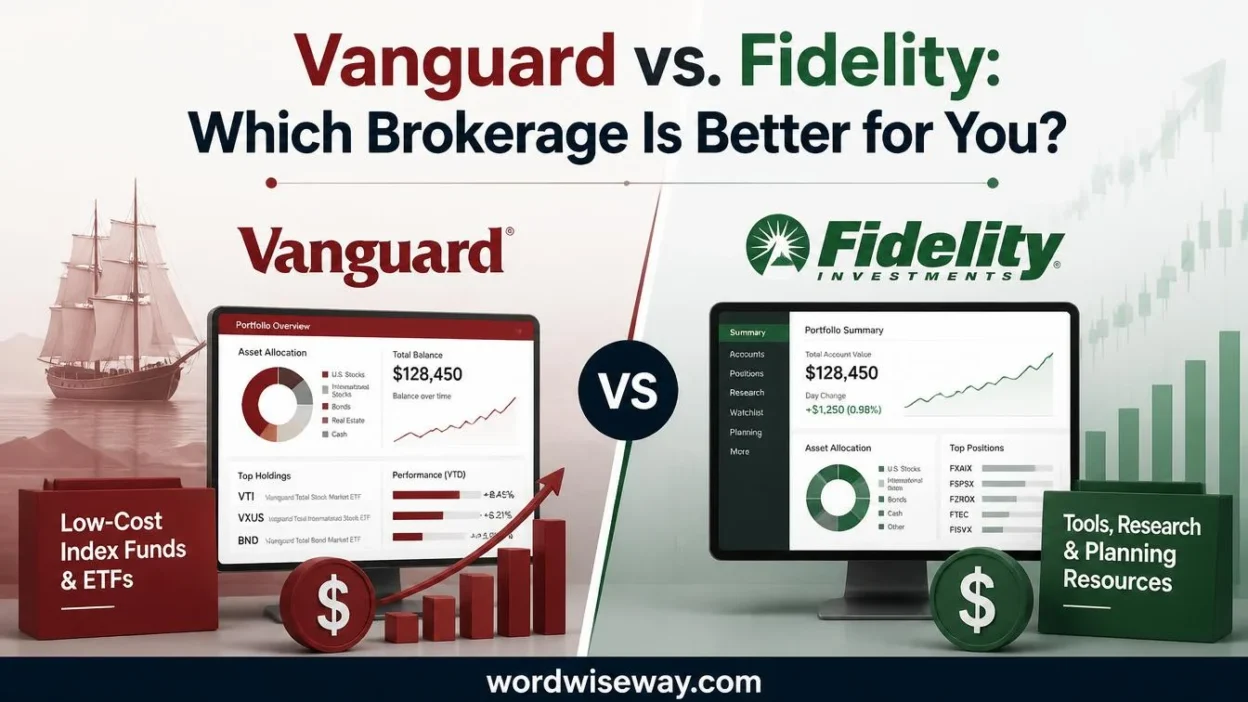
Choosing Vanguard vs. Fidelity: Which Brokerage Is Better for You? depends on your goals, investing style, fees, and preferred platform.
Vanguard focuses on long-term wealth building, low-cost index funds, mutual funds, and ETFs, while Fidelity offers a fuller-service experience, sophisticated tools, competitive fees, and support for active traders. Both provide broad investment choices, making them useful for beginners and experienced investors.
Before you move an account, consider practical issues such as POA, beneficiaries, and consolidated statements. Vanguard and Fidelity also differ in crypto options. Fidelity offers direct spot trading for Bitcoin, Ethereum, and Litecoin, while Vanguard allows third-party crypto ETFs and mutual funds. Compare costs, fees, and account features carefully.
Quick Answer
For a long-term, low-cost index investor, Vanguard remains a strong choice because of its extensive low-cost fund lineup and long history of emphasizing index investing. Vanguard reports an average mutual fund expense ratio of 0.08%, compared with an industry average of 0.50%, based on data as of December 31, 2025.
Fidelity is generally the more versatile choice if you want broader research, fractional shares, advanced trading tools, recurring investments, and access to a wide range of securities. Fidelity currently offers $0 online commissions for U.S. stocks and ETFs and supports fractional investing starting at $1 for eligible securities.
In simple terms:
- Choose Vanguard if your priority is low-cost, long-term fund investing.
- Choose Fidelity if you want a broader brokerage platform with more research and trading features.
- Consider either if you mainly want diversified index funds and the specific funds you need are available at both firms.
The best choice depends less on the logo and more on how you plan to invest.
Key Differences
The two firms overlap in many areas, but their strengths aren’t identical. Vanguard feels more centered on long-term investing and its fund ecosystem, while Fidelity offers a wider collection of tools for investors who want to research, trade, manage cash, and invest across different asset classes.
| Feature | Vanguard | Fidelity |
| Online U.S. stock trades | $0 | $0 |
| Online ETF trades | $0 | $0 |
| Fractional shares | More limited | Broad eligible U.S. stocks and ETFs |
| Mutual funds | Extensive Vanguard lineup | Extensive Fidelity and third-party lineup |
| Index funds | Major strength | Major strength, including ZERO funds |
| Research tools | Available | Extensive research and screening tools |
| Active trading tools | More limited | Stronger |
| Recurring investments | Available | Available |
| Retirement accounts | Yes | Yes |
| Bonds and CDs | Yes | Broad selection |
| Cash-management options | Available | Extensive |
| Best fit | Long-term fund investors | Broad-use investors and active researchers |
Fidelity currently advertises access to stocks, ETFs, mutual funds, bonds, CDs, options, and other investments, while its research platform includes tools from independent providers.
Vanguard, meanwhile, remains particularly compelling for investors who want to build a portfolio around its low-cost mutual funds and ETFs. Vanguard says its clients can trade thousands of ETFs and mutual funds from Vanguard and other companies commission-free online, subject to applicable terms.
Fees and Costs
Fees can look tiny when viewed one at a time. Over many years, however, recurring costs can quietly reduce investment returns. That’s why comparing the actual expenses attached to your investments matters more than simply seeing “$0 commission.”
Stock and ETF Trading Fees
Both Vanguard and Fidelity offer $0 online commissions for U.S. stock and ETF trades under their current standard pricing structures.
Fidelity lists online U.S. equity trades at $0 and online ETF trades at $0.
Vanguard also charges $0 commissions for online ETF trading. Its current fee information says clients can trade Vanguard ETFs online without commissions and provides broad access to ETFs.
That means the basic commission isn’t likely to decide the contest for most buy-and-hold investors.
The bigger question is what you pay inside the investment itself.
Mutual Fund Costs
Mutual funds carry an expense ratio, which represents the fund’s annual operating expenses as a percentage of assets.
Suppose two funds track similar indexes. One charges 0.05% while another charges 0.50%. The difference may appear microscopic, but it repeats every year and applies to the assets in the fund.
Vanguard reports an average mutual fund expense ratio of 0.08% as of December 31, 2025. It also states that its average mutual fund expense ratio is 84% below the industry average.
Fidelity has another notable feature: its ZERO expense-ratio index mutual funds. These funds don’t charge a management fee through the fund’s expense ratio, although investors should still review the specific fund’s structure and risks before investing.
Account Fees and Minimums
Fidelity currently advertises no account minimums or retail brokerage account fees for opening a standard brokerage account.
Vanguard’s current fee schedule lists a $25 annual account service fee for each brokerage account. However, Vanguard says the fee can be avoided through qualifying conditions, including e-delivery enrollment or having at least $1 million in qualifying assets.
This creates an important distinction. Vanguard isn’t necessarily expensive, but investors should understand its account-service-fee rules before opening an account.
Fractional Shares
Fractional shares let you invest a fixed dollar amount without purchasing an entire share.
For example, if a stock costs $400 and you only want to invest $25, fractional investing allows you to purchase a portion rather than waiting until you have enough for a whole share.
Fidelity supports fractional investing for eligible U.S. stocks and ETFs with investments starting at $1.
This feature makes Fidelity especially convenient for investors who contribute small amounts regularly.
Vanguard’s fractional-share availability is more limited, particularly when compared with Fidelity’s broad dollar-based investing system. Vanguard’s fractional investing has historically focused primarily on eligible Vanguard ETFs rather than offering the same breadth across thousands of individual U.S. securities.
Vanguard vs. Fidelity Investment Choices
Investment selection is another major dividing line.
Stocks and ETFs
Both brokerages provide access to stocks and ETFs. Fidelity, however, positions its brokerage as a broad investment platform that includes stocks, ETFs, mutual funds, bonds, CDs, options, and other securities.
Fidelity also offers international investing capabilities. Its current platform allows eligible customers to trade in 25 countries and exchange between 16 currencies through its international trading service.
Vanguard is less focused on turning its platform into a trading playground. Its strongest appeal remains diversified investing through mutual funds and ETFs.
Mutual Funds
Both companies offer substantial mutual fund choices.
Vanguard has an obvious advantage if you specifically want its well-known index and actively managed funds. Its lineup includes funds covering U.S. stocks, international markets, bonds, balanced portfolios, and retirement strategies.
Fidelity has a different advantage: it offers Fidelity funds alongside a broad collection of non-Fidelity funds. Its platform also provides screening and research tools that can help investors compare funds.
Fidelity’s commission schedule shows that Fidelity funds trade at $0, while certain non-Fidelity funds can carry transaction fees depending on the fund and transaction.
So, if you’re choosing a brokerage based on one specific mutual fund, check that fund’s actual transaction and expense costs before opening an account.
Index Funds
Index investing is one area where both companies shine.
Vanguard helped popularize low-cost index investing and continues to emphasize inexpensive diversified funds. Fidelity competes aggressively with its own low-cost index funds, including its ZERO expense-ratio lineup.
The more useful question isn’t simply “Vanguard or Fidelity?”
Instead, compare:
- Expense ratio
- Index tracked
- Holdings
- Diversification
- Tracking performance
- Tax efficiency
- Fund minimum
- Transaction costs
- Investment objective
A cheap fund isn’t automatically the right fund. The underlying strategy still matters.
Retirement Accounts
Retirement investors often care more about consistency and costs than sophisticated trading screens.
Both Vanguard and Fidelity provide retirement accounts such as Traditional IRAs and Roth IRAs.
Fidelity also offers a broad collection of retirement and savings accounts, including Traditional IRAs, Roth IRAs, rollover IRAs, and other account types.
Vanguard for Retirement Investing
Vanguard can work particularly well if you want a simple retirement portfolio built around diversified index funds or target-date funds.
Its target-date funds are designed to adjust their asset allocation as an investor approaches a target retirement year. That approach can reduce the need to constantly rebalance the portfolio manually.
Fidelity for Retirement Investing
Fidelity also provides target-date funds, index funds, retirement planning tools, and investment guidance.
Its broader platform can be useful if your retirement strategy eventually expands beyond basic index funds. You can access additional research, securities, fixed-income investments, and planning resources within the same ecosystem.
The key point is simple: the retirement account type matters more than the brokerage brand alone.
Beginners
Beginners often assume they need the platform with the most features. Usually, that’s backward.
The best platform is the one that helps you understand what you’re buying and stick to a sensible plan.
Why Vanguard May Appeal to Beginners
Vanguard can make sense for a beginner who wants to focus on:
- Low-cost index funds
- Diversification
- Long-term investing
- Retirement savings
- Simple portfolio construction
- Minimal interest in frequent trading
Its fund-centered philosophy can actually be helpful because it reduces the temptation to constantly react to market headlines.
Why Fidelity May Appeal to Beginners
Fidelity gives beginners more tools to explore.
Its platform includes educational material, recurring investments, research tools, fractional shares, and a broad selection of investments.
The ability to invest as little as $1 in eligible fractional shares can also make regular contributions easier for investors who are starting with modest amounts.
However, more choices can create more decisions. A beginner who sees dozens of screeners, research reports, and investment choices may feel like they’ve walked into a financial supermarket without a shopping list.
Experienced Investors
Experienced investors often want more than low-cost funds.
They may care about:
- Advanced charting
- Stock screeners
- Options tools
- Bond research
- Independent analyst reports
- Market news
- International investing
- Portfolio monitoring
- Advanced order functionality
This is where Fidelity gains a meaningful advantage.
Research and Analysis
Fidelity provides research from 20+ independent providers and offers research covering stocks, ETFs, mutual funds, bonds, options, and other investments.
Its research platform includes screening tools, analyst perspectives, market commentary, alerts, and other analytical resources.
For someone who wants to dig into a company before investing, that depth can be valuable.
Vanguard offers investment research as well, but its overall experience isn’t built around frequent security-by-security analysis to the same degree.
Trading Tools
Fidelity’s current trading ecosystem includes web, mobile, and desktop experiences. Its Trader+ platform provides advanced charting, dynamic screeners, saved orders, and multi-monitor layouts.
That makes Fidelity the stronger candidate for investors who need a more sophisticated trading environment.
Vanguard’s platform is better aligned with investors who don’t need a deep collection of active-trading tools.
Vanguard vs. Fidelity for Long-Term Index Investors
If your strategy is primarily buy, hold, contribute, and rebalance, the gap between the two becomes much smaller.
Both companies offer low-cost index funds.
For example, an investor might build a diversified portfolio using broad categories such as:
| Portfolio component | What it provides |
| U.S. total stock market | Exposure to a broad range of American companies |
| International stocks | Exposure to companies outside the U.S. |
| U.S. bonds | Potential income and diversification |
| Target-date fund | A professionally managed diversified allocation |
| S&P 500 fund | Exposure to large U.S. companies |
The important detail is what the fund actually owns and charges, not whether its parent company is Vanguard or Fidelity.
An investor who chooses a diversified low-cost fund and contributes consistently may be making a more important decision than someone who spends hours debating two similar brokerage interfaces.
Vanguard vs. Fidelity for Active Traders
Fidelity has the clearer advantage for investors who want advanced trading capabilities.
Its current platform supports stocks, ETFs, options, fixed income, mutual funds, and other investments. Fidelity also provides advanced research and trading technology across web, desktop, and mobile platforms.
Vanguard doesn’t compete as aggressively in this category.
Its platform makes more sense for investors who don’t need extensive trading tools and instead want to concentrate on long-term portfolio building.
That doesn’t mean frequent trading is automatically better. In fact, unnecessary trading can increase costs, taxes, and portfolio risk. The platform should serve your strategy rather than encourage you to trade simply because another button exists.
Vanguard vs. Fidelity for Cash and Uninvested Money
Uninvested cash deserves more attention than it usually gets.
When money sits in a brokerage account, you should understand where that cash goes and what yield it receives.
Fidelity currently promotes its SPAXX money market fund as a core cash option for eligible brokerage accounts and publishes its current seven-day yield on its website.
Cash-management features can also matter if you want your brokerage relationship to handle more than investments.
Fidelity offers a dedicated cash-management account with features designed for spending and saving.
Vanguard also provides cash and money-market options, but the exact yield and treatment of uninvested cash can change over time.
Because cash yields move with market conditions, never treat a historical yield as a permanent rate.
Vanguard vs. Fidelity for Financial Advice
Both companies offer ways to get investment guidance, although the structure and services vary.
Vanguard provides advice programs through affiliated advisory entities. The company notes that services, fees, eligibility, management, and advisor access vary by the specific program.
Fidelity also offers digital advice and access to financial professionals. Its Fidelity Go service combines digital investing with professional support, while other services provide more personalized planning and advice.
Before choosing an advisory service, examine:
- Advisory fee
- Account minimum
- Investment options
- Human advisor access
- Tax-planning features
- Portfolio management
- Financial planning services
A brokerage account and a managed investment account aren’t the same thing. One gives you control over investment decisions, while the other may put some decisions in the hands of a professional or automated system.
Customer Service
Customer support matters most when something goes wrong or when you need help understanding an account.
Fidelity currently advertises 24/7 live support for customers and trading-related assistance.
It also offers educational resources and research support.
Vanguard provides customer service and investment guidance through its brokerage and advisory ecosystem.
For many long-term investors, however, customer service may not be the deciding factor. If you rarely trade and mainly hold diversified funds, your research tools and investment costs may matter more.
Vanguard vs. Fidelity for Taxable Brokerage Accounts
A taxable brokerage account gives you flexibility that retirement accounts don’t always provide.
You can generally invest for goals such as:
- A future home purchase
- Education expenses
- Long-term wealth building
- A major purchase
- General investing
However, taxable accounts can create tax consequences through dividends, interest, and realized capital gains.
That means the investment itself matters.
For example, two funds may have similar market exposure but different turnover and distribution patterns. Their tax impact can differ even when their headline returns look similar.
Tax-loss harvesting can also matter for eligible investors. The strategy involves selling an investment that has declined and potentially using the realized loss to offset certain gains, subject to tax rules.
Because tax situations vary, investors should review the current IRS rules or consult a qualified tax professional before making tax-sensitive decisions.
Real-World Investor Scenarios
Scenario: A Beginner Building a Simple Portfolio
Imagine someone who wants to invest regularly in broad index funds and doesn’t care about advanced charts.
Vanguard may be the natural fit because its platform and fund lineup align closely with that long-term approach.
Fidelity could work just as well if the investor prefers fractional shares, recurring investments, and more research tools.
Scenario: A Retirement Investor
Someone saving for retirement may prioritize low fund expenses, diversification, automatic contributions, and a suitable asset allocation.
In this case, both Vanguard and Fidelity can work well.
The investor should compare the actual funds available in the chosen IRA rather than selecting a brokerage based solely on brand reputation.
Scenario: A Research-Heavy Investor
An investor who likes reading analyst reports, screening stocks, comparing securities, and studying markets will likely find Fidelity more suitable.
Its research platform draws from more than 20 independent providers and includes extensive screening and analytical tools.
Scenario: Someone Starting With Small Amounts
Fidelity has an obvious advantage when fractional investing matters.
Eligible securities can be purchased in dollar amounts starting at $1, which can make regular small contributions easier.
Scenario: An Investor Who Wants Advanced Trading Tools
Fidelity is the stronger choice for investors who specifically need advanced charting, screeners, options tools, and multi-platform trading technology.
Pros and Cons
| Vanguard | Fidelity |
| Pros: Excellent low-cost fund lineup | Pros: Extensive research and trading tools |
| Strong index-investing reputation | Broad range of investments |
| Competitive ETF costs | Fractional shares starting at $1 for eligible securities |
| Strong retirement-investing options | ZERO expense-ratio index mutual funds |
| Long-term investing focus | Strong cash-management options |
| Cons: Less focused on active trading | Cons: More features can feel overwhelming |
| Fractional investing is more limited | More choices require careful comparison |
| Account-service-fee rules require attention | Advanced tools may be unnecessary for simple investors |
What Matters More Than Choosing Vanguard or Fidelity?
The brokerage is only one part of the investment equation.
A useful decision checklist looks like this:
- What are you investing for?
- Which account type fits the goal?
- What investments do you actually need?
- How much will those investments cost?
- Can you diversify properly?
- Will you invest consistently?
- Do you need advanced research tools?
- Will you use fractional shares?
- What happens to your uninvested cash?
- Do you need professional advice?
That framework prevents a common mistake: choosing a brokerage because its website looks impressive while ignoring the actual portfolio.
A beautiful dashboard can’t rescue an unsuitable investment strategy.
Which One Should You Choose?
The Vanguard vs. Fidelity decision becomes much easier once you identify your investing style.
Choose Vanguard If You:
- Prefer long-term, low-cost investing.
- Want a strong selection of Vanguard index funds and ETFs.
- Care heavily about fund expense ratios.
- Don’t need sophisticated active-trading tools.
- Prefer a fund-centered investment experience.
- Are building a simple retirement portfolio.
Choose Fidelity If You:
- Want broad research and analysis tools.
- Need fractional shares across many eligible U.S. stocks and ETFs.
- Want recurring investment features.
- Prefer access to a wide range of securities.
- Want advanced web, desktop, and mobile trading tools.
- Like having research from multiple independent providers.
- Want Fidelity’s ZERO expense-ratio index mutual funds.
Consider Either If You:
- Primarily buy diversified index funds.
- Invest for the long term.
- Don’t trade frequently.
- Care about low costs.
- Already know which funds you want.
- Don’t need specialized brokerage features.
Final Verdict: Vanguard or Fidelity?
There isn’t one universal winner in the Vanguard vs. Fidelity comparison.
Vanguard is especially strong for long-term investors who want low-cost funds and a straightforward investing philosophy. Its average mutual fund expense ratio was 0.08% as of December 31, 2025, and its ETF lineup remains a major attraction for cost-conscious investors.
Fidelity is the stronger all-around brokerage for investors who want flexibility. Its combination of $0 online U.S. stock and ETF commissions, $1 fractional investing, broad investment choices, extensive research, recurring investments, and advanced trading technology gives it an unusually wide feature set.
For a simple index investor, the difference may be surprisingly small. If the same type of diversified fund is available at both firms with similar costs, consistent investing and sensible diversification can matter far more than the brokerage name.
Before opening an account or transferring investments, check the firms’ current fee schedules, fund expenses, account requirements, cash policies, and investment availability. Those details can change, and the right choice should fit the strategy rather than the hype.
Read More: JPG or PNG: Which Image Format Should You Use? & Difference
FAQs
Is Vanguard better than Fidelity for beginners?
Both can work well for beginners, but the better choice depends on what you need. Vanguard is especially appealing if you want straightforward, long-term investing with low-cost funds.
Fidelity may be easier for beginners who want more tools, educational resources, and flexibility in one platform.
Which has lower fees, Vanguard or Fidelity?
Both Vanguard and Fidelity are known for competitive costs, so there isn’t one universal winner. The actual cost depends on the investment, account, and service you choose.
Instead of comparing the brands broadly, check the specific expense ratios, account fees, and trading costs that apply to your situation.
Is Fidelity better for active investors?
Fidelity can be a strong option for active investors because it provides sophisticated research and trading tools. Its platform offers more features for people who frequently manage their investments.
Vanguard generally emphasizes long-term investing rather than short-term trading, making its approach different from Fidelity’s broader trading experience.
Can I build a three-fund portfolio with either brokerage?
Yes. Both Vanguard and Fidelity offer funds and ETFs that can be used to create a diversified three-fund portfolio.
The important part is choosing investments that match your goals and understanding their costs rather than assuming one brokerage automatically makes the portfolio better.
Does Vanguard offer cryptocurrency?
Vanguard allows clients to trade certain third-party cryptocurrency ETFs and mutual funds. However, it does not provide direct cryptocurrency trading through its own platform.
Fidelity takes a different approach by offering cryptocurrency services through Fidelity Crypto, including access to Bitcoin, Ethereum, and Litecoin.
Which brokerage offers better investment choices?
Both companies provide a wide selection of investments, including mutual funds and ETFs. Fidelity generally offers a broader range of tools and investment features.
Vanguard stands out for its strong lineup of index funds and ETFs, particularly for investors focused on long-term wealth building.
Can I transfer my Vanguard account to Fidelity?
You can generally transfer eligible investment accounts from one brokerage to another. However, the exact process depends on the account type and investments involved.
Before transferring, review fees, tax considerations, account features, and whether your current investments can move without being sold.
Which is better for long-term investing, Vanguard or Fidelity?
Vanguard has a long-standing reputation for long-term, low-cost investing, particularly through index funds and ETFs. That makes it attractive to investors who prefer a simple buy-and-hold approach.
Fidelity can also work very well for long-term investors while providing more tools and flexibility. Your strategy matters more than the brokerage name alone.
Does Fidelity have better tools than Vanguard?
Fidelity is generally known for offering a more extensive collection of research, planning, and trading tools. These features can be useful if you like having detailed information available.
Vanguard keeps its investing experience more focused. If you don’t need advanced tools, a simpler platform may actually feel more comfortable.
Should I choose Vanguard or Fidelity for my financial goals?
Start by identifying what matters most to you, such as low costs, investment choices, research tools, account features, or ease of use. Then compare both platforms against those priorities.
There is no single winner for every investor. The right brokerage is the one whose costs, investments, services, and overall experience fit your financial goals.
Conclusion
Vanguard and Fidelity both have strong reputations, but they serve investors in somewhat different ways. Vanguard remains closely associated with low-cost, long-term investing, while Fidelity combines competitive pricing with a broader set of research, planning, and trading tools. Neither brokerage wins every category, so choosing between them requires looking beyond brand loyalty.
Think about how you actually plan to use your account. If simple long-term investing is your priority, Vanguard may feel like a natural fit. If you want more flexibility, tools, and investment features, Fidelity could be the better match. Compare the details that affect your own investing experience before making the final choice.

Emma Smith has dedicated 14 years to Princeton University’s English Department, mentoring students in textual interpretation, literary movements, and critical frameworks. Her research explores Shakespearean drama, Victorian serial fiction, postcolonial narrative theory, and manuscript studies and probing how literary forms evolve across cultures and centuries. Emma has delivered lectures at international humanities congresses and published findings in distinguished academic journals, underscoring her commitment to scholarly depth and vibrant teaching.