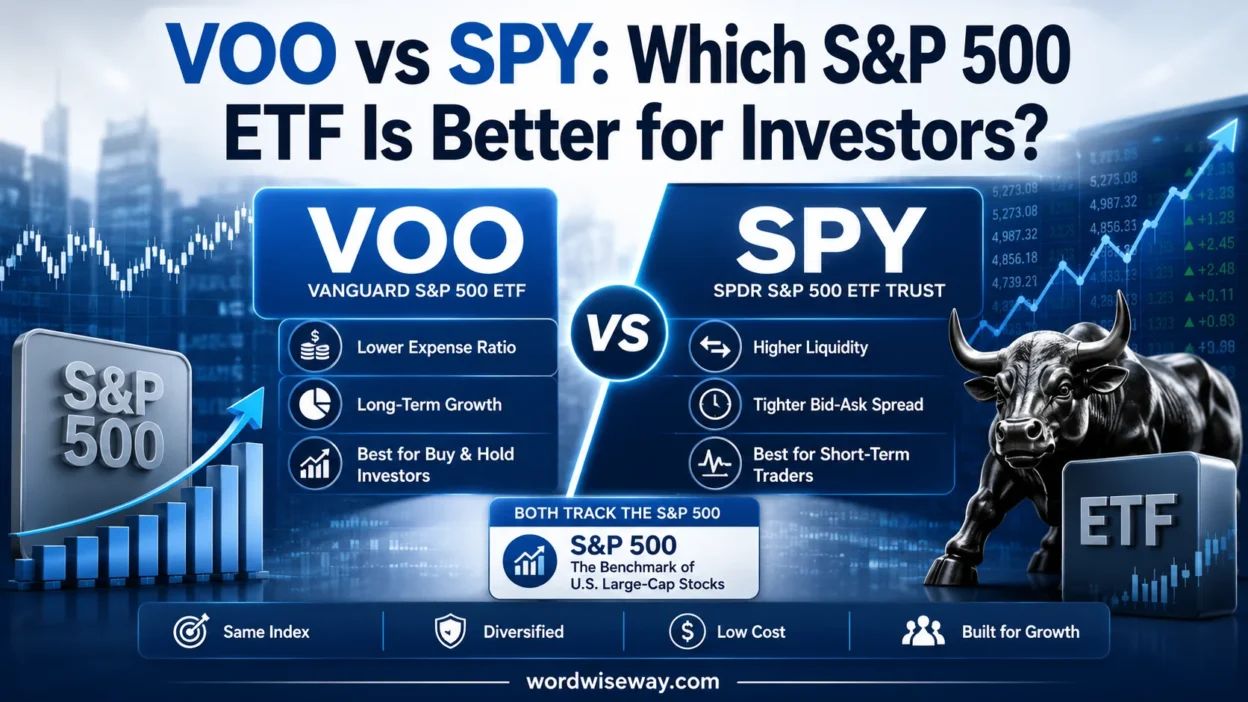
VOO vs SPY: Which S&P 500 ETF Is Better for Investors? is a common question for anyone seeking one of the best investments for broad exposure to the US economy through the top 500 stocks.
Over long periods, the S&P 500 has historically returned about 10% per year, although returns can vary. Investors who want exposure to all stocks in the S&P 500 Index can choose popular ETFs from State Street Global Advisors, represented by SPY, or Vanguard, represented by VOO. The better option depends on your financial goals, investment goals, and preferred investment approach.
Both funds act as foundational building blocks for long-term investors, tracking large-cap American companies that represent approximately 80% of U.S. market capitalization. Their costs, fees, liquidity, and structure differ slightly. VOO may suit investors focused on buy-and-hold strategies, while SPY remains popular among active traders and institutional traders seeking high-volume trading.
Understanding these subtle differences, performance, and long-term returns can reduce confusion and help you make a more informed decision.
Quick Answer:
For many long-term investors, VOO has the stronger cost proposition because its 0.03% expense ratio is substantially below SPY’s 0.0945%. Both aim to track the S&P 500, so you aren’t giving up the basic large-cap U.S. market exposure by choosing VOO.
SPY, however, has a major advantage for investors who care about trading liquidity, high trading activity, and options. State Street describes SPY as the world’s most traded and most liquid ETF. It also offers options.
In simple terms:
| Factor | VOO | SPY |
| Fund | Vanguard S&P 500 ETF | State Street SPDR S&P 500 ETF Trust |
| Benchmark | S&P 500 | S&P 500 |
| Inception | September 7, 2010 | January 22, 1993 |
| Expense ratio | 0.03% | 0.0945% |
| Holdings | About 500+ | 504 as of July 2026 |
| Distribution | Quarterly | Quarterly |
| Options | Available through the market | Available |
| Main strength | Low cost | Liquidity and trading activity |
| Typical appeal | Long-term investors | Traders and options users |
The S&P 500 itself currently has 503 constituents, although the number of securities in an ETF can differ because companies can have multiple share classes or because of fund-specific holdings. The index uses float-adjusted market-cap weighting, meaning larger eligible companies generally receive larger weights.
What Is VOO?
VOO, officially the Vanguard S&P 500 ETF, is an exchange-traded fund designed to track the S&P 500 Index. Vanguard launched the fund on September 7, 2010. Its expense ratio is 0.03%, which means an annual fund expense of roughly $3 for every $10,000 invested, before considering the effects of investment performance.
The fund uses a passive indexing approach rather than trying to identify a handful of stocks that will outperform. Instead, it seeks to replicate the benchmark’s composition and performance.
That approach makes VOO relatively straightforward. You aren’t betting on one company, one industry, or one manager’s stock-picking ability. Your investment rises and falls with the large-cap U.S. companies represented in the S&P 500.
How VOO Tracks the S&P 500
The basic mechanism is easier than it sounds.
Imagine the S&P 500 as a large basket containing hundreds of major U.S. companies. VOO builds a portfolio designed to resemble that basket. The weights of individual companies broadly follow their weights in the underlying index.
Vanguard explains that index ETFs generally hold securities that mirror their benchmark. That structure gives investors diversified exposure through a single ETF rather than requiring them to buy hundreds of individual stocks.
The important point is that VOO doesn’t represent the entire U.S. stock market. It focuses on the large-cap companies included in the S&P 500.
What Is SPY?
SPY, officially the State Street SPDR S&P 500 ETF Trust, is another fund designed to track the S&P 500.
Its history is much older than VOO’s. SPY launched on January 22, 1993, and State Street identifies it as the first exchange-traded fund listed in the United States.
That history gives SPY an unusual place in ETF history. It wasn’t simply another fund added to a crowded marketplace. It helped establish the ETF structure as a major investment vehicle.
As of July 2026, SPY had 504 holdings and a 0.0945% gross expense ratio. It distributes income quarterly and has options available.
How SPY Tracks the S&P 500
SPY’s objective is to provide investment results that generally correspond to the price and yield performance of the S&P 500 before expenses.
Because VOO and SPY both follow the same benchmark, their portfolios have enormous overlap.
That creates an important lesson for investors: two ETFs can have different names, issuers, and fees while providing nearly the same underlying market exposure.
The Biggest Differences
The headline difference isn’t their investment philosophy. Both are built around the S&P 500. The real differences emerge when you examine how each fund works and how investors use it.
Expense Ratio: VOO Has the Clear Edge
The expense ratio is one of the easiest differences to understand.
VOO charges 0.03%, while SPY’s current gross expense ratio is 0.0945%.
That difference may look microscopic. Over a single year, it is. Over decades, however, recurring costs can become meaningful because investment expenses reduce the money that remains invested.
For example, ignoring investment gains, losses, taxes, and trading costs:
| Investment | VOO at 0.03% | SPY at 0.0945% |
| $10,000 | $3.00/year | $9.45/year |
| $50,000 | $15.00/year | $47.25/year |
| $100,000 | $30.00/year | $94.50/year |
| $500,000 | $150.00/year | $472.50/year |
| $1 million | $300.00/year | $945.00/year |
These figures illustrate the expense-ratio difference only. They aren’t forecasts of actual investment results.
The gap equals 0.0645 percentage points, or 6.45 basis points. That isn’t enormous in isolation, but a long-term investor pays the difference repeatedly.
Liquidity: SPY Has a Major Advantage
Expense ratios aren’t the whole story.
SPY’s enormous trading activity gives it an important advantage when you care about liquidity. State Street describes SPY as the world’s most traded and most liquid ETF.
Liquidity matters because buying and selling securities involves a bid-ask spread. The bid is the highest price a buyer currently offers. The ask is the lowest price at which a seller is willing to sell.
A narrower spread can reduce the friction involved in entering or leaving a position.
For a person making occasional long-term purchases, this difference may be less important than the expense ratio. For an active trader making many transactions, it can become much more relevant.
Options and Trading Flexibility
SPY also has a huge role in the options market.
State Street confirms that options are available on SPY.
This matters because some traders use ETFs as vehicles for sophisticated options strategies. SPY’s enormous trading ecosystem can make it attractive to participants who care about liquidity and execution.
However, options aren’t necessary for ordinary S&P 500 investing. A long-term investor who simply wants broad exposure doesn’t need to use them.
That’s an important distinction. A feature can be valuable without being necessary.
Fund Structure
Another technical difference involves the legal structure of the funds.
SPY is structured as a unit investment trust, while VOO uses the more conventional open-end ETF structure. This distinction has historical and operational significance, although it usually isn’t the deciding factor for someone simply seeking S&P 500 exposure.
For most investors, the practical questions are more straightforward:
- What does the fund track?
- How much does it cost?
- How closely does it track its benchmark?
- How liquid is it?
- Does its structure suit the way you invest?
The legal architecture becomes more important when comparing detailed fund mechanics rather than basic buy-and-hold exposure.
What Do They Actually Own?
Here’s where the comparison becomes almost comically similar.
Both funds target the S&P 500. That index represents the large-cap segment of the U.S. equity market and uses float-adjusted market capitalization weighting.
As of July 2026, the S&P 500 had 503 constituents. SPY reported 504 holdings around the same period.
The exact number of securities can change. The index also can contain multiple share classes of the same company, so “500 companies” and “500 securities” aren’t always interchangeable.
Why Market Cap Weighting Matters
The S&P 500 doesn’t give every company an equal slice.
Instead, it uses float-adjusted market capitalization weighting. Larger companies therefore tend to have larger influence on the index.
That means buying VOO or SPY doesn’t give you 0.2% exposure to every company simply because the index has around 500 constituents.
A mega-cap company can influence performance much more than a smaller constituent.
This is why the performance of the largest companies can have an outsized effect on both VOO and SPY.
Sector Exposure
Because both funds track the same index, their sector exposure is broadly similar.
The S&P 500 covers all 11 GICS sectors, according to State Street.
That means both ETFs provide exposure to areas such as:
- Information technology
- Financials
- Health care
- Communication services
- Consumer discretionary
- Industrials
- Energy
- Consumer staples
- Utilities
- Real estate
- Materials
The exact weights change as stock prices move and as the index changes.
So don’t choose between VOO and SPY because you expect one to suddenly become a technology ETF while the other behaves like a financial-sector fund. Their benchmark keeps them closely aligned.
Performance
Performance comparisons require a little care.
Looking only at share-price changes can produce a misleading picture because both ETFs make distributions. Total return, which accounts for distributions and assumes their reinvestment in standard fund-performance reporting, provides a more useful comparison.
State Street’s June 30, 2026 data showed SPY’s 10-year annualized NAV return at 13.26%, compared with 13.41% for the S&P 500 benchmark over the same period. Its since-inception NAV return was 10.83% annualized, compared with 10.97% for the benchmark.
Those figures illustrate something important: an ETF that tracks an index doesn’t usually match the index perfectly after costs.
The index itself doesn’t pay an expense ratio. The ETF does.
Tracking Difference Explained
Suppose an index gains 10% before expenses. An ETF tracking that index could deliver slightly less because of:
- Fund expenses
- Transaction costs
- Portfolio management mechanics
- Cash balances
- Timing differences
- Other operational factors
This difference is called tracking difference.
For VOO and SPY, the goal isn’t to beat the S&P 500 through stock picking. The goal is to follow it as closely as practical.
That changes how performance should be judged. The question isn’t simply, “Did the ETF beat the market?”
A better question is, “How efficiently did the ETF deliver the exposure it promised?”
Dividend Comparison
Both VOO and SPY distribute income generated by their underlying holdings.
SPY’s official fund information lists a quarterly distribution frequency. Vanguard’s published VOO fund materials also identify a quarterly dividend schedule.
Dividend yield, however, isn’t fixed.
It changes as companies alter their dividends and as the ETF’s market price moves.
That’s why comparing a dividend yield from one date with a different date can create a distorted picture.
For long-term investors, total return generally matters more than dividend yield alone. A fund can have a higher yield at one moment without delivering a better overall investment result.
VOO vs SPY for Long Term Investors
For a long-term investor, the strongest argument for VOO is straightforward: it charges much less.
At 0.03%, VOO’s expense ratio is less than one-third of SPY’s 0.0945%.
If you’re buying an S&P 500 ETF and holding it for many years, keeping recurring costs low can be attractive.
VOO also gives you the same basic S&P 500 exposure that makes SPY popular.
That makes VOO particularly compelling when your strategy looks something like this:
- Buy periodically.
- Hold for years.
- Reinvest distributions.
- Avoid unnecessary trading.
- Focus on broad market exposure.
- Keep recurring fund expenses low.
The simplicity is part of the appeal.
VOO vs SPY for Active Traders
SPY’s advantages become more obvious when the investor’s behavior changes.
An active trader may care deeply about:
- Trading volume
- Bid-ask spreads
- Intraday liquidity
- Options activity
- Order execution
- Market depth
SPY’s enormous trading ecosystem makes it particularly prominent for this kind of activity. State Street specifically markets SPY around its liquidity and trading characteristics.
This creates an interesting split.
VOO emphasizes low ongoing fund cost. SPY emphasizes trading infrastructure and liquidity.
Neither characteristic is universally better. It depends on what you’re actually doing.
Case Study: A Long Term Investor vs. an Active Trader
Consider two hypothetical investors.
Investor A: The Long-Term Buyer
Investor A wants S&P 500 exposure and expects to hold the ETF for decades. They make periodic purchases and don’t frequently trade.
For this investor, the expense ratio deserves serious attention.
VOO’s 0.03% expense ratio gives it a clear cost advantage over SPY’s 0.0945%.
The investor doesn’t need SPY’s extensive trading ecosystem to accomplish the basic goal.
Investor B: The Active Market Participant
Investor B frequently trades an S&P 500 ETF and cares about liquidity and options.
Here, SPY’s trading ecosystem can become more valuable. State Street describes SPY as the world’s most traded and most liquid ETF, and its fund information confirms options availability.
The key lesson is simple: the best ETF depends partly on how you use it.
VOO vs SPY for Different Investor Types
| Investor type | Important factor | Likely advantage |
| Long-term buy-and-hold investor | Low ongoing cost | VOO |
| Frequent trader | Liquidity | SPY |
| Options-focused trader | Options ecosystem | SPY |
| Cost-conscious investor | Expense ratio | VOO |
| Investor wanting established history | Fund age | SPY |
| Investor wanting simple S&P 500 exposure | Benchmark and cost | VOO |
| Investor comparing broad market exposure | Index tracking | Very similar |
This table isn’t a personalized investment recommendation. It simply connects fund characteristics with common investment priorities.
Cost Example
The expense-ratio difference becomes easier to see with real numbers.
Suppose you have $100,000 invested.
VOO’s 0.03% expense ratio works out to approximately $30 per year based on that starting balance. SPY’s 0.0945% works out to approximately $94.50 per year.
The difference is about $64.50 per year before considering changes in the account value.
Over a long period, the impact isn’t limited to the fee itself. Money spent on expenses isn’t available for potential future compounding.
Of course, actual fund costs don’t behave like a fixed dollar charge because the portfolio value changes. The example simply isolates the expense-ratio difference.
Are VOO and SPY Basically the Same Investment?
In terms of broad market exposure, yes, they are extremely similar.
Both are designed around the S&P 500 and provide exposure to large U.S. companies. Both are market-cap weighted through their common benchmark and distribute income.
The major differences are found elsewhere:
- VOO costs less.
- SPY has a longer history.
- SPY has exceptional trading liquidity.
- SPY has a deep options ecosystem.
- Their fund structures differ.
This also means buying both usually doesn’t create dramatically different stock exposure.
If you already own VOO and then add SPY, you’re not suddenly diversifying into a new region or asset class. You’re largely adding another vehicle tracking the same benchmark.
Tax Considerations
Taxes can complicate any ETF comparison because the outcome depends on the investor’s country, account type, tax rules, holding period, distributions, and individual circumstances.
In a taxable account, investors may need to consider taxes associated with dividends and capital gains.
In retirement or tax-advantaged accounts, the rules can differ substantially.
For that reason, tax treatment shouldn’t be reduced to a universal claim that one ETF is always more tax-efficient than the other for everyone.
A sensible comparison considers the fund alongside the account in which it is held.
Common Mistakes
A few mistakes appear again and again.
Comparing Share Prices
A higher share price doesn’t mean an ETF is more expensive in the way that matters.
The expense ratio is a fund-level cost. Share price is simply the market price of one ETF share.
Looking Only at Price Return
Dividends matter. Use total-return data when comparing long-term investment results.
Assuming SPY Must Be Better Because It’s Older
SPY’s 1993 launch is historically significant, but age alone doesn’t guarantee better future returns.
Ignoring Liquidity
For frequent trading, liquidity can matter more than a small difference in annual fund expenses.
Assuming VOO and SPY Diversify Each Other
They largely follow the same benchmark.
Owning both doesn’t provide the kind of diversification you’d get by adding bonds, international equities, small-cap stocks, or another distinct asset class.
Using Outdated Data
Expense ratios, holdings, assets, yields, and performance figures can change.
A comparison should always state its data date. For this article, fund statistics are based primarily on information available through July 2026.
Read More: IRA vs. 401(k): Which Retirement Account Is Better in 2026?
FAQs
Is VOO or SPY better for long term investing?
VOO is often a strong choice for long-term investors because it has a low-cost structure and tracks the same S&P 500 index as SPY. For a buy-and-hold strategy, keeping investment costs low can matter over many years.
Do VOO and SPY track the same index?
Yes. Both VOO and SPY track the S&P 500 Index, giving investors exposure to large-cap U.S. companies. Their underlying investment goal is very similar, even though their structures and costs differ.
Why is SPY so popular among traders?
SPY has become a major choice for active traders because of its strong trading volume and liquidity. These characteristics can make it particularly useful for investors who frequently buy and sell ETF shares.
Is VOO cheaper than SPY?
Generally, VOO has a lower expense ratio than SPY, which can make it attractive for investors focused on long-term costs. However, expense ratios aren’t the only factor to consider when comparing the two ETFs.
Which ETF has better liquidity, VOO or SPY?
SPY is widely known for its exceptionally high trading volume and liquidity. VOO is also highly liquid, but SPY’s trading activity can be especially appealing to active and institutional traders.
Can beginners invest in VOO or SPY?
Yes. Both ETFs can be used by a beginner investor seeking broad exposure to the S&P 500. The choice usually comes down to factors such as costs, investment goals, trading preferences, and how long you plan to hold the investment.
Does VOO have the same companies as SPY?
For practical purposes, VOO and SPY hold the same major S&P 500 companies because both funds are designed to track the same index. Their holdings can have minor differences in weighting or implementation, but their overall exposure is very similar.
Which is better for buy-and-hold investors?
VOO may be particularly appealing for a buy-and-hold strategy because its low expenses can help reduce the drag of investment costs over time. SPY can also work well for long-term investors, depending on their preferences.
Which ETF is better for active trading?
SPY is generally more suitable for active trading because of its enormous trading volume and deep liquidity. Those features can be valuable when investors enter or exit positions frequently.
Should I choose VOO or SPY for my financial goals?
There isn’t one universal winner. VOO may fit investors prioritizing low costs and long-term ownership, while SPY may appeal to active traders who value liquidity. Your financial goals, time horizon, and investment strategy should guide the decision.
Conclusion
Choosing between VOO and SPY doesn’t require picking a completely different investment. Both ETFs provide broad exposure to the S&P 500, allowing investors to participate in the performance of many leading U.S. companies through a single fund. The more meaningful differences appear in costs, structure, liquidity, and trading characteristics.
For many long-term investors, VOO can be attractive because of its low-cost approach and suitability for buy-and-hold investing. SPY, meanwhile, remains a powerful option for investors who place greater importance on trading volume and liquidity. The best choice ultimately depends on your investment goals, strategy, and time horizon, rather than simply which ticker is more popular.

Emma Smith has dedicated 14 years to Princeton University’s English Department, mentoring students in textual interpretation, literary movements, and critical frameworks. Her research explores Shakespearean drama, Victorian serial fiction, postcolonial narrative theory, and manuscript studies and probing how literary forms evolve across cultures and centuries. Emma has delivered lectures at international humanities congresses and published findings in distinguished academic journals, underscoring her commitment to scholarly depth and vibrant teaching.