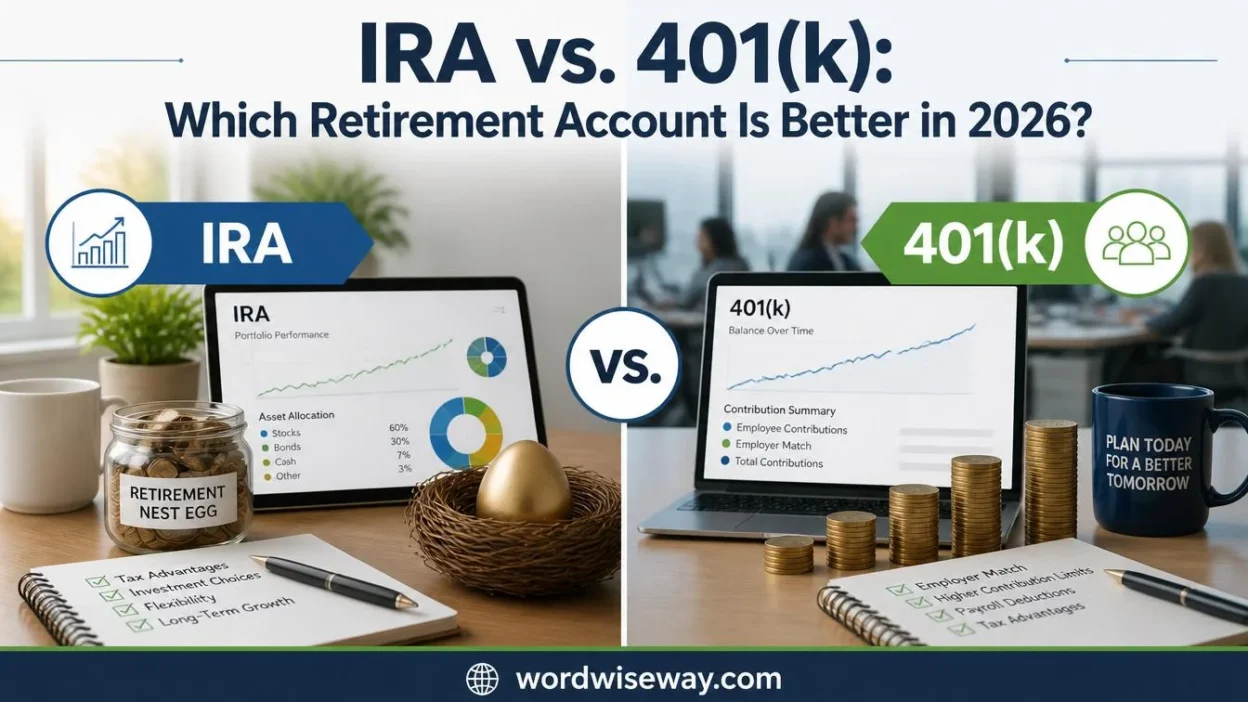
When comparing IRA vs. 401(k): Which Retirement Account Is Better in 2026?, consider your income, employer, and retirement goals.
Both are tax-advantaged ways to save money for the future. A 401(k) usually comes through an employer and offers higher contribution limits, while an IRA can provide more investment options and flexibility. An employer match may also help employees build retirement savings faster.
The better retirement account depends on your financial goals, tax benefits, investment flexibility, and expected retirement income. You may choose one account or use both accounts as part of your retirement strategy.
In 2026, consider your financial needs, job type, available workplace benefits, and long-term plans before making your account choice.
Quick Answer
If your employer offers a 401(k) match, contributing enough to receive the full available match is often a strong first move. An employer match can add money to your retirement savings on top of your own contributions.
After capturing the available match, an IRA can be attractive because it may offer a wider investment selection and additional tax-planning flexibility. If you still have money available for retirement savings, you can then increase your 401(k) contributions.
A simple framework looks like this:
| Situation | Account to Consider |
| Employer offers a valuable 401(k) match | 401(k) first |
| No employer match | Compare IRA and 401(k) |
| You want broader investment choices | IRA may have an advantage |
| You want to save more than the IRA limit | 401(k) |
| You qualify for a Roth IRA | Roth IRA may be worth considering |
| Your 401(k) has reasonable fees and good funds | 401(k) can be attractive |
| You want to use both tax structures | Consider both |
The important point is that IRA vs. 401(k) isn’t necessarily an either-or decision. Eligible workers can potentially contribute to both, subject to the rules that apply to each account.
What Is an IRA?
An IRA, or Individual Retirement Arrangement, is a retirement account that an individual can establish independently of an employer.
You can generally open an IRA through a financial institution that offers these accounts. The account can then hold investments permitted by the provider and applicable rules.
Two major types dominate the IRA landscape: the Traditional IRA and the Roth IRA.
Traditional IRA
A Traditional IRA generally provides a potential tax deduction for eligible contributions. However, the deduction isn’t automatically available to everyone.
Your ability to deduct a Traditional IRA contribution can depend on factors such as your income, filing status, and whether you or your spouse participates in a workplace retirement plan.
For 2026, the IRS lists a deduction phase-out range of $81,000 to $91,000 for single taxpayers covered by a workplace retirement plan. For married couples filing jointly, the range is $129,000 to $149,000 when the contributing spouse is covered by a workplace plan.
That distinction matters. Contributing to an IRA and receiving a tax deduction aren’t always the same thing.
Roth IRA
A Roth IRA works differently.
You contribute money after paying applicable income taxes. Qualified withdrawals can then be tax-free under the applicable rules.
The Roth IRA also has income limits. For 2026, the contribution phase-out range is $153,000 to $168,000 for single taxpayers and heads of household. For married couples filing jointly, the range is $242,000 to $252,000.
That makes income an important part of the Roth IRA decision.
What Is a 401(k)?
A 401(k) is an employer-sponsored retirement plan. Instead of opening the account independently, employees generally participate through their workplace.
Contributions can typically come directly from your paycheck. Depending on the plan, your employer may also contribute money through matching or other contributions.
That employer contribution is one of the biggest reasons a 401(k) can be difficult to ignore.
Traditional 401(k)
A Traditional 401(k) generally allows employees to make pre-tax elective deferrals. Those contributions can reduce current taxable income, subject to the applicable rules.
The money can remain invested inside the account until you take distributions according to the plan and tax rules.
Roth 401(k)
Some workplace plans also offer a Roth 401(k).
Roth 401(k) contributions generally use after-tax money. The tax treatment therefore differs from a Traditional 401(k), which generally provides its primary tax benefit upfront.
A Roth 401(k) isn’t simply a Roth IRA with an employer logo attached. The accounts have different contribution rules, eligibility requirements, and plan structures.
Contribution Limits in 2026
Contribution limits are one of the clearest differences between these accounts.
For 2026, the IRS sets the basic employee 401(k) elective-deferral limit at $24,500. The annual IRA contribution limit is $7,500 across all of your Traditional and Roth IRAs combined.
That means you can’t contribute $7,500 to a Traditional IRA and another $7,500 to a Roth IRA under the standard annual limit. The two accounts share the same IRA contribution ceiling.
| Account | 2026 Basic Contribution Limit |
| Traditional IRA | $7,500 combined with Roth IRA |
| Roth IRA | $7,500 combined with Traditional IRA |
| 401(k) employee contributions | $24,500 |
| IRA catch-up contribution, age 50+ | $1,100 |
| 401(k) catch-up contribution, age 50+ | $8,000 |
| 401(k) catch-up, ages 60–63 | $11,250 |
The 401(k) rules become even more interesting for older workers. In 2026, employees ages 60 through 63 can generally use a higher catch-up limit of $11,250 when the plan permits it.
The numbers tell an important story: a 401(k) gives many workers substantially more room to save each year.
Employer Matching Can Change the Decision
Imagine an employer says, “We’ll match part of your 401(k) contribution.”
That changes the equation.
Suppose a hypothetical employer matches a portion of employee contributions. If you contribute enough to receive the full available match, you’re taking advantage of part of your workplace compensation package.
The exact match formula varies by employer. That’s why you should read the actual plan documents rather than assume every 401(k) works the same way.
“Vesting” means ownership.
Your own 401(k) contributions are generally immediately vested. Employer contributions can follow a vesting schedule, depending on the plan.
For example, an employer may gradually vest matching contributions over several years. Some plans provide faster vesting or immediate ownership.
Always check your plan’s vesting rules before making decisions based on employer contributions.
Investment Choices and Fees
Contribution limits tell only half the story.
The investments available inside the account matter too.
An IRA often gives you access to a broader selection of investments than an employer-sponsored 401(k). The exact choices depend on the financial institution and account.
A 401(k), however, uses the investment menu selected by the employer and plan administrators. That menu might contain low-cost index funds, target-date funds, actively managed funds, or other investment options.
More choices aren’t automatically better.
A giant investment menu can feel like walking into a restaurant with a 40-page menu. Variety sounds wonderful until you’re still choosing dinner 45 minutes later.
Why 401(k) Fees Matter
Two 401(k) plans can look similar while costing very different amounts.
Potential costs can include:
- Investment expense ratios
- Administrative fees
- Recordkeeping fees
- Individual service fees
- Other plan-related expenses
Even small recurring costs can matter over decades because retirement savings may remain invested for a very long time.
Before deciding that an IRA is automatically better, compare the actual fees and investment options in your workplace plan.
Traditional IRA vs. Traditional 401(k)
Both accounts can provide tax advantages, but the mechanics differ.
| Feature | Traditional IRA | Traditional 401(k) |
| Account type | Individual | Employer-sponsored |
| Contributions | Individual | Employee payroll contributions |
| Potential tax deduction | Subject to rules | Generally pre-tax employee deferrals |
| 2026 basic contribution limit | $7,500 | $24,500 |
| Employer match | No standard employer match | May be available |
| Investment choices | Often broad | Determined by plan |
| Income-related rules | Apply to certain IRA benefits | Different rules apply |
A Traditional IRA can become particularly useful when you want more control over investments. A Traditional 401(k) can shine when the workplace plan offers a valuable match or strong low-cost investment options.
Roth IRA vs. Roth 401(k)
The word Roth can make these accounts sound nearly identical. They’re not.
A Roth IRA is an individual account with income-based contribution rules. A Roth 401(k) is part of an employer-sponsored plan.
One major difference involves income eligibility.
The Roth IRA has income phase-outs. The Roth 401(k) generally doesn’t use the same income-based contribution eligibility structure.
The contribution limits also differ dramatically. In 2026, the basic employee 401(k) limit is $24,500, while the combined Traditional and Roth IRA limit is $7,500.
This makes a Roth 401(k) potentially useful for someone who wants Roth treatment but earns too much to make a direct Roth IRA contribution.
Can You Have an IRA and a 401(k)?
Yes.
Having one account doesn’t automatically prevent you from having the other.
For example, an eligible worker could contribute to a workplace 401(k) and also contribute to a Traditional or Roth IRA, provided the applicable rules are satisfied.
That creates an important strategy:
- Contribute enough to the 401(k) to capture an available employer match.
- Consider an IRA if eligible and if its investment or tax features suit your situation.
- Increase 401(k) contributions if you want to save more.
- Review fees, taxes, investment choices, and long-term goals regularly.
The best account isn’t always the one that gets every dollar.
Sometimes the best strategy is using each account for what it does well.
Which Should You Choose First?
There’s no universal ranking, but a practical framework can help.
Consider the 401(k) First When Your Employer Matches
An employer match can make the 401(k) especially compelling.
The exact value depends on the employer’s formula. Read the plan documents and determine how much you need to contribute to receive the maximum available match.
Consider an IRA When Investment Choice Matters
An IRA may give you a broader investment universe.
That flexibility can matter if your 401(k) has expensive funds or a narrow investment menu.
However, don’t reject a 401(k) simply because an IRA offers more choices. A low-cost workplace plan with a strong match can still be extremely valuable.
Consider Both When You Want More Retirement-Saving Capacity
The annual limits don’t have to force an either-or decision.
A worker who has access to a 401(k) can potentially use both accounts and take advantage of their different features.
Think of them as two containers with different shapes. You don’t have to choose one container forever. You can decide how much belongs in each.
IRA vs. 401(k) for Different Savers
A New Worker
For someone entering the workforce, the first priority often involves establishing a consistent savings habit.
If the employer provides a match, understanding that benefit should be high on the list.
Starting early can also give investments more time to potentially compound. The specific investment return isn’t guaranteed, but time can be a powerful part of long-term retirement planning.
A Higher-Income Worker
Higher-income workers need to pay closer attention to IRA rules.
Roth IRA eligibility can phase out at higher income levels. Traditional IRA deductions can also become limited when the taxpayer or spouse participates in a workplace retirement plan.
That’s why income, filing status, and workplace coverage should be checked before assuming a particular IRA strategy works.
A Worker With an Expensive 401(k)
Suppose an employer offers a 401(k), but its investment choices carry relatively high costs.
An IRA could provide another place for retirement savings if the person qualifies and the available IRA offers lower costs or better investment choices.
The key is comparison, not assumption.
A Worker Near Retirement
Someone closer to retirement may care more about contribution limits, tax treatment, fees, withdrawal planning, and account consolidation.
At this stage, the question becomes broader than “IRA or 401(k)?”
It becomes: How should all retirement accounts work together?
Case Study
Consider a hypothetical worker named Jordan.
Jordan’s employer offers a 401(k) with a company match. The plan also offers several low-cost investment options.
Jordan could simply put all retirement savings into an IRA. However, doing that could mean missing part of the employer’s matching benefit.
Instead, Jordan could first contribute enough to the 401(k) to capture the available match. After that, Jordan could consider an IRA if eligible.
If the IRA provides attractive investment options and suitable tax treatment, it becomes a useful second account.
If Jordan still wants to save more, the higher 401(k) contribution limit provides additional capacity.
This example illustrates the central lesson:
Account selection should follow the features of the actual plan.
Common Mistakes
Ignoring the Employer Match
Leaving an available employer match unused can weaken your retirement strategy.
Check the matching formula, eligibility requirements, and vesting schedule.
Assuming Every IRA Contribution Is Deductible
A Traditional IRA contribution doesn’t automatically guarantee a tax deduction.
Income, filing status, and workplace retirement-plan coverage can affect deductibility.
Treating Every 401(k) as Identical
Employer plans vary.
One plan might offer inexpensive index funds and a strong match. Another could have higher fees and fewer investment choices.
Look at the actual plan.
Focusing Only on Contribution Limits
A $24,500 401(k) limit sounds impressive. A $7,500 IRA limit sounds small by comparison.
Yet contribution capacity isn’t the whole story.
Taxes, employer contributions, investment costs, flexibility, and eligibility all matter.
Confusing Roth IRA and Roth 401(k) Rules
Both use Roth tax treatment, but they aren’t interchangeable accounts.
Their contribution limits and eligibility rules differ. Always check the rules for the specific account.
Can You Roll a 401(k) Into an IRA?
A rollover can move retirement assets from one eligible retirement account to another.
People may consider a 401(k)-to-IRA rollover after leaving an employer. An IRA can offer broader investment choices and may simplify accounts when someone has accumulated multiple workplace plans.
However, a rollover isn’t automatically the best move.
Before acting, consider:
- Investment costs
- Available investment choices
- Tax consequences
- Account protections
- Withdrawal rules
- Existing plan features
- Whether the new account creates additional fees
The right choice depends on the specific accounts involved.
Can You Roll an IRA Into a 401(k)?
Some employer plans accept eligible IRA rollovers.
However, not every plan accepts every type of rollover. The plan’s rules matter.
This option can sometimes become relevant when someone wants to consolidate retirement assets inside an employer plan. Tax considerations can also make the details important.
Because rollover transactions can have tax consequences, checking the applicable IRS rules and the receiving plan’s requirements is essential.
Pros and Cons
| Account | Major Advantages | Potential Drawbacks |
| Traditional IRA | Individual control and potentially broad investment choices | Lower contribution limit and deduction restrictions |
| Roth IRA | Roth tax treatment and individual ownership | Income-based contribution limits |
| Traditional 401(k) | High contribution limit and possible employer match | Investment menu depends on employer plan |
| Roth 401(k) | High contribution capacity with Roth tax treatment | Requires employer plan to offer the feature |
Neither account wins every category.
That’s the point.
The better decision comes from matching the account’s strengths with your circumstances.
Read More: BMW or Mercedes: Which Luxury Car Brand Is Better?
FAQs
1. Is a 401(k) better than an IRA in 2026?
Not necessarily. A 401(k) can be more useful when your employer offers a matching contribution or when you want higher contribution limits. An IRA may suit you better if you value flexibility and a broader selection of investments.
2. Can I have both a 401(k) and an IRA?
Yes. Having both can give you more ways to build retirement savings. You can use your workplace 401(k) while also contributing to an IRA, as long as you follow the applicable contribution and income rules.
3. What is the main difference between an IRA and a 401(k)?
The biggest difference is how you access them. An employer typically provides a 401(k), while you can generally open an IRA independently. They also differ in contribution limits, investment choices, and certain tax rules.
4. Does a 401(k) have higher contribution limits than an IRA?
Yes. A 401(k) generally allows substantially higher annual contributions than an IRA. This makes it useful for people who want to put more money toward retirement each year.
5. Why is an employer match important?
An employer match can add money to your retirement savings based on your own contributions. If your workplace offers a match, understanding its rules can be an important part of deciding how to prioritize your retirement contributions.
6. Is an IRA good for beginners?
An IRA can be a straightforward retirement account for beginners who want more control over their investment choices. However, you should understand its contribution, tax, and withdrawal rules before choosing how to use it.
7. Which account gives me more investment choices?
An IRA often provides access to a wider range of investment options than a typical 401(k). The exact choices depend on the financial institution and investment platform you use.
8. Can freelancers use a 401(k) or IRA?
Freelancers can generally use an IRA, while self-employed individuals may have access to certain types of self-employed retirement plans. The right option depends on income, business structure, and applicable retirement-plan rules.
9. Should I choose an IRA or 401(k) first?
If your employer offers a matching contribution, it may make sense to consider the 401(k) first because the match can add to your savings. After that, an IRA may provide another useful way to diversify your retirement strategy.
10. What should I consider when choosing a retirement account in 2026?
Look at contribution limits, employer matching, tax treatment, investment options, fees, income, withdrawal rules, and your retirement goals. Comparing these factors gives you a clearer picture than simply asking which account is universally better.
Conclusion
There isn’t one retirement account that wins for everyone. A 401(k) can be especially valuable when an employer provides a match or when you want higher contribution limits. An IRA can complement it by offering additional investment flexibility and another way to build long-term savings.
For many people, the strongest strategy isn’t choosing between the two at all. Using a 401(k) and IRA together can provide greater flexibility as your income, career, and retirement goals change. Review your options carefully, understand the rules that apply to you in 2026, and choose an approach that fits your financial situation rather than following a one-size-fits-all answer.

Evelyn Shaw has spent 14 years at Yale University’s English Department, leading students through close readings, genre studies, and interpretive methodologies. Her scholarly interests include Renaissance drama, gothic fiction, feminist literary criticism, and archival research and examining how texts generate meaning across historical periods. Evelyn has presented at major academic conferences and published essays in peer-reviewed journals, reflecting her passion for rigorous analysis and student-centered learning.