In digital communication, CC is a commonly used term in professional correspondence, emails, offices, schools, and businesses.
Knowing its correct usage helps prevent confusion and miscommunication. When CC changes from a noun into a past tense verb, writers commonly use CC’d or CC’ed. The choice can depend on spelling style and professional preference, making this a common question for English learners and professionals.
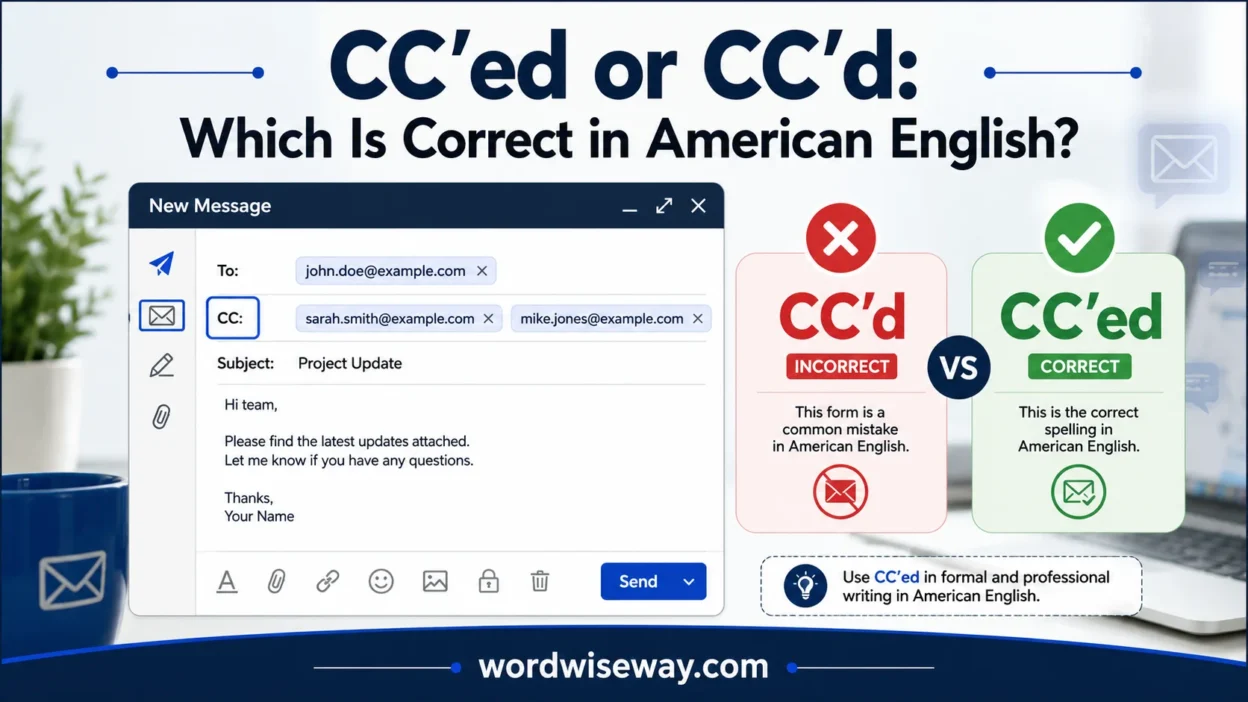
Understanding the origin, transformation, and usage of CC makes the difference clearer. In American English, both CC’d and CC’ed appear in professional writing, while CC’d is often preferred for its concise form.
Learning common mistakes, spelling differences, and real-life examples can help you use CC correctly in formal and personal communications.
Quick Answer
CC’d and CC’ed can both mean that someone was included as a recipient of a copy of an email or document.
If you want the most concise and dictionary-supported form, choose CC’d. Merriam-Webster lists cc’d as the past-tense and past-participle form of the verb cc. Oxford Learner’s Dictionaries also gives cc’d as the past simple and past participle.
CC’ed is also used in English. Dictionary.com lists both cc’ed and cc’d as verb forms.
| Form | Meaning | Recommended use |
| CC’d | Sent someone a copy | Concise and widely recognized |
| CC’ed | Sent someone a copy | Also established and understandable |
| copied | Sent someone a copy | Clear alternative when avoiding abbreviation |
For most American English writing, CC’d is the cleanest choice. If your workplace or publication uses CC’ed, that form can also work as long as you use it consistently.
What Does CC Mean in an Email?
CC stands for carbon copy. In an email, the CC field lets you send a copy of a message to another person who isn’t necessarily the primary recipient.
The term comes from older paper correspondence. Before email existed, carbon paper could create a duplicate of a typed or handwritten document. The copy could then go to another person for information or record-keeping. Merriam-Webster traces carbon copy in this document-related sense to the late nineteenth century.
Modern email kept the terminology even though carbon paper disappeared from ordinary office life. Today, you can CC a colleague, CC your manager, or CC a client without making a physical copy of anything.
Cambridge defines cc as sending a copy of a letter or email to someone in addition to the person it is addressed to.
For example:
To: Sarah
CC: Daniel
Subject: Project Schedule
Sarah is the main recipient. Daniel receives a copy so he can stay informed.
Why Do People CC Someone?
CC usually serves a straightforward purpose: keeping another relevant person in the loop.
You might CC someone when:
- They need to know what was discussed.
- They are involved in the project.
- They need the information for their records.
- They may need to respond later.
- Their supervisor or team needs visibility into the conversation.
- The message affects their work even though they aren’t the main recipient.
A CC recipient isn’t necessarily expected to take action. Often, the person simply needs awareness.
What’s the Difference?
The main difference between CC’d and CC’ed is the way writers attach the past-tense ending to the abbreviation CC.
The underlying verb is cc. Merriam-Webster defines it as a transitive verb meaning to send someone a copy of an email, letter, or memo. Its listed forms include cc’d and cc’ing.
Oxford gives the same basic pattern:
- Present: cc
- Past: cc’d
- Past participle: cc’d
- -ing form: cc’ing
The apostrophe helps show that letters have been added to an abbreviation. In CC’d, the ’d represents the past-tense ending.
With CC’ed, writers retain the fuller -ed ending instead. That creates a slightly longer form while preserving the same meaning.
Why Does CC Become a Verb?
English frequently turns nouns and abbreviations into verbs when speakers need a convenient way to describe an action.
In email language, CC started as a noun or abbreviation referring to a copy. It later developed into a verb meaning to send someone a copy.
Merriam-Webster dates the verb cc to 1983.
That gives us a simple progression:
CC as an abbreviation → CC as a verb → CC’d or CC’ed as a past form
For example:
- Present: I CC Maria.
- Past: I CC’d Maria.
- Past participle: Maria was CC’d.
- -ing form: I’m CC’ing Maria.
Once you see the pattern, the spelling becomes much less mysterious.
Is CC’d or CC’ed Correct?
CC’d is unquestionably an established form. Major dictionaries recognize it.
Merriam-Webster explicitly lists cc’d as the past and past-participle form of cc. Oxford Learner’s Dictionaries does the same.
However, calling CC’ed completely incorrect would paint the picture too narrowly. Dictionary.com lists cc’ed alongside cc’d as a verb form.
That distinction matters because language doesn’t always follow a single mechanical formula when abbreviations become verbs.
Consider the practical difference:
- I CC’d my supervisor.
- I CC’ed my supervisor.
Both tell the reader that the supervisor received a copy.
For polished American English, CC’d has a strong advantage because it is concise and explicitly supported by major learner and general dictionaries. Still, CC’ed can appear in legitimate writing.
Which Form Should You Choose?
If you’re deciding between the two while writing an email, use this simple rule:
Choose CC’d when you want the shorter, familiar form.
Use CC’ed if that spelling matches the style used consistently by your organization or publication.
When clarity matters more than email shorthand, use copied:
I copied my supervisor on the email.
That sentence removes the entire spelling debate.
Why Is CC’d So Common?
One reason CC’d works so well is its compactness. Email communication tends to favor short expressions because people often scan messages rather than read every word slowly.
Compare:
I CC’d James on the message.
with:
I copied James on the message.
Neither sentence is difficult. The first simply uses the familiar language of email.
The apostrophe also makes the construction visually clear. Without it, CCd can look awkward because the reader has to work out where the abbreviation ends and the suffix begins.
That is why CC’d is much easier to recognize at a glance.
How to Use CC’d in a Sentence
The form CC’d works naturally in active and passive constructions.
Active Voice
When the sender performs the action, use CC’d directly after the subject:
- I CC’d Maria on the email.
- We CC’d the finance team on the update.
- She CC’d her supervisor before sending the report.
- The coordinator CC’d everyone involved in the project.
Active sentences usually sound direct because they clearly identify who performed the action.
Passive Voice
You can also describe the recipient:
- Maria was CC’d on the email.
- The supervisor was CC’d on the report.
- Everyone involved was CC’d on the update.
The passive form can be useful when the recipient matters more than the sender.
For example, if the important point is that your manager received the information, “My manager was CC’d” puts the focus exactly there.
How to Use CC’ed in a Sentence
CC’ed functions in the same basic way.
Examples include:
- I CC’ed Maria on the email.
- She CC’ed her manager on the report.
- We CC’ed the entire team on the announcement.
- The client was CC’ed on the message.
The meaning doesn’t change when you replace CC’d with CC’ed.
Compare these sentences:
I CC’d Daniel on the email.
I CC’ed Daniel on the email.
The recipient and action remain identical. Only the spelling of the past-tense form changes.
Examples
The following examples show how both forms work in ordinary email writing.
| CC’d example | CC’ed example | Meaning |
| I CC’d Lisa on the update. | I CC’ed Lisa on the update. | Lisa received a copy. |
| We CC’d the manager. | We CC’ed the manager. | The manager received a copy. |
| Tom was CC’d on the email. | Tom was CC’ed on the email. | Tom received the message as a copied recipient. |
| She CC’d the client. | She CC’ed the client. | The client received a copy. |
| They CC’d our department. | They CC’ed our department. | The department received a copy. |
The important point is that meaning doesn’t change.
If you’re writing for a professional audience, consistency matters. Switching between forms randomly can make a document look less polished even when both forms are understandable.
CC as a Verb vs. CC as a Noun
Another source of confusion comes from the fact that CC can function as both a noun and a verb.
As a noun, it refers to the copy or the CC field:
Please add Sarah to the CC.
As a verb, it describes the act of sending that copy:
Please CC Sarah on the email.
The difference becomes even clearer when you change the tense.
| Grammatical role | Example |
| Noun | Sarah is in the CC. |
| Present verb | I CC Sarah. |
| Past verb | I CC’d Sarah. |
| Alternative past form | I CC’ed Sarah. |
| -ing form | I’m CC’ing Sarah. |
Cambridge and Oxford both recognize cc as a verb for sending a copy of an email or letter.
What’s the Difference?
CC and BCC both involve sending copies, but they don’t work the same way.
CC means carbon copy. People receiving the email can generally see who else appears in the To and CC fields.
BCC means blind carbon copy. A BCC recipient receives the message without appearing in the visible recipient list seen by the other recipients. Merriam-Webster defines a blind carbon copy as a copy sent without the knowledge of the other recipients.
| Feature | CC | BCC |
| Full term | Carbon copy | Blind carbon copy |
| Recipient gets the email | Yes | Yes |
| Other recipients can normally see them | Yes | No |
| Main purpose | Keep someone informed | Send a copy privately |
| Common email field | CC | BCC |
The distinction becomes important when you’re deciding who should be visible to everyone receiving a message.
Common Mistakes
Even though the difference between CC’d and CC’ed is small, several related mistakes appear regularly.
Writing CCd
CCd removes the apostrophe, which can make the word harder to read.
I CCd Maria yesterday.
A clearer version is:
I CC’d Maria yesterday.
The apostrophe visually separates the abbreviation from the ending.
Assuming CC’ed Is Always Wrong
Some grammar discussions treat CC’ed as an error simply because CC’d is more common in major dictionaries.
That’s too absolute.
Dictionary.com lists both cc’ed and cc’d, while Merriam-Webster and Oxford explicitly list cc’d.
So the more accurate conclusion is that CC’d is the preferred concise form in many contexts, while CC’ed is also found in established usage.
Writing C.C.’d
Older correspondence sometimes used forms such as C.C. or c.c. for carbon copy. Modern email writing normally uses CC or cc without periods.
Using C.C.’d can therefore look unnecessarily old-fashioned in contemporary digital communication.
Confusing CC With BCC
Don’t use the terms interchangeably.
If recipients need to know who else received the message, CC is generally the relevant field. If recipients should not see another recipient’s address, BCC serves a different purpose.
Should You Use CC’d or CC’ed in Formal Emails?
For a professional email written in American English, CC’d is a strong default.
It is short, recognizable, and directly supported by major dictionaries. Oxford lists cc’d as both the past simple and past participle. Merriam-Webster also gives cc’d and cc’ing in its verb entry.
For example:
I CC’d the project manager on the latest update.
That sentence is concise without sounding casual.
Still, CC’ed isn’t automatically inappropriate in formal writing. If your company’s internal style consistently uses that form, there is little reason to switch solely because another variant exists.
What About Very Formal Writing?
Sometimes the best solution is neither abbreviation.
Use copied when your audience may not be familiar with email terminology or when you’re writing prose that benefits from plain language.
For example:
The project manager was copied on the correspondence.
This version is especially useful in reports, explanatory documents, and formal prose where abbreviations may interrupt the flow.
CC’d, CC’ed, or Copied: Which Sounds Best?
Each option has a slightly different feel.
| Expression | Strength | Best context |
| CC’d | Short and familiar | Everyday professional email |
| CC’ed | Clear abbreviation plus full ending | Organizations that prefer this style |
| copied | Plain and immediately understandable | Formal prose and general audiences |
Think of CC’d as the compact email-native option. Copied is the plain-English option. CC’ed sits between the two.
There isn’t a meaning difference that changes the action being described.
A Practical Case Study: Choosing the Right Form
Imagine that a project coordinator sends an updated schedule to a client. The coordinator also wants the department manager to know about the change.
Three sentences can communicate the same basic fact:
1.I CC’d my manager on the email.
2.I CC’ed my manager on the email.
3.I copied my manager on the email.
All three communicate that the manager received a copy.
For a normal workplace email, CC’d is probably the most economical choice. If the company’s writing style uses CC’ed, that version can remain consistent with the organization’s conventions. In a formal report, copied may read more naturally.
The decision isn’t really about changing the meaning. It’s about style, clarity, and consistency.
A Simple Rule to Remember
If you’re stuck between CC’ed or CC’d, remember this:
CC’d is the safest concise choice for American English.
It is explicitly listed by Merriam-Webster and Oxford Learner’s Dictionaries.
At the same time, CC’ed is not meaningless or incomprehensible. It appears in established dictionary usage, including Dictionary.com.
When you want to avoid the issue altogether, write copied.
A quick memory guide:
- CC’d = concise and widely recognized
- CC’ed = established alternative
- copied = clearest plain-English option
Read More: Stoping or Stopping: Correct Spelling, Meaning, and Usage
FAQs
Is CC’d correct in American English?
Yes, CC’d is correct and widely accepted in American English. It is the shortened past-tense form of CC and works naturally in professional emails.
Is CC’ed also correct?
Yes, CC’ed is also a valid form. Writers may choose it because the -ed ending clearly shows that CC is being used as a verb.
What does CC mean in an email?
CC stands for “carbon copy.” When you CC someone, you send that person a copy of the email while another recipient may remain the primary addressee.
Which is better, CC’d or CC’ed?
Neither is grammatically wrong. CC’d is shorter and commonly used, while CC’ed may look more familiar to readers who prefer a standard -ed ending.
Can CC be used as a verb?
Yes. CC can function as a verb in everyday email language. For example, you can say, “I CC’d my supervisor on the message.”
What is the past tense of CC?
The past tense can be written as CC’d or CC’ed. Both forms indicate that someone was included as a copied recipient of an email.
Is CC’d suitable for professional writing?
Yes, CC’d is suitable for professional communication. You can use it in workplace emails, business messages, and other situations where you need to explain that someone received a copy.
Why do people write CC’ed instead of CC’d?
Some writers prefer CC’ed because adding -ed makes the past-tense ending easier to recognize. It can also feel more natural when reading the abbreviation as a verb.
Does American English prefer CC’d?
American English commonly accepts CC’d, particularly because it is compact and easy to use in email writing. However, CC’ed is not automatically incorrect.
How can I use CC’d correctly in a sentence?
You can write, “I CC’d Sarah on the email.” This tells the reader that Sarah received a copy of the message for her information.
Conclusion
The choice between CC’d and CC’ed can seem surprisingly complicated for such a small abbreviation. In practice, both forms can serve as the past tense of CC, and neither should cause confusion in normal professional communication.
If you want the shorter and cleaner option, CC’d is a strong choice for American English. If you prefer the clearer -ed ending, CC’ed also works. The most important thing is to keep your writing clear, consistent, and appropriate for your audience.