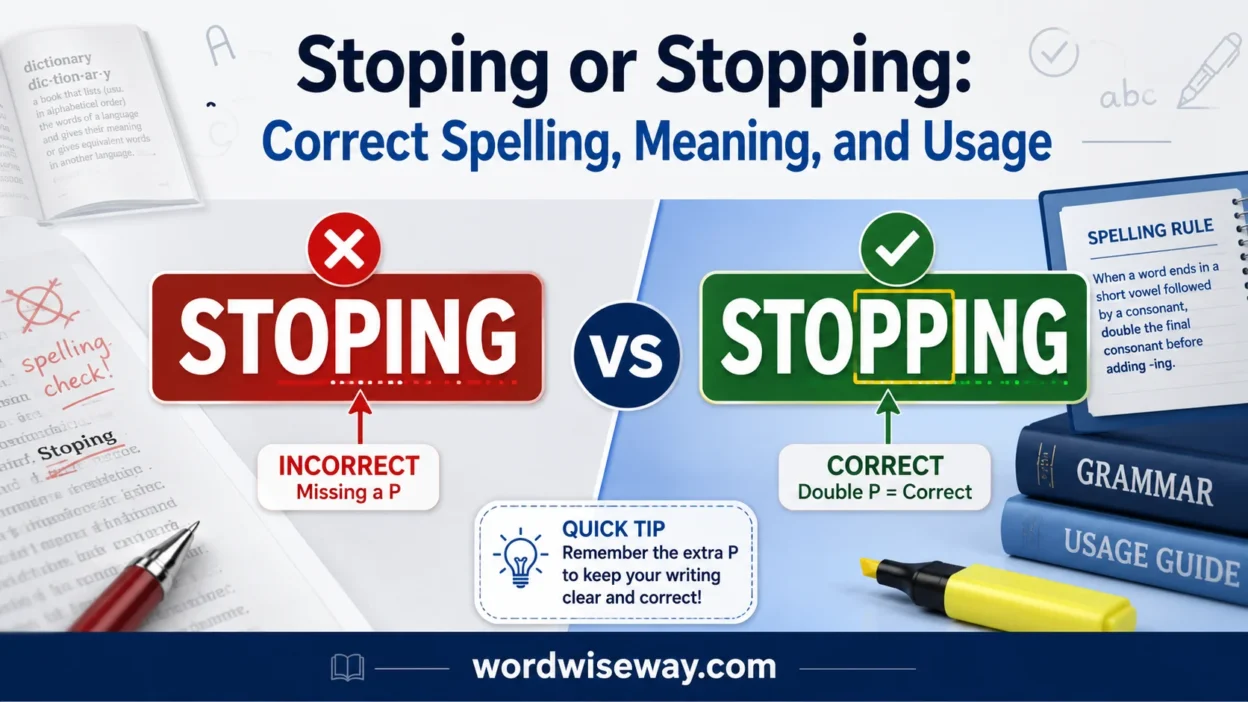
Stoping and stopping are a common spelling mistake because they sound the same, but have different meanings and uses.
Stoping is a mining term for extracting ore from underground, while stopping means to come to a halt or cease an action. They aren’t interchangeable, so using the correct word in the right context prevents confusion and misunderstanding.
The correct spelling for everyday English is stopping, while stoping is usually incorrect outside mining. Standard spelling rules explain the difference: the base word stop has a final consonant, so you double the p before adding -ing.
This rule helps you write correctly in emails, reports, school assignments, and other formal documents.
Quick Answer
Stopping is the correct spelling when you mean the action of stopping, pausing, halting, or ending something.
Stoping is a specialized technical term used in fields such as mining and geology. It isn’t the normal -ing form of the verb stop.
| Word | Correct in everyday English? | Meaning |
| Stopping | Yes | Halting, pausing, ending, or preventing something |
| Stoping | Usually no | A specialized mining or geological term |
For example:
- Correct: The bus is stopping at the station.
- Correct: She is stopping the machine.
- Correct: We are stopping for lunch.
- Incorrect: The bus is stoping at the station.
The safest rule is simple: If you’re talking about the ordinary verb “stop,” use “stopping.”
What Does Stopping Mean?
Stopping is the present participle and gerund form of the verb stop. It describes an action in which movement, activity, operation, or continuation comes to an end.
The word can describe physical movement, such as a car stopping at a traffic light. It can also describe an activity ending, such as someone stopping work. In other situations, it means preventing something from happening.
Consider these examples:
- The driver is stopping the car.
- The children are stopping their game.
- The machine keeps stopping unexpectedly.
- We are stopping at a restaurant.
- The new system is stopping unwanted messages.
Each sentence uses stopping correctly, but the exact meaning changes slightly with context.
Stopping Physical Movement
One of the most common meanings involves movement.
The train is stopping at the next station.
Here, stopping means the train is slowing down and coming to a halt.
You can use the same idea with cars, buses, bicycles, people, elevators, and many other moving things.
Stopping an Activity
Stopping can also mean ending an activity.
She is stopping the game because it’s getting late.
In this sentence, the game isn’t necessarily moving anywhere. Instead, the activity is coming to an end.
You might also say:
- He is stopping work early.
- They are stopping the discussion.
- She is stopping the lesson.
- We are stopping the meeting.
Stopping Something From Happening
Another important use means preventing something.
The security system is stopping unauthorized access.
Here, stopping doesn’t mean physically coming to a halt. It means preventing an event or action from occurring.
This pattern often appears as:
stop + someone/something + from + -ing
For example:
The fence stopped the dog from running into the road.
This construction is extremely common in everyday English.
Why Is Stopping Spelled With Two P’s?
The spelling stopping follows an English consonant-doubling rule.
When certain short verbs take endings such as -ing or -ed, the final consonant doubles. The verb stop becomes:
stop → stopping
and:
stop → stopped
The extra p prevents the spelling from becoming stoping in the ordinary verb form.
You can see the same pattern in several familiar words:
| Base Verb | Present Participle |
| stop | stopping |
| hop | hopping |
| sit | sitting |
| run | running |
| plan | planning |
The pattern becomes easier once you recognize it in several words rather than treating stopping as a spelling rule you have to memorize from scratch.
The Simple Formula
For this particular word, remember:
STOP + ING = STOPPING
Not:
STOP + ING = STOPING
The second spelling may look tempting because you’re simply adding -ing, but English spelling rules sometimes require a small change at the end of the base word.
Is Stoping a Real Word?
Here’s where things get more interesting.
Stoping is a real word. However, it doesn’t normally mean “stopping.”
In mining, stoping refers to a method or process associated with extracting ore from an underground mine. The related noun stope refers to an excavation from which ore is extracted.
The term can also appear in geology in a specialized context involving the incorporation of surrounding rock into intrusive magma.
So, if you encounter stoping in a mining textbook, geological paper, or technical report, it may be completely correct.
The key is context.
Stoping in Mining
Mining uses specialized vocabulary that can look unusual in ordinary English.
Stoping describes the process of extracting ore from a stope or underground excavation. Different mining methods use different approaches depending on the shape and location of the ore body, rock stability, depth, and other geological and engineering factors.
For example, a technical document might discuss:
- Underground stoping
- Longhole stoping
- Open stoping
- Stoping methods
- Ore extraction through stoping
These uses have nothing to do with writing the ordinary present participle of stop.
That distinction is important because saying “stoping is always wrong” would also be incorrect.
What’s the Difference?
The easiest way to separate these words is to look at their meanings and origins.
| Feature | Stopping | Stoping |
| Related base word | stop | stope |
| Everyday English | Common | Rare |
| Standard form of stop + ing | Yes | No |
| Main meaning | Halting or ending something | Specialized mining process |
| Common outside technical writing | Yes | No |
| Used in mining | Sometimes as ordinary grammar | Yes, as technical terminology |
Think of the difference this way:
Stopping belongs to everyday English.
Stoping belongs mainly to specialized technical vocabulary.
That one distinction eliminates most confusion.
Stopping in Example Sentences
Seeing the word in different contexts makes its meaning easier to understand.
Example 1: A Vehicle
The car is stopping at the traffic light.
The car is coming to a halt.
Example 2: A Machine
The printer keeps stopping halfway through the job.
Here, stopping means the machine repeatedly ceases to operate.
Example 3: An Activity
They are stopping the project temporarily.
The project is being brought to a halt.
Example 4: A Journey
We’re stopping at the next gas station.
Here, the travelers are taking a break during their journey.
Example 5: Preventing an Action
The guard is stopping people from entering the building.
In this case, stopping means preventing people from entering.
These examples show why the word is so useful. Its basic idea stays connected to ending or preventing something, but the surrounding context determines the precise meaning.
Common Mistakes
The most common error occurs when writers add -ing to stop without doubling the final consonant.
Incorrect
I am stoping the car.
Correct
I am stopping the car.
The same problem appears with the past tense.
Incorrect
The bus stoped suddenly.
Correct
The bus stopped suddenly.
A useful comparison is:
| Wrong Form | Correct Form |
| stoping | stopping |
| stoped | stopped |
If you’re unsure, look at the base word and its common forms together:
stop → stops → stopped → stopping
That sequence makes the double p much harder to forget.
Stop, Stops, Stopped, and Stopping
Understanding the main forms of stop can make the spelling clearer.
| Form | Example |
| stop | Please stop talking. |
| stops | The bus stops here. |
| stopped | The car stopped suddenly. |
| stopping | The car is stopping now. |
Each form has a different grammatical function.
Stop is the base form.
Stops is the third-person singular present form.
Stopped is the past tense and past participle.
Stopping is the present participle and gerund.
Notice that both stopped and stopping contain two p’s.
In American English
In American English, use stopping when you’re using the everyday verb stop with -ing.
This isn’t a case of American English preferring one spelling while British English prefers another. Both varieties use stopping as the ordinary form.
For comparison, some English words genuinely have regional spellings:
- American: color
- British: colour
But you don’t have the same situation with stopping.
The standard spelling remains:
stopping
The spelling stoping only becomes appropriate when you’re using the separate technical term.
Stop + -ing vs. Stop + To
There’s another useful grammar point connected with stopping.
The expressions stop doing something and stop to do something have different meanings.
Stop Doing Something
When stop comes before an -ing form, it means that the activity ends.
She stopped talking.
This means she was talking and then ended that activity.
Other examples include:
- He stopped running.
- They stopped arguing.
- I stopped checking my phone.
- We stopped working at six.
Stop to Do Something
When stop comes before to + verb, it means someone pauses one activity in order to do another.
She stopped to talk to her friend.
She wasn’t necessarily ending her entire journey. Instead, she paused what she was doing so she could talk.
Compare these two sentences:
| Sentence | Meaning |
| She stopped talking. | She ended the act of talking. |
| She stopped to talk. | She paused another activity in order to talk. |
This tiny grammatical difference can completely change the meaning of a sentence.
A Practical Case Study: Choosing Between the Two Spellings
Imagine you’re writing a sentence about a road trip:
We were stopping at several towns along the way.
That’s correct because you’re describing pauses during a journey.
Now imagine you’re reading a technical article about underground mining. The article says:
The engineers selected a particular stoping method.
That spelling can also be correct because the writer is using a specialized mining term.
The lesson is straightforward: context determines whether the word belongs in the sentence.
You shouldn’t automatically “correct” every occurrence of stoping to stopping. A technical writer discussing mining may have deliberately chosen stoping.
On the other hand, if someone writes:
The bus is stoping at the station.
the intended word is almost certainly stopping.
How to Remember the Correct Spelling
A few simple tricks can make the spelling stick.
Use the Double-P Rule
Remember:
stop → stopping
The final p doubles before -ing.
Connect It With Hopping
Think about the pair:
hop → hopping
Then apply the same pattern:
stop → stopping
Once you notice the pattern, the spelling becomes much more natural.
Remember the Technical Exception
Keep this distinction in mind:
Stopping = ordinary English
Stoping = specialized technical term
This prevents you from making the opposite mistake of assuming stoping can never be a legitimate word.
Key Facts
Here are the most important facts to remember:
- Stopping is the standard -ing form of stop.
- Stopped is the correct past tense of stop.
- Stoping is a legitimate technical word.
- Stoping commonly appears in mining and geology.
- Stopping can describe halting movement or ending an activity.
- Stopping can also mean preventing something from happening.
- American and British English both use stopping as the ordinary spelling.
- Stop + -ing means ending an activity.
- Stop + to + verb means pausing one activity to perform another.
- The safest everyday spelling is stopping.
Read More: VOO vs SPY: Which S&P 500 ETF Is Better for Investors?
FAQs
Is “stopping” the correct spelling?
Yes. Stopping is the standard spelling when you mean bringing something to a halt or ending an action.
Is “stoping” always incorrect?
No. Stoping is a legitimate mining term referring to the extraction of ore from underground.
Why does “stop” become “stopping”?
The final p is doubled before adding -ing because of the standard spelling rule for short words ending in a consonant.
What does “stopping” mean?
Stopping means coming to a halt, ending an action, or preventing something from continuing.
What does “stoping” mean in mining?
Stoping describes a mining process in which workers extract ore from an underground area called a stope.
Are “stoping” and “stopping” interchangeable?
No. They have different meanings and should be chosen according to the context in which you are writing.
Is “stoping” common in everyday English?
No. In everyday English, stoping is usually considered incorrect when you intend the verb stopping.
How can I remember the correct spelling?
Think of stop + ing = stopping. The final p doubles before -ing, giving you the standard spelling.
Why do people confuse “stoping” and “stopping”?
The words look and sound similar, so writers may forget the doubled p when changing stop into its -ing form.
Can a spell checker help with “stoping” and “stopping”?
Yes, a spell checker can identify many spelling mistakes, but understanding the meaning and spelling rule helps you choose the correct word yourself.
Conclusion:
The difference between stoping and stopping becomes much easier once you connect each spelling with its meaning. Stopping is the correct choice in everyday English when you mean coming to a halt, ending an action, or preventing something from continuing. Stoping, however, isn’t simply a misspelling in every situation. It is a genuine mining term used for extracting ore from an underground area. Because the two words look and sound similar, it’s easy to confuse them, especially when writing quickly. Remembering the meaning behind each word can help you avoid this small but noticeable spelling mistake.
The simplest rule is stop + ing = stopping, with the final p doubled before -ing. Use stopping in emails, reports, assignments, social media posts, and everyday communication whenever you mean to describe an action coming to an end. Reserve stoping for its specific mining context. Keeping this distinction in mind will make your writing clearer and help you choose the right spelling without relying entirely on a spell checker. Once the meaning and spelling rule become familiar, stoping or stopping is no longer a confusing pair, but an easy distinction to handle confidently.

Amelia Sanders has spent 14 years in Harvard University’s English Department, helping students navigate literary analysis, interpretive theory, and narrative techniques. Her academic pursuits center on 18th-century British prose, romantic poetry, diasporic writing, and digital editing exploring how textual choices influence cultural perspectives. Amelia has spoken at major international meetings and contributed essays to respected academic volumes, demonstrating her dedication to thoughtful scholarship and effective teaching.