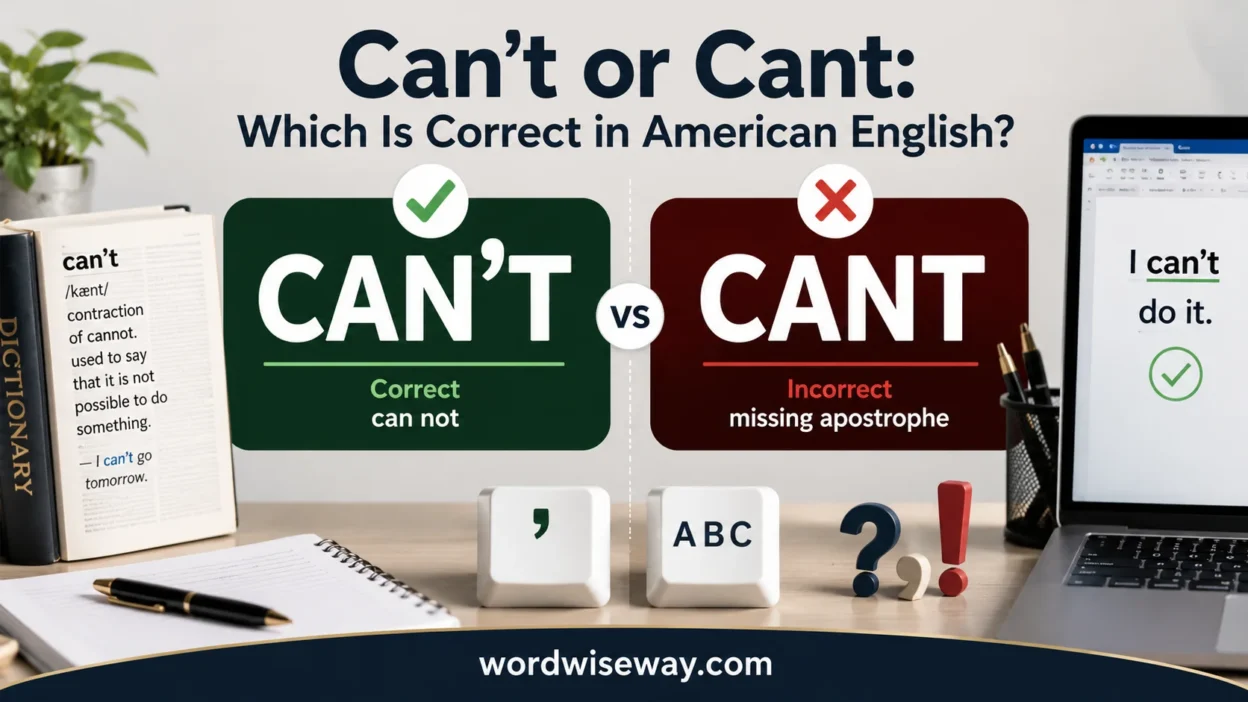
Can’t or Cant: Correct Spelling, Meaning, and Usage is a common English question. Can’t is the correct contraction of cannot and is widely used in everyday English.
Cant, without an apostrophe, is a different word meaning jargon, specialized language, or insincere speech. The two words look almost identical, which can cause confusion for students, writers, and English learners.
In writing, the correct choice depends on the intended meaning. Use Can’t when you mean cannot, such as “I can’t understand the question.” Use Cant only when its dictionary meaning is intended.
Understanding this small difference can help you avoid common spelling mistakes in emails, assignments, messages, and everyday conversations.
Quick Answer:
Can’t is correct when you mean cannot. Cant is a separate word with its own meanings and isn’t a shortened form of cannot.
| Word | Meaning | Example |
| can’t | Contraction of cannot | I can’t stay late. |
| cannot | Full negative form of can | She cannot attend today. |
| cant | Insincere talk or specialized language | The speech was full of political cant. |
| can not | Separate words used in certain constructions | You can not only study but also practice. |
The simplest test is to replace can’t with cannot. If the sentence keeps the intended meaning, can’t is correct.
For example:
- I can’t drive tonight.
- I cannot drive tonight.
Both sentences work. However:
- I cant drive tonight.
That sentence is incorrect if the intended meaning is I cannot drive tonight.
What Does “Can’t” Mean?
Can’t is the contraction of cannot. The apostrophe shows that the word has been shortened.
In everyday American English, can’t appears frequently in conversation, messages, emails, and informal writing. It can express several related ideas, including inability, lack of permission, and impossibility.
Can’t Means “Cannot”
The most common use of can’t expresses inability.
Examples include:
- I can’t swim.
- She can’t remember his name.
- We can’t finish the project today.
- He can’t understand the instructions.
- They can’t hear the announcement.
In each sentence, can’t means cannot.
Notice that can’t is followed by the base form of a verb:
I can’t understand the question.
You wouldn’t normally write:
I can’t to understand the question.
The modal verb can works with the base form of another verb.
Can’t Can Show Lack of Permission
Can’t can also indicate that someone isn’t allowed to do something.
Consider these examples:
- You can’t park here.
- Students can’t use phones during the exam.
- Visitors can’t enter this area.
- You can’t take photographs inside the museum.
In these sentences, the person may physically be able to perform the action. The problem is permission.
So can’t doesn’t always mean physical inability. Context determines the exact meaning.
Can’t Can Express Impossibility
Another important use of can’t involves something that seems impossible or highly unlikely.
For example:
- That can’t be true.
- This can’t be the right address.
- He can’t be serious.
- She can’t have forgotten the appointment.
- They can’t already be here.
Here, the speaker is making a judgment based on what they know or believe.
For instance, if someone says, “The store closed ten minutes ago,” you might respond:
That can’t be right. I was there five minutes ago.
The word expresses your belief that the information is impossible or incorrect.
Why Does “Can’t” Have an Apostrophe?
The apostrophe in can’t isn’t decorative. It marks the contraction.
The full form is:
cannot → can’t
When letters disappear during contraction, an apostrophe often marks the missing portion.
Compare:
- cannot → can’t
- do not → don’t
- does not → doesn’t
- will not → won’t
That means cant isn’t simply a faster spelling of can’t.
Compare these sentences:
- I can’t attend the meeting.
- I cannot attend the meeting.
- I cant attend the meeting.
The first two have the same basic meaning. The third uses a different word.
What Does “Cant” Mean?
Here’s where things get interesting: cant is a real English word.
It isn’t always a spelling mistake. In fact, cant has several dictionary meanings that are completely unrelated to cannot.
One common meaning refers to insincere, hypocritical, or empty talk. Another refers to specialized language used by a particular group.
Because these meanings aren’t common in everyday conversation, many readers rarely encounter cant. Still, it remains a valid word.
Cant as a Noun
As a noun, cant can refer to language that sounds morally respectable or sincere but lacks genuine belief or feeling.
For example:
The politician’s speech was dismissed as empty cant.
Here, cant suggests hollow or insincere statements.
Another use involves specialized vocabulary or language associated with a particular group.
For example:
The old document contains the cant of a particular profession.
In this context, cant refers to a type of specialized language.
Cant as a Verb
Cant can also function as a verb, although this use is less common in modern everyday writing.
Depending on the context, it can describe speaking in a particular jargon or using affected or insincere language.
For most readers, however, the key point is much simpler:
Cant has its own meanings. It isn’t a contraction of cannot.
Can’t vs. Cannot vs. Can Not
The forms can’t, cannot, and can not often cause confusion because they look almost identical.
However, they don’t always perform the same grammatical job.
| Form | Main use | Example |
| can’t | Contraction of cannot | I can’t stay. |
| cannot | Standard negative form | I cannot stay. |
| can not | Separate can and not in specific structures | You can not only read it but also explain it. |
When to Use “Cannot”
Cannot is the full form of the negative modal verb.
For example:
We cannot accept the application.
You can usually replace it with can’t:
We can’t accept the application.
The meaning remains essentially the same.
The main difference is tone. Can’t feels more conversational, while cannot can sound more formal, deliberate, or emphatic.
Compare:
I can’t attend the meeting tomorrow.
with:
I cannot attend the meeting tomorrow.
Both are grammatically correct. The second simply carries a slightly more formal tone.
When Is “Can Not” Correct?
Can not can be correct when not belongs to a larger grammatical structure.
A familiar example is:
You can not only read the book but also analyze its argument.
The structure here is:
can + not only + verb + but also + verb
The meaning isn’t simply “you cannot read the book.” Instead, it says that you have the ability to do two things.
Another example:
She can not only speak Spanish but also write it fluently.
Replacing can not only with cannot only would change the structure and create a different sentence.
This is why can not shouldn’t automatically be treated as an error.
Examples in Real Sentences
Context makes the distinction much easier to see.
| Sentence | Correct? | Explanation |
| I can’t open the door. | Correct | Can’t means cannot. |
| I cant open the door. | incorrect | Cant isn’t the contraction of cannot. |
| She can’t attend tonight. | Correct | It expresses inability or impossibility. |
| His speech was full of cant. | Correct | Cant means insincere or empty language. |
| You can’t park here. | Correct | It expresses lack of permission. |
| The writer uses technical cant. | Correct | Cant can mean specialized language. |
| They cant finish the work. | incorrect | The intended word is can’t. |
| You can not only study but also practice. | Correct | Can not belongs to a larger construction. |
The apostrophe may look like a tiny detail, but it separates two completely different words.
Common Mistakes
Writing “Cant” When You Mean “Can’t”
This is the most common mistake.
Incorrect:
I cant believe this happened.
Correct:
I can’t believe this happened.
The intended meaning is I cannot believe this happened. Therefore, the apostrophe belongs in the contraction.
Treating Cant as Another Spelling of Can’t
Some writers assume that cant is simply an informal spelling of can’t.
It isn’t.
Can’t and cant are separate words.
Think of them this way:
can’t = cannot
cant = insincere or specialized language
That distinction will solve most spelling problems involving these two forms.
Assuming Cant Is Always Wrong
It’s also incorrect to assume that cant can never be used.
Consider:
The article criticized the cant of political speeches.
Here, cant is correct because the sentence refers to insincere or stereotyped language.
The word isn’t common in casual conversation, but that doesn’t make it incorrect.
American English
In American English, can’t is the normal contraction of cannot.
You’ll see it in everyday speech and informal writing:
- I can’t go.
- We can’t wait.
- She can’t find it.
- You can’t do that.
Cant, meanwhile, is much less common in ordinary conversation. Its established meanings involve language, especially insincere speech or specialized vocabulary.
There’s another reason these words create trouble: can’t and cant can sound alike in American English.
That means pronunciation doesn’t always help.
When you’re speaking, the listener uses context to understand the intended meaning. When you’re writing, the apostrophe provides an important visual clue.
Which Should You Use?
Both can’t and cannot are grammatically useful. The better choice depends on the situation.
| Situation | Recommended form | Example |
| Casual conversation | can’t | I can’t come tonight. |
| Text messages | can’t | I can’t find it. |
| Informal email | can’t | I can’t attend today. |
| Professional writing | cannot often works well | We cannot approve the request. |
| Academic writing | cannot may fit better | The results cannot confirm the theory. |
| Strong emphasis | cannot | We cannot ignore this problem. |
| Not only construction | can not | You can not only read it but also explain it. |
Don’t treat this as a rigid rule. Can’t isn’t automatically wrong in formal writing.
Instead, think about tone.
A casual message might say:
I can’t attend the meeting.
A formal notice might say:
We cannot process incomplete applications.
The grammar works in both cases. The second simply sounds more formal.
A Simple Trick to Remember
When you’re unsure, use the cannot test.
Replace the questionable word with cannot.
If the sentence still makes sense, can’t is probably the right choice.
Example One
I can’t stay.
Replace it:
I cannot stay.
The meaning remains the same.
Therefore, can’t is correct.
Example Two
The speech was filled with cant.
Replace it:
The speech was filled with cannot.
The sentence falls apart.
Therefore, cant is correct.
This trick works because it focuses on meaning rather than appearance.
A Practical Editing Case Study
Imagine that you’re proofreading this paragraph:
I cant attend the workshop because I cant finish my project today. The speaker’s remarks sounded like political cant.
At first, the three uses might look confusing. Context clears everything up.
The corrected version is:
I can’t attend the workshop because I can’t finish my project today. The speaker’s remarks sounded like political cant.
The first two words mean cannot. They need apostrophes.
The final word means insincere or hollow language. It doesn’t need an apostrophe.
This small example captures the entire distinction.
Read More: CC’ed or CC’d: Which Is Correct in American English?
FAQs
What is the correct spelling: Can’t or Cant?
Can’t is the correct spelling when you mean cannot. It is a contraction formed by combining “can” and “not,” with an apostrophe showing the shortened form.
Cant is also a real English word, but it has a different meaning. It can refer to specialized language, jargon, or speech that isn’t sincere. In ordinary writing, Can’t is usually the word you need.
Is “cant” without an apostrophe correct?
Yes, cant is a legitimate English word. However, it isn’t the standard spelling of the contraction can’t. The meaning and context determine which form belongs in a sentence.
For example, “I can’t attend the meeting” means “I cannot attend the meeting.” Using “cant” in that sentence would be a spelling mistake because the intended meaning is cannot.
What does “Can’t” mean?
Can’t means cannot. It can express inability, impossibility, or something that isn’t allowed, depending on the sentence.
For example, “I can’t swim” expresses inability, while “You can’t park here” can express a restriction. The apostrophe is important because it identifies can’t as a contraction.
What does “Cant” mean?
Cant has several dictionary meanings that are unrelated to the contraction can’t. It may describe specialized language used by a particular group or speech that sounds insincere or affected.
The word can also appear in specialized or historical contexts. Because these meanings are uncommon in everyday conversation, most people searching for “cant or can’t” actually need can’t.
Why do people confuse Can’t and Cant?
The main reason is their nearly identical appearance. The only visible difference is the apostrophe, but that small mark changes the word’s grammatical function and meaning.
Spoken English can make the confusion even greater because can’t and cant may sound very similar. In writing, however, the apostrophe provides an important clue.
Can I use “can not” instead of “cannot”?
Sometimes, but cannot is generally the standard one-word form when expressing inability or impossibility. Can not may be used when not has a separate emphasis or function.
For everyday sentences such as “I cannot attend,” the one-word form is normally the clearest choice. Can’t is the more conversational contraction.
Is Can’t formal or informal?
Can’t is natural and widely accepted, but it generally sounds more conversational than cannot. It works well in everyday writing, messages, emails, dialogue, and other less formal contexts.
In formal academic or professional writing, some writers prefer cannot because it has a more formal tone. The choice depends on the style and audience.
Is Cant commonly used in everyday English?
Not usually. Although cant is a genuine English word, its meanings are much less common than the meaning of can’t.
If you’re writing a normal sentence about being unable to do something, can’t is almost certainly the form you need. Always consider the sentence’s intended meaning before choosing between them.
How can I remember the difference between Can’t and Cant?
A simple trick is to connect the apostrophe in can’t with the missing letters from cannot. When you mean “cannot,” think can’t.
When you see cant without an apostrophe, remember that it is a separate dictionary word. This quick check can prevent mistakes in school assignments, emails, articles, and everyday messages.
Is “I cant understand the question” correct?
No. If you mean that you are unable to understand the question, the correct sentence is “I can’t understand the question.”
The apostrophe matters because can’t means cannot. Without it, cant refers to a completely different word, so leaving out the apostrophe can create confusion for your reader.
Conclusion
Can’t and cant may look almost identical, but they serve very different purposes in English. Can’t is the contraction of cannot and is the correct choice when you’re talking about inability, impossibility, or something that isn’t permitted. The apostrophe isn’t decorative. It signals that the word has been shortened from “cannot.”
Cant, meanwhile, is a separate English word associated with meanings such as specialized language, jargon, or insincere speech. It appears far less often in everyday writing. When you’re unsure which form to use, check the meaning of your sentence first. If you could replace the word with cannot, choose can’t. That simple test will help you avoid one of the easiest spelling traps in English.

Emma Smith has dedicated 14 years to Princeton University’s English Department, mentoring students in textual interpretation, literary movements, and critical frameworks. Her research explores Shakespearean drama, Victorian serial fiction, postcolonial narrative theory, and manuscript studies and probing how literary forms evolve across cultures and centuries. Emma has delivered lectures at international humanities congresses and published findings in distinguished academic journals, underscoring her commitment to scholarly depth and vibrant teaching.