Dandruff or Lice: Difference, Symptoms, and Treatment can help you understand why scratching, flakes, and itching happen on the scalp.
Lice are a contagious parasitic infection caused by tiny parasites living in the hair and feeding on blood. Dandruff is a common skin problem linked to dry skin or a yeast infection. These are different conditions, so their treatment and remedies differ. Lice can be transmitted person to person, while dandruff usually cannot.
To tell the difference, identify, recognize, and distinguish the signs carefully. Lice and dandruff may look similar, but lice can remain attached to hair, while dandruff often falls away as loose flakes.
Knowing these distinctions is crucial for choosing the right remedies and proper prevention. Once you know what you’re dealing with, you can treat the problem effectively and avoid unnecessary confusion or embarrassment.
Quick Answer
If you’re wondering whether the white material in your hair is dandruff or lice, start with how it behaves.
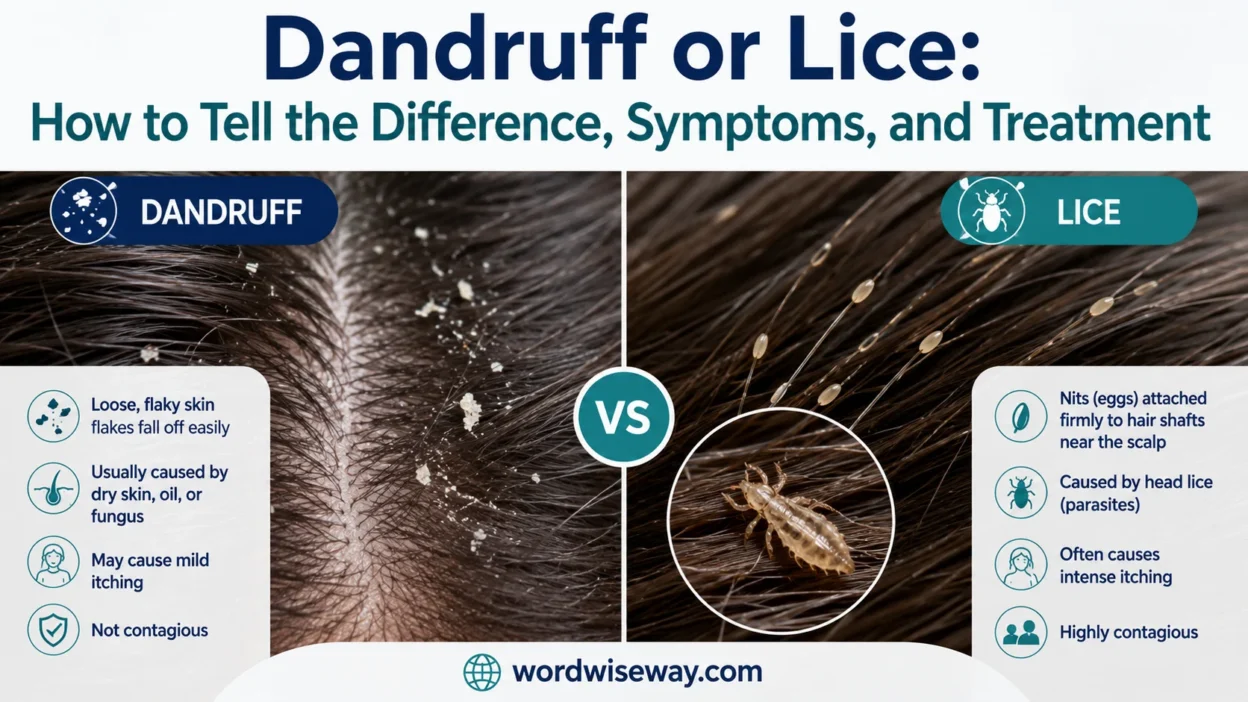
Dandruff is loose and usually comes away from the scalp or hair easily. Nits are attached to individual hair strands and can be difficult to remove. Live lice move through the hair and are usually found close to the scalp.
Itching alone doesn’t tell you which condition you have. Both can make the scalp itchy. The more useful clues are whether the material moves, whether it is attached to the hair, where you find it, and whether you can identify a live louse.
| Feature | Dandruff | Head Lice |
| What causes it? | Scalp flaking | Parasitic insects |
| Appearance | White or yellowish flakes | Small insects and oval-shaped nits |
| Moves on its own? | No | Live lice can crawl |
| Attached to hair? | Usually no | Nits are firmly attached |
| Itching | Common | Common |
| Contagious? | No | Yes |
| Common location | Across the scalp and hair | Near the scalp, especially behind ears and at the nape |
| Main clue | Loose flakes | Moving lice or firmly attached nits |
What Is Dandruff?
Dandruff is a common scalp condition in which pieces of skin shed from the scalp. You may notice small flakes in your hair, on your shoulders, or on dark clothing. It can also cause itching.
The condition isn’t simply a sign that someone doesn’t wash their hair. The American Academy of Dermatology notes that dandruff can have several contributing factors, including oily skin, hair-care habits, and certain medical conditions.
Dandruff can also overlap with seborrheic dermatitis, a related skin condition that can cause itching, scaling, and an irritated scalp. Dermatologists may recommend medicated shampoos or other treatments depending on the severity and underlying cause.
Common Signs of Dandruff
Dandruff often has a recognizable pattern. You might notice:
- Loose white or yellowish flakes
- An itchy scalp
- Flakes on your shoulders or clothing
- Dry-looking scalp
- An oily or irritated scalp
- Symptoms that come and go
One important clue is movement. If a white particle falls from your hair or comes away easily when you touch it, it is more consistent with dandruff than a nit.
What Causes Dandruff?
Dandruff doesn’t have one single cause. Several factors can contribute to scalp flaking.
The scalp naturally produces sebum, an oily substance that helps protect the skin. A type of yeast that normally lives on human skin can also play a role in seborrheic dermatitis. Dermatologists believe that a person’s response to this yeast, along with scalp oil and other factors, can contribute to inflammation and scaling.
Other factors may include:
- Oily skin
- Dry or irritated scalp
- Certain hair-care products
- Changes in weather
- Existing skin conditions
- Hair-washing habits
That means dandruff isn’t simply a cleanliness problem. In fact, the AAD specifically identifies the idea that poor hygiene causes dandruff as a misconception.
Is Dandruff Contagious?
No. Ordinary dandruff isn’t contagious.
You don’t catch dandruff because someone else has flakes in their hair. Sharing a room, sitting beside someone, or being around a person with dandruff doesn’t cause you to develop it.
This is one of the biggest differences between dandruff and head lice. Lice can spread between people, while dandruff doesn’t spread as an infestation.
What Are Head Lice?
Head lice are tiny insects that live on the human scalp and feed on blood. They don’t have wings and don’t jump or fly from one person to another.
A head-lice infestation can cause persistent itching, although itching may not appear immediately in every person. You may also notice live insects or their eggs attached to hair close to the scalp.
Because adult lice are small and can move quickly, finding one may take careful inspection. The CDC recommends using bright light and separating the hair into sections so you can see the scalp and hair shafts clearly.
What Do Head Lice Look Like?
Adult head lice are very small insects. The CDC describes crawling lice as being around the size of a poppy seed. They can appear darker against some hair colors and may be easier to spot when you carefully part the hair.
Lice tend to stay close to the scalp because that’s where they feed and reproduce.
Areas worth checking include:
- Behind the ears
- Around the nape of the neck
- Near the crown
- Along the hairline
- Close to the scalp
What Are Nits?
Nits are lice eggs.
Unlike loose dandruff, nits attach firmly to individual hair shafts. They are usually found close to the scalp because lice lay their eggs near the scalp.
Nits may appear white, grayish, or yellowish-brown. Their appearance can vary depending on lighting, hair color, and how old the eggs are.
The attachment is one of the most useful clues. The CDC notes that dandruff can generally be removed easily, while nits are difficult to pull away from the hair.
Dandruff or Lice: How Can You Tell the Difference?
When you’re trying to identify dandruff or lice, don’t rely on itching alone. Instead, inspect what you can actually see in the hair.
Check Whether the White Speck Moves
A piece of dandruff doesn’t crawl.
A live louse does.
If you see something moving through the hair, that’s a strong reason to investigate for head lice. However, don’t assume that every moving speck is a louse. Careful inspection matters because tiny pieces of debris can be misleading.
Check Whether It Is Attached to the Hair
This is one of the simplest checks.
Dandruff usually sits loosely on the scalp or hair. A nit, however, attaches to the hair shaft.
The CDC recommends trying to flick or pull away a suspicious white speck. Dandruff is easier to remove, while nits remain attached.
Think of the difference as loose dust versus a tiny bead glued to a thread. The comparison isn’t perfect, but it captures the important clue: attachment.
Look at Where You Find It
Dandruff can appear across the scalp and throughout the hair.
Lice and nits are often concentrated close to the scalp. The areas behind the ears and around the nape deserve particular attention because lice and nits are commonly found there.
Don’t Use Itching as the Only Test
An itchy scalp doesn’t automatically mean lice.
Dandruff can cause itching too. So can several other scalp conditions, including irritation from hair products and certain skin disorders. The AAD lists multiple possible causes of an itchy scalp, which is why identifying the underlying problem matters.
If the only evidence is itching, there isn’t enough information to confidently call it lice.
Use a Fine-Toothed Comb for Inspection
A careful inspection can make the difference easier to spot.
Under bright light, separate the hair into small sections. Examine the scalp and the hair close to the roots. A fine-toothed lice comb can also help with inspection.
Focus especially on:
- Behind both ears
- The back of the neck
- The crown
- Hair close to the scalp
The goal isn’t to guess. It’s to look for evidence.
Dandruff vs. Nits: Why They Get Confused
Dandruff and nits can look surprisingly similar from a distance. Both may appear as small pale particles scattered through dark hair.
The difference becomes much clearer when you examine the particles closely.
Dandruff is usually irregular, loose, and easy to move. Nits are tiny and attached to individual hairs.
Hair products can complicate the picture too. Styling products, dried shampoo, and other debris may create white or pale particles that resemble either dandruff or nits.
That’s why a quick glance isn’t always enough.
A Simple Inspection Method
Try this approach:
- Find a bright, well-lit area.
- Separate the hair into small sections.
- Look directly at the scalp.
- Examine individual hairs near the roots.
- Look behind the ears and around the nape.
- Check whether suspicious particles move.
- See whether they pull away easily.
- Look specifically for crawling insects.
If you find a live crawling louse, that provides much stronger evidence of an active infestation than simply finding a white speck.
Can You Have Dandruff and Lice at the Same Time?
Yes.
Dandruff doesn’t protect you from head lice, and having lice doesn’t prevent you from developing dandruff.
That creates an especially confusing situation. Someone may see flakes and assume everything comes from dandruff while overlooking attached nits. Another person may notice itching and immediately assume lice when the actual problem is dandruff.
When symptoms overlap, inspect the hair rather than relying on one symptom.
How to Treat Dandruff
Treatment depends on how severe the dandruff is and what is causing it.
For mild dandruff, regular hair washing may help. If that isn’t enough, dermatologists commonly recommend dandruff shampoos containing active ingredients such as:
- Zinc pyrithione
- Salicylic acid
- Sulfur
- Selenium sulfide
- Ketoconazole
- Coal tar
The AAD recommends following the directions on the specific shampoo because some products need to remain on the scalp for several minutes before rinsing.
Don’t simply pour on more product because you want faster results. More isn’t automatically better.
What If Dandruff Doesn’t Improve?
Persistent flaking may point to something other than ordinary dandruff.
Conditions such as seborrheic dermatitis, psoriasis, eczema, or a fungal infection can produce scalp symptoms that resemble dandruff. The AAD recommends seeing a dermatologist when dandruff doesn’t improve with appropriate care or becomes severe.
How to Deal With Head Lice
If you suspect head lice, first confirm that you’re actually seeing lice or firmly attached nits rather than treating every white speck as an infestation.
Head-lice treatment can involve approved lice-killing products and careful combing. Because treatment instructions differ between products and age groups, follow the product label or guidance from a healthcare professional.
A second important step is checking people who have had close contact with the affected person. Head lice primarily spread through direct hair-to-hair contact.
Avoid using random household chemicals or unapproved substances on the scalp. They can irritate the skin and aren’t a safe substitute for appropriate lice treatment.
How Do Head Lice Spread?
Head lice mainly spread through direct head-to-head contact.
For example, if two people’s hair touches closely during play, conversation, or another activity, lice can move from one person’s hair to the other’s.
They don’t jump or fly.
Because lice crawl, direct hair contact provides a much more realistic route of transmission than simply being in the same room.
Sharing personal items that touch the hair can also be relevant, although direct head-to-head contact is the main route to focus on.
How to Reduce the Risk of Head Lice
Practical prevention is more useful than panic.
You can reduce opportunities for transmission by:
- Avoiding head-to-head contact during an active infestation.
- Not sharing combs or brushes.
- Not sharing hats or other hair-contact items.
- Checking close contacts when lice are confirmed.
- Inspecting the hair carefully rather than assuming every flake is a nit.
There’s no need to treat everyone simply because one person has an itchy scalp. Confirmation matters.
Common Myths About Dandruff or Lice
Myth: Dandruff Causes Lice
It doesn’t.
Dandruff is a scalp-flaking condition. Head lice are an infestation caused by parasitic insects. One doesn’t transform into the other.
Myth: Lice Mean Someone Has Poor Hygiene
Head lice aren’t a measure of cleanliness.
They can affect people with different hair types, lifestyles, and hygiene routines. The important issue is exposure and transmission, not whether someone’s hair is clean.
Myth: Every White Speck Is a Nit
Definitely not.
Dandruff, dried hair products, skin flakes, and other debris can look similar. The CDC specifically notes that dandruff and debris can be mistaken for nits during examination.
Myth: Lice Jump From Hair to Hair
Head lice don’t fly or jump. They crawl.
That distinction matters because it helps you understand how transmission actually happens.
Myth: You Need to Treat the Entire House With Chemicals
A suspected lice infestation doesn’t mean you should spray harsh chemicals around your home.
The sensible approach is to identify the infestation, treat it appropriately, and follow current guidance for personal items and close contacts.
A Practical Case Example: Flakes or Nits?
Imagine a student notices an itchy scalp after spending time around classmates. Small white particles appear in the hair.
At first glance, it looks like dandruff.
During a careful inspection, however, some particles remain firmly attached to individual hairs near the scalp. A few sections also show tiny crawling insects.
That changes the picture.
The loose particles may be dandruff or ordinary scalp debris, but the attached nits and crawling insects provide evidence consistent with head lice. The next step isn’t to keep guessing. Appropriate lice management and checking close contacts become more relevant.
Now consider a different situation. Someone notices flakes scattered across the hair and shoulders. The particles fall away easily when the hair is brushed. No crawling insects appear, and nothing remains firmly attached to the hair shafts.
That pattern is more consistent with dandruff than lice.
The lesson is simple: look at the evidence, not just the itch.
When Should You See a Healthcare Professional?
A healthcare professional can help when the cause isn’t obvious or symptoms don’t improve.
Consider getting professional advice if:
- Severe scalp irritation develops.
- Persistent itching continues.
- Dandruff doesn’t improve with appropriate treatment.
- You aren’t sure whether you’re seeing nits or dandruff.
- The scalp develops unusual scaling or rash.
- Suspected lice remain after following an appropriate treatment.
- Scratching causes significant skin irritation.
A dermatologist can distinguish dandruff from other scalp conditions and recommend treatment based on the actual diagnosis. The AAD notes that persistent or severe dandruff may sometimes reflect another condition requiring different treatment.
Dandruff or Lice: Final Checklist
When you’re stuck between dandruff or lice, run through this quick checklist:
- Loose flakes: More consistent with dandruff.
- Firmly attached particles: More consistent with nits.
- Moving insects: Strong evidence of live lice.
- Itching alone: Doesn’t distinguish lice from dandruff.
- Flakes on clothing: Common with dandruff.
- Nits close to the scalp: Supports a lice infestation.
- Behind the ears and nape: Important areas to inspect for lice.
- Uncertainty: A healthcare professional can help confirm the cause.
The most useful clue is often surprisingly simple: Can you easily remove the particle, or is it firmly attached to the hair?
Read More: Eczema or Ringworm: Difference, Symptoms, and Causes
FAQs
How can I tell dandruff from lice?
Dandruff usually appears as loose, white or yellowish flakes that can fall from the scalp and hair. Lice are tiny insects, and their eggs, called nits, tend to stay attached to individual hair strands.
Does dandruff cause itching like lice?
Yes. Both can make your scalp itchy, but itching alone doesn’t tell you which one you have. Check for loose flakes versus lice or firmly attached nits to better understand the cause.
Can lice spread from one person to another?
Yes. Lice can spread through close head-to-head contact. Dandruff isn’t considered contagious, so you generally don’t catch it from another person.
Can dandruff turn into lice?
No. Dandruff and lice are separate scalp problems. Dandruff doesn’t develop into lice, and having dandruff doesn’t mean you’ll get a lice infestation.
What is the best treatment for lice and dandruff?
Treatment depends on the problem. Lice require products designed to kill or remove lice and nits, while dandruff is commonly managed with an appropriate anti-dandruff shampoo and regular scalp care.
Can I have dandruff and lice at the same time?
Yes, it is possible to have both. If you’re unsure whether the flakes are dandruff or lice eggs, examining the scalp and hair carefully can help you identify the problem.
Are lice visible to the naked eye?
Lice are small but can sometimes be seen by looking closely at the hair and scalp. Their eggs are often easier to notice because they remain attached to individual hairs.
Do dandruff flakes stick to hair?
Usually, dandruff flakes are loose and can fall or brush away easily. Nits, however, are attached firmly to the hair shaft, which makes them harder to remove.
Can poor hygiene cause lice?
No. Lice can affect people regardless of how clean their hair is. They spread mainly through close contact, so having lice isn’t a sign that someone has poor hygiene.
When should I get help for scalp itching?
If itching continues, becomes severe, or you’re unsure whether you’re dealing with lice or dandruff, consider asking a parent, guardian, pharmacist, or healthcare professional for help.
Conclusion
Understanding the difference between dandruff and lice makes an itchy, flaky scalp much less confusing. Dandruff is generally associated with scalp skin and loose flakes, while lice are parasites that live in the hair and can spread through close contact. The symptoms can overlap, so simply seeing flakes or feeling itchy isn’t always enough to identify the cause.
Once you know what signs to look for, choosing the appropriate treatment becomes easier. Avoid guessing or using unnecessary treatments when you’re uncertain. A careful look at the scalp and hair can help you figure out whether you’re facing dandruff, lice, or both.

Evelyn Shaw has spent 14 years at Yale University’s English Department, leading students through close readings, genre studies, and interpretive methodologies. Her scholarly interests include Renaissance drama, gothic fiction, feminist literary criticism, and archival research and examining how texts generate meaning across historical periods. Evelyn has presented at major academic conferences and published essays in peer-reviewed journals, reflecting her passion for rigorous analysis and student-centered learning.