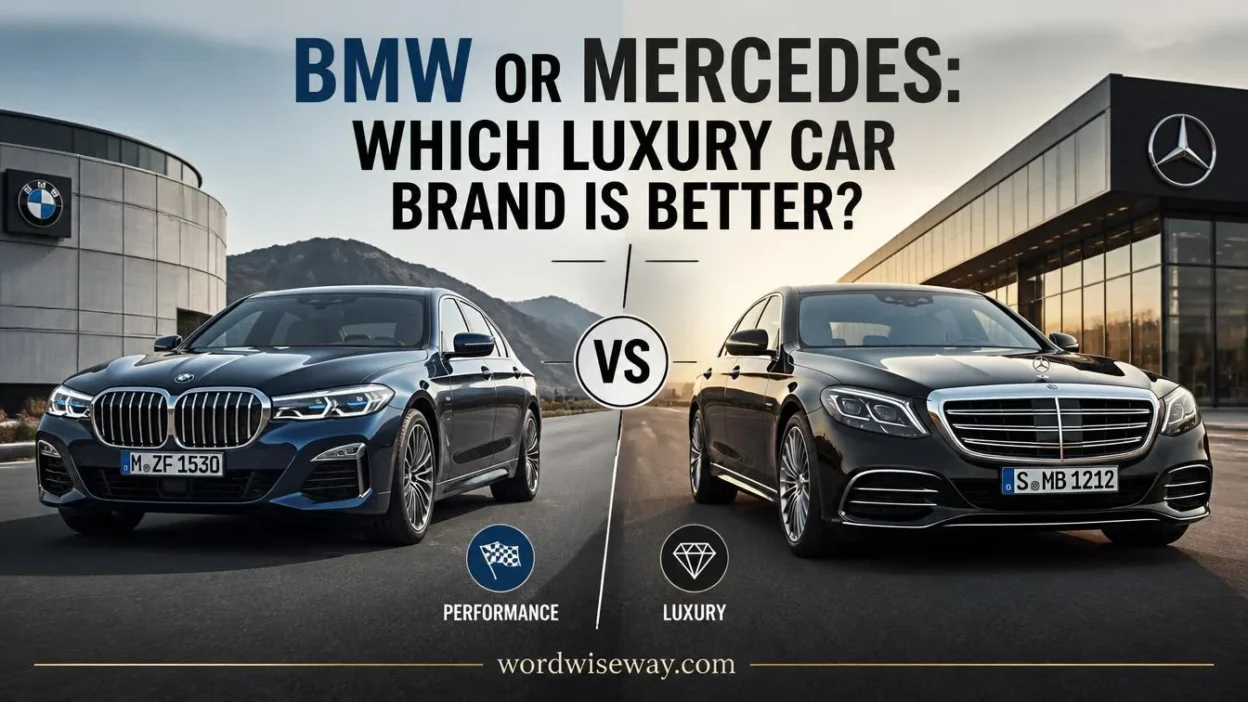
BMW or Mercedes: Which Luxury Car Brand Is Better? helps buyers compare performance, comfort, technology, driving style, and ownership needs.
Both BMW and Mercedes-Benz are leading luxury car brands with decades of innovation and advanced engineering. BMW favors sporty handling, sharp steering, and an engaging driving experience, while Mercedes-Benz emphasizes comfort, elegance, smooth ride, and classic luxury. Both offer sleek sedans, powerful SUVs, and electric vehicles with modern technology.
Your choice depends on your needs, lifestyle, and location. BMW suits drivers seeking performance, while Mercedes-Benz fits those wanting sophistication and a luxurious haven. Before choosing your next vehicle, consider ownership, driving conditions, and long-term costs.
Looking beyond marketing hype and comparing real-world differences can help you choose wisely.
Quick Answer
BMW is usually the better choice if you prioritize driving dynamics, responsive handling, and a sportier character. Mercedes-Benz is usually the better choice if comfort, refinement, cabin presentation, and luxury are your top priorities.
That doesn’t make one brand universally superior. The exact model matters enormously.
For example, the 2026 BMW 330i starts at $48,000 and produces 255 horsepower, while the 2026 Mercedes-Benz C 300 starts at $49,650 with the same 255-horsepower output. BMW lists a 5.6-second 0-to-60-mph estimate for the 330i, while Mercedes lists 6.0 seconds for the C 300.
So, at this level, the numbers are already close. The decision comes down to more than horsepower.
| Category | BMW | Mercedes-Benz |
| Driving feel | Sportier and more engaging | Smooth and composed |
| Ride comfort | Strong, especially on larger models | Usually a major strength |
| Interior design | Modern and driver-focused | Dramatic and luxury-focused |
| Performance division | BMW M | Mercedes-AMG |
| Flagship luxury | 7 Series | S-Class |
| Compact sedan | 3 Series | C-Class |
| Midsize sedan | 5 Series | E-Class |
| Midsize SUV | X5 | GLE |
| Large SUV | X7 | GLS |
| Electric lineup | BMW i models | Mercedes-EQ and newer EV models |
| Best for | Enthusiastic drivers | Comfort-focused luxury buyers |
What Is the Real Difference?
The easiest way to understand the BMW vs. Mercedes debate is to forget the badges for a moment.
Imagine two roads. One twists through a mountain route with corners arriving one after another. The other stretches across a long highway where quietness and comfort matter most. Both cars can handle either road, but their personalities become clearer in those situations.
BMW’s Driving-Focused Character
BMW has built much of its reputation around the driver’s experience. The brand’s current lineup still reflects that philosophy, particularly in models such as the 3 Series, 5 Series, M3, M5, and X5.
Steering response, chassis tuning, acceleration, and body control receive considerable attention. That doesn’t mean every BMW feels aggressive. A 7 Series, for instance, is a large luxury sedan designed to deliver comfort as well as performance.
The 2026 BMW 5 Series demonstrates that balance. The 530i produces 255 horsepower and BMW lists a 5.9-second 0-to-60-mph estimate. The 540i xDrive increases output to 375 horsepower with a listed 4.4-second 0-to-60-mph time.
Mercedes-Benz’s Comfort and Luxury Focus
Mercedes-Benz approaches luxury from a somewhat different angle. Its cars often emphasize smoothness, quietness, technology, and cabin atmosphere.
The difference becomes especially noticeable as you move upward through the lineup. Mercedes offers the S-Class at the flagship level, while Maybach adds another layer of luxury above conventional Mercedes models.
The result is a lineup that can feel especially appealing when you spend hours commuting, traveling on highways, or carrying passengers who care about rear-seat comfort.
Performance
Performance is where the comparison becomes especially interesting because both brands have serious hardware.
BMW has BMW M, while Mercedes-Benz has Mercedes-AMG. These aren’t merely cosmetic packages. They represent high-performance versions with substantial changes to engines, chassis systems, brakes, suspension tuning, and other components.
BMW M vs. Mercedes-AMG
BMW’s performance range includes models such as the M2, M3, M4, M5, and high-performance SUVs.
The 2026 BMW X5 M Competition, for example, is rated at 617 horsepower with a manufacturer-listed 0-to-60-mph estimate of 3.7 seconds. BMW lists its starting MSRP at $131,000.
Mercedes-AMG answers with vehicles such as the AMG C 43 and AMG C 63 S E Performance. The 2026 C 63 S E Performance combines a 2.0-liter turbocharged four-cylinder with an electric motor and produces a remarkable 671 horsepower. Mercedes lists a 3.3-second 0-to-60-mph estimate.
That comparison reveals an important point: neither brand owns the performance crown across every category.
Engine and Powertrain Choices
Both manufacturers now use a mixture of traditional gasoline engines, mild-hybrid systems, plug-in hybrids, and battery-electric powertrains.
BMW’s current X5 lineup illustrates the range. The 2026 X5 sDrive40i uses a 375-horsepower six-cylinder engine, while the X5 xDrive50e plug-in hybrid produces 483 horsepower.
Mercedes also uses electrification extensively. The 2026 C 300, for example, combines a turbocharged 2.0-liter four-cylinder with a 48-volt mild-hybrid system. Mercedes rates it at 255 horsepower and 295 lb-ft of torque.
For that reason, comparing “BMW engines” with “Mercedes engines” as broad categories doesn’t tell you much. Compare the exact engine, transmission, drivetrain, and vehicle.
Ride and Handling
Which One Handles Better?
If sharp handling sits near the top of your wish list, BMW generally has the stronger argument.
The brand’s smaller sedans tend to reward active driving. A 3 Series, for example, has a compact footprint that makes it easier to place through corners than a large luxury sedan.
BMW’s SUVs also try to retain some of that character. The X5 combines utility with performance, and BMW specifically emphasizes steering response and power delivery in its description of the model.
Still, tire choice and suspension configuration can change the experience dramatically. A vehicle with large wheels and performance tires won’t necessarily feel like the same car fitted with a softer setup.
Which One Has a Smoother Ride?
Mercedes-Benz generally has a strong advantage when ride comfort is the priority.
Its larger luxury models are particularly well suited to relaxed highway travel. The S-Class sits at the top of the traditional Mercedes sedan range, where refinement becomes a central part of the product.
That doesn’t mean BMW makes uncomfortable cars. The 5 Series and 7 Series can both provide substantial comfort. The difference is more about personality than capability.
Interior and Comfort
A luxury car’s interior is where you spend most of your time. Consequently, screen size alone shouldn’t determine which cabin wins.
BMW Interior Design
BMW interiors tend to combine modern technology with a cockpit that still feels oriented toward the driver.
Current models use large digital displays and connected features while retaining a relatively structured layout. The experience can feel more technical than theatrical.
The 5 Series is a good example. BMW describes it as combining technology, luxury, and performance while offering a balance suited to both shorter trips and longer journeys.
Mercedes-Benz Interior Design
Mercedes takes a more dramatic approach in many models.
Large displays, ambient lighting, premium trim, and technology-heavy dashboards create a cabin that immediately announces its luxury intentions. The effect can feel closer to a high-end lounge than a traditional driver’s cockpit.
That approach is particularly noticeable in upper-level Mercedes vehicles.
Which Interior Is Better?
There isn’t a universal winner.
Choose BMW if you prefer:
- A more driver-oriented layout
- Sportier visual cues
- A technology-rich but relatively structured cabin
- A stronger connection between the driver and controls
Choose Mercedes if you prefer:
- A more dramatic cabin
- Strong visual emphasis on screens and lighting
- A lounge-like atmosphere
- A comfort-first luxury experience
BMW vs. Mercedes: Technology
Modern luxury cars have effectively become computers with wheels. That creates another major area of competition.
Infotainment and Digital Features
BMW and Mercedes both offer sophisticated infotainment systems, digital displays, smartphone integration, navigation, connected services, and voice-related features.
However, more technology doesn’t automatically mean better technology.
A system can have a giant screen and still frustrate you if basic functions take too many steps. Conversely, a simpler interface can feel better after several months of ownership.
That’s why a test drive should include more than a lap around the dealership. Try adjusting climate settings, changing audio sources, checking navigation, and using the driver’s display.
Driver-Assistance Technology
Both brands offer advanced driver-assistance features. Availability depends heavily on the exact model, trim, and package.
That detail matters because a feature advertised for a model family may not come standard on every version.
Safety technology should therefore be compared using the exact vehicle configuration, not a general brand brochure.
Software and Over-the-Air Updates
Software now plays a much larger role in vehicle ownership.
BMW provides software-update functionality that allows owners to check for available updates using the vehicle identification number.
Mercedes likewise continues to develop connected vehicle services and digital features.
For buyers, this means a luxury vehicle’s long-term experience increasingly depends on both mechanical components and software support.
BMW vs. Mercedes: Electric Vehicles
The electric-car battle adds another layer to the BMW vs. Mercedes comparison.
BMW’s Electric Lineup
BMW currently sells several electric models in the United States, including the i4, i5, i7, iX3, and iX. Its broader lineup also includes plug-in hybrid vehicles.
The i4 gives buyers an electric alternative in a sporty four-door format. The i5 moves the concept into the executive sedan class, while the i7 targets flagship luxury.
BMW’s current U.S. pricing illustrates the spread. The i4 eDrive40 starts at $57,900, while the i5 eDrive40 starts at $67,100 and the i7 50 xDrive starts at $106,200.
Mercedes-Benz Electric Lineup
Mercedes-Benz offers electric SUVs such as the EQB, EQE SUV, and EQS SUV, while its lineup continues to evolve toward newer EV products.
The current U.S. Mercedes lineup lists the EQB from $53,050, the EQE SUV from $64,950, and the EQS SUV from $89,950. Mercedes also lists a GLC Electric SUV with pricing shown as forthcoming on its current vehicle page.
Which Brand Has Better EVs?
The smarter answer is model-specific.
If you’re comparing an i4 with an EQB, that’s one conversation. Comparing an i7 with an EQS-class product creates a completely different discussion.
Look at:
- Driving range
- Charging capability
- Efficiency
- Acceleration
- Interior space
- Software
- Cargo capacity
- Price
- Warranty
- Charging access
The electric winner can change depending on those priorities.
Sedans
Sedans remain one of the clearest places to compare the two brands.
BMW 3 Series vs. Mercedes C-Class
This is one of the most direct BMW vs. Mercedes battles.
The 2026 BMW 330i starts at $48,000, produces 255 horsepower, and has a manufacturer-listed 5.6-second 0-to-60-mph estimate. The 2026 Mercedes C 300 starts at $49,650, also produces 255 horsepower, and has a 6.0-second estimate.
| Specification | 2026 BMW 330i | 2026 Mercedes C 300 |
| Starting MSRP | $48,000 | $49,650 |
| Horsepower | 255 hp | 255 hp |
| 0-60 mph | 5.6 sec | 6.0 sec |
| Character | Sport-oriented | Comfort-oriented |
| Drive focus | Handling and response | Refinement and luxury |
Case study: If your daily commute includes winding roads and you enjoy controlling the car through corners, the 330i makes a compelling case. If your commute involves traffic, long highway stretches, and a strong preference for a luxury-focused cabin, the C 300 may suit you better.
BMW 5 Series vs. Mercedes E-Class
The 5 Series and E-Class sit in the executive sedan category.
BMW offers several powertrain choices in the 5 Series, including the 530i, 540i xDrive, plug-in hybrid 550e xDrive, electric i5 models, and M5.
Mercedes positions the E-Class as a more upscale step above the C-Class, emphasizing comfort, technology, and executive-car refinement.
Here, the difference becomes less about raw speed and more about how you want to spend your time inside the car.
BMW 7 Series vs. Mercedes S-Class
This is the heavyweight luxury matchup.
The BMW 7 Series focuses heavily on technology, luxury, rear-seat comfort, and modern design. The Mercedes S-Class remains one of the brand’s defining flagship products.
Mercedes’ current S-Class generation includes advanced driver assistance, air suspension, large digital displays, and high-end cabin features.
At this level, the question isn’t simply, “Which car is faster?”
It’s more useful to ask:
- Which rear seat do you prefer?
- Which technology feels easier to use?
- Which ride quality suits you?
- Which cabin design feels more appealing?
- How much do options cost?
- Will you drive the car or spend time being driven?
SUVs
SUVs have become central to both brands.
BMW X3 vs. Mercedes GLC
The 2026 BMW X3 30 xDrive starts at $51,300, produces 255 horsepower, and has a manufacturer-listed 6.0-second 0-to-60-mph estimate.
Mercedes lists the GLC SUV from $49,550 in the current U.S. lineup.
The X3 tends to emphasize driving response, while the GLC puts greater emphasis on comfort and luxury presentation.
For a buyer who wants a compact luxury SUV that still feels lively, the X3 deserves serious attention. For someone who wants a softer luxury experience, the GLC may be the more natural fit.
BMW X5 vs. Mercedes GLE
This is one of the most important SUV comparisons.
The 2026 BMW X5 sDrive40i starts at $68,300 with 375 horsepower. BMW also offers the xDrive40i and 483-horsepower X5 xDrive50e plug-in hybrid.
Mercedes lists the 2026 GLE 350 from $62,250, with higher trims including the GLE 450 and GLE 450e.
| Category | BMW X5 | Mercedes GLE |
| Driving character | Sportier | Comfort-focused |
| Main strength | Balance of handling and utility | Ride comfort and luxury |
| Hybrid choice | X5 xDrive50e | GLE 450e |
| Family use | Excellent | Excellent |
| Performance options | Extensive | Extensive |
BMW X7 vs. Mercedes GLS
At the large three-row level, comfort becomes even more important.
The BMW X7 offers three-row seating and currently starts at $87,500 in the U.S.
Mercedes lists the GLS from $90,250 and offers higher-performance AMG and luxury-focused Maybach variants.
For families, the decision should focus on third-row usability, cargo space, child-seat access, ride comfort, visibility, and daily maneuverability.
A large SUV can look magnificent in a showroom and become surprisingly inconvenient in a crowded parking lot. Real-world dimensions matter.
Reliability and Maintenance
Reliability is one area where broad internet stereotypes can create more confusion than clarity.
There isn’t a reliable rule saying every BMW is less reliable than every Mercedes, or vice versa.
Model, engine, generation, maintenance history, and driving conditions matter.
J.D. Power’s 2025 Vehicle Dependability Study evaluates problems reported by owners of three-year-old vehicles. Interestingly, its category winners included the BMW 3 Series for Compact Premium Car and the Mercedes-Benz GLC for Compact Premium SUV.
That doesn’t mean every BMW 3 Series or GLC will be trouble-free. It demonstrates why specific model-level evidence is more useful than brand stereotypes.
Maintenance Costs
Luxury vehicles can cost more to maintain than mainstream cars because they often use sophisticated components, specialized systems, larger wheels, premium tires, complex electronics, and high-output powertrains.
Potential ownership expenses include:
- Routine servicing
- Tires
- Brake components
- Fluids
- Batteries
- Suspension components
- Electronics
- Cooling-system components
- Insurance
- Premium fuel for applicable engines
Performance versions can increase those costs further.
Used BMW vs. Used Mercedes
When buying used, condition beats badge.
A well-maintained BMW with complete service records can be a smarter purchase than a neglected Mercedes. The reverse is equally true.
Before purchasing a used luxury car, check:
- Service history
- Vehicle-history report
- Accident records
- Tire condition
- Brake condition
- Warning lights
- Suspension behavior
- Fluid leaks
- Electronic functions
- Previous maintenance
- Pre-purchase inspection results
Don’t buy a complicated machine based solely on a shiny exterior.
BMW vs. Mercedes: Safety
Safety should always be judged at the vehicle level.
The Insurance Institute for Highway Safety evaluates individual models using crashworthiness and crash-avoidance tests. For example, the 2025 BMW 3 Series received a Good rating in the small-overlap front test and an Acceptable rating in the updated moderate-overlap front test.
IIHS also maintains model-specific 2026 safety results for Mercedes-Benz vehicles.
The important takeaway is simple: don’t assume a brand-wide safety score applies equally to every model.
Check the exact model year and equipment.
Pricing and Ownership Value
Luxury-car pricing can become slippery once options enter the picture.
A car with a reasonable starting MSRP can become substantially more expensive after adding premium packages, larger wheels, advanced driver-assistance systems, upgraded audio, special paint, and other features.
For example, BMW’s current U.S. lineup lists the 2026 330i at $48,000, while the X5 begins at $68,300 and the X7 at $87,500.
Mercedes’ current lineup lists the C 300 from $49,650, GLE from $62,250, GLS from $90,250, and G-Class from $153,900.
When comparing ownership value, consider more than MSRP:
| Ownership factor | Why it matters |
| Purchase price | Determines initial financial commitment |
| Financing | Interest can materially change total cost |
| Insurance | Luxury and performance models can cost more to insure |
| Fuel/electricity | Powertrain affects ongoing energy costs |
| Maintenance | Service requirements vary by model |
| Repairs | Complex components can be expensive |
| Tires and brakes | Performance vehicles can consume costly wear items |
| Depreciation | Affects long-term ownership value |
| Resale value | Important when selling or trading |
Which Brand Is Better for Different Buyers?
The best choice becomes much clearer when you start with your priorities.
| Your priority | Better starting point |
| Sporty driving | BMW |
| Sharp handling | BMW |
| Relaxed ride | Mercedes-Benz |
| Traditional luxury feel | Mercedes-Benz |
| Performance models | Both |
| Flagship luxury | Both |
| Compact luxury sedan | BMW 3 Series or Mercedes C-Class |
| Executive sedan | BMW 5 Series or Mercedes E-Class |
| Family SUV | BMW X5 or Mercedes GLE |
| Three-row SUV | BMW X7 or Mercedes GLS |
| Electric vehicle | Compare exact models |
| Used luxury car | Condition and service history first |
These aren’t laws of physics. They’re starting points.
Pros and Cons
BMW Pros
- Strong driving dynamics
- Broad range of performance models
- Excellent selection of sedans and SUVs
- BMW M performance lineup
- Growing electric portfolio
- Strong balance between luxury and driver engagement
- Several powertrain options across major model families
BMW Cons
- Options can push the price upward quickly
- Sport-oriented configurations can reduce ride comfort
- Maintenance can become expensive outside warranty
- Model and package differences can make comparisons complicated
Mercedes-Benz Pros
- Excellent focus on comfort and refinement
- Strong flagship luxury models
- Sophisticated cabin technology
- Broad SUV lineup
- Mercedes-AMG performance vehicles
- Mercedes-Maybach luxury models
- G-Class offers a distinctive combination of luxury and off-road capability
Mercedes-Benz Cons
- Options can become expensive
- Technology-heavy interiors won’t appeal to everyone
- Some features depend heavily on trim and packages
- Model-specific differences make broad reliability claims unreliable
BMW or Mercedes: Which Should You Buy?
Choose BMW If You Value Driving
BMW is the natural starting point if you enjoy being behind the wheel.
The 3 Series, 5 Series, X3, and X5 provide different levels of practicality while retaining a performance-oriented character. BMW M then pushes that philosophy much further.
For someone who sees a winding road as part of the entertainment, BMW has the stronger overall personality.
Choose Mercedes-Benz If Comfort Comes First
Mercedes makes more sense when your ideal luxury car feels quiet, smooth, comfortable, and technologically impressive.
The C-Class provides a relatively accessible entry into the brand, while the E-Class and S-Class move progressively deeper into luxury.
For passengers, long-distance travelers, and buyers who value cabin atmosphere, Mercedes-Benz has a compelling advantage.
Compare the Exact Models Before Deciding
This is perhaps the most important advice in the entire comparison.
Don’t ask only, “Is BMW better than Mercedes?”
Ask:
Is the BMW 330i better for me than the Mercedes C 300?
Then compare:
- Price
- Equipment
- Acceleration
- Fuel economy
- Interior
- Ride quality
- Handling
- Warranty
- Maintenance
- Resale value
- Safety equipment
That question produces a much better buying decision.
BMW vs. Mercedes: Final Verdict
So, BMW or Mercedes?
For drivers who prioritize handling, responsiveness, and performance, BMW generally has the edge. Its lineup gives you plenty of ways to combine everyday practicality with an engaging driving experience.
For buyers who prioritize comfort, refinement, cabin atmosphere, and luxury, Mercedes-Benz often makes the stronger case. Its higher-end models especially demonstrate how seriously the brand treats passenger comfort and technological presentation.
Yet neither brand wins every category. A BMW X5 can be remarkably comfortable. A Mercedes-AMG can be brutally quick. A BMW 7 Series can deliver serious flagship luxury. An S-Class can still move with surprising authority.
The smartest answer is therefore not a simple brand verdict. Choose the personality that matches how you actually drive. Then compare the exact models, trims, powertrains, equipment, and ownership costs.
For current U.S. specifications, BMW’s official model listings provide pricing and powertrain information across its lineup, while Mercedes-Benz USA provides current model pricing and configurations.
Read More: Vanguard vs. Fidelity: Which Brokerage Is Better for You?
FAQs
1. Is BMW better than Mercedes?
BMW is often a better choice for drivers who enjoy sporty handling, responsive steering, and an engaging driving experience. Mercedes-Benz may suit people who prioritize comfort, elegance, and a smoother ride.
2. Which is more luxurious, BMW or Mercedes?
Both brands offer premium interiors, advanced technology, and high-quality materials. Mercedes-Benz generally emphasizes a more comfort-focused and elegant atmosphere, while BMW combines luxury with a stronger performance-oriented character.
3. Which brand has better performance, BMW or Mercedes?
BMW has a strong reputation for driving dynamics and performance-focused vehicles. Mercedes-Benz also offers powerful models, but its lineup often balances performance with comfort and refinement.
4. Which is more comfortable, BMW or Mercedes?
Mercedes-Benz is usually associated with a softer, more relaxed driving experience. BMW can still provide excellent comfort, but many of its models place greater emphasis on handling and driver engagement.
5. Are BMW and Mercedes reliable luxury cars?
Reliability can vary significantly by model, engine, year, and maintenance history. Regular servicing and choosing a well-maintained vehicle are important when considering either brand.
6. Which brand has better technology?
BMW and Mercedes-Benz both offer advanced infotainment, driver-assistance systems, digital displays, and connected features. The better choice often comes down to which interface and features feel easier for you to use.
7. Which is better for everyday driving?
Mercedes-Benz can be appealing for relaxed commuting because of its comfort-oriented character. BMW may be preferable if you want everyday practicality combined with more engaging handling.
8. Is BMW or Mercedes more expensive to maintain?
Maintenance costs depend on the specific model, age, mileage, parts, and service provider. Since both are premium German brands, buyers should budget for higher maintenance costs than they might expect from many mainstream vehicles.
9. Which brand has better SUVs?
Both BMW and Mercedes-Benz offer a broad range of SUVs, from compact models to large luxury vehicles. Your decision should depend on space, comfort, performance, technology, and how you plan to use the SUV.
10. Should I buy a BMW or Mercedes?
Choose BMW if performance, handling, and driver involvement matter most to you. Choose Mercedes-Benz if you prefer comfort, refinement, and a sophisticated cabin. Test-driving comparable models is one of the best ways to make the final decision.
Conclusion
Choosing between BMW and Mercedes-Benz isn’t simply about picking the more famous badge. Both luxury car brands have built strong reputations through engineering, design, technology, performance, and decades of automotive development. BMW stands out for drivers who enjoy responsive handling and a more performance-focused experience, while Mercedes-Benz appeals to those who value comfort, elegance, and a refined driving environment. The right choice ultimately depends on what you expect from your vehicle every day.
Before making a purchase, compare specific models rather than judging the entire brand from one vehicle. Consider your budget, driving habits, comfort preferences, maintenance expectations, available features, and long-term ownership plans. A careful comparison can turn the BMW or Mercedes debate from a confusing brand battle into a much simpler personal decision.