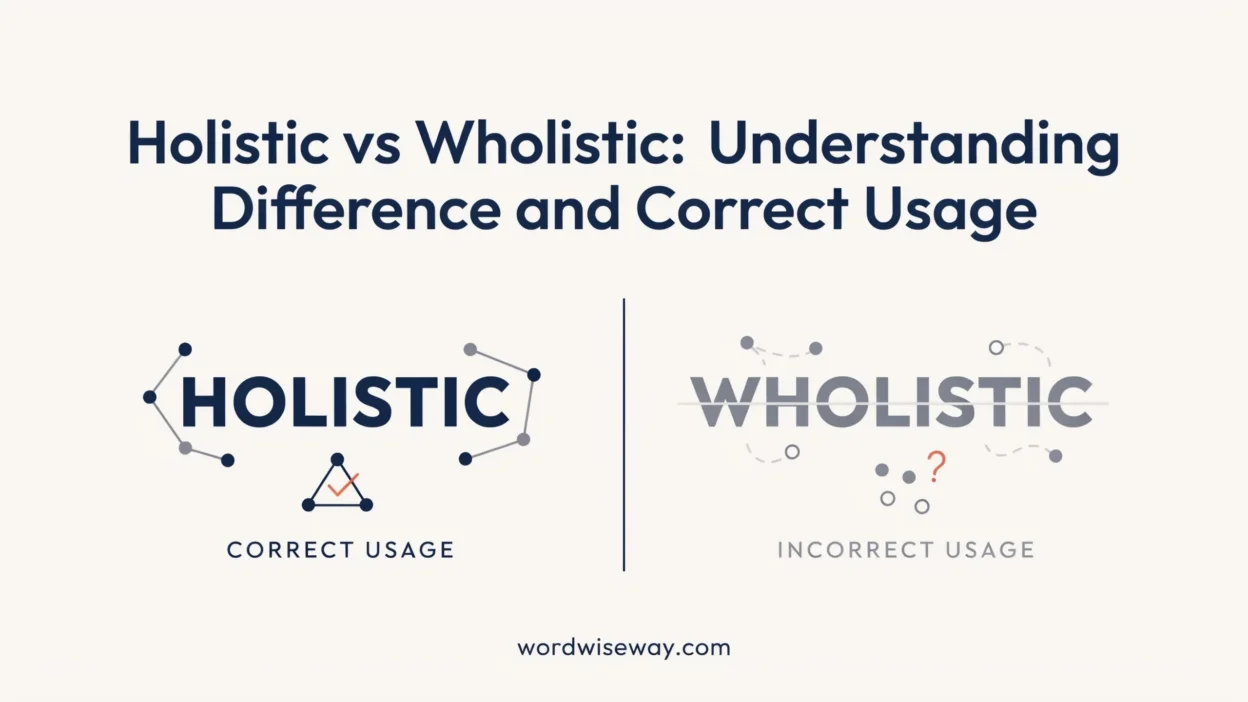
The Holistic vs Wholistic: Difference and Correct Usage topic explains why these words create confusion among writers because they have a similar sound and appear in related contexts
. Holistic is the standard and preferred spelling in modern English, while wholistic is a recognized variant but less common. Both describe a philosophy where all parts of a thing are interconnected. In healthcare, holistic treatment focuses on the whole person, including the mind, body, and social factors, while wholistic often describes a broader philosophy of life and well-being.
Many people use holistic and wholistic interchangeably because their meanings are closely connected. However, holistic appears more frequently in healthcare, wellness, and personal development discussions. Understanding the correct usage, common spelling differences, and practical examples helps you avoid common mistakes while choosing the most appropriate term for your writing.
Quick Answer
✅ Holistic is the correct and widely accepted spelling in modern English.
❌ Wholistic is a recognized variant, but it is less common and usually avoided in general writing.
- ✅ Holistic is commonly used in healthcare, wellness, education, and personal development.
- ✅ It focuses on treating the whole person, including the mind, body, and overall well-being.
- ⚠️ Wholistic can be used when someone wants to emphasize a complete or whole approach, but it is not the preferred spelling.
- ✅ For most professional and academic writing, choose holistic.
Holistic vs Wholistic: Why This Confusion Exists
At first glance, the difference looks like a simple typo. Many assume “wholistic” is just a misspelling of “holistic.” Others believe both are equally valid and interchangeable.
The reality is more nuanced.
- Holistic is the standard, widely accepted spelling used in academic, medical, and professional contexts
- Wholistic is a variant spelling that exists mainly for stylistic emphasis on the word “whole”
So the confusion comes from meaning overlap, not meaning difference.
Both words point toward the idea of seeing something as a complete system instead of separate parts, but only one is universally recognized as standard English.
What Does Holistic Mean?
The word holistic refers to an approach that considers the entire system rather than isolating individual components.
It comes up in many fields:
- Medicine
- Education
- Psychology
- Business strategy
- Environmental studies
Simple Definition
Holistic means focusing on the whole instead of breaking things into parts.
Real-world meaning
Instead of treating just symptoms, a doctor might examine lifestyle, diet, stress, and environment together. That is a holistic approach.
Example sentences
- The clinic uses a holistic approach to patient care.
- The company adopted a holistic business strategy to improve long-term growth.
- Teachers are encouraged to take a holistic view of student development.
Key idea
Holistic thinking connects everything. Nothing exists in isolation.
What Does Wholistic Mean?
The word wholistic is less formal and less widely accepted, but it still appears in writing.
Simple Definition
Wholistic is a variant spelling of holistic that emphasizes the idea of “whole.”
Where it appears
- Wellness and alternative medicine writing
- Branding in health and lifestyle industries
- Informal or expressive contexts
Example sentences
- The trainer follows a wholistic lifestyle program that includes mindset and nutrition.
- Some wellness coaches prefer a wholistic healing method.
Important note
Even though wholistic and holistic often mean the same thing in practice, wholistic is not the preferred academic spelling.
Etymology: Where Holistic vs Wholistic Comes From
To really understand this difference, we need to go back in time.
Holistic origin
The word holistic comes from the Greek word:
- holos → meaning whole, entire, complete
It entered English through scientific and philosophical usage in the early 20th century, especially in psychology and systems thinking.
Wholistic origin
The spelling wholistic developed later in English as writers tried to:
- Make pronunciation clearer
- Highlight the word “whole” visually
- Emphasize completeness in a more intuitive way
So wholistic is not older. It is actually a reinterpretation of holistic.
Holistic vs Wholistic: Key Differences Explained Simply
Even though they look similar, their usage is not equal.
Core difference
- Holistic = Standard, widely accepted spelling
- Wholistic = Variant spelling used for emphasis or branding
Meaning difference
There is almost no meaning difference in modern usage. Both refer to the idea of completeness or total systems thinking.
Context difference
The real difference lies in where you use them.
Holistic vs Wholistic Comparison Table
| Feature | Holistic | Wholistic |
| Standard usage | Yes | No (variant) |
| Academic acceptance | High | Low |
| Medical usage | Common | Rare |
| Branding use | Common | Sometimes preferred |
| Dictionary listing | Standard entry | Often listed as variant |
| Meaning difference | None | None significant |
| Professional tone | Strong | Informal |
When to Use Holistic (Safe and Correct Choice)
If you are unsure, choose holistic. It is always the safer option in formal writing.
Use holistic in:
- Academic essays
- Medical writing
- Scientific research
- Journalism
- Corporate communication
Why it works better
It is recognized across all English-speaking regions and carries authority.
Example usage
- A holistic healthcare model improves patient outcomes by treating root causes.
- Companies need a holistic strategy to survive competitive markets.
When Wholistic Appears in Writing
Even though wholistic is less formal, it still shows up in specific contexts.
Common usage areas
- Wellness blogs
- Spiritual coaching content
- Lifestyle branding
- Alternative health practices
Why people choose it
Writers often prefer wholistic because it:
- Feels more intuitive
- Highlights the word “whole” visually
- Matches brand identity
But here’s the catch
Search engines and academic institutions still favor holistic, so wholistic can reduce clarity in professional contexts.
Common Misconceptions About Holistic vs Wholistic
Let’s clear up the confusion.
Misconception 1: Wholistic is the correct spelling
Not really. It is a variant, not the standard.
Misconception 2: They mean different things
In most modern contexts, they do not.
Misconception 3: Holistic is a typo
False. Holistic is the original and widely accepted form.
Misconception 4: Wholistic is more modern
Incorrect. Holistic predates it in formal usage.
Real-World Examples: Holistic vs Wholistic in Sentences
Holistic examples
- The hospital uses a holistic treatment model combining physical and emotional care.
- The policy takes a holistic view of education reform.
- The designer adopted a holistic approach to user experience.
Wholistic examples
- The coach offers a wholistic training system including diet and mindset.
- The brand promotes a wholistic wellness philosophy.
Style Guide: How Writers Should Choose Between Holistic vs Wholistic
Choosing the right word depends on your audience.
Use holistic when:
- Writing for formal readers
- Targeting academic or professional credibility
Use wholistic when:
- Brand identity explicitly uses it
- Writing informal or niche wellness content
- Emphasizing philosophy over formal correctness
Golden rule
If clarity and authority matter, stick with holistic.
Mini Decision Flow: Holistic vs Wholistic
Use this quick mental check:
- Writing formal or academic content? → Use holistic
- Writing for wellness branding? → Maybe wholistic
- Unsure? → Always choose holistic
- Want maximum clarity? → Stick with holistic
Case Study: Branding Choice in Holistic vs Wholistic Usage
Let’s imagine two wellness brands.
Brand A: Uses “Holistic Wellness Center”
- Appears in search results easily
- Builds trust quickly
- Aligns with medical and academic language
Brand B: Uses “Wholistic Healing Studio”
- Feels more niche and spiritual
- Attracts a specific audience
- May lose search traffic due to spelling variation
- Works better for identity-driven branding
Takeaway
Both work, but only one scales broadly across search and formal credibility.
Read More: Kill or Be Killed: Meaning, Usage, and Difference
FAQs
1. Is holistic the correct spelling?
Yes, holistic is the standard and most widely accepted spelling in modern English. It is commonly used in healthcare, wellness, education, and personal development.
2. Is wholistic a real word?
Yes, wholistic is a recognized word, but it is much less common than holistic. Some people use it to emphasize the idea of considering the complete or whole picture.
3. What is the main difference between holistic and wholistic?
The main difference is usage and popularity. Both words refer to a complete approach that considers all connected parts, but holistic is the preferred spelling in most situations.
4. Why do people confuse holistic and wholistic?
People often confuse these words because wholistic looks like it comes directly from the word “whole.” Since both words have similar meanings, the spelling difference can be confusing.
5. Is wholistic incorrect?
No, wholistic is not completely incorrect. However, it is less common, and many writers prefer holistic because it is more established and widely recognized.
6. Should I use holistic in professional writing?
Yes. In professional, academic, and online writing, holistic is usually the better choice because readers recognize it more easily.
7. What does holistic mean in healthcare?
In healthcare, holistic means looking at a person as a whole by considering physical, mental, emotional, and social factors instead of focusing on only one issue.
8. Can holistic and wholistic be used interchangeably?
In many cases, yes. Both words express the idea of treating something as a complete system, but holistic is used far more often.
9. What are related words for holistic?
Related words include holism and holistically. These terms describe the idea that different parts work together as one connected system.
10. Which word should I use: holistic or wholistic?
For most writing purposes, choose holistic. It is the accepted spelling and works best for healthcare, education, business, and general communication.
Conclusion
Understanding the difference between holistic and wholistic helps you make better spelling and writing choices. While both words share a similar meaning and describe a complete approach, holistic remains the preferred and most common option. Whether you are writing about healthcare, wellness, education, or personal growth, using holistic will make your message clearer and more familiar to readers.
Although wholistic has its place and some organizations or practitioners still use it to highlight the idea of a complete approach, it is not the usual choice in modern writing. Choosing the right word depends on your audience and purpose, but in most cases, holistic is the safest and most recognized term. A clear understanding of these words allows you to communicate ideas about the whole person, connected systems, and overall well-being with greater confidence.

Emma Smith has dedicated 14 years to Princeton University’s English Department, mentoring students in textual interpretation, literary movements, and critical frameworks. Her research explores Shakespearean drama, Victorian serial fiction, postcolonial narrative theory, and manuscript studies and probing how literary forms evolve across cultures and centuries. Emma has delivered lectures at international humanities congresses and published findings in distinguished academic journals, underscoring her commitment to scholarly depth and vibrant teaching.