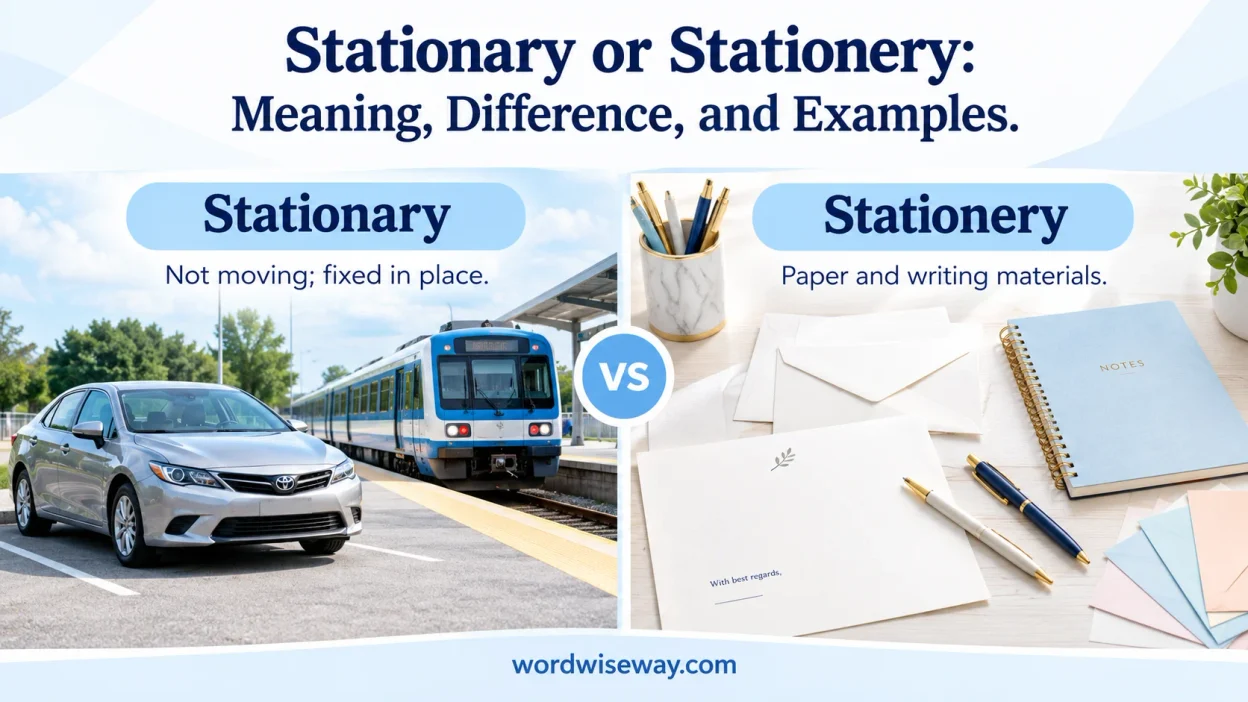
Stationary or Stationery: Meaning, Difference, and Examples explains why these words often confuse readers. They sound alike, but have different meanings. Stationary means something that doesn’t move, while stationery includes paper, pens, notebooks, and office supplies.
This spelling confusion is common in emails, school work, business writing, and social media posts. Choosing stationary instead of stationery can create spelling mistakes, change the meaning of a sentence, and make your writing look less professional.
A clear understanding of their origin, spelling rules, and common mistakes helps with real-world usage. In American English, British English, and global communication, the difference stays the same. Remembering that stationary means staying still and stationery means writing supplies makes these examples easier to use correctly.
Quick Answer:
Use stationary when you mean not moving, fixed, or staying in one position.
Use stationery when you mean writing materials or office supplies used for writing.
| Word | Meaning | Part of Speech | Example |
| Stationary | Not moving or changing | Adjective | The car remained stationary. |
| Stationery | Writing materials and supplies | Noun | She bought new stationery. |
A quick way to remember the difference is to connect stationery with envelopes. Both contain an e. When you need paper, envelopes, or writing supplies, think stationery.
When something isn’t moving, choose stationary.
What Does Stationary Mean?
Stationary is an adjective that describes something that stays still or remains in one position. It can describe a person, vehicle, object, machine, or even something that isn’t changing.
Cambridge Dictionary gives examples such as a stationary car or train and also uses the word for something that remains unchanged.
For example:
- The bus remained stationary at the stop.
- Please keep the camera stationary.
- The cyclist stood stationary for several seconds.
- The machine must remain stationary during the test.
- The traffic became completely stationary.
In each example, the central idea is lack of movement or change.
Stationary Means Not Moving
The most common meaning of stationary is simply “not moving.”
Imagine a car parked at the side of the road. The car isn’t traveling anywhere. It is stationary.
Now imagine the same car moving down the highway. It is no longer stationary.
This makes the word useful when you want to describe a contrast between movement and stillness.
Moving: The train is traveling toward the station.
Not moving: The train is stationary at the platform.
Stationary Can Also Mean Unchanging
The word doesn’t always describe physical movement. It can also describe something that remains unchanged.
For example:
The inflation rate remained stationary for several months.
Here, stationary doesn’t mean that the inflation rate has a physical location. It means the rate hasn’t changed.
This broader use matters because it prevents you from treating stationary as a word that applies only to objects.
Common Uses of Stationary
You can use stationary with many nouns:
- stationary car
- stationary train
- stationary bicycle
- stationary object
- stationary camera
- stationary position
- stationary machine
- stationary target
The noun tells you what remains still. The adjective stationary describes its condition.
What Does Stationery Mean?
Stationery is a noun that refers to materials used for writing. Depending on the context, it can include paper, envelopes, pens, pencils, cards, letterhead, and similar writing supplies. Cambridge classifies stationery as an uncountable noun.
For example:
- I need some new stationery.
- She bought stationery for school.
- The office ordered more stationery.
- He designed personalized stationery for his business.
- The letter arrived on official company stationery.
The meaning centers on writing materials, not movement.
What Counts as Stationery?
The exact contents can vary depending on context. Common stationery items include:
- Paper
- Envelopes
- Letterhead
- Notepads
- Writing cards
- Pens
- Pencils
- Folders
- Business cards
- Other writing or office materials
Cambridge’s American Dictionary specifically includes paper and writing materials such as pens, pencils, and books for writing.
However, stationery doesn’t necessarily mean every object found in an office. The word has a particular connection with writing and related paper or office materials.
Stationery in Business
Businesses often use stationery for materials carrying a company’s name, logo, address, or other identifying information.
For example:
- Company letterhead
- Business envelopes
- Printed correspondence paper
- Business cards
A company might order new stationery after changing its logo or brand identity.
In that context, stationery can have a practical branding role. The paper itself becomes part of the company’s written communication.
Stationery in School
Students also use stationery, although the exact meaning can vary by region and context.
A student’s stationery might include:
- Pens
- Pencils
- Paper
- Notebooks
- Folders
- Writing cards
- Envelopes
For example:
Correct: The school asked students to bring their own stationery.
The sentence refers collectively to writing supplies.
The Main Difference
The easiest distinction is based on meaning:
Stationary = still
Stationery = writing materials
Here’s the difference in context:
| Sentence | Correct Word | Why |
| The car remained ___ at the intersection. | stationary | The car wasn’t moving. |
| I bought some new ___ for school. | stationery | The sentence refers to writing supplies. |
| Keep the camera ___. | stationary | The camera needs to stay still. |
| The company ordered new ___. | stationery | The company ordered writing or office materials. |
| The train remained ___ for ten minutes. | stationary | The train wasn’t moving. |
| She keeps her ___ in a desk drawer. | stationery | The drawer contains writing materials. |
The meaning of the sentence tells you which spelling belongs there.
Which Spelling Is Correct?
Both spellings are correct. The important question is what you mean.
When to Use Stationary
Choose stationary when something is:
- Not moving
- Staying in one position
- Fixed in place
- Remaining unchanged
Examples:
- The truck was stationary.
- The camera remained stationary.
- The patient was asked to remain stationary during the scan.
- The object appeared stationary from a distance.
- The machine stayed stationary throughout the experiment.
When to Use Stationery
Choose stationery when you’re talking about writing materials or related office supplies.
Examples:
- She bought new stationery.
- The office needs more stationery.
- He ordered personalized stationery.
- The invitation was printed on elegant stationery.
- Keep your stationery in the top drawer.
The distinction is straightforward once you connect each spelling with its meaning.
A Simple Memory Trick
One of the easiest spelling tricks is to remember the e in stationery.
Think:
Stationery → E → Envelope
An envelope is a type of writing material, so the e can remind you to choose stationery.
For stationary, think about something that stays in one place. The word describes stillness or a fixed position.
This isn’t the historical reason for the spellings. It’s simply a practical memory device.
Remember It This Way
Stationary = still
Stationery = writing supplies
If you’re describing a parked car, use stationary.
If you’re buying paper and envelopes, use stationery.
Examples
It become especially useful because these words can look almost identical on the page.
Examples With Stationary
- The bus remained stationary for several minutes.
- The camera must stay stationary during the recording.
- The cyclist stood stationary near the entrance.
- The vehicle was stationary when the accident occurred.
- The machine should remain stationary during maintenance.
- The object appeared stationary from the window.
- The train was stationary at the platform.
- The target remained stationary during the test.
Every example involves something that doesn’t move or change position.
Examples With Stationery
- She bought new stationery for her classes.
- The company ordered personalized stationery.
- I keep my stationery beside my computer.
- The letter was printed on official stationery.
- The office needs more stationery.
- He chose simple stationery for his correspondence.
- The store sells cards, envelopes, and other stationery.
- She organized her stationery in a drawer.
Here, every example involves writing materials or related supplies.
Common Mistakes
Because both words sound similar, spelling mistakes are common. The good news is that most errors disappear once you identify the intended meaning.
Mistake: “I Need New Stationary”
If you’re talking about writing supplies, stationary is incorrect.
Incorrect: I need new stationary for school.
Correct: I need new stationery for school.
The sentence refers to writing materials, so stationery is the correct choice.
Mistake: “The Car Was Stationery”
If you mean the car wasn’t moving, use stationary.
Incorrect: The car was stationery.
Correct: The car was stationary.
Here, stationery would suggest writing materials, which makes no sense in the context.
Mistake: “A Stationery”
Another common problem involves treating stationery as a normal singular count noun.
Because stationery is generally used as an uncountable noun, you normally don’t say:
Incorrect: I bought a stationery.
Instead, use a specific countable noun or a phrase such as:
- a piece of stationery
- a stationery item
- a sheet of stationery
- some stationery
For example:
1.Correct: She bought some stationery.
2.Correct: She bought a sheet of stationery.
3.Correct: She bought a stationery item.
Cambridge labels stationery as a noun with no plural form in its learner dictionary, reinforcing its typical uncountable use.
Why Are Stationary and Stationery Confused?
The main reason is pronunciation.
In American English, stationary and stationery are pronounced alike. Cambridge gives the same US pronunciation for the two words.
That makes them homophones: words that sound the same but have different meanings and spellings.
This creates a problem that you won’t notice while speaking.
If someone says:
“I need some stationery.”
You hear the sound, not the spelling. The context tells you the meaning.
When you write the sentence, however, you must choose between stationary and stationery.
Why Spell-Check May Not Catch the Error
Both words are legitimate English words.
If you type:
The car was stationery.
A basic spell-checker may recognize stationery as a correctly spelled word. The problem isn’t spelling in isolation. It’s word choice.
This is an important lesson in English writing: a correctly spelled word can still be the wrong word for the sentence.
Stationary vs. Stationery in American English
In US English, the distinction remains clear:
- Stationary is an adjective meaning not moving or not changing.
- Stationery is a noun referring to writing materials.
The pronunciation makes them easy to confuse, but their grammatical roles are different.
Stationary as an Adjective
An adjective describes a noun.
Consider:
The stationary car blocked the driveway.
Here, stationary describes the car.
Other examples include:
- a stationary object
- a stationary bike
- a stationary camera
- a stationary vehicle
- a stationary target
Stationery as a Noun
A noun names something or refers to a category of things.
Consider:
The office ordered new stationery.
Here, stationery names a category of writing materials.
You can also modify it with another word:
- business stationery
- personal stationery
- official stationery
- school stationery
- printed stationery
Stationery in School, Office, and Personal Writing
The meaning of stationery becomes clearer when you see how people use it in different settings.
School Stationery
Students may use stationery for everyday writing and organization.
Examples include:
- Paper
- Pens
- Pencils
- Notepads
- Envelopes
- Folders
A school supply list might therefore contain stationery alongside textbooks and other materials.
Office Stationery
In an office, stationery often refers to materials used for written communication.
That can include:
- Letterhead
- Envelopes
- Business cards
- Writing paper
- Notepads
For example:
The company ordered new stationery after updating its logo.
The word can therefore refer to practical supplies as well as branded materials.
Personal Stationery
Personal stationery often refers to writing paper, cards, or other materials designed for an individual.
For example:
She ordered personalized stationery with her name printed at the top.
The word doesn’t require a business setting.
Stationary in Everyday Situations
You can use stationary whenever something remains still.
Vehicles
The truck remained stationary while the driver checked the engine.
Cameras
Keep the camera stationary for a clear image.
People
The runner stood stationary before the race began.
Machines
The machine must remain stationary while the technician works on it.
Objects
The object appeared stationary from across the room.
The common thread is simple: nothing is moving from its position.
Stationary or Stationery in Sentences
Comparing the words in pairs makes the distinction almost impossible to miss.
Pair One
The car remained stationary.
The car wasn’t moving.
She bought new stationery.
She bought writing materials.
Pair Two
The camera must remain stationary.
The camera needs to stay still.
The company printed new stationery.
The company printed materials used for correspondence.
Pair Three
The train stood stationary at the platform.
The train wasn’t moving.
The stationery was stored in a cabinet.
Writing supplies were stored in the cabinet.
Pair Four
The machine remained stationary during the inspection.
The machine didn’t move.
The office ordered stationery for the new employees.
The office ordered writing supplies.
A Practical Context Test
When you’re unsure whether to use stationary or stationery, don’t stare at the spelling. Look at the sentence’s meaning.
Ask yourself:
Is something staying still?
If yes, choose stationary.
Am I talking about paper, envelopes, pens, or writing supplies?
If yes, choose stationery.
This simple test works because the two words occupy completely different semantic territory.
Read More: Exclusive OR Gate (XOR Gate): Truth Table, and Applications
A Quick Comparison
| Point | Stationary | Stationery |
| Meaning | Not moving or changing | Writing materials |
| Part of speech | Adjective | Noun |
| Main idea | Stillness | Writing supplies |
| Common examples | Car, train, camera, machine | Paper, envelopes, pens, letterhead |
| Can describe movement? | Yes | No |
| Refers to writing supplies? | No | Yes |
| Example | The vehicle was stationary. | She bought stationery. |
FAQs
What is the difference between stationary and stationery?
Stationary describes something that stays in one place and does not move. Stationery refers to writing materials such as paper, envelopes, notebooks, and pens.
Is stationery related to writing?
Yes. Stationery means the paper and other writing supplies you use for letters, notes, school work, or office tasks.
What does stationary mean?
Stationary means remaining still or staying in the same position. For example, a parked car is stationary.
Why do people confuse stationary and stationery?
People often confuse them because they look and sound very similar. Their meanings are different, so remembering what each word describes can prevent spelling mistakes.
Is stationery used in offices?
Yes. Offices commonly use stationery such as letterhead, envelopes, notebooks, paper, and pens for everyday communication and record-keeping.
Can I use stationary to mean paper?
No. When you mean paper, pens, notebooks, or similar writing materials, stationery is the correct spelling. Stationary means something that does not move.
Is stationery singular or plural?
Stationery is generally used as an uncountable noun when referring to writing materials as a group. You can say “some stationery” rather than “a stationery.”
Does the meaning change in American and British English?
The distinction between stationary and stationery is generally the same in American English and British English. The spelling and meaning remain separate.
What is an easy way to remember stationery?
Connect stationery with writing supplies. You can remember the ending -ery by associating it with envelopes, paper, and other materials used for writing.
Which spelling should I use for writing supplies?
Use stationery when you’re talking about writing supplies. Use stationary when you’re describing something that remains still or does not move.
Conclusion
Understanding the difference between stationary and stationery becomes much easier when you focus on what each word means. Stationary describes something that stays still, while stationery refers to writing materials such as paper, envelopes, notebooks, and pens. Although they sound almost identical, their uses are quite different.
This small spelling distinction matters in everyday writing, especially in emails, school work, business communication, and other professional settings. A quick check of the word’s meaning can help you avoid an embarrassing spelling mistake. If you’re talking about something that doesn’t move, choose stationary. If you mean writing supplies, choose stationery.
Once you connect each spelling with its meaning, the difference is much easier to remember. Think of stationary as something staying in one spot, while stationery belongs on your desk. With that simple distinction in mind, you can use both words confidently in everyday communication.