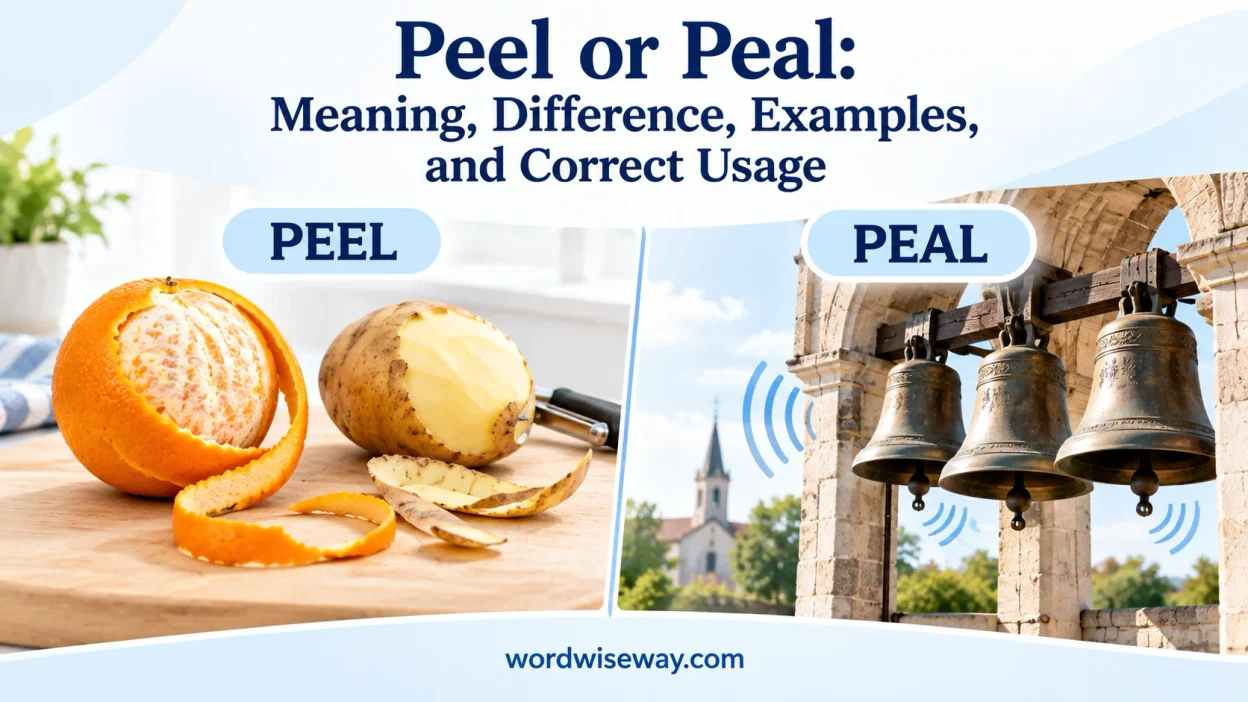
If you’ve ever confused peel and peal, you’re dealing with two homophones that sound exactly the same but have different meanings. Peel or Peal: Meaning, Difference, Examples, and Usage helps you understand which word fits your sentence and avoid common spelling mistakes.
Use peel when you mean removing the skin from fruit or vegetables, such as an orange. Use peal when you mean the ringing of bells or a loud sound. Their identical pronunciation makes them easy to mix up, especially in emails, essays, social posts, and other everyday writing.
The key is to look at the context. Learning these simple meanings, examples, and usage rules makes the difference easier to remember. Once you understand how each word works, you can choose the correct spelling and write with confidence.
Quick Answer:
Peel means to remove an outer covering or refers to that outer covering itself. You can peel an orange, peel a potato, or talk about orange peel.
Peal means a loud, ringing sound, especially one made by bells. You might hear a peal of bells, a peal of laughter, or a peal of thunder.
| Word | Meaning | Common Use | Example |
| Peel | To remove an outer layer or the outer layer itself | Fruit, vegetables, skin, paint | Peel the apple before eating it. |
| Peal | A loud, ringing, or resonant sound | Bells, laughter, thunder | A peal of bells echoed through the village. |
The easiest distinction is simple: peel has a covering connection, while peal has a sound connection.
What Does “Peel” Mean?
Peel has two closely related uses. It can work as a verb when you remove an outer layer, and it can work as a noun when you mean the outer layer itself.
That makes it a remarkably flexible word.
Peel as a Verb
As a verb, peel means to remove the outer skin, layer, or covering from something.
The word appears frequently in cooking and everyday descriptions. For example, you can peel a banana, potato, carrot, cucumber, or orange.
Here are some examples:
- Peel the potatoes before boiling them.
- She peeled an orange for her younger brother.
- You should peel the carrots before adding them to the soup.
- The children helped peel the bananas.
- The old paint began to peel from the wall.
However, peel isn’t limited to food. You can use it for many types of surfaces and layers.
For example, paint can peel from a wall when it loses its adhesion. Wallpaper can peel away from a surface. A sticker can peel off a notebook.
The word also appears in figurative expressions. When someone peels back a layer of an issue, they examine something more deeply. The expression borrows the physical idea of removing one layer to reveal another underneath.
Peel as a Noun
As a noun, peel means the outer skin or covering of a fruit or vegetable.
Common examples include:
- Orange peel
- Lemon peel
- Potato peel
- Banana peel
- Apple peel
- Carrot peel
For instance, in the sentence “Lemon peel adds flavor to the cake,” the word peel refers to the outer part of the lemon.
The noun can also describe an outer layer that comes away from another surface.
For example:
The paint’s peel was noticeable around the window frame.
In ordinary conversation, however, peel most commonly appears when people talk about fruit, vegetables, or something being removed from a surface.
What Does “Peal” Mean?
Peal has a completely different meaning. It generally refers to a loud, ringing, resonant, or repeated sound.
The word is strongly associated with bells.
Imagine several bells ringing across a town square. Their sound doesn’t simply appear as one tiny ding. It rolls outward, resonates, and continues through the surrounding space. That kind of sound can be described as a peal.
Peal as a Noun
The noun peal commonly describes a loud or resonant sound.
It frequently appears with bells:
- A peal of bells rang through the church.
- The wedding ended with a joyful peal of bells.
- A distant peal of bells drifted across the countryside.
However, bells aren’t the only possible source.
English also uses peal with sounds such as laughter and thunder.
Examples include:
- A peal of laughter erupted from the audience.
- We heard a peal of thunder in the distance.
- Her peal of laughter broke the silence.
The word often suggests a sound that is strong, clear, resonant, or repeated, rather than a quiet or ordinary noise.
Peal as a Verb
Peal can also function as a verb. As a verb, it means to produce a loud, ringing sound.
For example:
- The church bells pealed across the valley.
- The bells pealed at noon.
- Laughter pealed through the room.
This use is less common in everyday conversation than the noun peal, but it remains a legitimate English usage.
The distinction becomes clearer when you compare the two forms:
Noun: We heard a peal of bells.
Verb: The bells pealed throughout the morning.
The Key Difference
The central difference between peel and peal is meaning.
Peel connects with outer layers and removal.
Peal connects with loud, ringing sounds.
| Feature | Peel | Peal |
| Main meaning | An outer layer or the act of removing it | A loud, ringing sound |
| Common noun use | Fruit or vegetable skin | A ringing or resonant sound |
| Common verb use | Remove an outer covering | Produce a loud ringing sound |
| Common association | Oranges, potatoes, paint | Bells, laughter, thunder |
| Example | Peel the banana. | A peal of bells rang. |
There’s no meaningful overlap between the two definitions. If you’re talking about removing an orange’s skin, peel is the word you need. If you’re describing the sound of bells, peal is correct.
Which One Should You Use?
Choosing between the words becomes straightforward when you identify what you’re describing.
Use “Peel” for an Outer Layer
Choose peel when you’re talking about:
- Removing the skin from fruit
- Removing the skin from vegetables
- The skin of a fruit or vegetable
- Paint coming away from a surface
- A layer separating from another surface
- Figuratively removing or examining a layer of something
Examples:
- Peel the apple carefully.
- The orange peel smelled fresh.
- The paint started to peel after years of exposure.
- The chef removed the lemon peel.
Use “Peal” for a Ringing Sound
Choose peal when you’re describing:
- Bells ringing
- Loud laughter
- Thunder
- Other strong, resonant sounds
Examples:
- A peal of bells announced the celebration.
- Her peal of laughter filled the room.
- A sudden peal of thunder shook the quiet evening.
- The bells pealed across the town.
A useful test is to ask yourself: “Am I talking about a layer or a sound?”
If it’s a layer, choose peel. If it’s a ringing sound, choose peal.
Examples
Seeing the words in realistic sentences makes the distinction much easier to remember.
Examples With “Peel”
- Please peel the potatoes before dinner.
- She saved the lemon peel for a recipe.
- The banana peel fell onto the floor.
- The paint began to peel from the wooden door.
- He carefully peeled the orange.
- Remove the cucumber peel before slicing it.
- The label started to peel away from the bottle.
- The recipe calls for grated orange peel.
Examples With “Peal”
- A peal of bells rang across the square.
- We heard a distant peal of thunder.
- Her peal of laughter made everyone smile.
- The church bells pealed during the ceremony.
- Another peal of thunder followed the lightning.
- A joyful peal of bells welcomed the newly married couple.
Common Phrases
Some expressions make the difference especially easy to spot.
Common Expressions With “Peel”
Peel an orange
Means to remove an orange’s outer skin.
1.Orange peel
Means the outer skin of an orange.
2.Peel a potato
Means to remove the potato’s skin.
3.Peel off
Means to remove something from a surface or separate from it.
4.Peel back
Can mean to remove a layer physically or reveal something metaphorically.
For example:
The investigation began to peel back the layers of the complicated story.
Common Expressions With “Peal”
1.A peal of bells
Means a loud or repeated ringing of bells.
2.A peal of laughter
Describes a burst of loud, ringing laughter.
3.A peal of thunder
Describes a loud roll or burst of thunder.
4.Peal out
Can describe a sound ringing loudly through an area.
For example:
The bells pealed out across the valley.
These phrases give you a useful mental map. Peel belongs to layers. Peal belongs to sound.
Common Mistakes
Because the words sound similar, spelling mistakes are easy to make. Context provides the best defense.
“Peal the Orange” vs. “Peel the Orange”
The correct sentence is:
Peel the orange before eating it.
Here, you’re removing the orange’s outer covering. Therefore, peel is correct.
Incorrect:
Peal the orange before eating it.
That spelling would suggest a connection to a ringing sound, which makes no sense in this context.
“A Peel of Bells” vs. “A Peal of Bells”
The correct expression is:
A peal of bells echoed through the town.
You’re describing sound, so peal is the appropriate spelling.
Incorrect:
A peel of bells echoed through the town.
Bells don’t have a peel. They produce a peal.
“The Bells Peeled” vs. “The Bells Pealed”
The correct sentence is:
The bells pealed across the valley.
Here, pealed is the past tense of the verb peal.
By contrast, peeled comes from peel and means that something had its outer layer removed or came away from a surface.
Compare:
- The chef peeled the apple.
- The bells pealed across the square.
The extra -ed doesn’t change the underlying distinction. The base words still carry completely different meanings.
A Simple Memory Trick
A quick mnemonic can keep these words apart.
Think:
PEEL = covering
PEAL = sound
You can also connect the extra A in peal with audio. It isn’t a linguistic rule, but it’s a convenient memory aid.
When you see peel, picture an orange being stripped of its skin.
When you see peal, picture bells sending a ringing sound across the air.
That mental split turns a spelling trap into an easy choice.
A Practical Comparison
| Sentence | Correct Word | Why |
| I need to ___ the apple. | Peel | You’re removing the skin. |
| The orange ___ tastes bitter. | Peel | It means the outer skin. |
| The paint began to ___. | Peel | A surface layer is coming away. |
| We heard a ___ of bells. | Peal | It describes ringing sound. |
| A ___ of laughter filled the room. | Peal | It describes a loud, ringing sound. |
| The church bells ___. | Pealed | The bells produced a ringing sound. |
| She ___ the potatoes. | Peeled | She removed their outer skin. |
Case Study: How Context Reveals the Correct Spelling
Consider this sentence:
The children heard a loud sound while helping their mother prepare dinner.
The surrounding words matter. If the next sentence says the bells rang outside, the correct word is peal.
Now change the context:
The children helped their mother remove the skin from several oranges.
Here, the correct word is peel.
The pronunciation may not help much because peel and peal are homophones in standard English. Context becomes the deciding factor.
This illustrates an important spelling principle: sound alone doesn’t always determine spelling. English contains many words that share pronunciation while carrying different meanings and spellings.
Are Peel and Peal Homophones?
Yes. Peel and peal are generally considered homophones because they have the same pronunciation while differing in spelling and meaning.
Other common English homophones include:
- Pair / pear
- Flower / flour
- Sea / see
- Right / write
- Son / sun
Homophones create spelling problems because your ears can’t always distinguish between them. When you hear someone say peel or peal, the surrounding context tells you which written word makes sense.
For that reason, proofreading should focus on meaning and context, not pronunciation alone.
Word Forms to Know
Knowing related forms can make writing easier.
Forms of Peel
| Form | Example |
| Peel | Peel the carrot. |
| Peels | She peels the potatoes. |
| Peeled | He peeled the apple. |
| Peeling | The paint is peeling. |
Forms of Peal
| Form | Example |
| Peal | The bells peal loudly. |
| Peals | Peals of laughter filled the room. |
| Pealed | The bells pealed at noon. |
| Pealing | The pealing bells echoed outside. |
Notice the spelling carefully. Peeled comes from peel, while pealed comes from peal. One extra vowel changes the visual form while the pronunciation remains closely related.
Final Difference
The difference between peel and peal comes down to two completely separate ideas.
Peel refers to an outer covering or the act of removing one. You peel an orange, remove potato peel, or watch paint peel from a wall.
Peal refers to a loud, ringing, resonant sound. You can hear a peal of bells, a peal of laughter, or a peal of thunder.
Remember the basic rule:
Peel = outer layer.
Peal = ringing sound.
Once you connect each spelling with its meaning, this pair becomes much easier to handle. The next time you hear the word pronounced, don’t rely on sound alone. Look at the context. If you’re dealing with a covering, choose peel. If you’re describing a ringing sound, choose peal.
Read More: Nap or Nothing: Meaning, Origin, and Whether Naps Actually Help
FAQs
What is the difference between peel and peal?
Peel usually refers to the outer skin of a fruit or vegetable or the action of removing it. Peal refers to a loud, clear, ringing sound, especially from bells.
Are peel and peal homophones?
Yes. Peel and peal are homophones because they have the same pronunciation but different meanings and spellings.
When should you use peel in a sentence?
Use peel when discussing removing or referring to the skin of fruits and vegetables. For example, you might peel an orange before eating it.
When should you use peal in a sentence?
Use peal when describing a loud, ringing sound. It often appears when talking about bells, laughter, or other strong sounds.
Is it correct to say peal an orange?
No. When you mean removing the skin from an orange, the correct word is peel. Peal doesn’t describe this action.
Why do people confuse peel and peal?
People often confuse these words because they sound identical when spoken. Their different spellings don’t provide any clue when you’re listening to them.
Can peal describe laughter?
Yes. Peal can describe a loud, clear burst of laughter. The word emphasizes the ringing or resonant quality of the sound.
What does peel mean besides removing skin?
Besides the action of removing skin, peel can also mean the outer covering or skin of certain fruits and vegetables, such as an orange peel.
How can you remember the difference between peel and peal?
Connect peel with fruit or vegetable skin, while peal can be associated with a ringing sound, such as bells. Thinking about the context can make the distinction easier.
Which word should you use in everyday writing, peel or peal?
The correct choice depends on your meaning. Use peel for skin or removing skin, and use peal for a loud ringing sound or similar resonant noise.
Conclusion
Understanding peel and peal becomes much easier when you focus on their meanings rather than their pronunciation. Although these words sound alike, peel relates to skin or removing skin, while peal describes a loud, clear, ringing sound. Knowing this basic distinction can help you avoid common spelling mistakes.
When writing, always consider the context before choosing between these homophones. If you’re talking about an orange, vegetable skin, or removing a covering, peel is the word you need. If you’re describing bells, ringing sounds, or a resonant burst of laughter, choose peal instead.
With a little practice, you’ll quickly recognize which spelling fits your sentence. Keep the meaning in mind, check the surrounding words, and use real examples to reinforce the difference. Once the distinction becomes familiar, choosing peel or peal will feel natural in everyday writing.

Emma Smith has dedicated 14 years to Princeton University’s English Department, mentoring students in textual interpretation, literary movements, and critical frameworks. Her research explores Shakespearean drama, Victorian serial fiction, postcolonial narrative theory, and manuscript studies and probing how literary forms evolve across cultures and centuries. Emma has delivered lectures at international humanities congresses and published findings in distinguished academic journals, underscoring her commitment to scholarly depth and vibrant teaching.