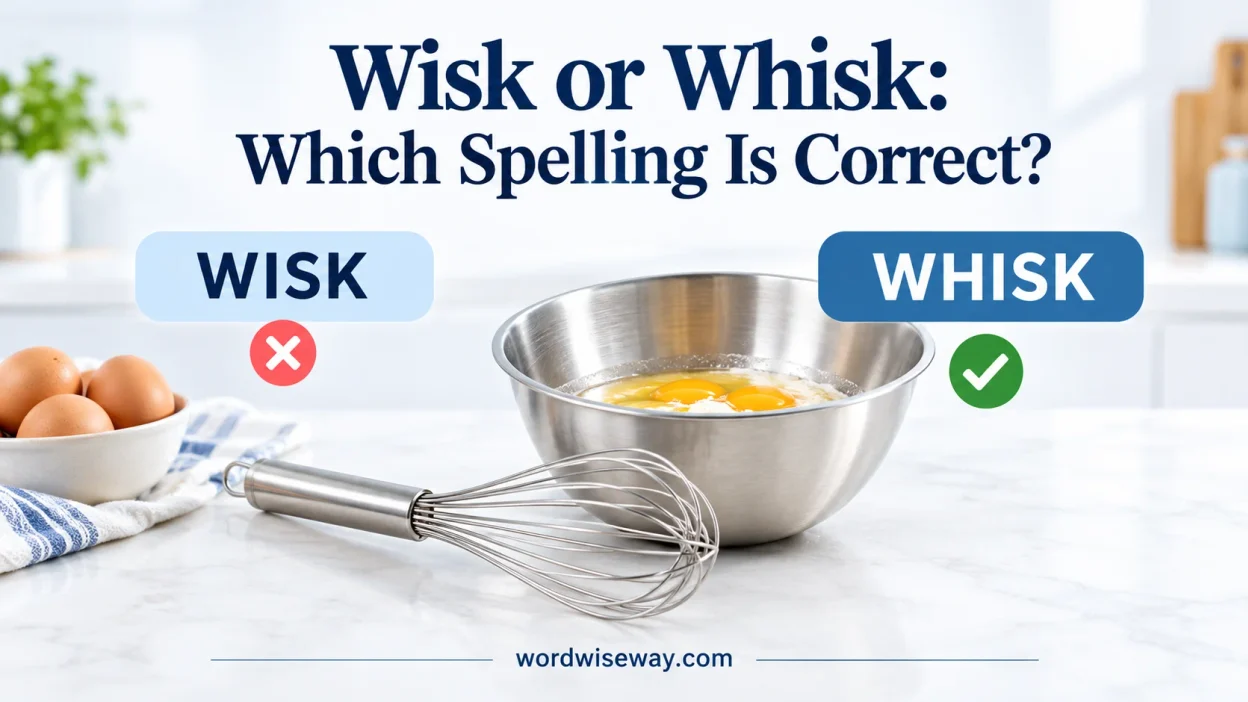
Wisk or Whisk: Correct Spelling, Meaning and usage has a simple answer: whisk is the correct spelling and right spelling in standard English spelling.
Wisk often appears in recipe instructions, search queries, and everyday writing because both versions have a similar sound when spoken. The missing h is a frequent mistake because it isn’t strongly pronounced.This spelling confusion is common in English, especially when the written form doesn’t match pronunciation.
A single missing letter may seem minor, but correctness improves the quality of your writing. Understanding why wisk appears often helps you avoid this mistake in real sentences. The word whisk can mean a kitchen utensil, the action of mixing ingredients, or the act of moving something quickly.In cooking, recipes, grocery lists, and online searches, you’ll often encounter wisk or whisk.
For example, whisk the eggs is natural in a cake recipe. If you’ve ever typed wisk and wondered how to spell it, the quick answer is whisk. Students, beginner writers, and English learners can use this guide, common examples, and real-life examples to write better emails, blog posts, and social media captions while avoiding spelling errors at school or work.
Quick Answer:
Whisk is the correct standard spelling for the common English word.
Wisk is generally a misspelling when you mean the kitchen utensil or the related verb. Standard dictionary entries define whisk as a kitchen tool and as a verb meaning to beat ingredients or move something quickly.
| Spelling | Standard English word? | Main meaning | Correct for normal writing? |
| Whisk | Yes | Kitchen utensil; mix rapidly; move quickly | ✓ Yes |
| Wisk | No, when intended as whisk | Usually a misspelling of whisk | ✗ No |
For example:
- Correct: Whisk the eggs until they’re smooth.
- Incorrect: Wisk the eggs until they’re smooth.
The easiest rule is simple: When you mean the cooking tool or the action, spell it whisk.
What Does Whisk Mean?
The word whisk has several connected meanings. Its culinary meaning is the one you’ll encounter most often, but the word also describes quick movement.
Whisk as a Noun
As a noun, a whisk is a kitchen utensil used to beat, mix, or aerate ingredients. Traditional whisks often have several thin wires joined to a handle.
Cambridge defines a whisk as a kitchen tool used for beating foods such as eggs and cream, particularly when adding air makes the mixture lighter.
For example:
- I need a whisk to mix the eggs.
- The recipe calls for a wire whisk.
- She used a small whisk to blend the dressing.
- Keep the whisk nearby while preparing the sauce.
A whisk doesn’t simply move ingredients around. Its shape allows you to incorporate air while mixing. That’s especially useful when preparing whipped cream, egg whites, sauces, batters, and emulsions.
Whisk as a Verb
Whisk can also function as a verb.
In cooking, it means beating or mixing ingredients quickly with a whisk or similar utensil. The action can help combine ingredients evenly and incorporate air into the mixture.
Examples include:
- Whisk the eggs before adding the milk.
- Whisk the flour into the sauce.
- Whisk the cream until it thickens.
- Whisk the ingredients together until smooth.
Notice how the same spelling works for the tool and the action.
Whisk the eggs with a wire whisk.
The first whisk is a verb. The second is a noun.
Whisk Can Also Mean “Move Quickly”
There’s another meaning that has nothing to do with cooking.
To whisk someone or something away means to take that person or thing somewhere quickly or suddenly. Cambridge lists this as a separate verb sense.
Examples:
- The driver whisked us away from the airport.
- The nurse whisked the patient into the examination room.
- They whisked the guests away before the rain started.
This meaning developed from the broader idea of quick or sweeping movement.
Is Wisk a Correct Word?
When you’re trying to spell the ordinary English word whisk, wisk isn’t the standard spelling.
That distinction matters because English contains many words whose spelling doesn’t perfectly match their pronunciation. Whisk is one of them. You can hear the word clearly without necessarily knowing that it contains wh.
In ordinary writing, these sentences should use whisk:
- Please whisk the eggs.
- Where’s the whisk?
- Use a whisk to combine the ingredients.
- She whisked the sauce until smooth.
Writing wisk instead creates a spelling error when the intended word is whisk.
However, there’s one important nuance. A word such as Wisk could appear as a brand name, company name, username, product name, or other proper name. A proper name can have its own spelling conventions. That doesn’t make wisk the standard spelling of the ordinary English cooking word.
Why Do People Write Wisk Instead of Whisk?
The wisk vs. whisk confusion is understandable because pronunciation doesn’t always reveal spelling.
The word is pronounced /wɪsk/ in the Cambridge English Dictionary, while the American Dictionary entry also records /hwɪsk/ as a pronunciation.
For many speakers, the h isn’t strongly noticeable in everyday speech. When someone hears the word, they may naturally connect the sound with wisk rather than whisk.
English spelling also contains many historical leftovers. Not every letter survives because modern pronunciation needs it.
That makes whisk a useful example of why spelling and pronunciation shouldn’t always be treated as identical systems.
The Spelling Difference
The difference between these two forms is only one letter, but only one is the standard spelling for the ordinary word.
| Feature | Whisk | Wisk |
| Spelling | Standard | Usually a misspelling |
| Kitchen utensil | Yes | No |
| Cooking verb | Yes | No |
| “Move quickly” meaning | Yes | No |
| Standard dictionary entry for these meanings | Yes | Not as the ordinary spelling |
| Recommended in standard US English | ✓ | ✗ |
Think of the h as part of the word’s fixed spelling rather than an optional letter.
You wouldn’t normally remove letters from established words simply because their pronunciation doesn’t make every letter obvious. The same principle applies here.
How to Spell Whisk Correctly
The correct spelling is:
W-H-I-S-K
A useful visual memory trick is to remember the opening wh:
WH + ISK = WHISK
Once you connect the word with the familiar kitchen utensil, the spelling becomes easier to remember.
You can also remember this sentence:
“Use a WHisk when you WHip up a mixture.”
The connection isn’t a formal spelling rule. It’s simply a memory device. If it helps you keep the h in the word, it has done its job.
How to Pronounce Whisk
In standard dictionary notation, whisk is pronounced /wɪsk/. Cambridge also lists /hwɪsk/ as an American English pronunciation variant.
The word has one syllable.
The ending sounds like the ending in words such as risk and brisk. The opening sound begins with the w sound, with pronunciation varying somewhat among English speakers.
The important point for spelling is this:
The pronunciation does not change the standard spelling.
Even if you pronounce the beginning without an audible h, the written word remains whisk.
Whisk in a Sentence
Seeing the word in different contexts makes the distinction much easier to understand.
Whisk as a Kitchen Noun
- The whisk is beside the mixing bowl.
- I bought a stainless-steel whisk for baking.
- A small whisk works well for salad dressing.
- She reached for the whisk before adding the eggs.
Whisk as a Cooking Verb
- Whisk the eggs until they’re well combined.
- Whisk the sauce continuously.
- Whisk the sugar into the egg mixture.
- Whisk the ingredients until the batter becomes smooth.
Whisk Meaning “Take Away Quickly”
- The driver whisked them to the hotel.
- The staff whisked the guests inside when the weather changed.
- The security team whisked the celebrity away from the crowd.
These examples show why context matters. The same word can describe an object, a cooking action, or rapid movement.
Whisk vs. Stir: What’s the Difference?
Whisk and stir are related cooking terms, but they don’t describe exactly the same action.
To stir something means to move it around, usually with a spoon, spatula, fork, or another utensil, so the ingredients combine or remain in motion.
To whisk means to beat or mix rapidly with a whisk or similar utensil. The movement can incorporate air into the food.
| Word | Basic action | Common purpose |
| Whisk | Rapid beating or mixing | Combine ingredients and often add air |
| Stir | Moving ingredients around | Combine, distribute, or prevent sticking |
| Beat | Vigorous mixing | Blend ingredients or change texture |
| Mix | General combining | Bring ingredients together |
For example, you might stir soup while it simmers. You might whisk eggs before making an omelet.
The words can overlap in everyday cooking instructions, but whisk gives the reader more information about the type of movement involved.
Whisk vs. Beat: Are They the Same?
Not quite.
Recipes often use beat as a broader instruction. It can mean mixing an ingredient vigorously, often with a whisk, fork, spoon, or electric mixer.
Whisk points more specifically toward the whisking action and often suggests incorporating air.
For instance:
- Beat the butter and sugar until creamy.
- Whisk the eggs until combined.
Both instructions involve vigorous mixing, but the intended tool and technique can differ.
That’s why replacing every instance of whisk with beat isn’t always ideal. The words overlap, but they aren’t perfect synonyms.
Whisk vs. Mix: Which Word Should You Use?
Mix is the broadest term of the three.
If a recipe says to mix the ingredients, it generally means to combine them. It doesn’t necessarily tell you how to do it.
When a recipe says to whisk the ingredients, it specifies a particular method.
Consider these instructions:
Mix the flour and sugar.
This tells you the desired result: combine them.
Whisk the eggs and milk.
This tells you more about the action: beat the ingredients together using a whisk or similar utensil.
That extra precision can matter in cooking because different techniques produce different textures.
Common Mistakes
The missing h isn’t the only mistake people can make with this word.
Writing Wisk in a Recipe
The most common error is simply replacing whisk with wisk.
Incorrect:
Wisk the eggs until smooth.
Correct:
Whisk the eggs until smooth.
Confusing the Noun and Verb
Because whisk can be both a noun and a verb, sentence structure determines its role.
In “Grab the whisk,” the word is a noun.
In “Whisk the eggs,” the word is a verb.
The spelling stays exactly the same.
Assuming Pronunciation Determines Spelling
English pronunciation can be a poor spelling guide.
The absence of a clearly heard h doesn’t justify dropping the letter in writing. Dictionary entries consistently use whisk for the standard word.
Whisk: Singular, Plural, and Verb Forms
The word changes naturally depending on how you use it.
| Form | Example |
| Whisk | Use a whisk to combine the ingredients. |
| Whisks | She owns several whisks. |
| Whisked | He whisked the eggs quickly. |
| Whisking | She is whisking the cream. |
The plural noun is whisks, not wiskes.
The past tense is whisked, and the present participle is whisking.
These forms retain the wh spelling throughout.
The History and Origin of Whisk
The history of whisk helps explain why its spelling looks less obvious than its pronunciation.
Etymonline traces the noun to the late 14th century, when whisk referred to a quick stroke or sweeping movement. The source is probably connected to Old Norse visk, meaning a wisp of hay or something used for sweeping.
The cooking-tool meaning appeared later. Etymonline dates the meaning of a small implement used for beating or agitating eggs and cream to the 1660s.
The verb also has a long history. It developed from a Scandinavian source associated with wiping, rubbing, sweeping, or rapid movement.
Interestingly, the wh spelling wasn’t part of the word’s earliest history in the same form. Etymonline notes that the spelling with wh is attested from the 1570s.
That history gives the modern spelling a little more context. The h isn’t there because modern speakers need to pronounce it distinctly. It’s part of the established spelling that developed over centuries.
A Simple Real-World Case Study: Following a Recipe
Imagine you’re making pancakes.
The recipe says:
- Crack two eggs into a bowl.
- Add the milk.
- Whisk the eggs and milk together.
- Add the dry ingredients.
- Mix until combined.
If you write wisk instead of whisk, the intended meaning remains obvious to most readers. However, the spelling is still incorrect in standard English.
This small example shows why spelling matters even when a reader can understand the intended word. Correct spelling makes your writing look polished and prevents unnecessary errors in recipes, schoolwork, blogs, menus, instructions, and professional communication.
Is Wisk Ever Acceptable?
There is an important distinction between a word and a name.
A company, brand, username, product, organization, or fictional character can use a spelling that differs from standard dictionary vocabulary. If an official name is spelled Wisk, that capitalization and spelling may be intentional.
That doesn’t change the answer to the ordinary spelling question.
If you’re writing:
“Use a wisk to beat the eggs.”
the standard spelling is whisk.
If you’re referring to a specific entity officially named Wisk, you should preserve that entity’s official spelling.
This distinction prevents a common mistake: assuming that every appearance of Wisk online proves that it is an alternative spelling of whisk.
Quick Facts
- Correct spelling: Whisk
- Common misspelling: Wisk
- Part of speech: Noun and verb
- Main noun meaning: A kitchen utensil
- Main cooking verb: To beat or mix ingredients rapidly
- Another verb meaning: To take someone or something away quickly
- Standard pronunciation: /wɪsk/
- Plural noun: Whisks
- Past tense: Whisked
- -ing form: Whisking
- Cooking-related meaning recorded historically: By the 1660s, according to Etymonline
Read More: Peel or Peal: Meaning, Difference, Examples, and Usage
FAQs
Is Wisk or Whisk the Correct Spelling?
Whisk is the correct spelling in standard English. Wisk is usually a misspelling, especially when you’re referring to mixing ingredients or the kitchen tool.
What Does Whisk Mean?
Whisk can mean a kitchen utensil used to mix or beat ingredients. It can also describe the action of mixing ingredients or moving someone or something away quickly.
Why Do People Spell Whisk as Wisk?
People often write wisk because the h in whisk isn’t strongly heard in normal pronunciation. This makes both spellings sound very similar.
Is Wisk a Real English Word?
In ordinary English writing, wisk isn’t the standard spelling of the word whisk. If you’re writing a recipe, school assignment, email, or blog post, use whisk.
How Do You Use Whisk in a Sentence?
You can use whisk as a verb or noun. For example, you might say, “Whisk the eggs until they’re well mixed,” or “Use a whisk to combine the ingredients.”
Is Whisk Used as a Noun or a Verb?
Whisk can work as both a noun and a verb. As a noun, it refers to the kitchen utensil. As a verb, it means to mix ingredients quickly or move something rapidly.
Is Whisk Different From Whip?
Yes. Whisk and whip can both describe mixing ingredients, but they aren’t always interchangeable. Whisking usually involves mixing or beating with a whisk, while whipping often means beating ingredients to add air and create a lighter texture.
What Is the Plural of Whisk?
The plural form of whisk is whisks. For example, “The store sells several types of whisks for different cooking tasks.”
How Can I Remember the Spelling of Whisk?
A simple way to remember whisk is to connect it with the kitchen tool. Think of whisk as the spelling you see in recipes whenever you’re mixing ingredients.
Is Whisk Spelled the Same in American and British English?
Yes. Whisk is spelled the same in both American and British English. Unlike some words that have different regional spellings, this word keeps the same standard spelling.
Conclusion:
When you’re unsure about wisk or whisk, remember that whisk is the correct spelling in standard English. The word can describe a kitchen utensil, the action of mixing ingredients, or moving something quickly. Although wisk may appear in searches, recipes, or casual writing, it’s generally a spelling mistake rather than the standard form.
The easiest way to avoid this error is to connect whisk with cooking. When a recipe tells you to whisk the eggs, you know you need the spelling with h. Once you notice how the word looks and works in real sentences, remembering the correct form becomes much easier.
So, the next time you type wisk, pause for a second and check the spelling. Choose whisk for recipes, schoolwork, emails, blog posts, and other standard English writing. That small h makes the difference and keeps your writing clear and accurate.

Evelyn Shaw has spent 14 years at Yale University’s English Department, leading students through close readings, genre studies, and interpretive methodologies. Her scholarly interests include Renaissance drama, gothic fiction, feminist literary criticism, and archival research and examining how texts generate meaning across historical periods. Evelyn has presented at major academic conferences and published essays in peer-reviewed journals, reflecting her passion for rigorous analysis and student-centered learning.