Incase or In Case: Correct Spelling, Meaning, and Usage can confuse English learners and writers because the spellings look similar, and the spoken sound seems the same.
This confusion often leads people to search for in case or incase before they write emails, exams, or work documents. The correctness is simple: in case is the standard two-word expression, while incase is the wrong form when you mean that phrase.The correct spelling, correct usage, meaning, and form matter in English.
Use just in case when discussing a possible situation, but don’t use the spellings interchangeably. Encasing something is a different idea, while encase is a different word with its own meaning.The truth becomes easier to remember with simple tips. Remember that in case stays as two words when it describes preparation for a possible event.
These small differences can change your writing and make it appear unprofessional or incorrect in formal situations. Reviewing common mistakes, examples, and useful phrases can make learners more confident about the difference and the right form every time.
Quick Answer
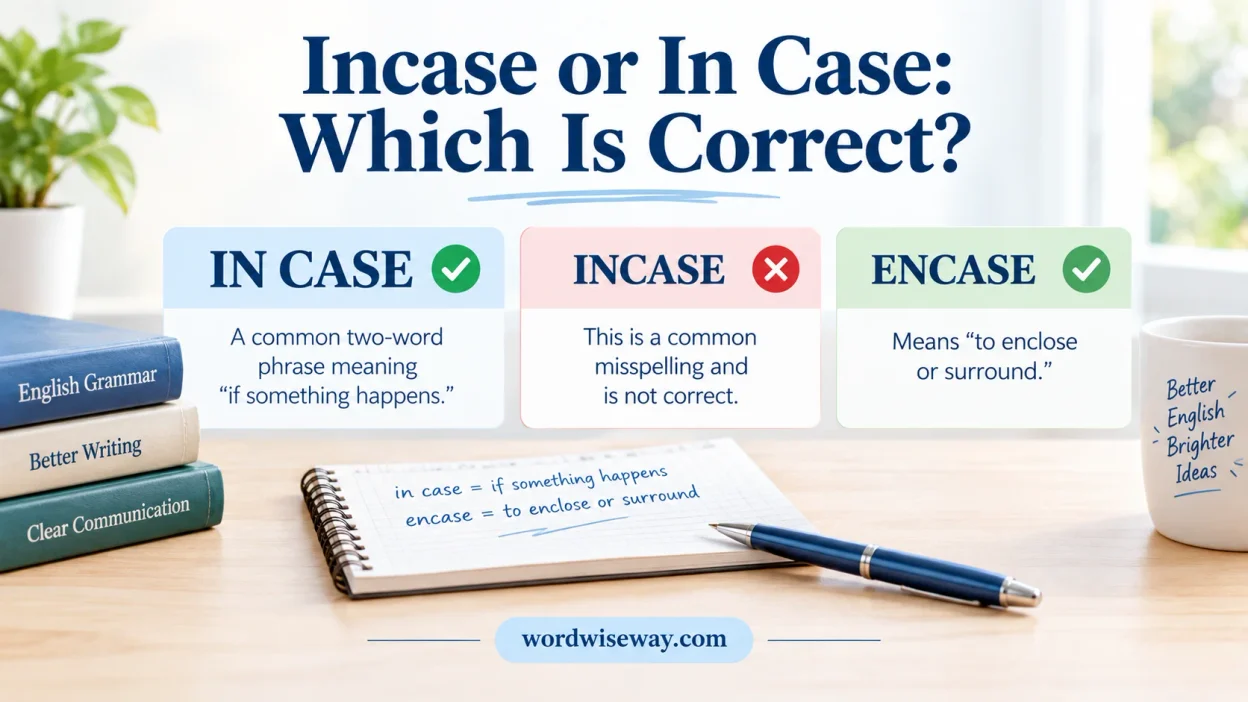
In case is the correct choice when you mean “if something happens,” “because something might happen,” or “as a precaution.”
Incase is generally a misspelling when someone intends to write in case.
Encase is a real word, but it has a completely different meaning. It means to enclose, cover, or surround something.
| Form | Correct use | Meaning | Example |
| in case | Common phrase | If something happens or as preparation | Take an umbrella in case it rains. |
| incase | Usually incorrect in this context | Usually a misspelling of in case | ❌ Take an umbrella incase it rains. |
| encase | Verb | To cover or enclose completely | The artifact was encased in glass. |
So, if you’re writing an ordinary sentence about a possible event, choose in case.
In Case: Meaning and Definition
In case is a common English phrase used when something is possible and you take action because you want to be prepared for it.
Cambridge Dictionary defines in case in the sense of guarding against a possibility. Its examples show the phrase being used when someone prepares for something that might happen.
For example:
- Take a jacket in case it gets cold.
- Save a copy in case your computer crashes.
- Bring some water in case you get thirsty.
- Keep my number in case you need help.
Notice the pattern. The first part describes an action. The in case clause explains the possible situation that motivates that action.
In Case Shows Preparation
One of the most useful ways to understand in case is to think about preparation.
Imagine that the sky looks clear, but rain is possible. You decide to carry an umbrella.
I took an umbrella in case it rained.
The rain hasn’t necessarily started. You’re simply preparing for the possibility.
That distinction matters because in case often connects an action with a possible future or later situation.
In Case Can Refer to Past Situations
In case doesn’t only work with future possibilities. You can also use it when describing something someone prepared for in the past.
For example:
She packed some snacks in case she got hungry.
The packing happened in the past. The hunger was a possible situation at that time.
The British Council also explains that in case can appear with past forms when describing a real past action taken because something was possible.
This makes the phrase more flexible than many learners initially expect.
How to Use “In Case” in a Sentence
The basic structure is straightforward:
main action + in case + possible situation
For example:
Bring a charger in case your phone runs out of power.
The main action is bring a charger. The possible situation is your phone running out of power.
You can also place the in case clause first:
In case you need help, save this phone number.
When the in case clause comes first, a comma commonly separates it from the main clause.
In Case for a Possible Future Situation
Use in case when you prepare for something that could happen later.
Examples include:
- I’ll take a sweater in case the room is cold.
- Write down the address in case you lose your phone.
- Charge the camera in case we stay out late.
- Bring your notes in case the teacher asks questions.
The possible event doesn’t need to happen. In fact, the speaker often expects that it may not happen.
That’s the heart of the expression: preparation for possibility.
In Case as a Precaution
In case can also emphasize precaution.
Consider this sentence:
Keep a flashlight nearby in case the power goes out.
The flashlight isn’t necessarily needed right now. You keep it nearby because an outage is possible.
This kind of sentence appears frequently in everyday instructions, travel advice, emergency planning, and ordinary conversation.
Incase: Is It Correct?
For most sentences involving possibility or precaution, incase is not the correct spelling.
For example:
❌ Take an umbrella incase it rains.
The correct version is:
✓ Take an umbrella in case it rains.
The confusion usually comes from pronunciation. When people speak quickly, the two words can sound closely connected. That can make the phrase look like it should be one word.
English contains many expressions that sound more compact than they look in writing. In case is one of them.
However, there is an important word that looks similar: encase.
Encase vs. In Case: Don’t Confuse These Words
Encase is a genuine English verb. It has nothing to do with the conditional phrase in case.
Merriam-Webster defines encase as a verb meaning “to enclose in or as if in a case.” The dictionary lists examples involving objects covered or surrounded by another material.
Cambridge gives the same core meaning: to cover or surround something or someone completely.
For example:
The valuable coin was encased in protective plastic.
Here, encased means the coin was enclosed or surrounded by plastic.
Compare that with:
Take the coin with you in case you need it.
The two expressions look similar, but their jobs are completely different.
| Word or phrase | Function | Meaning |
| in case | Phrase | If something happens; as preparation |
| encase | Verb | Cover or enclose completely |
| incase | Usually a spelling error | Usually intended to mean in case |
A useful memory trick is simple: in case deals with a possibility, while encase deals with containment.
In Case vs. If
Another common source of confusion involves in case and if.
They can sometimes appear in similar sentences, but they don’t always express the same idea.
Compare these:
I’ll take an umbrella in case it rains.
I’ll take an umbrella if it rains.
The first sentence suggests preparation before the possible rain. The second can suggest that the action depends on whether rain actually occurs.
Here’s another example:
Save the document in case the computer crashes.
You save it now because a crash is possible.
Now consider:
Save the document if the computer crashes.
This sentence suggests that the saving happens after the crash, which may not make practical sense.
That’s why in case can be especially useful when you want to show preventive action.
In Case vs. Just in Case
You’ll also frequently see just in case.
Cambridge Dictionary defines just in case as something done because of a possibility of something happening or being needed.
Compare:
Bring a jacket in case it gets cold.
Bring a jacket just in case it gets cold.
Both sentences express precaution. Adding just often gives the sentence a slightly stronger or more casual precautionary feel.
You might say:
I don’t think we’ll need extra batteries, but I’ll bring some just in case.
The speaker doesn’t strongly expect to need them. Still, carrying them provides a little insurance against an unexpected problem.
In Case vs. In Case Of
These expressions look similar, but their grammatical patterns differ.
Use in case + clause when a subject and verb follow.
Call me in case you need help.
Use in case of + noun or noun phrase when you name the situation directly.
Call this number in case of emergency.
Cambridge classifies in case of as a formal phrase meaning if something happens or in preparation for when something happens.
| Structure | Example |
| in case + clause | Bring water in case you get thirsty. |
| in case of + noun | Bring water in case of dehydration. |
In everyday writing, don’t automatically add of after in case. Look at what comes next.
If a full clause follows, in case usually fits.
If a noun names the situation, in case of may fit.
In Case vs. In the Case Of
In the case of has another meaning and shouldn’t be treated as a longer version of in case of.
For example:
In the case of Sarah, the decision was different.
Here, the phrase points to a particular person or situation.
Compare:
In case of fire, leave the building.
The second sentence describes what to do if a particular event occurs.
The extra the changes the structure and meaning. That’s a tiny word with a surprisingly large job.
Common Mistakes
These mistakes appear frequently because the phrase sounds like one connected unit.
Writing “incase” Instead of “in case”
❌ Check the weather incase it rains.
✓ Check the weather in case it rains.
Confusing “in case” With “in case of”
❌ Bring an umbrella in case of it rains.
✓ Bring an umbrella in case it rains.
Or:
✓ Bring an umbrella in case of rain.
The first correct version uses a clause. The second uses a noun.
Using “encase” When You Mean “in case”
❌ Take your ID encase someone asks for it.
✓ Take your ID in case someone asks for it.
The first sentence uses the spelling of the verb encase, which doesn’t express the intended meaning.
Treating “incase” as the Normal One-Word Form
A quick spelling check can prevent this mistake. When you mean “if something happens”, write in case as two words.
In Case or Incase: Correct Examples
Here are several examples you can use as a quick reference.
| Incorrect | Correct | Reason |
| Take water incase you’re thirsty. | Take water in case you’re thirsty. | In case introduces a possibility. |
| Save the file incase something goes wrong. | Save the file in case something goes wrong. | The phrase shows preparation. |
| Bring a coat incase it gets cold. | Bring a coat in case it gets cold. | Two words are required. |
| Call me incase you need anything. | Call me in case you need anything. | The phrase introduces a possible situation. |
| The object was incase in glass. | The object was encased in glass. | The verb is encase, not incase. |
That last example highlights an important point. Incased is not the normal spelling of the verb. The correct form is encased.
A Simple Way to Remember
Use this three-part rule:
- In case = possibility or preparation.
- Encase = surround or enclose.
- Incase = usually a spelling mistake when you mean in case.
Think of the difference this way:
In case → something might happen.
Encase → something is surrounded.
For example:
Take an umbrella in case it rains.
The statue was encased in glass.
The first sentence prepares for a possibility. The second describes physical containment.
Once you connect each spelling with its meaning, the distinction becomes much easier to remember.
In Case in Formal and Informal Writing
In case works naturally across almost every type of English writing.
You can use it in:
- School assignments
- Business emails
- Instructions
- Blog posts
- Everyday messages
- Technical documentation
- Travel writing
- Academic prose
- Conversation
For example:
Keep a backup copy in case the original file becomes corrupted.
That sentence sounds perfectly natural in technical writing.
Likewise:
Bring a sweater in case the theater is cold.
That sentence works in everyday conversation.
The uncommon spelling incase shouldn’t replace the standard phrase simply because the words sound connected.
Pronunciation of In Case
In case is pronounced as two words, but natural speech can make them sound closely linked.
The pronunciation itself doesn’t tell you whether the phrase should appear as one word or two. English spelling depends on the grammatical identity of the expression, not simply on how quickly someone says it.
That explains why in case can feel like a single sound while still remaining two written words.
The separate verb encase has a different spelling and meaning. Cambridge and Merriam-Webster both give its pronunciation as beginning with the same general sound pattern as the prefix-like en- followed by case.
Quick Revision:
Remember these points before you finish:
| Question | Answer |
| Is in case correct? | ✓ Yes |
| Should you write in case as two words? | ✓ Yes |
| Is incase normally correct for “if something happens”? | ❌ No |
| Is encase a real word? | ✓ Yes |
| What does encase mean? | To cover or enclose completely |
| What does in case mean? | If something happens or as a precaution |
| Can in case refer to past situations? | ✓ Yes |
| Is just in case correct? | ✓ Yes |
| Is in case of correct? | ✓ Yes, with the appropriate noun structure |
Practice Section
Choose in case, incase, or encase where appropriate.
- Take an umbrella ______ it rains.
- Save the document ______ your computer shuts down.
- The fragile object was ______ in protective foam.
- Keep some cash with you ______ you need it.
- The designer decided to ______ the artwork in glass.
- Bring a jacket ______ the temperature drops.
- Please keep this receipt ______ you need to return the item.
- The stone was ______ in a thick layer of concrete.
Answer Key
- in case
- in case
- encased
- in case
- encase
- in case
- in case
- encased
The pattern is consistent. When you describe a possible event or precaution, choose in case. When you describe enclosing something, choose encase.
Read More: Grey vs. Gray: Difference, Correct Spelling, and Meaning
FAQs
1. Is “in case” one word or two words?
In case is written as two words when you mean “if something happens” or “as a precaution.” For example, you might keep an umbrella with you in case it rains. Writing incase for this meaning is incorrect in standard English.
2. Is “incase” ever a correct word?
Incase is generally not the correct spelling of the common phrase in case. However, encase is a real English verb meaning to cover or surround something completely. Therefore, don’t treat incase and encase as interchangeable spellings.
3. What does “in case” mean?
In case usually introduces a possible situation that you want to prepare for. It can also mean that something is done as a precaution. For example, “Take some water in case you get thirsty” shows preparation for a possible need.
4. How do you use “in case” in a sentence?
You can use in case before a clause describing a possible event or situation. For example, “Save the address in case you need it later” explains why the action is useful. The phrase can appear naturally in everyday conversations, emails, and formal writing.
5. What is the difference between “in case” and “encase”?
In case refers to a possible situation or precaution, while encase means to surround or enclose something. For example, “Bring a jacket in case it gets cold” has a completely different meaning from “The material will encase the object.”
6. Why do people write “incase” instead of “in case”?
People often write incase because the two words in in case are frequently spoken together. Their similar sound can make the phrase feel like a single word. This is a common spelling mistake, especially among learners who rely heavily on pronunciation.
7. Is “just in case” grammatically correct?
Yes, just in case is a common and grammatically correct phrase. It emphasizes that someone is taking an action as a precaution. For example, “I saved a copy just in case the original file was lost.”
8. Can “in case” be used in formal writing?
Yes, in case works well in both everyday and formal writing. You can use it in emails, reports, academic work, and professional documents when the meaning fits. You don’t need to replace it simply because the writing is formal.
9. How can I remember the correct spelling of “in case”?
A simple way to remember it is to think of in case as a phrase made from two separate words. When you mean preparation for a possible situation, keep in and case separate. Reserve encase for the verb meaning to surround or enclose something.
10. What is the most common mistake with “in case”?
The most common mistake is joining the two words and writing incase when the intended phrase is in case. This error often appears in quick writing because the phrase sounds connected when spoken. Checking the meaning before choosing the spelling can help you avoid this mistake.
Conclusion
Understanding in case and incase becomes much easier once you separate spelling from sound. In case is the correct two-word phrase when you discuss a possible situation, precaution, or preparation. Although incase may look familiar, it shouldn’t replace the standard phrase in your writing.
The distinction also becomes clearer when you remember encase, which is a different word with a different meaning. Encased objects are surrounded or enclosed, while in case introduces a possible circumstance. Keeping these meanings separate can prevent unnecessary spelling mistakes in emails, exams, articles, and professional documents.
When you aren’t sure which form to choose, look at the meaning of the sentence first. If you’re talking about something that might happen, in case is usually the form you need. With regular practice and attention to context, this small spelling difference becomes much easier to handle confidently.

Evelyn Shaw has spent 14 years at Yale University’s English Department, leading students through close readings, genre studies, and interpretive methodologies. Her scholarly interests include Renaissance drama, gothic fiction, feminist literary criticism, and archival research and examining how texts generate meaning across historical periods. Evelyn has presented at major academic conferences and published essays in peer-reviewed journals, reflecting her passion for rigorous analysis and student-centered learning.