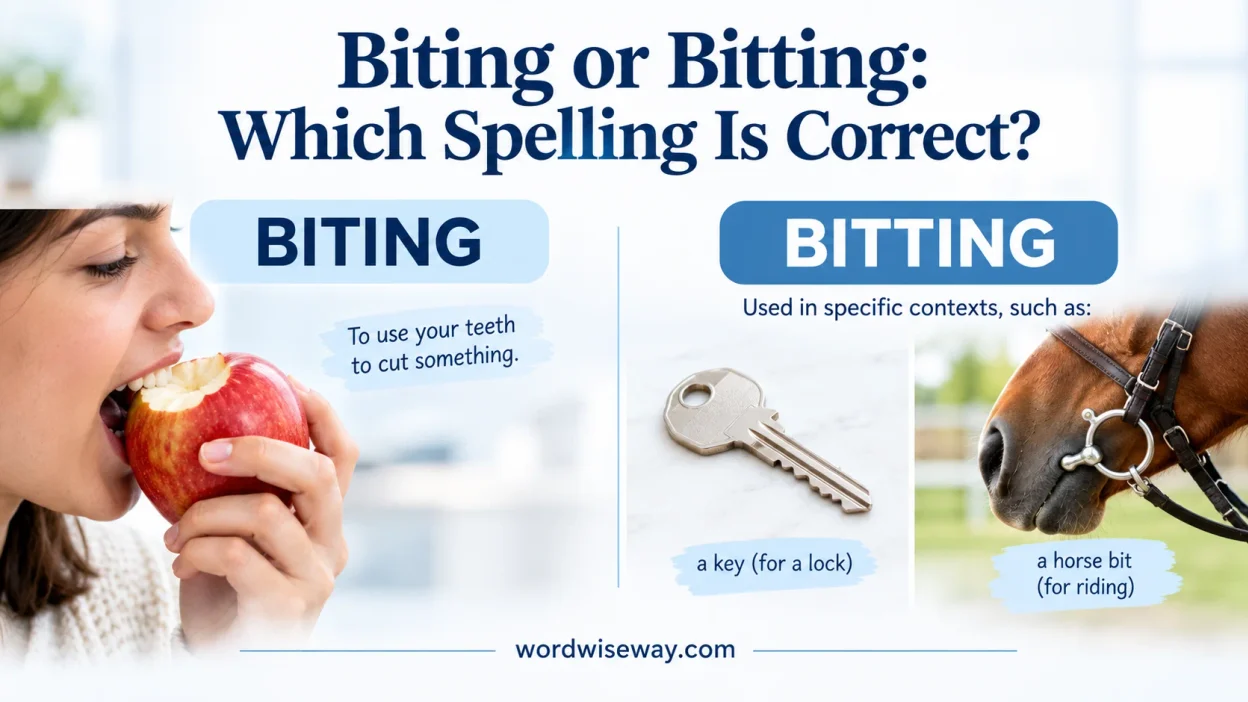
If you’re confused about Biting or Bitting: Which Spelling Is Correct?, the answer is biting. This is the correct spelling in standard English when you mean using your teeth or making a sharp comment. Bitting is generally incorrect, except in rare technical contexts.
This difference can cause misunderstandings because the words have similar pronunciation and appearance. In modern English usage, biting is widely accepted across regions. Learners, writers, and content creators can avoid grammar errors by checking the intended meaning before writing.
The issue often appears in writing, texting, social media captions, and professional documents, where accuracy and clarity matter. Understanding the alternative form, relevant contexts, and common mistakes helps you choose the right spelling for casual and formal communication.
Quick Answer:
Biting is the correct spelling when you mean the ordinary action of using your teeth or when you use bite in one of its figurative meanings.
Examples:
- The puppy is biting the toy.
- Stop biting your nails.
- The mosquitoes are biting tonight.
- She made a biting comment.
- We walked through the biting cold.
The ordinary verb forms are:
bite → bit → bitten → biting
Bitting, however, has specialized meanings. In locksmithing, it can refer to the cuts or indentations made in a key. In equestrian terminology, it can refer to working with a horse’s bit or teaching a horse to respond to it.
So, for everyday writing, remember this simple rule:
If you mean using teeth, use “biting.”
What Does “Biting” Mean?
Biting is the present participle of bite. It describes the action of using the teeth to grip, cut, tear, hold, or chew something.
The word can describe people, animals, insects, fish, and even figurative forms of speech.
Biting as a Physical Action
The most familiar meaning involves teeth.
Consider these examples:
- The dog is biting its toy.
- The child was biting the sandwich.
- The puppy keeps biting the blanket.
- The rabbit is biting the carrot.
In each sentence, biting describes an action happening now or around the present time.
Biting as a Gerund
An -ing form can also function as a noun. When it does, grammarians call it a gerund.
For example:
- Biting your nails can become a habit.
- Biting into a crisp apple feels satisfying.
- Biting can be a defensive behavior in some animals.
Here, biting doesn’t simply describe what someone is doing at that moment. It names an activity.
Biting as an Adjective
Biting can also describe something sharp, severe, intense, or unpleasant.
For example:
- A biting wind swept across the field.
- They walked through the biting cold.
- Her biting criticism attracted attention.
- His biting sarcasm changed the mood.
This figurative meaning comes from the idea of something that feels as sharp or painful as a bite.
What Does “Bitting” Mean?
Bitting is a legitimate word, but it isn’t the ordinary present participle of bite.
The word appears in specialized terminology.
One use relates to locksmithing. In this context, bitting refers to the pattern of cuts or indentations associated with a key. These cuts correspond to the internal mechanism of a lock.
For example:
The locksmith examined the key’s bitting before making a duplicate.
Another use appears in equestrian terminology. In horse training, bitting can refer to introducing a horse to a bit and teaching the animal to respond appropriately to it.
For example:
The trainer included bitting in the young horse’s preparation.
These meanings have little to do with someone using their teeth.
That’s the key distinction.
What’s the Difference?
The easiest way to understand the difference is to look at the context.
| Word | Meaning | Typical Context | Example |
| Biting | Using the teeth or describing something sharp or harsh | Everyday English | The puppy is biting the toy. |
| Bitting | A specialized term involving key cuts or horse training | Locksmithing or equestrian terminology | The locksmith checked the key’s bitting. |
In ordinary conversation, biting is overwhelmingly more common.
You’d use biting when discussing:
- Animals using their teeth
- People using their teeth
- Eating
- Insect bites
- Fish taking bait
- Sharp criticism
- Harsh sarcasm
- Extremely cold weather
You may encounter bitting when reading specialized material about:
- Keys and locks
- Horse training
- Equestrian equipment
Why Is “Biting” Spelled With One T?
The spelling becomes much easier when you start with the base verb:
bite
When English adds -ing to a verb ending in a silent e, the final e usually disappears.
For example:
- bite → biting
- write → writing
- make → making
- take → taking
- drive → driving
- smile → smiling
So:
bite + ing → biting
Not:
bite + ing → biteing
And not:
bite + ing → bitting
The spelling rule explains why the ordinary present participle has only one t.
Why Does Bitting Have Two Ts?
The answer lies in the word’s different origins and specialized uses.
Biting comes from the verb bite:
bite → biting
The spelling changes because the final silent e disappears before -ing.
Bitting, in its specialized uses, is connected with bit rather than the ordinary verb bite. For example, equestrian terminology can use bit as a noun referring to equipment placed in a horse’s mouth.
This distinction explains why the two words can coexist without being interchangeable.
Is “Bitting” a Misspelling of “Biting”?
Sometimes. Not always.
If someone writes:
The dog is bitting my shoe.
they almost certainly mean biting.
The correct sentence is:
The dog is biting my shoe.
However, consider this sentence:
The locksmith examined the key’s bitting.
Here, bitting has a specialized technical meaning. Replacing it with biting would make the sentence incorrect.
The same principle applies to equestrian writing:
The trainer worked on the horse’s bitting.
In that context, the specialized term can be appropriate.
A Simple Context Test
When you’re unsure, ask yourself what the sentence describes.
Does it involve teeth?
Use biting.
Does it involve a key’s cuts or specialized horse-training terminology?
Bitting may be correct.
This tiny context check solves most cases.
Common Mistakes
The spelling confusion often happens because English contains many words that double a final consonant before -ing.
For example:
- run → running
- sit → sitting
- stop → stopping
- plan → planning
- swim → swimming
That pattern can make bitting look reasonable.
However, bite follows a different spelling pattern because it ends in a silent e.
Mistake: “The Dog Is Bitting Me”
Incorrect: The dog is bitting me.
Correct: The dog is biting me.
The sentence describes an ordinary physical action, so biting is required.
Mistake: “She Was Bitting Into an Apple”
Incorrect: She was bitting into an apple.
Correct: She was biting into an apple.
The verb is bite, so its present participle is biting.
Mistake: Assuming Bitting Never Exists
This mistake goes in the opposite direction.
Bitting is a legitimate word in specialized vocabulary. It can describe key-related terminology and certain aspects of horse training.
Therefore, context matters more than appearance.
A rare word isn’t automatically an incorrect word.
Biting or Bitting in Different Contexts
The surrounding words often reveal which spelling belongs in your sentence.
When Talking About Animals
Use biting when an animal uses its teeth.
Examples:
- The puppy is biting the toy.
- The dog started biting the rope.
- The rabbit was biting the carrot.
- The horse suddenly started biting the fence.
The last example is particularly useful because it shows how biting and bitting can appear in the same general subject area while having completely different meanings.
When Talking About People
Use biting for the ordinary physical action.
Examples:
- She was biting an apple.
- He keeps biting his nails.
- The child stopped biting the pencil.
- He accidentally bit his tongue while eating.
Notice the different verb forms:
bite → bit → bitten → biting
For example:
- Present: She bites the apple.
- Past: She bit the apple.
- Present perfect: She has bitten the apple.
- Progressive: She is biting the apple.
When Talking About Food
Biting commonly describes taking or making a bite of food.
Examples:
- She was biting into a fresh apple.
- He kept biting small pieces from the sandwich.
- The child started biting the cookie.
The phrase bite into is especially common when describing the action of using your teeth on food.
When Describing Criticism
Biting can describe criticism that feels sharp, severe, or cutting.
For example:
The article contained biting criticism of the proposal.
No teeth are involved here. The word uses a figurative meaning.
Other examples include:
- biting criticism
- biting commentary
- biting remarks
- biting satire
- biting humor
The shared idea is sharpness.
When Describing Sarcasm
Biting sarcasm is sarcasm that carries a particularly sharp or hurtful edge.
For example:
His biting sarcasm made the conversation uncomfortable.
Again, the meaning is figurative. The words aren’t literally biting anything.
When Describing Cold Weather
English also uses biting to describe severe cold.
Examples:
- A biting wind swept across the road.
- The hikers faced biting cold.
- The morning air was biting.
The expression suggests cold that feels sharp against your skin.
When Talking About Horses
Bitting can appear in equestrian contexts involving a horse’s bit.
This is where the distinction becomes particularly important.
A horse can be biting something with its teeth. That’s ordinary English.
Bitting, however, refers to a specialized training or equipment-related concept involving a horse’s bit.
For example:
The trainer studied different approaches to bitting young horses.
The words look similar because they share bit, but their grammatical and semantic roles differ.
Bite, Bit, Bitten, and Biting
The verb bite doesn’t follow the regular pattern used by many English verbs.
Instead, it changes its form:
| Grammatical Form | Word | Example |
| Base form | bite | Dogs sometimes bite when frightened. |
| Third-person singular | bites | The puppy bites the toy. |
| Simple past | bit | The dog bit the toy. |
| Past participle | bitten | The dog has bitten the toy. |
| Present participle | biting | The dog is biting the toy. |
This table exposes another common mistake.
You wouldn’t normally say:
He bitted the apple.
For the ordinary verb bite, the past tense is:
He bit the apple.
The past participle is:
He has bitten the apple.
The present participle is:
He is biting the apple.
These forms belong to the same everyday verb family.
Biting in Common Expressions
The word biting appears in several familiar expressions.
Biting Cold
Biting cold describes extremely cold weather.
Example:
They waited outside in the biting cold.
The phrase emphasizes how intensely uncomfortable the temperature feels.
Biting Wind
A biting wind feels intensely cold and harsh.
Example:
A biting wind swept through the valley.
Biting Criticism
Biting criticism is sharply negative or severe criticism.
Example:
The report included biting criticism of the company’s decision.
Biting Sarcasm
Biting sarcasm uses sarcasm with a particularly sharp edge.
Example:
Her biting sarcasm quickly ended the discussion.
Biting Wit
Biting wit describes clever humor that can also be pointed or cutting.
Example:
His biting wit made every interview unpredictable.
These expressions show that biting has developed well beyond its literal connection to teeth.
A Closer Look at “Bitting” as a Technical Word
Technical vocabulary often looks unusual because it develops within a specific profession or activity.
Bitting provides a good example.
Bitting in Locksmithing
In locksmithing, a key contains a particular arrangement of cuts. Those cuts interact with the internal components of a lock.
The term bitting can describe the key’s cutting pattern or the indentations that form part of its operating structure.
For example:
The locksmith recorded the key’s bitting before creating a duplicate.
In this context, bitting has nothing to do with someone biting with their teeth.
Bitting in Horse Training
In equestrian terminology, bitting relates to introducing a horse to a bit and teaching the animal to respond appropriately to it.
The exact methods can vary depending on the trainer, horse, equipment, and training system.
For example:
The trainer discussed bitting as part of the horse’s early preparation.
This specialized meaning explains why you might encounter bitting in horse-training books or equestrian discussions.
Practical Sentence Comparison
| Sentence | Status | Why |
| The puppy is biting my shoe. | ✅ Correct | Ordinary action involving teeth |
| The puppy is bitting my shoe. | ❌ Incorrect | The ordinary form is biting |
| She was biting into an apple. | ✅ Correct | Present participle of bite |
| She was bitting into an apple. | ❌ Incorrect | Bitting isn’t the ordinary form of bite |
| The locksmith examined the key’s bitting. | ✅ Correct | Specialized locksmithing term |
| The trainer studied the horse’s bitting. | ✅ Correct | Specialized equestrian usage |
| He bit the apple yesterday. | ✅ Correct | Simple past of bite |
| He bitted the apple yesterday. | ❌ Incorrect | The ordinary past form is bit |
How to Remember the Correct Spelling of Biting
A short memory trick can save you from repeatedly checking the spelling.
Remember:
BITE → BITING
The silent e disappears before -ing.
You can connect it with other familiar examples:
- make → making
- write → writing
- drive → driving
- take → taking
- bite → biting
If you’re talking about teeth, there’s usually no need to overthink it.
Use biting.
If you’re reading a specialized text about keys or horses and encounter bitting, don’t automatically assume it’s a typo. Check the context first.
Is Biting an Adjective or a Verb?
It can be either.
Consider:
The dog is biting the toy.
Here, biting is part of the verb phrase is biting.
Now consider:
The wind was biting.
Here, biting describes the wind and functions adjectivally.
Finally:
Biting your nails can become a habit.
Here, biting functions as a gerund and acts as the subject of the sentence.
The -ing ending doesn’t automatically determine the grammatical role. The sentence does.
Is Bitting the Present Participle of Bite?
No.
The ordinary present participle of bite is:
biting
The standard sequence is:
bite → biting
Bitting belongs to specialized vocabulary and can be associated with the verb bit in particular technical contexts.
This distinction matters because simply looking at the spelling can lead you toward the wrong conclusion.
English contains many words that look related but have separate histories and meanings. Biting and bitting are a compact example of that larger pattern.
Read More: Wisk or Whisk: Correct Spelling, Meaning and usage
FAQs
Is “biting” the correct spelling?
Yes. Biting is the standard spelling when you mean using your teeth to bite something or describe a sharp or cutting remark.
Is “bitting” a real word?
Bitting can appear in specialized or technical contexts, but it isn’t the standard spelling for the everyday meaning of biting.
What is the difference between biting and bitting?
The main difference is usage. Biting is commonly used in standard English, while bitting has limited use in specific contexts.
Why do people spell biting as bitting?
The confusion often comes from the similar appearance and pronunciation of the two forms. English spelling can make this kind of mistake surprisingly easy.
Is bitting an alternative spelling of biting?
No, bitting isn’t normally an alternative spelling of biting in everyday English. Use biting when referring to the action of using your teeth.
How do you use biting in a sentence?
You can use biting to describe an action, such as an animal biting something, or a comment that sounds harsh, sarcastic, or sharply critical.
Is biting used in formal English?
Yes. Biting is appropriate in both casual and formal writing when it matches the intended meaning and context.
Can bitting be used in technical writing?
It can occur in certain specialized technical contexts, but its meaning depends on the subject. It shouldn’t automatically replace biting.
Which spelling should English learners use?
English learners should generally use biting for the common meaning involving teeth or a sharp remark. This choice helps maintain clear and accurate writing.
How can I avoid confusing biting and bitting?
Check the meaning and context first. If you’re talking about using teeth or making a sharp comment, biting is the spelling you want.
Conclusion
If you’ve ever hesitated between biting and bitting, you’re not alone. The confusion usually comes from their similar appearance, but biting is the standard English spelling when you’re talking about using your teeth or describing a sharp remark. Bitting has limited use in specialized contexts and shouldn’t normally replace it.
Knowing this small spelling difference can save you from unnecessary mistakes in everyday writing, texting, and social media posts. It also helps you maintain better clarity and accuracy when you’re preparing professional or formal documents. A quick check of the intended meaning can often prevent the error before it reaches the page.
So, when the choice comes down to biting or bitting, look at the context first. For ordinary English communication, biting is the form you’ll generally need. Once you understand how each word is used, this easy-to-miss spelling problem becomes much simpler to handle.

Emma Smith has dedicated 14 years to Princeton University’s English Department, mentoring students in textual interpretation, literary movements, and critical frameworks. Her research explores Shakespearean drama, Victorian serial fiction, postcolonial narrative theory, and manuscript studies and probing how literary forms evolve across cultures and centuries. Emma has delivered lectures at international humanities congresses and published findings in distinguished academic journals, underscoring her commitment to scholarly depth and vibrant teaching.