Knaw or Gnaw: Correct Spelling, Meaning, and Usage is a vital resource that safely guides readers past the severe confusion many writers face. When you hear a word spoken aloud with a simple / naw / sound, it is completely normal to feel unsure about how to write it down in your text. Through my years of analyzing the nuances of the English language, I have watched people guess the wrong phonetic path and accidentally choose knaw.
This misspelling seems entirely reasonable because of how we treat initial letters in similar words, but modern dictionaries firmly confirm that this obsolete or dialectal form is a mistake.The standard and proper spelling you must use today is gnaw, where the initial consonant remains completely silent. This common pronunciation trap has caused a great deal of linguistic anxiety for anyone trying to gain a clear understanding of these two highly similar spellings.
Reading this article closely ensures a full recognition of the structural differences between the terms so you can protect your writing from a simple mistake and ensure your literacy skills are completely up to standard.
Knaw or Gnaw: The Quick Answer
When comparing knaw vs gnaw, the answer is clear:
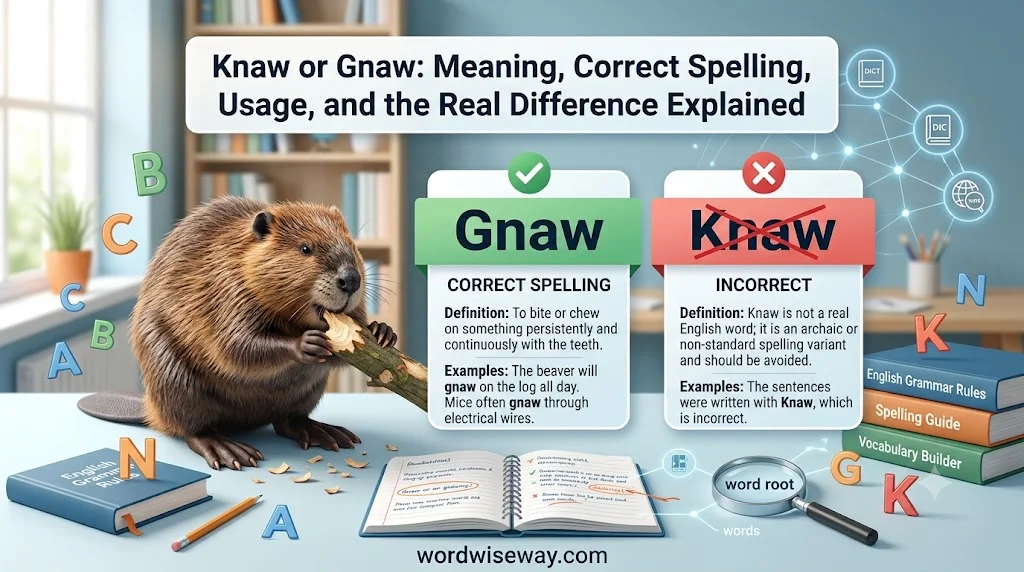
Gnaw is the correct English word.
The word knaw is generally considered a misspelling when someone wants to describe chewing, biting, or a feeling that slowly causes worry.
| Word | Correct Spelling | Meaning | Example |
| Gnaw | Yes | To chew repeatedly or slowly trouble someone | The dog likes to gnaw on its toy. |
| Knaw | No | Not the standard spelling of this verb | Knaw is usually a spelling mistake. |
The correct usage:
✅ The rabbit will gnaw on the carrot.
✅ The memory continued to gnaw at him.
Incorrect usage:
❌ The rabbit will knaw on the carrot.
Although both spellings might appear to have the same pronunciation, only gnaw should be used in normal writing.
Is Knaw a Correct Word?
Why Do People Write Knaw Instead of Gnaw?
The confusion between knaw or gnaw happens because English contains many silent-letter words.
For example:
| Word | Pronunciation | Silent Letter |
| Know | Noh | K |
| Knife | Nife | K |
| Knee | Nee | K |
| Knock | Nok | K |
Because these words keep the letter “k” even though it is silent, some people assume knaw could be the correct spelling for a word pronounced “naw.”
However, gnaw does not follow the “kn” pattern. It begins with gn, where the “g” is silent.
The correct spelling is:
Gnaw = to chew, bite, or slowly bother.
When Might You See the Word Knaw?
Although knaw is not the standard spelling of the verb, you may occasionally find it in unusual situations.
For example:
- A username on social media
- A fictional character name
- A creative spelling choice
- A brand or personal project name
These uses do not make knaw a replacement for gnaw.
Standard English spelling exists to help readers understand words quickly and consistently. Creative spellings can work in specific situations, but they should not replace correct vocabulary in everyday writing.
Read More: Set vs Sit: Differences, and Correct Usage
What Does Gnaw Mean?
The word gnaw has two main meanings. The first describes a physical action, while the second describes an emotional or mental experience.
Gnaw Meaning: To Bite or Chew Repeatedly
The most common meaning of gnaw is to bite something again and again.
Unlike a quick bite, gnawing involves repeated chewing. The action usually happens slowly and continues for some time.
Animals often gnaw because their teeth need constant use or because they need to break down hard materials.
Examples:
- A mouse may gnaw through cardboard.
- A dog may gnaw on a toy.
- A beaver may gnaw on tree branches.
- A rabbit may gnaw on vegetables.
The word creates an image of steady effort. A small animal does not destroy something instantly. Instead, it keeps working on the same object until it changes.
Common examples of things animals gnaw:
| Animal | What It May Gnaw |
| Mouse | Wood, cardboard, food |
| Rabbit | Plants and vegetables |
| Beaver | Tree branches |
| Dog | Toys and bones |
| Squirrel | Nuts and hard materials |
Gnaw Meaning in a Figurative Sense
English often takes physical actions and uses them to describe emotions. Gnaw works this way too.
When something gnaws at you, it does not physically bite you. Instead, it slowly troubles your thoughts or feelings.
For example:
“The mistake continued to gnaw at her.”
This means the mistake stayed in her mind and caused ongoing worry.
Other examples:
- Doubt began to gnaw at his confidence.
- A feeling of guilt gnawed at him.
- The unanswered question kept gnawing at my mind.
The figurative use of gnaw is powerful because it suggests something slowly wearing you down.
Instead of simply saying:
“The problem bothered him.”
You can say:
“The problem gnawed at him.”
The second sentence creates a stronger image. It shows that the problem stayed present and became difficult to ignore.
Why Does Gnaw Have a Silent G?
The spelling of gnaw comes from the history of the English language.
Hundreds of years ago, words beginning with gn were pronounced differently. Speakers once used both sounds, including the “g.” Over time, pronunciation changed and the first sound disappeared.
However, the spelling remained.
English has many words with silent letters that reflect older forms of pronunciation.
Examples:
| Word | Modern Pronunciation | Silent Letter |
| Gnaw | Naw | G |
| Gnat | Nat | G |
| Gnome | Nome | G |
| Gnash | Nash | G |
The silent “g” may seem strange today, but it connects modern English to its earlier roots.
How to Pronounce Gnaw Correctly
The word gnaw is pronounced:
“naw”
The letter g is completely silent.
Pronunciation:
- Written: gnaw
- Spoken: naw
Incorrect pronunciation:
❌ “g-naw”
Correct pronunciation:
✅ “naw”
The same silent “g” pattern appears in words like:
- gnat
- gnome
- gnash
Remembering this pattern can make words like gnaw easier to pronounce and spell.
Knaw vs Gnaw: Detailed Comparison
Understanding the difference between these two spellings becomes easier when you compare them directly.
| Feature | Gnaw | Knaw |
| Standard English word | Yes | No |
| Pronunciation | Naw | Usually intended as naw |
| Meaning | To chew or slowly bother | No standard meaning |
| Dictionary usage | Common | Not recognized as the correct verb |
| Recommended spelling | ✅ Use this | ❌ Avoid this |
The simple rule:
If you mean chewing, biting, or a problem slowly bothering someone, always use “gnaw.”
Common Mistakes When Using Gnaw
Mistake: Writing Knaw Instead of Gnaw
The most common error is replacing the “gn” spelling with “kn.”
Incorrect:
The puppy likes to knaw on its toy.
Correct:
The puppy likes to gnaw on its toy.
The mistake happens because writers often rely on familiar spelling patterns. However, the correct spelling must be remembered because English has many exceptions.
Mistake: Thinking Gnaw Only Applies to Animals
Some people believe gnaw only describes animals chewing objects.
That is only one meaning.
The word also describes emotions, thoughts, and problems that continue over time.
Examples:
Physical:
The rabbit gnawed on the branch.
Emotional:
Fear gnawed at his confidence.
Both sentences use the same word correctly.
Mistake: Confusing Gnaw With Know
Because gnaw and know look somewhat similar, they can confuse learners.
| Word | Meaning | Example |
| Know | To understand or be aware | I know the answer. |
| Gnaw | To chew or bother slowly | The worry gnawed at her. |
A simple memory trick:
Know is connected with your mind. Gnaw is connected with teeth or a problem eating away at your thoughts.
Examples of Gnaw Used Correctly in Sentences
The best way to understand gnaw meaning is to see how people use it in everyday sentences. The word has both a literal meaning and a figurative meaning, which makes it useful in different situations.
When you describe an animal chewing something repeatedly, gnaw creates a clear picture of continuous biting. When you describe emotions, it shows how a thought or feeling slowly affects someone.
Literal Examples of Gnaw
In its literal meaning, gnaw describes repeated chewing or biting. It often involves animals or objects that require constant pressure from teeth.
Examples:
- The puppy likes to gnaw on its favorite toy.
- The mouse managed to gnaw through the cardboard box.
- The beaver used its teeth to gnaw on the tree branch.
- The rabbit sat in the corner and gnawed on a carrot.
- The squirrel carefully gnawed the hard shell of the nut.
The difference between bite and gnaw is repetition. A bite can happen once, but gnawing continues for a longer period.
| Sentence | Meaning |
| The dog bit the toy. | The dog performed one biting action. |
| The dog gnawed the toy. | The dog repeatedly chewed the toy. |
Figurative Examples of Gnaw
The figurative use of gnaw describes something that slowly troubles a person emotionally or mentally.
For example:
The fear of failure began to gnaw at him.
This does not mean fear physically bites someone. It means the fear stays in his mind and continues causing stress.
More examples:
- Regret continued to gnaw at her.
- Doubts started to gnaw away at his confidence.
- The unanswered question kept gnawing at my thoughts.
- A feeling of guilt had been gnawing at him for years.
The word gnaw works well in these situations because it compares emotional problems to something slowly eating away at a person.
Gnaw vs Similar Words: Understanding the Difference
Many English words share similar meanings, but small differences change how they sound and feel. Understanding these differences helps you choose the right word.
Gnaw vs Chew
Both words involve using teeth, but they are not always used in the same way.
Chew is a general term. It describes breaking food or another object with your teeth.
Gnaw suggests repeated biting, especially on something hard.
| Word | Meaning | Example |
| Chew | To crush food with teeth | She chewed her dinner slowly. |
| Gnaw | To bite repeatedly | The dog gnawed on the bone. |
A person usually chews food, but an animal often gnaws on bones, wood, or toys.
Gnaw vs Bite
The main difference between these words is duration.
A bite usually happens quickly.
A gnaw continues over time.
Examples:
- The insect bit the leaf.
- The rabbit gnawed on the leaf.
The first sentence describes a single action. The second describes repeated chewing.
Gnaw vs Worry
When talking about emotions, gnaw and worry are related but have different strengths.
Worry means feeling concerned.
Gnaw suggests a worry that keeps returning and slowly affects you.
| Word | Feeling |
| Worry | General concern |
| Gnaw | Persistent concern that stays in your mind |
Example:
Simple:
She worried about the exam.
Stronger:
The upcoming exam gnawed at her confidence.
History and Origin of the Word Gnaw
Where Did Gnaw Come From?
The word gnaw has existed in English for more than a thousand years. It comes from the Old English word gnagan, which meant “to bite” or “to chew.”
Over time, English pronunciation changed. Speakers stopped pronouncing the first sound, but the traditional spelling remained.
This explains why gnaw has a silent “g.”
Many English words have similar histories:
| Word | Silent Letter | Pronunciation |
| Gnaw | G | Naw |
| Gnat | G | Nat |
| Gnome | G | Nome |
| Gnash | G | Nash |
The spelling of these words connects modern English with its older roots.
Memory Trick: How to Remember Gnaw vs Knaw
Simple Rule to Avoid the Mistake
Remember this:
Gnaw = teeth or thoughts.
If something is being chewed:
The puppy gnaws on the toy.
If something is troubling someone:
The worry gnaws at her.
The spelling knaw should not be used for these meanings.
Visual Memory Technique
Imagine a small animal chewing a wooden stick.
The animal is doing one thing:
GNAWING.
The silent G stays in the spelling even though you cannot hear it.
A simple reminder:
- Gnaw = correct
- Knaw = usually incorrect
Read More: Set vs Sit: Differences, and Correct Usage
Frequently Asked Questions About Knaw and Gnaw
Q1. Is it spelled knaw or gnaw?
The correct spelling is gnaw. The spelling “knaw” is an incorrect variant often used because people confuse the silent “g” with the silent “k” found in words like “know” or “knee.”
Q2. What does the word gnaw mean?
To gnaw means to bite or chew on something repeatedly, slowly wearing it away over time. It can refer to physical chewing or be used metaphorically to describe a persistent, troubling feeling.
Q3. Why is the letter G silent in gnaw?
The silent “g” is a remnant of Old English pronunciation, where the “g” sound was originally spoken before the “n.” Over centuries, English pronunciation changed, but the traditional spelling remained the same.
Q4. Can humans gnaw on things?
Yes, humans can physically gnaw on things, such as chewing stubbornly on a piece of tough meat or a pen cap, though the term is most frequently associated with the eating habits of animals.
Q5. What are common examples of animals that gnaw?
Rodents like mice, rats, squirrels, and beavers are prime examples. They must constantly gnaw on hard objects like wood or bark to prevent their front teeth from growing too long.
Q6. How do you use gnaw in a figurative sentence?
In a figurative context, it describes an ongoing emotional distress. For example: “A lingering sense of guilt began to gnaw at his conscience throughout the day.”
Q7. What is the difference between gnaw and chew?
While both involve using teeth, chewing is typically the normal process of breaking down food to swallow it. Gnawing implies a persistent, repetitive biting at a hard surface to wear it down.
Q8. Is knaw completely recognized in any English dictionary?
“Knaw” is not recognized as a standard, valid word in modern English dictionaries. Some historical or regional dialect archives note it as an obsolete spelling error, but it should not be used today.
Q9. What are some common synonyms for gnaw?
Common synonyms include nibble, chew, bite, erode, corrode, and wear away. In a mental context, synonyms include plague, torment, or trouble.
Q10. How can I remember to use the G instead of the K?
A helpful trick is to associate the “g” in gnaw with grinding teeth or the gums in your mouth. Remembering that gnawing is a gritty, persistent action can keep you from typing a “k.”
Conclusion
Understanding the distinct line between standard language conventions and common phonetic mistakes is essential for clear communication. The confusion between “gnaw” and its incorrect counterpart “knaw” stems naturally from the quirks of English pronunciation, where silent letters often leave writers guessing. By mastering the correct spelling and recognizing the silent “g,” you elevate the quality of your writing and avoid simple errors that can distract your readers.
Ultimately, vocabulary is about precision in both literal and figurative contexts. Whether you are describing the persistent habits of backyard rodents or the nagging anxieties that trouble the human mind, using “gnaw” correctly ensures your message is delivered effectively. Keeping these minor linguistic d

Evelyn Shaw has spent 14 years at Yale University’s English Department, leading students through close readings, genre studies, and interpretive methodologies. Her scholarly interests include Renaissance drama, gothic fiction, feminist literary criticism, and archival research and examining how texts generate meaning across historical periods. Evelyn has presented at major academic conferences and published essays in peer-reviewed journals, reflecting her passion for rigorous analysis and student-centered learning.