Language is full of tools that help us explain ideas, tell stories, and communicate complex Analogy vs Allegory: What’s the Difference and Correct Usage helps writers, students, and professionals explore literary terms clearly.
Many people struggle with these commonly used literary terms because both involve comparison and reveal deeper meaning. An Analogy is a tool that uses a comparison between two things to explain and clarify a concept or idea clearly. It helps connect one idea to another through something familiar, making complex concepts easier to understand.
In teaching, communication, and academic contexts, an analogy improves precise communication, effective teaching, and persuasive storytelling by helping readers understand ideas without confusion. It supports better writing, essays, and discussions. Understanding the purpose and structure of an analogy allows learners to confidently understand its usage and improve their communication abilities in different situations.
An Allegory is a narrative, story, or visual representation where characters, events, symbols, and objects represent broader ideas and deeper meanings. It often symbolizes a larger idea with a moral lesson or deeper message that may be political, spiritual, or related to society. Unlike analogy, an allegory tells an entire story where every element carries symbolic meaning.Misusing these literary terms can distort meaning, create confusion, and undermine credibility, leading to incorrect literary analysis or weak academic arguments.
This guide helps readers, avid readers, and those studying literature understand the difference, distinction, grammar definitions, literary definitions, structural differences, historical origins, real-world examples, common mistakes, practice exercises, answers, and expert-level insights needed to confidently understand and tell apart analogy and allegory in academic writing, professional contexts, and everyday discussions.
Analogy vs Allegory: The Difference at a Glance
Before diving deeper, here’s a quick comparison table.
| Feature | Analogy | Allegory |
| Primary Purpose | Explain a concept | Convey symbolic meaning |
| Form | Comparison | Narrative story |
| Length | Usually brief | Usually extended |
| Symbolism | Optional | Essential |
| Literal Meaning | Remains important | Often secondary |
| Common Uses | Education, communication, persuasion | Literature, philosophy, politics |
| Reader Goal | Understand | Interpret |
| Example | “Life is like a marathon.” | Animal Farm |
The Simplest Way to Remember
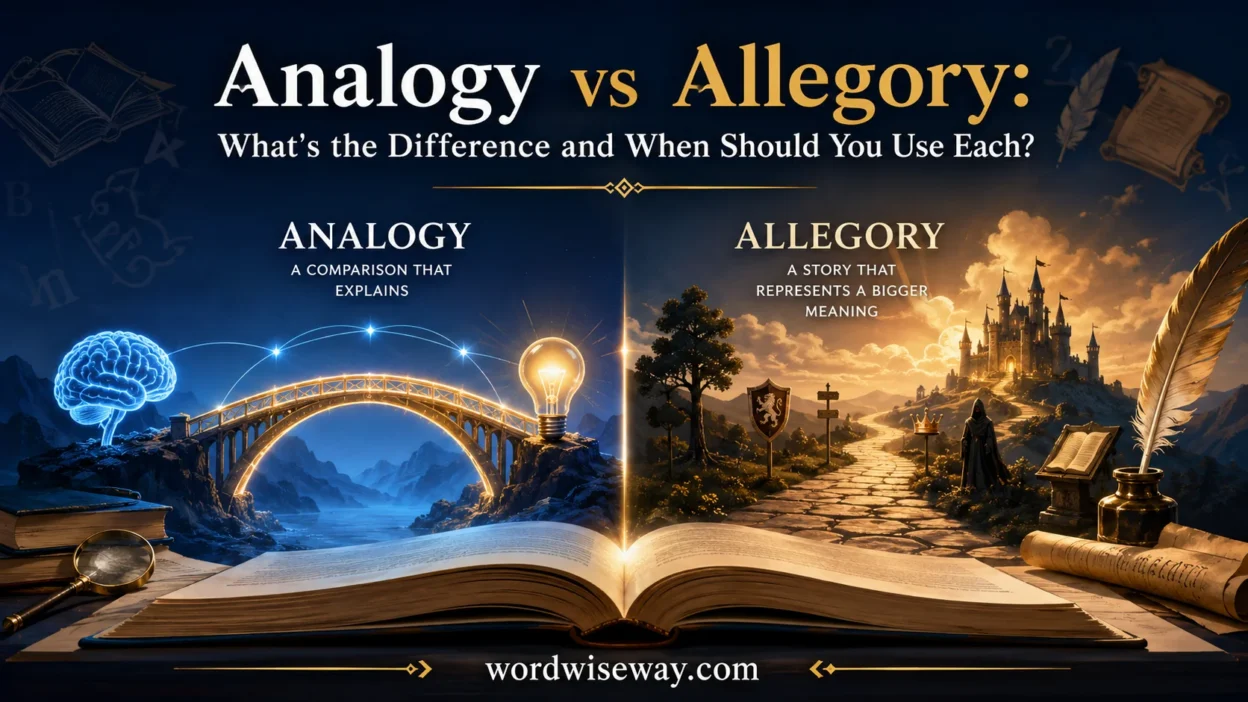
Think of an analogy as a flashlight.
It shines light on an idea that might otherwise be difficult to understand.
Think of an allegory as a treasure map.
The surface story matters, but the real value lies beneath the surface.
What Is an Analogy?
An analogy is a comparison between two different things that helps explain, clarify, or illustrate an idea.
Writers, teachers, scientists, and public speakers use analogies constantly because people naturally understand new information when it connects to something familiar.
Definition of Analogy
An analogy compares two things based on shared characteristics or relationships.
The goal isn’t necessarily to prove that the two things are identical. Instead, the goal is to make understanding easier.
For example:
“The human brain works like a computer.”
This statement doesn’t claim that brains are literally computers.
Instead, it highlights similarities. Both process information, store data, and perform tasks.
The comparison helps people understand a complex concept quickly.
Why Analogies Work So Well
The human brain loves patterns.
When people encounter something unfamiliar, they instinctively search for something familiar that resembles it.
Analogies take advantage of this tendency.
Instead of explaining every detail from scratch, an analogy creates a bridge between existing knowledge and new information.
For example:
- Electricity flowing through wires resembles water flowing through pipes.
- A company’s organizational structure resembles a tree with branches.
- A password functions like a key to a locked door.
Each analogy transforms abstract information into something tangible.
Types of Analogies
Not all analogies function in the same way.
Understanding the major categories can help writers choose the most effective comparison.
Literal Analogies
Literal analogies compare things that already share substantial similarities.
Example:
“A kitten is to a cat what a puppy is to a dog.”
The relationship remains straightforward and factual.
Figurative Analogies
Figurative analogies compare seemingly unrelated things.
Example:
“Running a business is like steering a ship through rough seas.”
Businesses and ships differ completely, yet the comparison helps explain leadership and decision-making.
Functional Analogies
These analogies focus on purpose.
Example:
“The heart is a pump.”
The heart isn’t mechanically identical to a pump, but both move fluids through a system.
Structural Analogies
Structural analogies compare organization or arrangement.
Example:
“The atom resembles a miniature solar system.”
Both involve smaller bodies orbiting a central core.
Real-World Examples of Analogies
Analogies appear everywhere.
Once you start looking for them, you’ll notice them in classrooms, boardrooms, advertisements, and everyday conversations.
Everyday Conversation
People use analogies naturally.
Examples include:
- “Finding that file was like searching for a needle in a haystack.”
- “Learning a new language is like building a house brick by brick.”
- “Parenting is like being a coach.”
Each comparison makes a point easier to understand.
Science and Education
Scientists frequently use analogies to explain difficult concepts.
Examples include:
| Concept | Analogy |
| Electrical current | Water flowing through pipes |
| DNA | Instruction manual |
| Immune system | Army defending a nation |
| Brain neurons | Communication network |
Without analogies, many scientific concepts would seem far more intimidating.
Business and Marketing
Successful marketers often rely on analogies.
Consider these examples:
- A financial advisor might compare investing to planting a tree.
- A software company may compare cloud storage to a digital filing cabinet.
- A project manager may describe workflows as assembly lines.
These comparisons help audiences understand products and services quickly.
What Is an Allegory?
An allegory is a narrative in which characters, events, places, and actions symbolize deeper meanings.
Unlike analogies, allegories aren’t primarily designed to explain.
They’re designed to represent.
Every major element contributes to a hidden layer of interpretation.
Definition of Allegory
An allegory is an extended story with symbolic meaning.
The narrative works on two levels:
- The literal story.
- The symbolic message beneath it.
Readers can enjoy the story itself while also discovering larger themes.
These themes often involve:
- Politics
- Religion
- Morality
- Philosophy
- Social criticism
How Allegories Function
Imagine watching a puppet show.
On the surface, you see characters moving across a stage.
Behind the curtain, however, someone controls every movement.
An allegory works similarly.
The visible story exists, but another meaning guides it behind the scenes.
Every major character, event, and setting contributes to the symbolic message.
Characteristics of Allegory
Several traits distinguish allegories from ordinary stories.
Extended Symbolism
Unlike isolated symbols, allegories sustain symbolism throughout the entire narrative.
Consistent Meaning
Characters consistently represent larger concepts.
The symbolism doesn’t appear randomly.
Narrative Structure
Allegories require a story framework.
A single sentence rarely qualifies as a complete allegory.
Deeper Themes
Most allegories explore important questions about society, ethics, politics, or human nature.
Famous Examples of Allegory
Some of history’s most influential works are allegories.
Let’s examine a few of the most famous examples.
Animal Farm
George Orwell’s Animal Farm remains one of the most recognizable political allegories ever written.
On the surface, it’s a story about farm animals overthrowing their human owner.
Underneath, it represents the Russian Revolution and the rise of Soviet communism.
Key examples include:
| Character | Historical Representation |
| Napoleon | Joseph Stalin |
| Snowball | Leon Trotsky |
| Mr. Jones | Tsar Nicholas II |
| Boxer | Working class citizens |
The story entertains readers while simultaneously critiquing political power.
Plato’s Allegory of the Cave
This philosophical allegory explores perception and reality.
Prisoners live inside a cave and mistake shadows for reality.
When one prisoner escapes, he discovers the truth beyond the cave.
The cave symbolizes ignorance.
The outside world symbolizes knowledge and enlightenment.
The Pilgrim’s Progress
This classic religious allegory follows a character named Christian on a spiritual journey.
Nearly every location and character symbolizes a religious concept.
The Chronicles of Narnia
Many scholars interpret parts of the series as Christian allegory.
Characters and events often mirror biblical themes.
Read More:Breaker or Braker: Correct Spelling, and Meaning
The Key Differences Between Analogy and Allegory
Now that we’ve defined both terms, let’s explore the differences in greater detail.
Although analogies and allegories both involve comparison, they operate in fundamentally different ways.
Purpose: Explanation vs Representation
The most important distinction involves purpose.
An analogy exists to explain.
An allegory exists to represent.
When someone says:
“Learning a language is like climbing a mountain.”
They’re using an analogy.
The comparison helps explain the challenges and rewards of language learning.
By contrast, when an entire story uses a mountain journey to symbolize personal growth, spiritual awakening, or life’s struggles, it becomes an allegory.
Structure: Comparison vs Narrative
An analogy usually appears as a statement, paragraph, or brief explanation.
An allegory unfolds through a complete narrative.
Consider these examples:
Analogy
“A team functions like an orchestra. Every member has a different role, but success depends on harmony.”
Allegory
A story about musicians struggling to perform together while representing different social classes and political ideologies.
The analogy explains.
The allegory explores.
Length: Brief vs Extended
Most analogies are relatively short.
Many can fit within a single sentence.
Examples:
- Life is like a journey.
- Time is like money.
- Memory works like a filing cabinet.
Allegories typically require more space.
A complete allegory often spans:
- Short stories
- Novellas
- Novels
- Plays
- Films
Symbolism: Optional vs Essential
An analogy doesn’t require symbolism.
It simply highlights similarities.
An allegory depends entirely on symbolism.
Without symbolic meaning, an allegory becomes an ordinary story.
Reader Experience
Readers approach analogies differently than allegories.
With analogies, readers ask:
“What is this helping me understand?”
With allegories, readers ask:
“What does this represent?”
That difference changes how people interpret the text.
Analogy vs Allegory: Side-by-Side Examples
Understanding the distinction becomes much easier when you compare examples directly.
Example: Personal Growth
As an Analogy
“Personal growth is like planting a tree. Progress happens slowly, but consistent care produces strong roots.”
The comparison explains a concept.
As an Allegory
Imagine a story about a gardener nurturing a fragile sapling through storms, droughts, and changing seasons.
The tree symbolizes the gardener’s emotional development.
The entire narrative carries symbolic meaning.
That’s allegory.
Example: Society
As an Analogy
“Society functions like a machine. Every component contributes to the larger system.”
This statement clarifies how societies operate.
As an Allegory
Imagine a fictional city where gears, engines, and machinery represent different social groups.
The story explores inequality, cooperation, and power structures.
That transforms the concept into an allegory.
Example: Leadership
As an Analogy
“A leader is like a ship captain guiding a crew through uncertain waters.”
The comparison explains leadership.
As an Allegory
A novel about a captain navigating dangerous oceans while symbolizing political leadership and national struggles becomes an allegory.
Common Mistakes People Make
Many students, writers, and readers confuse these literary devices.
Let’s clear up several common misconceptions.
Mistaking Every Comparison for an Allegory
Not every comparison is symbolic.
Most comparisons are simply analogies.
Example:
“The internet is a highway of information.”
This explains a concept.
It doesn’t create a symbolic narrative.
Confusing Allegory With Symbolism
Symbolism and allegory overlap, but they aren’t identical.
A symbol represents something else.
An allegory builds an entire story around symbolic representation.
For example:
A white dove may symbolize peace.
That alone isn’t an allegory.
However, a story in which every character, setting, and event symbolizes larger ideas may qualify as one.
Confusing Allegory With Metaphor
Metaphors and allegories share similarities.
Yet metaphors remain much shorter.
Example:
“Time is a thief.”
That’s a metaphor.
A full story where a thief represents the passage of time becomes allegorical.
Assuming Every Story Is Allegorical
Some readers search so intensely for hidden meaning that they find symbolism where none exists.
Not every novel, film, or poem functions as an allegory.
Sometimes a story is simply a story.
Writers may include themes without constructing a fully allegorical framework.
Analogy vs Allegory vs Metaphor vs Symbolism
These literary devices frequently appear together.
Understanding their differences helps prevent confusion.
| Literary Device | Purpose | Typical Length | Symbolic Meaning |
| Analogy | Explain | Short to medium | Usually no |
| Metaphor | Compare | Short | Usually no |
| Symbol | Represent | Varies | Yes |
| Allegory | Tell a symbolic story | Extended | Yes |
Analogy vs Metaphor
Many people treat these terms as interchangeable.
They’re related but different.
A metaphor directly states one thing is another.
Example:
“Knowledge is power.”
An analogy explains a relationship in greater detail.
Example:
“Knowledge is like a tool chest. The more tools you possess, the more problems you can solve.”
Both compare ideas.
The analogy provides more explanation.
Allegory vs Symbolism
Every allegory uses symbolism.
Not every symbol creates an allegory.
Think of symbolism as a building block.
Think of allegory as an entire building constructed from those blocks.
When Writers Should Use an Analogy
Analogies are among the most effective communication tools available.
Teaching Complex Concepts
Teachers rely on analogies because they simplify difficult subjects.
Examples include:
- Electricity and water flow
- DNA and instruction manuals
- Computer memory and filing cabinets
Students learn faster when abstract ideas become concrete.
Simplifying Technical Topics
Technical experts often struggle with communication.
Analogies bridge that gap.
For example:
A cybersecurity expert might compare a firewall to a security guard controlling access to a building.
The audience instantly understands the concept.
Strengthening Arguments
Persuasive writing frequently uses analogies.
Strong analogies help readers grasp unfamiliar ideas through familiar experiences.
Increasing Reader Engagement
People remember stories and comparisons more easily than raw facts.
An effective analogy can make a complex article significantly more memorable.
When Writers Should Use an Allegory
Allegories serve different goals.
Rather than simplifying concepts, they encourage reflection and interpretation.
Exploring Political Themes
Political allegories allow writers to discuss controversial topics indirectly.
This approach often proves more powerful than direct criticism.
Animal Farm remains a perfect example.
Addressing Social Issues
Allegories can examine:
- Inequality
- Corruption
- Justice
- Freedom
- Human rights
By creating symbolic narratives, writers encourage readers to think critically.
Communicating Moral Lessons
Many traditional fables contain allegorical elements.
The symbolic framework reinforces ethical and philosophical ideas.
Creating Multiple Layers of Meaning
One reason allegories endure for centuries is their depth.
Different readers may discover different interpretations.
The best allegories reward repeated reading.
Can a Work Contain Both Analogy and Allegory?
Absolutely.
The two devices aren’t mutually exclusive.
A single work may contain both.
For example:
An allegorical novel may include analogies within dialogue.
A political allegory might feature a character who uses analogies to explain ideas.
The distinction lies in function.
An analogy explains.
An allegory symbolizes.
Even when they appear together, they remain separate literary devices.
A Quick Test: Is It an Analogy or an Allegory?
When you’re unsure, ask three simple questions.
Question One
Does it primarily compare two things?
If yes, it’s likely an analogy.
Question Two
Does it tell a story?
If yes, it may be an allegory.
Question Three
Do the characters, settings, and events consistently represent larger ideas?
If yes, it’s probably an allegory.
Simple Decision Framework
| If It… | Then It’s Likely… |
| Explains through comparison | Analogy |
| Uses symbolic storytelling | Allegory |
| Clarifies a concept | Analogy |
| Represents deeper meaning | Allegory |
| Can fit into one sentence | Usually analogy |
| Requires a narrative structure | Usually allegory |
Why Understanding the Difference Matters
At first glance, the distinction may seem academic.
In reality, understanding these concepts improves both reading and writing.
Better Communication
When explaining difficult ideas, you’ll know when to use analogies effectively.
Stronger Literary Analysis
You’ll recognize symbolic narratives more accurately.
Improved Writing Skills
Choosing the right literary device makes writing more engaging and persuasive.
Greater Critical Thinking
Understanding allegory encourages deeper interpretation of texts, films, and cultural works.
Frequently Asked Questions
Q1. What is the main difference between analogy and allegory?
An analogy is a comparison between two things used to explain an idea, concept, or situation more clearly. It connects a familiar example with something that may be difficult to understand. An allegory, on the other hand, is a complete story, narrative, or representation where characters, events, and symbols carry deeper meanings, often related to moral, political, or spiritual messages.
Q2. Is an analogy a type of allegory?
No, an analogy and an allegory serve different purposes. An analogy is mainly a tool for explaining and clarifying ideas through comparison, while an allegory uses a full narrative structure to communicate a hidden or symbolic message. Although both involve deeper meaning, their methods and purposes are different.
Q3. When should you use an analogy in writing?
You should use an analogy when you want to make a complex concept easier for readers to understand. Writers, teachers, and professionals often use analogies to explain unfamiliar ideas by comparing them with something familiar. This makes communication clearer and helps readers connect one idea to another.
Q4. When should you use an allegory?
You should use an allegory when you want to tell a symbolic story that represents broader ideas or messages. Allegories are commonly used in literature, novels, speeches, and storytelling to discuss themes such as morality, society, politics, or human behavior through characters and events.
Q5. Why do people confuse analogy and allegory?
People often confuse analogy and allegory because both involve comparison and deeper meaning. They both help communicate ideas beyond their surface level. However, an analogy usually explains a specific idea, while an allegory develops an entire story where multiple elements represent something greater.
Q6. Can an analogy have a moral lesson like an allegory?
An analogy can sometimes support a moral lesson, but its primary purpose is explanation rather than storytelling. An allegory is specifically designed to represent deeper messages through symbols, characters, and events, making the moral or symbolic meaning an essential part of the narrative.
Q7. How are analogy and allegory used in academic writing?
In academic writing, analogies help explain difficult concepts, theories, and arguments by creating understandable comparisons. Allegories are often analyzed in literature studies because they contain symbolic meanings and deeper interpretations. Using the correct term improves clarity and credibility.
Q8. What are common mistakes when using analogy and allegory?
A common mistake is using the word analogy when referring to a symbolic story or using allegory for a simple comparison. Misusing these literary terms can create confusion, weaken arguments, and lead to incorrect literary analysis in essays, discussions, and professional communication.
Q9. Are analogies and allegories only used in literature?
No, analogies and allegories appear in many areas beyond literature. Analogies are used in teaching, science, communication, and everyday explanations, while allegories appear in novels, films, speeches, art, and cultural discussions to express deeper meanings.
Q10. How can I easily remember the difference between analogy and allegory?
A simple way to remember the difference is to think of analogy as a comparison that explains and allegory as a story that symbolizes. Analogy helps you understand an idea, while allegory invites you to interpret a hidden message behind characters, events, and symbols.
Conclusion
Understanding Analogy vs Allegory helps you communicate ideas more accurately and confidently. While both terms involve comparison and deeper meaning, they have different roles in language and storytelling. An analogy focuses on explaining a concept by connecting two things, whereas an allegory uses a narrative filled with characters, symbols, and events to represent broader ideas. Knowing this distinction allows writers, students, and readers to avoid confusion and use these literary terms correctly.
Whether you are improving writing skills, studying literature, preparing exams, or analyzing speeches and stories, recognizing the difference between analogy and allegory strengthens your interpretation abilities. By understanding their purposes, structures, and practical applications, you can choose the right term, create clearer arguments, and appreciate the deeper messages found in effective communication and storytelling.
Read More:Donar or Donor: Correct Spelling, Meaning, Difference, and Usage

Evelyn Shaw has spent 14 years at Yale University’s English Department, leading students through close readings, genre studies, and interpretive methodologies. Her scholarly interests include Renaissance drama, gothic fiction, feminist literary criticism, and archival research and examining how texts generate meaning across historical periods. Evelyn has presented at major academic conferences and published essays in peer-reviewed journals, reflecting her passion for rigorous analysis and student-centered learning.