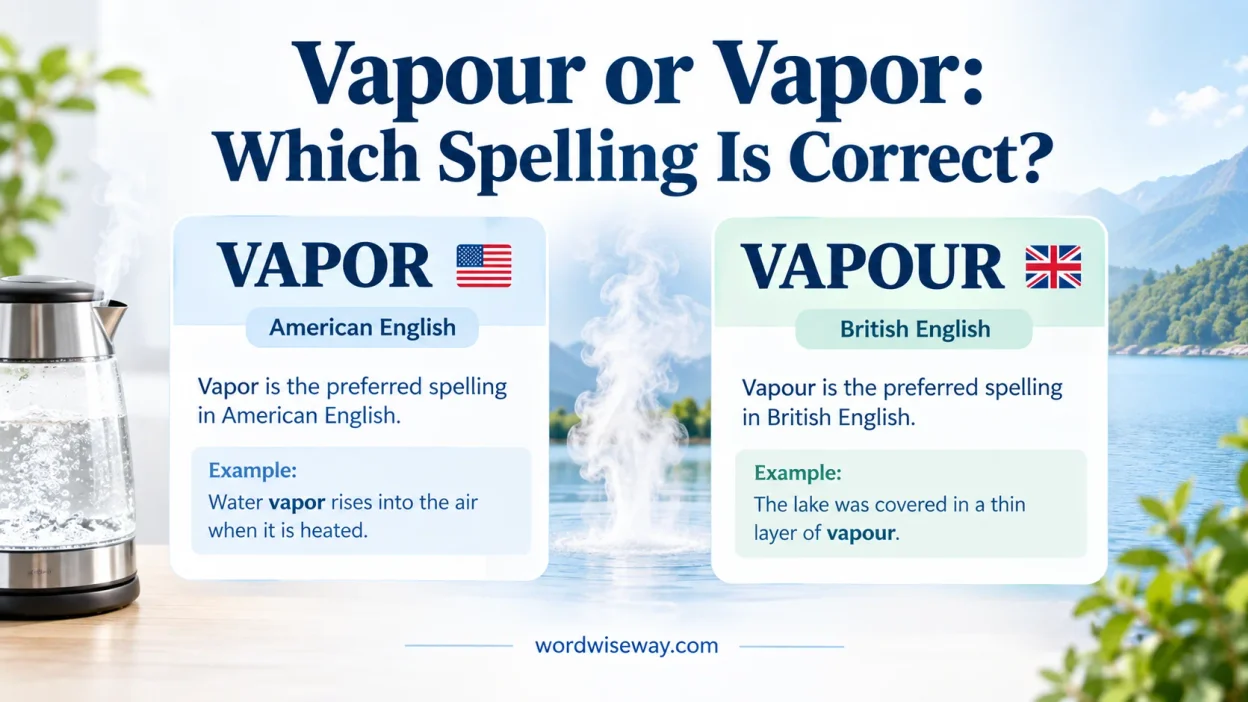
Vapour or Vapor: Which Spelling Is Correct? Both forms describe the gaseous phase of a substance that may be liquid or solid at room temperature.
The choice depends on the variant of English. British English uses vapour as the standard spelling, following -our spellings such as colour and honour.American English uses vapor, following -or endings like color and honor. These spelling differences reflect English variants and regional spelling, not different meanings.
The word has the same meaning, although different spellings may matter to writers, students, and professionals working with websites, textbooks, articles, science papers, and tech content.For emails,and assignments consider your audience and use one version consistently.
Understanding the English language, language variations, regions, world usage, origin, and usage rules improves clarity and readability. Real examples and practical advice can also reduce confusion about terminology, grammar, writing, search, keyword, publishing online, and search engine performance.
Quick Answer:
Vapor is correct in American English.
Vapour is correct in British English.
Both words have the same meaning. They refer to a gas or extremely small droplets produced when a liquid or solid is heated. Cambridge gives examples involving water vapor, mercury vapor, and poisonous vapors.
| Spelling | English variety | Example |
| Vapor | American English | Water vapor rises from the hot surface. |
| Vapour | British English | Water vapour rises from the hot surface. |
So, if you’re writing in US English, choose vapor. If you’re following British English, choose vapour.
Neither spelling is an error when used in the appropriate variety of English.
What’s the Difference?
The difference between vapour and vapor is primarily one of spelling.
The words have the same basic meaning, function, and pronunciation pattern. The distinction follows a broader spelling difference between American and British English.
American English often removes the u found in certain British spellings. You can see the same pattern in several familiar words.
| American English | British English |
| Vapor | Vapour |
| Color | Colour |
| Favor | Favour |
| Honor | Honour |
| Labor | Labour |
| Neighbor | Neighbour |
This doesn’t mean American English simply removes every u from British words. English spelling has a long history with many exceptions. Still, the -or/-our pattern provides a useful clue.
Vapor: The American English Spelling
Vapor is the standard American English spelling.
For example:
Water vapor forms when liquid water changes into a gas.
You’ll commonly see vapor in American scientific, educational, technical, and everyday writing.
Common American English expressions include:
- water vapor
- vapor pressure
- vapor barrier
- vapor cloud
- vapor phase
- vaporization
If your article, report, school assignment, or website follows US English, vapor should generally be your choice.
Vapour: The British English Spelling
Vapour is the standard British English spelling.
For example:
Water vapour forms when liquid water changes into a gas.
The meaning hasn’t changed. Only the spelling has.
British English uses vapour in scientific and general writing. Cambridge specifically labels vapour as the UK form of the word.
What Does Vapor Mean?
Vapor is a noun that generally refers to a gas or extremely small liquid droplets produced from a liquid or solid.
In chemistry and physics, the word has a more precise use. A vapor is the gaseous form of a substance that can exist as a liquid or solid under appropriate conditions.
For example, water can exist as ice, liquid water, and water vapor.
Vapor as a Noun
As a noun, vapor describes the gaseous or suspended form of a substance.
Consider these examples:
- Water vapor exists in the atmosphere.
- The scientist measured the vapor pressure of the liquid.
- A cloud of vapor appeared above the heated solution.
- The container released a small amount of vapor.
The word can describe naturally occurring atmospheric moisture as well as gases produced during scientific or industrial processes.
Vapor as a Verb
Vapor can also function as a verb in American English, although this use is less common in everyday conversation.
As a verb, it can mean to turn something into vapor or cause it to become vapor.
Related forms include vaporize, vaporized, and vaporization.
For example:
The intense heat can vaporize the liquid.
The verb vaporize is especially common in technical and scientific contexts. Cambridge also lists vaporization as a term for the relevant physical process.
Vapor in Scientific and Technical Contexts
Science gives vapor a particularly important role.
You’ll encounter the word in subjects such as:
- chemistry
- physics
- meteorology
- engineering
- environmental science
- thermodynamics
One familiar example is water vapor. Atmospheric water vapor plays an important role in weather and Earth’s climate system.
Another technical expression is vapor pressure, which describes the pressure exerted by a vapor when it is in equilibrium with its condensed phase at a given temperature.
In technical writing, spelling consistency matters. If a document follows American English, terms should generally retain the American spelling throughout.
What Does Vapour Mean?
Vapour has the same meaning as vapor. The difference is that vapour is the British English spelling.
Cambridge defines vapour as a gas or extremely small drops of liquid that result from heating a liquid or solid.
Vapour in British English
British English commonly uses vapour in ordinary and technical contexts.
For example:
- Water vapour is present in the atmosphere.
- The experiment produced vapour.
- The glass became cloudy because of water vapour.
- Scientists measured the vapour pressure.
If you’re writing according to British spelling conventions, these forms are appropriate.
Vapour in Commonwealth English
The spelling vapour also appears in English varieties influenced by British spelling conventions.
However, English usage varies by country, institution, publication, and style guide. That’s why the safest approach is to follow the spelling system required by your audience or publication.
For an American audience, use vapor. For British-style writing, use vapour.
Vapor vs. Vapour in American and British English
The easiest way to remember the distinction is to connect the spelling with the variety of English.
US English: Vapor
American English uses:
vapor
Examples:
- water vapor
- vapor pressure
- vapor barrier
- vapor phase
- vaporization
If your website follows US English, vapor should be your default spelling.
UK English: Vapour
British English uses:
vapour
Examples:
- water vapour
- vapour pressure
- vapour barrier
- vapour phase
- vapourization
The underlying concept remains the same.
Canadian, Australian, and Other English Usage
English spelling can become less tidy when you cross national borders.
Canadian English often uses a mixture of American and British spelling conventions. Australian English generally follows British-derived spelling traditions, although actual usage depends on the word and context.
Therefore, don’t assume that every English-speaking country uses exactly the same spelling system.
When you’re writing for a particular country, check the style guide or dictionary preferred by that audience. Consistency matters more than trying to force one spelling onto every reader.
Meaning and Grammar
Both vapor and vapour can function as nouns. The same word family also produces related verbs and nouns.
| Form | American English | British English |
| Main noun | vapor | vapour |
| Related verb | vaporize | vaporize |
| Process noun | vaporization | vaporization |
| Common compound | vapor pressure | vapour pressure |
The spelling difference is most obvious in the base noun.
Vapor/Vapour as a Noun
The noun usually refers to a gaseous substance or tiny suspended droplets.
For example:
The heated liquid released vapor.
In British English:
The heated liquid released vapour.
Both sentences communicate the same idea.
Vapor/Vapour as a Verb
The related verb vaporize means to turn into vapor or cause something to become vapor.
For example:
Extreme heat can vaporize certain materials.
The related noun is vaporization.
Interestingly, the British spelling distinction doesn’t simply apply by changing every -or ending to -our. English word families have their own spelling conventions, so you shouldn’t automatically transform related words without checking the accepted form.
Related Words and Forms
The vapor/vapour family appears in several technical expressions.
Common examples include:
- water vapor
- water vapour
- vapor pressure
- vapour pressure
- vapor phase
- vapour phase
- vaporize
- vaporization
When technical accuracy matters, use the terminology preferred by your field and maintain one spelling convention throughout the document.
Examples
These make this spelling difference much easier to remember.
Examples With Vapor
Here are several examples in American English:
- Water vapor is an important component of Earth’s atmosphere.
- The scientist measured the vapor pressure of the sample.
- Heat caused the liquid to produce vapor.
- The surface became covered with tiny droplets after exposure to water vapor.
- The experiment examined how quickly the substance changed into vapor.
Examples With Vapour
The same ideas can appear in British English:
- Water vapour is an important component of Earth’s atmosphere.
- The scientist measured the vapour pressure of the sample.
- Heat caused the liquid to produce vapour.
- The surface became covered with tiny droplets after exposure to water vapour.
- The experiment examined how quickly the substance changed into vapour.
Notice what changes. The core meaning doesn’t. The spelling does.
Examples in Scientific Writing
Scientific writing often exposes the difference because terms such as water vapor and vapor pressure appear frequently.
For an American English paper:
The concentration of water vapor increased as the temperature rose.
For British English:
The concentration of water vapour increased as the temperature rose.
Neither sentence is inherently more correct. The appropriate choice depends on the English variety being used.
Examples in Everyday Sentences
You don’t need a laboratory to use the word.
For example:
Steam filled the bathroom with warm vapor.
Or:
The mirror became cloudy because of water vapor.
In British English, simply use vapour instead.
Vapor and Vapour in Technical and Scientific Writing
Scientific terminology makes spelling consistency particularly important.
A technical article can look careless if it switches between American and British forms without a reason. Imagine reading water vapor in one paragraph and water vapour in the next. The meaning remains clear, but the inconsistency creates unnecessary friction.
Water Vapor and Water Vapour
It is the American spelling.
Water vapour is the British spelling.
Water vapor is water in its gaseous state. It’s naturally present in Earth’s atmosphere and contributes to atmospheric processes such as cloud formation and precipitation.
Vapor Pressure and Vapour Pressure
Vapor pressure is the American form.
Vapour pressure is the British form.
The term describes the pressure exerted by a vapor in equilibrium with its condensed phase at a particular temperature.
Temperature strongly affects vapor pressure. As temperature rises, molecules generally gain more energy and more readily enter the gas phase.
Vaporization and Vapourization
Here, caution matters.
It’s easy to assume that every American -or spelling automatically becomes a British -our spelling. English doesn’t work that neatly.
The standard form vaporization is widely used, including in British technical contexts. Cambridge’s dictionary entry uses vaporization for the process.
This is an excellent reminder that spelling families require attention rather than mechanical letter swapping.
Vapor-Based and Vapour-Based Terms
Compound expressions usually follow the spelling convention of the base word.
American English:
- vapor-based system
- vapor barrier
- vapor pressure
- vapor phase
British English:
- vapour-based system
- vapour barrier
- vapour pressure
- vapour phase
When editing technical content, consistency across headings, tables, captions, and body text is worth checking.
Why Does Vapor Have Two Spellings?
The difference comes from the development of different English spelling traditions.
British English retained many spellings influenced by historical French and Latin forms. American English later developed its own spelling conventions, with several forms becoming shorter.
The -our/-or distinction appears in words such as colour/color, favour/favor, and honour/honor.
However, spelling history isn’t a perfectly symmetrical system. Some words retain different patterns for historical or conventional reasons.
That explains why you shouldn’t treat vapour and vapor as separate vocabulary words. They’re two regional spellings of the same word.
Common Words With -or and -our Differences
The following table provides a useful comparison:
| American English | British English |
| Vapor | Vapour |
| Color | Colour |
| Favor | Favour |
| Honor | Honour |
| Labor | Labour |
| Neighbor | Neighbour |
These pairs aren’t random. They illustrate a recurring difference between American and British spelling conventions.
Still, don’t apply the pattern blindly to every English word. Dictionary evidence remains the better guide.
Is “Vapour” or “Vapor” More Correct?
Neither spelling is universally more correct.
The right choice depends on the variety of English you’re writing.
When to Use Vapor
Choose vapor when:
- you’re writing in US English
- your audience primarily uses American English
- your style guide specifies American spelling
- you’re writing an American academic or technical document
- your website consistently uses American spelling
For example:
Water vapor makes up part of Earth’s atmosphere.
When to Use Vapour
Choose vapour when:
- you’re writing in British English
- your publication follows British spelling
- your institution requires British conventions
- your audience expects British English
For example:
Water vapour makes up part of Earth’s atmosphere.
The key is consistency. Don’t switch between the two forms without a clear editorial reason.
Common Mistakes
These words cause a few predictable errors.
Mixing US and UK Spellings
One common mistake is mixing spelling systems within the same article.
For example, a writer might use:
The colour of the vapor changed.
That combination isn’t automatically grammatically wrong because English varieties can coexist in informal writing. However, it creates an inconsistent style when the document is supposed to follow one spelling system.
If you’re writing in US English, use color and vapor.
If you’re writing in British English, use colour and vapour.
Using Vapour in American English
Vapour isn’t meaningless or unintelligible in American English. Readers will understand it.
However, vapor is the standard US spelling. If your goal is consistent American English, use vapor.
Assuming One Spelling Is Incorrect
This is perhaps the biggest misunderstanding.
Vapour isn’t a misspelling of vapor.
Likewise, vapor isn’t an incorrect version of vapour.
They’re established regional spellings. Cambridge explicitly labels vapor as US and vapour as UK.
Pronunciation
The two spellings have essentially the same pronunciation pattern.
Cambridge gives the American pronunciation as /ˈveɪ.pɚ/ and the British pronunciation as /ˈveɪ.pə/.
The main difference is the final unstressed vowel sound associated with the regional accent.
For practical writing purposes, you don’t need to pronounce the words differently simply because one contains u.
The extra letter changes the spelling, not the fundamental identity of the word.
Synonyms and Related Terms
Depending on context, you may encounter related words such as:
- gas
- mist
- fumes
- steam
- moisture
- vaporization
- evaporation
These aren’t perfect synonyms.
For instance, steam commonly refers to water in a gaseous state, especially in everyday language. Mist refers to tiny liquid droplets suspended in the air. Fumes often refers to gas, smoke, or vapor associated with a substance.
Therefore, replacing vapor with another word isn’t always an exact substitution.
A Simple Way to Remember
Here’s an easy memory trick:
American English = vapor
British English = vapour
Think of the British spelling as carrying an extra u, just as it does in colour, favour, and honour.
If your writing follows US English, remove the u and write vapor.
If your writing follows British English, keep the u and write vapour.
Read More: Prove or Proove: Which Spelling Is Correct?
FAQs
Is Vapour or Vapor the Correct Spelling?
Both vapour and vapor are correct spellings. The choice depends on the type of English you are using.
What Is the Difference Between Vapour and Vapor?
There is no difference in meaning. Vapour is commonly used in British English, while vapor is standard in American English.
Is Vapour British or American English?
Vapour is the standard British English spelling. It follows the same -our pattern found in words such as colour and honour.
Is Vapor Used in American English?
Yes. Vapor is the standard American English form and follows the American preference for -or endings.
Should I Use Vapour in British Writing?
Yes, vapour is appropriate when you are following British English spelling conventions in writing.
Should I Use Vapor in American Writing?
Yes. Use vapor when following American English conventions, especially in American-focused articles, assignments, or professional writing.
Do Vapour and Vapor Have the Same Meaning?
Yes. Both words refer to the gaseous phase of a substance. The spelling changes according to the English variant.
Which Spelling Should I Use for a Global Audience?
Choose the spelling that matches your target audience and use it consistently. Consistency can make your writing clearer and easier to read.
Does Vapour or Vapor Matter for SEO Content?
It can matter when your content targets searches from a particular English-speaking region. Using the relevant spelling can help align your content with regional search terminology.
How Can I Remember the Difference Between Vapour and Vapor?
A simple way to remember it is to connect vapour with British -our spellings and vapor with American -or spellings.
Conclusion:
Vapour and vapor have the same meaning, but their spelling reflects different forms of English. British English uses vapour, while American English uses vapor. Neither spelling is incorrect when used in the appropriate regional context.
For everyday writing, assignments, articles, and professional communication, the key is to follow the spelling style expected by your audience. If you are writing for British readers, choose vapour. For American readers, vapor is the usual choice.
Once you understand this regional difference, the confusion becomes much easier to handle. Check your target audience, choose the suitable version, and keep your spelling consistent throughout the same piece of content. This simple approach supports clear and natural English.

Amelia Sanders has spent 14 years in Harvard University’s English Department, helping students navigate literary analysis, interpretive theory, and narrative techniques. Her academic pursuits center on 18th-century British prose, romantic poetry, diasporic writing, and digital editing exploring how textual choices influence cultural perspectives. Amelia has spoken at major international meetings and contributed essays to respected academic volumes, demonstrating her dedication to thoughtful scholarship and effective teaching.