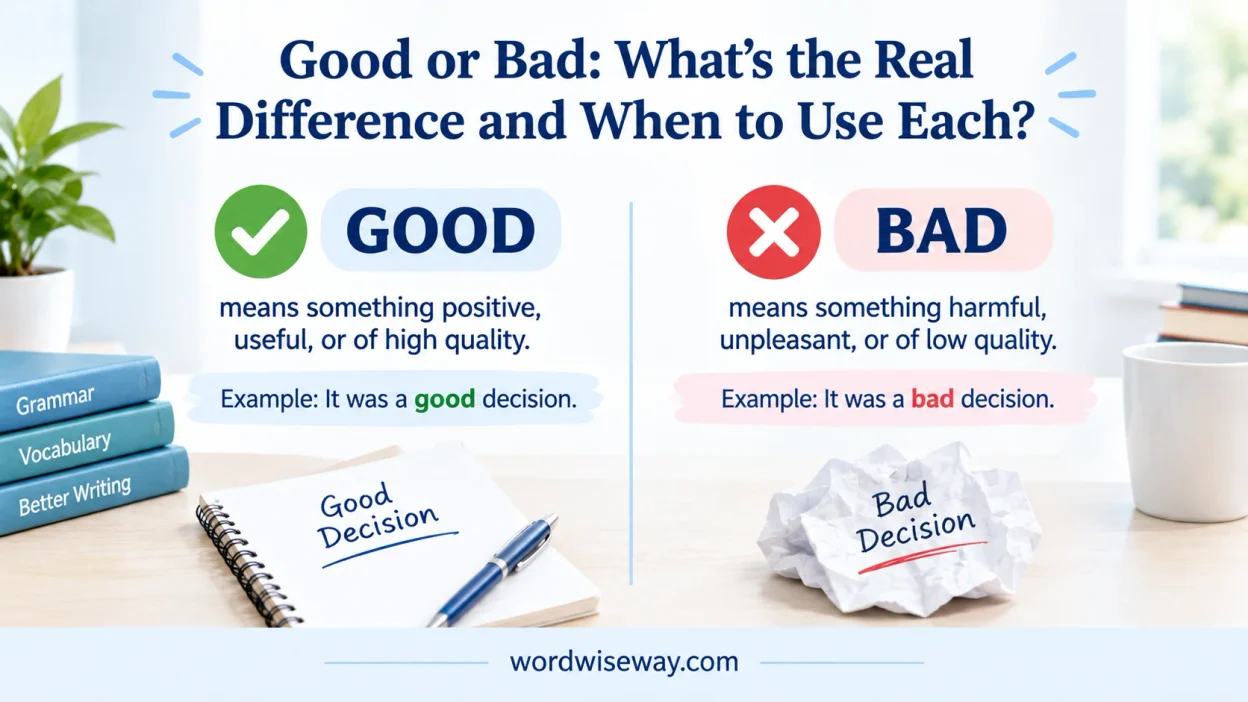
Good or Bad: What’s the Real Difference and When to Use Each? becomes clearer when you look at everyday situations.
People judge things as good or bad based on experience. A meal can taste good, while a decision may feel bad because of its outcomes. These opposite words stay connected when you compare ideas, choices, and results.
The phrase is common in speech, writing, and online content. However, learners may face confusion when they mix up grammar rules or feel unsure about formal writing. Its meaning depends on the context, so correct usage requires attention to the words around it and the same sentence.
A simple guide offers clear meaning and simple guidance through real-life examples. You can learn the difference, use each word correctly, and understand its function with greater confidence. By the end, you’ll know how to describe different results, value, and quality naturally.
Quick Answer:
Good describes something positive, desirable, useful, suitable, enjoyable, successful, or of acceptable quality. Bad describes something negative, undesirable, harmful, unsuitable, unpleasant, unsuccessful, or of poor quality.
| Word | Basic Meaning | Common Uses | Example |
| Good | Positive or desirable | Quality, behavior, results, skills, experiences | She made a good decision. |
| Bad | Negative or undesirable | Quality, behavior, results, problems, experiences | She made a bad decision. |
The easiest way to remember the difference is to ask what you’re describing. If it has a positive or desirable quality, use good. If it has a negative or undesirable quality, use bad.
For example:
- This is a good idea. = The idea seems useful or sensible.
- This is a bad idea. = The idea seems unwise or likely to cause problems.
- He is good at writing. = He has strong writing skills.
- He is bad at writing. = His writing skills aren’t strong.
- The weather is good. = The weather is pleasant or favorable.
- The weather is bad. = The weather is unpleasant or unfavorable.
The words are opposites in many situations, but their meanings aren’t always absolute. What counts as “good” or “bad” can depend on the situation, purpose, or person’s judgment.
What Does “Good” Mean?
Good is one of the most common adjectives in English. Its broad meaning is connected to something positive, desirable, suitable, effective, or valuable.
The exact meaning depends on the noun or situation it describes.
For example, good food can mean food that tastes pleasant or has high quality. A good decision can mean a wise or beneficial choice. A good student might describe someone who studies effectively, behaves responsibly, or performs well academically.
Definition of Good
The word good can describe:
- High or acceptable quality
- Positive results
- Useful or beneficial things
- Appropriate choices
- Pleasant experiences
- Strong skills
- Positive behavior
- Moral qualities
- Favorable conditions
Consider these examples:
- She gave me good advice.
- We had a good experience.
- He made a good decision.
- That’s a good idea.
- She is good at mathematics.
- The restaurant serves good food.
- They received good results.
Notice something important: good doesn’t always mean perfect or exceptional.
If someone says, “The movie was good,” they usually mean they liked it or considered it satisfactory. They aren’t necessarily saying the movie was the greatest film ever made.
Examples of Good in Sentences
The meaning of good becomes clearer when you see it in different contexts.
Quality:
This is a good laptop.
Here, good suggests that the laptop has desirable qualities.
Decision:
You made a good decision.
The choice was sensible, useful, or beneficial.
Skill:
Maria is good at drawing.
The sentence describes Maria’s ability in a particular area.
Behavior:
The children showed good behavior.
Here, good describes conduct that meets an expected standard.
Benefit:
Walking is good for your health.
In this construction, good for means beneficial to something.
What Does “Bad” Mean?
Bad generally expresses the negative side of the same spectrum. It can describe poor quality, harmful effects, unpleasant experiences, unsuitable choices, negative behavior, or unfavorable conditions.
Like good, its precise meaning depends heavily on context.
Definition of Bad
The word bad can describe:
- Poor quality
- Harmful effects
- Unpleasant experiences
- Negative results
- Unwise decisions
- Poor performance
- Negative behavior
- Unfavorable conditions
- Moral wrongdoing
For example:
- That’s a bad idea.
- We had a bad experience.
- He made a bad decision.
- The weather is bad today.
- This habit is bad for you.
- She had a bad result on the test.
- His behavior was bad.
Just as good doesn’t always mean “perfect,” bad doesn’t always mean “evil.”
If someone says, “I had a bad day,” they usually mean the day contained unpleasant or difficult events. They aren’t saying the entire day possessed some form of moral evil.
Examples of Bad in Sentences
Quality:
This is a bad product.
The product has poor or undesirable qualities.
Decision:
Buying that broken phone was a bad decision.
The choice produced or could produce an unfavorable outcome.
Experience:
We had a bad experience at the hotel.
The experience was unpleasant or disappointing.
Effect:
Too much screen time can be bad for your sleep.
Here, bad for means harmful or unfavorable to something.
Main Differences
The simplest distinction is positive versus negative. Yet several useful contrasts explain how these words work in real sentences.
| Good | Bad |
| Positive | Negative |
| Desirable | Undesirable |
| Beneficial | Harmful |
| Favorable | Unfavorable |
| Suitable | Unsuitable |
| High or acceptable quality | Poor quality |
| Wise or sensible | Unwise or problematic |
| Pleasant | Unpleasant |
For example, imagine someone choosing between two study methods.
Method A produced good results.
The results were favorable.
Method B produced bad results.
The results were unfavorable.
The nouns haven’t changed. Only the evaluation has changed.
Positive vs. Negative Meaning
Good normally points toward a favorable quality, outcome, or experience.
Bad points in the opposite direction.
Compare:
- good news vs. bad news
- good habit vs. bad habit
- good result vs. bad result
- good choice vs. bad choice
- good experience vs. bad experience
This contrast makes the words useful in everyday English because they quickly communicate evaluation.
Desirable vs. Undesirable
Another useful distinction involves preference.
Something good is often something you want, value, or consider useful. Something bad is often something you want to avoid.
For example:
Getting enough sleep is good for your health.
Staying awake all night regularly can be bad for your health.
The words describe the expected effect of two different habits.
Helpful vs. Harmful
The expressions good for and bad for are especially common when discussing effects.
Fresh air can be good for you.
Excessive stress can be bad for you.
Here, good doesn’t simply mean “pleasant.” It means beneficial.
Likewise, bad means harmful or unfavorable.
Good and Bad as Opposites
Good and bad are common antonyms, meaning they frequently express opposite qualities.
You can see this clearly in paired expressions:
- good decision / bad decision
- good behavior / bad behavior
- good habit / bad habit
- good result / bad result
- good experience / bad experience
- good weather / bad weather
- good idea / bad idea
- good quality / bad quality
However, English doesn’t always treat opposites as perfectly symmetrical.
For example, the opposite of good in one context could be poor, unpleasant, harmful, wrong, or unsuitable.
Likewise, bad doesn’t always have a single replacement opposite. Context decides which word fits best.
When to Use “Good”
Knowing the definition is useful. Knowing when to use good is even more practical.
Use Good for Positive Qualities
Use good when something has a quality you consider desirable.
She is a good teacher.
This can mean she teaches effectively, supports students, explains ideas clearly, or meets the expected standard.
Another example:
That’s a good solution.
The solution appears useful or appropriate for the problem.
Use Good for High-Quality Things
Good commonly describes products, food, books, movies, services, and other things people evaluate.
This is a good book.
They sell good coffee.
She bought a good computer.
In these sentences, good indicates favorable quality. It doesn’t necessarily mean the item is flawless or exceptional.
Use Good for Beneficial Results
Use good for when something provides a benefit.
Exercise is good for your health.
Reading is good for vocabulary development.
This change could be good for the business.
The structure is important:
good + for + noun/pronoun
The phrase answers the question of what benefits from something.
Use Good for Skill or Ability
Use good at when you describe someone’s ability in a particular activity or subject.
He is good at football.
She’s good at mathematics.
I’m good at explaining difficult ideas.
The standard structure is:
good + at + activity or subject
Don’t confuse this with good for.
She is good at writing.
Writing is good for her career.
The first sentence describes ability. The second describes a benefit.
Use Good for Morally Positive Behavior
Good can also describe behavior or character.
He is a good person.
The child showed good behavior.
She did a good thing by helping her neighbor.
However, moral judgments depend on context and social standards. In these sentences, good expresses a value judgment rather than a measurable physical quality.
When to Use “Bad”
The same principles work in reverse when you choose bad.
Use Bad for Poor Quality
Use bad when something doesn’t meet an expected standard.
The product was bad.
That was a bad movie.
The food tasted bad.
These sentences communicate dissatisfaction or poor quality.
Use Bad for Harmful Effects
Use bad for when something causes a negative effect.
Smoking is bad for your health.
Too much sugar can be bad for your teeth.
That decision could be bad for the company.
Here, bad for means harmful, damaging, or unfavorable.
Use Bad for Unpleasant Experiences
You can describe an unpleasant event or experience as bad.
We had a bad experience during the trip.
She had a bad day at work.
It was a bad experience for everyone involved.
The word doesn’t necessarily describe something objectively harmful. It can simply express a person’s negative experience.
Use Bad for Poor Results or Performance
Bad can describe results that fall below an expected standard.
He received a bad result.
The team had a bad performance.
The experiment produced bad results.
The meaning comes from the context and expected standard.
Use Bad for Negative Behavior
Use bad when describing behavior that violates an expected rule or standard.
The student displayed bad behavior.
Lying can become a bad habit.
That was a bad thing to do.
Again, context matters. The word expresses a negative evaluation.
Good vs. Bad in Different Contexts
The same two words can work across many everyday situations.
Good or Bad Decisions
A good decision is usually sensible, useful, or beneficial.
A bad decision is usually unwise, harmful, or likely to create problems.
Saving money for an emergency was a good decision.
Ignoring the warning was a bad decision.
The words evaluate the likely or actual consequences of the choices.
Good or Bad Behavior
Good behavior generally follows expected rules or standards.
Bad behavior breaks those standards or creates problems.
The students showed good behavior during the event.
The student received a warning for bad behavior.
Good or Bad Results
A good result meets or exceeds an expected standard.
A bad result falls below that standard or creates an undesirable outcome.
For example:
The new strategy produced good results.
The old strategy produced bad results.
Good or Bad Experiences
A good experience is pleasant, satisfying, useful, or memorable in a positive way.
A bad experience is unpleasant, disappointing, stressful, or otherwise negative.
My first visit was a good experience.
My second visit was a bad experience.
The evaluation can be personal because experiences differ from one person to another.
Good or Bad Weather
English speakers commonly use good weather and bad weather.
We had good weather for the picnic.
The storm brought bad weather.
Here, “good” often means suitable or pleasant for the activity. “Bad” means unfavorable or unpleasant.
Grammar
Understanding the grammatical role of these words prevents several common mistakes.
Good and Bad as Adjectives
Both good and bad primarily function as adjectives.
They can appear before nouns:
She bought a good book.
She bought a bad book.
They can also appear after linking verbs:
The book is good.
The book is bad.
In both cases, the words describe something.
Good After Linking Verbs
You can use good after verbs such as be, seem, look, feel, smell, taste, and sound when the adjective describes the subject.
The food tastes good.
You look good today.
That sounds good.
I feel good.
In these examples, good describes the subject or its condition.
Bad After Linking Verbs
The same structure works with bad.
The food tastes bad.
That sounds bad.
The situation looks bad.
I feel bad about what happened.
The adjective remains connected to the subject through the linking verb.
Good vs. Well
One of the most important distinctions related to good vs. bad is good vs. well.
Good is generally an adjective. Well is commonly an adverb that describes how someone performs an action.
Compare:
She is a good singer.
She sings well.
The first sentence describes the singer. The second describes how she sings.
Another example:
He is a good writer.
He writes well.
A useful rule is:
Good describes a person or thing. Well often describes an action.
However, English has exceptions. Well can also function as an adjective when it means “in good health.”
I don’t feel well today.
This distinction becomes easier when you focus on what the word modifies.
Bad vs. Badly
The same grammatical pattern appears with bad and badly.
Bad usually works as an adjective:
That was a bad performance.
Badly usually works as an adverb:
He performed badly.
The first sentence describes the performance. The second describes how he performed.
Compare:
| Adjective | Adverb |
| She is a good writer. | She writes well. |
| He is a bad singer. | He sings badly. |
| It was a good performance. | They performed well. |
| It was a bad performance. | They performed badly. |
This simple comparison clears up one of the most persistent adjective-adverb problems in English.
Common Expressions With Good
Several expressions use good in fixed or highly common patterns.
Good at
Good at describes ability.
She’s good at drawing.
He’s good at solving problems.
Good for
Good for describes a beneficial effect.
Exercise is good for you.
This change is good for the environment.
Good with
Good with can describe someone’s ability to handle, work with, or interact with something or someone.
She’s good with children.
He’s good with computers.
Good to
Good to can describe kind or favorable treatment.
She was good to me.
It can also appear in other common constructions with different meanings, so context matters.
Good enough
Good enough means sufficiently suitable or acceptable for a particular purpose.
This answer is good enough for the assignment.
It doesn’t mean perfect. It means it meets the necessary standard.
As good as
As good as can compare quality or express that something is effectively equivalent in a particular context.
This model is as good as the newer one.
The comparison depends on the specific quality being discussed.
Common Expressions With Bad
Bad also appears in many familiar expressions.
Bad at
Use bad at to describe weak ability.
I’m bad at remembering names.
Bad for
Use bad for to describe a harmful or unfavorable effect.
Too much stress can be bad for your health.
Bad with
Bad with can describe difficulty handling or managing something.
He’s bad with money.
Bad habit
A bad habit is a repeated behavior considered harmful, undesirable, or unhelpful.
Staying up too late became a bad habit.
Bad idea
A bad idea is a suggestion or plan considered unwise or unsuitable.
Skipping the instructions was a bad idea.
Bad luck
Bad luck refers to an unfortunate event or unfavorable circumstances.
We had bad luck with the weather.
Common Mistakes
Using Good Instead of Well
A common mistake occurs when someone uses good to describe an action.
Incorrect in standard formal usage:
She sings good.
Standard:
She sings well.
However, you’ll hear “sings good” in some informal speech and dialects. Standard written English generally uses well here.
Using Bad Instead of Badly
The same issue occurs with bad and badly.
He performed badly.
Here, badly describes the manner of performing.
Assuming Good Always Means Excellent
Good doesn’t necessarily mean outstanding.
Consider this scale:
acceptable → good → very good → excellent → exceptional
The exact boundaries depend on context, but the point remains: good can indicate a positive quality without claiming perfection.
Assuming Bad Always Means Evil
This mistake creates an unnecessarily strong interpretation.
The weather was bad.
Nobody is suggesting that the weather committed a moral crime.
Bad can simply mean unpleasant, poor, unfavorable, or unsuccessful.
Confusing Good for With Good At
Compare:
She is good at painting.
This describes her skill.
Painting is good for her career.
This describes a benefit.
Changing the preposition changes the relationship between the words.
Ignoring Context
A word can carry different shades of meaning depending on its surroundings.
For example:
He is a good player.
This usually praises his ability.
He is a good person.
This commonly evaluates his character.
This is a good price.
This may mean the price is favorable or reasonable.
The adjective stays the same. The context does the heavy lifting.
Practical Comparison
| Context | Good | Bad |
| Decision | A wise or beneficial choice | An unwise or harmful choice |
| Quality | High or acceptable quality | Poor quality |
| Behavior | Appropriate or positive conduct | Inappropriate or negative conduct |
| Result | Favorable outcome | Unfavorable outcome |
| Experience | Pleasant or satisfying | Unpleasant or disappointing |
| Weather | Pleasant or suitable conditions | Unpleasant or unfavorable conditions |
| Habit | Beneficial behavior | Harmful or undesirable behavior |
| Skill | Strong ability | Weak ability |
| Effect | Beneficial | Harmful |
| Idea | Useful or sensible | Unwise or unsuitable |
How to Choose the Right Word
When you’re unsure, don’t guess based only on the sentence’s emotional tone. Identify what you’re evaluating.
Ask yourself these questions:
- Is the quality positive or desirable? Use good.
- Is the quality negative or undesirable? Use bad.
- Are you describing someone’s ability? Consider good at or bad at.
- Are you describing a benefit? Consider good for.
- Are you describing a harmful effect? Consider bad for.
- Are you describing how someone performs an action? Consider well or badly.
- Are you describing character or behavior? Consider the relevant context and standard.
For example:
She is ___ at mathematics.
You’re describing ability, so good at or bad at fits.
Exercise is ___ for your health.
You’re describing an effect, so good for or bad for fits.
He answered the question ___.
You’re describing how he performed an action, so well or badly fits better than good or bad.
This small decision process prevents many common errors.
Good vs. Bad in Formal and Informal English
Both good and bad are completely normal in everyday English. They aren’t inherently informal words.
However, formal writing sometimes benefits from more precise vocabulary.
Instead of:
The policy had a good effect.
You might write:
The policy had a beneficial effect.
Instead of:
The method had a bad effect.
You might write:
The method had a harmful effect.
The more precise alternatives communicate the specific relationship more clearly.
| General Word | More Specific Alternatives |
| Good | Beneficial, effective, suitable, favorable, positive |
| Bad | Harmful, ineffective, unsuitable, unfavorable, negative |
Still, don’t replace every simple word with a longer one. Clear writing doesn’t need a thesaurus parade. Choose the word that expresses the intended meaning most precisely.
Real-World Examples
Imagine a student choosing between two study habits.
The student reviews lessons regularly, sleeps well, and practices difficult topics. Those habits may produce good results because they support consistent learning.
Now imagine another student repeatedly skips preparation and studies only minutes before an exam. That approach may produce bad results if it leaves important material unfinished.
The words describe the outcomes, but the context explains why those outcomes receive those labels.
Here’s another example involving technology:
This laptop has a good battery life.
The speaker considers its battery performance desirable.
This laptop has bad battery life.
The speaker considers its battery performance poor.
Nothing mysterious happens grammatically. Good and bad simply evaluate the same feature in opposite directions.
Read More: Mondays or Monday’s: Which Is Correct?
FAQs
What does “good or bad” mean?
“Good or bad” is used to describe two contrasting possibilities. It can refer to quality, value, results, behavior, choices, or experiences depending on the context.
Is “good or bad” grammatically correct?
Yes, “good or bad” is grammatically correct. It commonly appears when you’re comparing two possible conditions, outcomes, opinions, or qualities.
Can “good” and “bad” appear in the same sentence?
Yes. You can use both words in the same sentence when you’re contrasting different things or describing opposite possibilities.
When should you use the word “good”?
Use “good” when you want to describe something positively, such as a favorable result, pleasant experience, useful choice, or satisfactory quality.
When should you use the word “bad”?
Use “bad” when something has an unfavorable quality, result, effect, or experience. The exact meaning depends on what you’re describing.
Is “good or bad” suitable for formal writing?
Yes, but its suitability depends on the sentence and purpose. In formal writing, choose wording that clearly expresses the specific quality, result, or judgment you mean.
Why do people confuse “good” and “bad”?
People may confuse these words when they’re unsure about grammar, context, or sentence structure. Learning how each word functions can make the distinction easier.
Can “good or bad” describe a decision?
Yes. You can use “good or bad” to discuss a decision, especially when considering whether its results or effects are favorable or unfavorable.
Does the meaning of “good or bad” change with context?
Yes. Context plays an important role. “Good” and “bad” can describe different qualities depending on the person, situation, object, action, or result being discussed.
How can I use “good or bad” correctly?
Start by identifying what you’re describing and what quality you want to express. Then choose “good,” “bad,” or the phrase “good or bad” based on the meaning of the sentence.
Conclusion
Understanding good or bad becomes much easier when you focus on context rather than treating the two words as fixed labels. Good usually expresses a positive quality or result, while bad points to an unfavorable one. The right choice depends on what you’re describing and the meaning you want to convey.
These words appear naturally in everyday speech, writing, and online communication. Whether you’re discussing a meal, decision, experience, or outcome, paying attention to the sentence around the word helps you choose it accurately. This simple habit can also reduce common grammar confusion.
With regular practice and real-life examples, you can use good or bad more confidently. Instead of memorizing complicated rules, notice how each word works in context and choose the one that matches your intended meaning

Evelyn Shaw has spent 14 years at Yale University’s English Department, leading students through close readings, genre studies, and interpretive methodologies. Her scholarly interests include Renaissance drama, gothic fiction, feminist literary criticism, and archival research and examining how texts generate meaning across historical periods. Evelyn has presented at major academic conferences and published essays in peer-reviewed journals, reflecting her passion for rigorous analysis and student-centered learning.