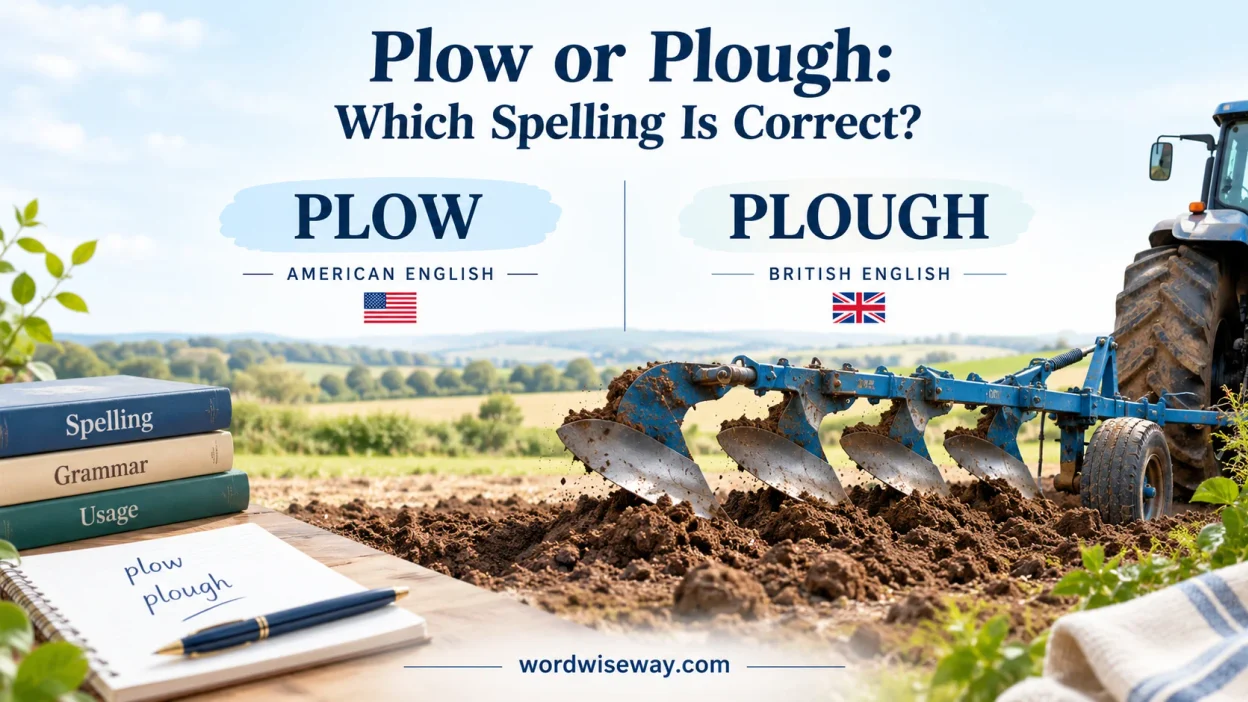
Many English speakers see plow and plough and wonder about the correct spelling, meaning, and usage. Both words describe a farm implement used in farming and agriculture, but their spelling varies by English variety. American English and Canadian English generally use plow, while British English and Australian English commonly use plough.
The difference is mainly a regional spelling distinction, not a difference in meaning. The same pattern appears in related verb forms: American and Canadian writers use plowed and plowing, while British and Australian writers use ploughed and ploughing. Both forms have the same pronunciation, so the distinction appears in writing rather than speech.
Today, farm-related terminology has dwindled in everyday English usage because fewer people work on farms. Still, plow and plough remain closely related words, and understanding their historical context, regional spelling, and usage patterns helps writers choose the appropriate form with confidence.
Quick Answer:
Plow is the standard American English spelling. Plough is the standard British English spelling.
Both forms have the same basic meaning. They can work as either a noun or a verb.
| Spelling | English Variety | Example |
| Plow | American English | The farmer will plow the field tomorrow. |
| Plough | British English | The farmer will plough the field tomorrow. |
| Plowed | American English | The farmer plowed the field yesterday. |
| Ploughed | British English | The farmer ploughed the field yesterday. |
| Plowing | American English | The tractor is plowing the field. |
| Ploughing | British English | The tractor is ploughing the field. |
So, neither spelling is simply “right” while the other is “wrong.” The correct choice depends on the variety of English you’re using.
What’s the Difference?
The main difference between plow and plough is regional spelling. The meaning doesn’t normally change.
In American English, you’ll usually see:
- plow
- plowed
- plowing
- snowplow
In British English, you’ll generally see:
- plough
- ploughed
- ploughing
- snowplough
Consider these two sentences:
- American English: Farmers plow their fields before planting.
- British English: Farmers plough their fields before planting.
The agricultural activity remains exactly the same. Only the spelling changes.
This distinction matters because consistent spelling makes writing feel polished and intentional. If you’re writing for readers in the United States, plow will normally look natural. If you’re following British English conventions, plough is the expected form.
Does the Meaning Change?
No. Plow and plough generally have the same meaning.
Both can refer to an agricultural implement used to break up and turn soil. Both can also function as verbs describing the process of working the land.
The words can also appear in figurative expressions. For example, someone might plow through a difficult book or plough through a long report.
The regional spelling changes, but the underlying idea remains intact.
What Does Plow Mean?
Plow can function as both a noun and a verb.
As a noun, a plow is an agricultural implement designed to cut into soil and turn it over. Farmers use different types of plows depending on the soil, crop, farming method, and machinery involved.
Traditional plows were pulled by animals. Modern versions are commonly attached to tractors and can cover large areas much more quickly.
For example:
- The farmer bought a new plow for the tractor.
- The old plow stood beside the barn.
- The tractor pulled the plow across the field.
As a verb, plow means to work or turn soil using a plow.
For example:
- Farmers plow the field before planting.
- The tractor plowed the soil in early spring.
- They plow several fields every year.
The word can also describe clearing snow.
For example:
- The crew plowed the road after the heavy snowfall.
- A snowplow cleared the highway before sunrise.
So, although farming provides the word’s central meaning, plow has developed several practical uses beyond agriculture.
What Does Plough Mean?
Plough carries the same basic meanings as plow, but it follows British English spelling.
As a noun, a plough is a tool or machine used to turn soil. As a verb, to plough means to work or turn the soil.
For example:
- The farmer attached the plough to the tractor.
- The workers prepared the plough for the field.
- Farmers plough the land before planting.
- The tractor ploughed through the soil.
The extra gh doesn’t create a different agricultural process. It simply reflects the traditional British spelling.
This makes plough an excellent example of how English can maintain different spelling traditions across regions without changing the core meaning of a word.
Plow or Plough in American and British English
The easiest way to remember the distinction is to connect each spelling with its regional variety.
Plow in American English
Use plow when you’re writing in American English.
Common forms include:
- plow
- plowed
- plowing
- snowplow
Examples:
- The farmer will plow the field tomorrow.
- They plowed the land before planting.
- The tractor is plowing the soil.
- The snowplow cleared the road.
The shorter spelling is the normal choice for American readers.
Plough in British English
Use plough when you’re following British English conventions.
Common forms include:
- plough
- ploughed
- ploughing
- snowplough
Examples:
- The farmer will plough the field tomorrow.
- They ploughed the land before planting.
- The tractor is ploughing the soil.
- The snowplough cleared the road.
The -ough spelling remains a familiar feature of British English.
Pronunciation
One interesting part of this spelling difference is that plow and plough are generally pronounced the same way.
The standard pronunciation is commonly represented as /plaʊ/.
The vowel sound is the same one you hear in words such as:
- how
- now
- cow
The gh in plough doesn’t receive a separate spoken sound. In other words, you shouldn’t pronounce every visible letter individually.
This illustrates a broader feature of English spelling: letters can preserve historical patterns even when modern pronunciation no longer reflects them directly.
The result can look strange at first. However, once you learn the spelling distinction, the word becomes much less troublesome.
Which Is Correct?
The past tense follows the same American-British divide.
Plowed is the standard American English form.
Ploughed is the standard British English form.
Compare these examples:
- American: The farmer plowed the field yesterday.
- British: The farmer ploughed the field yesterday.
Both sentences describe the same completed action.
The difference becomes important when you’re maintaining a consistent style. If an American English article uses plow, then plowed usually fits naturally with it. A British English article using plough will normally use ploughed.
Quick Comparison
| American English | British English |
| plow | plough |
| plowed | ploughed |
| plowing | ploughing |
| snowplow | snowplough |
The pattern is remarkably consistent, which makes it easier to remember.
Plowing or Ploughing: Which Is Correct?
Plowing is the standard American English form.
Ploughing is the standard British English form.
For example:
- The farmer is plowing the field.
- The farmer is ploughing the field.
The difference comes from the spelling of the base word.
American English shortens plough to plow and therefore uses plowing. British English retains plough and uses ploughing.
If you’re writing for an American audience, choose plowing. If you’re following British English conventions, choose ploughing.
Plow or Plough as a Noun
As nouns, both words can describe agricultural equipment used to prepare soil.
A traditional plow or plough cuts into the ground and turns soil over. This process can help prepare land for planting by creating a workable soil surface.
Modern agriculture uses several kinds of tillage equipment. A conventional moldboard plow, for example, turns a substantial layer of soil. Other implements perform different forms of soil disturbance and preparation.
The important point for spelling purposes is simple: plow and plough refer to the same basic type of agricultural implement.
Snowplow and Snowplough
The spelling difference also appears in compounds.
American English generally uses snowplow.
British English generally uses snowplough.
A snowplow is equipment used to remove snow from roads, driveways, parking areas, and other surfaces.
For example:
- The snowplow cleared the highway.
- The snowplough cleared the road.
Again, the regional spelling changes while the basic meaning stays the same.
Plow or Plough as a Verb
The verb has a straightforward literal meaning: to plow or plough means to work or turn soil.
However, English speakers also use these words in figurative expressions. These expressions borrow imagery from the physical action of moving a plow through resistant ground.
That connection gives the word a surprisingly energetic character.
Plow Through or Plough Through
Plow through means to work through something with determination or to move through something forcefully.
For example:
- She plowed through the report before lunch.
- He plowed through three chapters in one evening.
British English commonly uses plough through instead.
The metaphor makes sense because a plow doesn’t politely ask the soil to move. It cuts through resistance and keeps going.
Plow On or Plough On
Plow on means to continue despite difficulties, delays, or obstacles.
For example:
- Despite the setbacks, the team plowed on.
- She decided to plough on with the project.
The expression carries a sense of persistence.
Plow Into or Plough Into
Plow into can describe moving forcefully into something. It can also describe putting considerable effort or resources into something.
For example:
- The vehicle plowed into the barrier.
- The company plowed money into research.
British English generally uses plough into in the same contexts.
Why Does Plow Have Two Spellings?
The difference between plow and plough has a long linguistic history.
The word developed through older forms of English and related Germanic languages. Historical spellings included forms such as plou, plouh, and plough. Over centuries, English spelling gradually settled into regional patterns.
British English retained the traditional -ough spelling. American English later favored the shorter -ow form.
This wasn’t an overnight spelling makeover. English spelling developed through centuries of pronunciation changes, regional habits, printing practices, and standardization.
The same broader story explains why English contains many words whose spelling doesn’t perfectly match their modern pronunciation.
In this case, however, the modern rule is refreshingly simple:
American English → plow
British English → plough
Common Examples
Seeing the words in context makes the distinction easier to remember.
American English Examples
- Farmers plow their fields before planting.
- The tractor plowed through the wet soil.
- The farmer is plowing a new field.
- The snowplow cleared the road.
- They plowed ahead despite the difficult conditions.
British English Examples
- Farmers plough their fields before planting.
- The tractor ploughed through the wet soil.
- The farmer is ploughing a new field.
- The snowplough cleared the road.
- They ploughed ahead despite the difficult conditions.
Notice how the spelling changes consistently throughout each group.
Plow vs. Plough: A Practical Case Study
Imagine that two writers describe the same farming operation.
An American writer might say:
The farmer plowed the field in early spring before planting corn.
A British writer could write:
The farmer ploughed the field in early spring before planting crops.
The agricultural activity hasn’t changed. Neither writer has misunderstood the word.
Now imagine that the American writer suddenly changes the sentence to:
The farmer ploughed the field before planting.
That spelling may stand out because it doesn’t match the expected American convention.
Likewise, a British publication that consistently uses plough may look inconsistent if it suddenly switches to plow.
What This Teaches You
The important lesson isn’t to memorize one spelling as “correct.”
Instead, remember these three points:
- Plow belongs to standard American English.
- Plough belongs to standard British English.
- Consistency matters when choosing between them.
This approach works for related forms, too.
Common Mistakes
Several mistakes appear repeatedly when writers encounter these two forms.
Assuming One Spelling Is Wrong
The most common misconception is that one spelling must be an error.
That’s not the case.
Both plow and plough are established English spellings. The difference is mainly regional.
Mixing American and British Forms
A writer may use plow in one sentence and ploughed in another without realizing that the forms belong to different spelling conventions.
For consistent American English, use:
plow → plowed → plowing
For consistent British English, use:
plough → ploughed → ploughing
Trying to Pronounce the GH
The gh in plough isn’t pronounced as a separate sound.
The word generally has the same pronunciation as plow.
Thinking the Words Have Different Meanings
They don’t normally have different meanings simply because one contains gh.
The spelling tells you more about the English variety than the meaning.
Which One Should You Use?
The answer depends on your audience.
If you’re writing for readers in the United States or following American English, choose plow.
If you’re writing in British English, choose plough.
For example, an American-focused article might use:
- plow
- plowed
- plowing
- snowplow
A British-focused article would normally use:
- plough
- ploughed
- ploughing
- snowplough
The safest approach is to choose one spelling system before you start writing. Then stick with it.
That small decision prevents a surprising amount of inconsistency.
Quick Comparison
| Feature | Plow | Plough |
| Main English variety | American English | British English |
| Part of speech | Noun and verb | Noun and verb |
| Basic meaning | Agricultural tool or action | Agricultural tool or action |
| Standard pronunciation | /plaʊ/ | /plaʊ/ |
| Past tense | plowed | ploughed |
| Present participle | plowing | ploughing |
| Snow-clearing term | snowplow | snowplough |
| Common figurative form | plow through | plough through |
| Common regional use | United States | United Kingdom and other British English contexts |
The table highlights the central point: the spelling changes, but the core meaning remains the same.
Read More: Grill or Grille: Meaning, Difference, and Correct Usage
FAQs
Is plow or plough the correct spelling?
Both plow and plough are correct spellings. The choice depends mainly on the variety of English you’re using. Plow is standard in American and Canadian English, while plough is common in British and Australian English.
What does plow or plough mean?
Plow and plough refer to a farm implement used to turn and prepare soil for planting. The words can also work as verbs, describing the action of working or turning the ground with this equipment.
Is plow American or British English?
Plow is the usual spelling in American English. British English generally uses plough. Canadian English typically follows plow, while Australian English generally uses plough.
Is plough still used in modern English?
Yes. Plough remains a standard word, particularly in British English and other varieties outside North America. Although farming terminology may appear less often in everyday conversations, the word remains familiar in agricultural and figurative contexts.
Is plow used as both a noun and a verb?
Yes. Plow can be a noun for the agricultural implement and a verb for the action of turning soil. The same applies to plough in varieties that use that spelling.
Are plow and plough pronounced differently?
No. Plow and plough have the same pronunciation. Their difference is primarily written, so you generally won’t hear which spelling someone has chosen when they say the word aloud.
What is the past tense of plow?
The past tense is plowed in American and Canadian English. In British and Australian English, the corresponding form is ploughed.
Is it plowing or ploughing?
Both forms are correct, but regional usage determines which one you should choose. Plowing is used in American and Canadian English, while ploughing is preferred in British and Australian English.
Why are there two spellings of plow?
The two spellings developed through different English spelling traditions. Plow became established in North American English, while plough remained common in British English and several other varieties.
Which spelling should I use in my writing?
Use the spelling that matches your intended variety of English and audience. If you’re writing in American or Canadian English, plow fits the usual convention. For British or Australian English, plough is generally the expected form.
Conclusion
Choosing between plow and plough is mostly a matter of regional English, not meaning. American and Canadian English generally favor plow, while British and Australian English use plough. Both spellings refer to the same farm implement and can also function as verbs describing the act of working or turning soil.
The difference becomes clearer when you look at related forms. American writers use plowed and plowing, whereas British and Australian writers use ploughed and ploughing. Although the spellings change, the pronunciation remains the same, so you’ll usually notice the distinction only when you see the word written down.
For your own writing, follow the variety of English you’re using and stay consistent throughout the piece. If you’re writing for an American audience, plow is the natural choice. For British or Australian readers, plough fits their usual spelling conventions. Once you know this simple regional pattern, choosing the right form becomes straightforward.