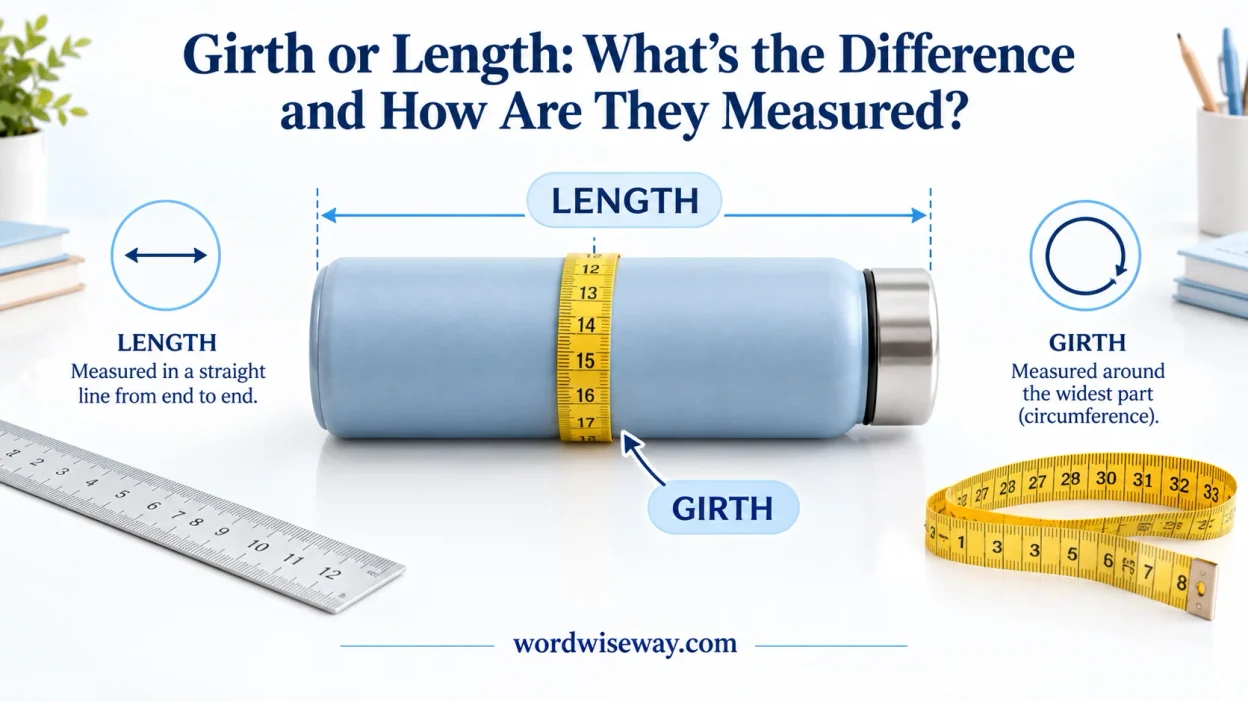
When you measure an object, length and girth describe different measurements. Girth or Length: Difference and How Are They Measured? becomes easier when you remember that length measures the distance from one end to the other end, while girth measures the distance around an object, often its circumference.
The difference matters in many everyday topics, including packages, luggage, pipes, trees, and cables. In construction, fitness equipment, and shipping, accurate dimensions and size can prevent shipping problems and incorrect product specifications. These terms are used in different situations, depending on what you need to measure.
This guide uses simple language to explain what each term means. In my experience, common misunderstandings happen when people confuse girth with length while measuring rounded objects. Choosing the right measure helps avoid common mistakes and a wrong measurement, especially when exact dimensions matter.
Quick Answer:
Length measures the distance from one end of an object to another, while girth measures the distance around an object.
In simple terms:
- Length = how far something extends
- Girth = how far something measures around
- Width = how wide something is from side to side
- Circumference = the distance around a circular or roughly circular object
For example, a cylindrical container could measure 20 centimeters from end to end while having a girth of 25 centimeters around its body. Neither number replaces the other because they describe different dimensions.
| Measurement | What it tells you | Typical direction |
| Length | How long something is | End to end |
| Width | How wide something is | Side to side |
| Height | How tall something is | Bottom to top |
| Girth | How far around something is | Around the object |
| Circumference | Distance around a circle | Around the circle |
What Does Length Mean?
Length is the distance between two points along an object or dimension. It usually describes the longest or primary dimension of something, although the exact meaning depends on context.
A ruler demonstrates the concept neatly. Place its zero mark at one endpoint and read the scale at the other endpoint. The resulting distance represents the object’s length.
Length commonly appears in everyday measurements such as:
- The length of a table
- The length of a rope
- The length of a road
- The length of a package
- The length of a pipe
- The length of a piece of fabric
The unit doesn’t change the concept. Inches, centimeters, feet, yards, and meters can all express length.
How Length Is Measured
Accurate length measurement starts with clearly defined endpoints. If you move either endpoint, the result changes.
For a straight object, place a ruler or measuring tape along its longest relevant dimension. Keep the measuring tool aligned with the object rather than holding it diagonally.
For curved objects, the process can become more complicated. A straight-line measurement across a curved object isn’t necessarily the same as the object’s actual length along its surface.
That distinction matters in engineering, manufacturing, tailoring, and scientific work.
A Simple Length Example
Suppose a wooden board measures 120 centimeters from one end to the other.
Its length is 120 centimeters.
That figure doesn’t tell you how wide the board is or how thick it is. You need additional measurements for those dimensions.
This is why product specifications often list several measurements instead of relying on one number.
What Does Girth Mean?
Girth describes the distance around an object. It is particularly useful for objects with rounded, cylindrical, oval, or irregular shapes.
Instead of measuring from point A to point B, you follow the object’s perimeter with a flexible measuring tape.
Think about measuring a tree trunk. A ruler placed against the trunk can’t easily tell you how much material surrounds the trunk. A flexible tape wrapped around it can.
That measurement is its girth.
Girth can therefore provide information that length alone cannot reveal.
How Girth Is Measured
A flexible measuring tape works best when you need to measure around an object.
Wrap the tape around the specified location and make sure it follows the surface evenly. Keep the tape level when the measurement requires a perpendicular circumference.
Avoid pulling the tape excessively tight. Doing so can compress flexible materials and produce an artificially small measurement.
The measurement point also matters.
For example, if an object has a narrow middle and wider ends, measuring its girth at different locations will produce different results. A useful measurement therefore identifies where the girth was taken.
Girth and the Widest Point
People sometimes assume that girth always means the widest possible part of an object. That’s not universally true.
In many practical contexts, the measurement location is specified in advance. A researcher might measure a particular anatomical location. A manufacturer might specify the circumference of a particular section. A forester might use a standard point on a tree trunk.
So the more precise question isn’t simply “What is the girth?”
It can be:
“Where was the girth measured?”
That small detail can make a major difference.
The Key Difference
The easiest way to remember the distinction is to imagine two different movements.
To measure length, you move along the object.
To measure girth, you move around it.
That difference sounds tiny, but it completely changes what the numbers mean.
| Feature | Length | Girth |
| Basic meaning | Distance from one point to another | Distance around an object |
| Measurement path | Along the object | Around the object |
| Common tool | Ruler or measuring tape | Flexible measuring tape |
| Useful for | Long dimensions | Rounded or surrounding dimensions |
| Related concept | Distance | Circumference |
| Depends on location | Usually endpoints | Often measurement position |
Neither measurement is automatically more important. The useful dimension depends on the question you’re trying to answer.
Is Girth the Same as Circumference?
Girth and circumference can describe the same physical measurement in many situations, but the words aren’t always interchangeable.
Circumference is a more specific mathematical term. It generally refers to the distance around a circle.
Girth has broader everyday and descriptive use. It can refer to the measurement around an object even when that object isn’t a perfect circle.
For a perfect circle, circumference can be calculated with:
C = πd
where:
- C represents circumference
- π is approximately 3.14159
- d represents diameter
You can also use the radius:
C = 2πr
This works neatly for circular objects because their geometry is predictable.
Real-world objects aren’t always perfect circles, though. A tree trunk, fabric-covered object, or irregular structure may have an uneven cross-section. In those cases, directly measuring around the object can be more practical than relying on a mathematical formula.
Is Girth the Same as Width?
No. Width measures across an object, while girth measures around it.
Picture a circular pipe.
Its width across the center corresponds to its diameter. Its measurement around the outside corresponds to its circumference or girth.
These measurements relate mathematically, but they’re not identical.
For a circular cross-section:
Girth = π × diameter
So if a circular object has a diameter of 10 centimeters, its circumference is approximately 31.4 centimeters.
That example shows why confusing width and girth can produce dramatically different numbers.
Why People Confuse Girth and Length
The confusion usually comes from treating all dimensions as if they describe the same kind of size.
They don’t.
A three-dimensional object can have several independent dimensions. A box, for example, might have:
- Length
- Width
- Height
- Circumference or girth around a particular section
Changing one dimension doesn’t automatically change the others in a predictable way.
Consider two cylinders with the same length. One could be narrow while the other is much wider. Their lengths would match, but their girths wouldn’t.
Likewise, two objects could have similar girths while having completely different lengths.
One measurement gives you one piece of the puzzle.
When Does Length Matter More?
Length becomes especially important when an object must fit within a particular distance.
Examples include:
- Furniture fitting against a wall
- A cable reaching between two locations
- A pipe spanning a specified gap
- Fabric being cut to a particular dimension
- Packaging designed around an item’s longest dimension
- Equipment designed to fit inside a defined space
Imagine buying a shelf for a 100-centimeter-wide space. The shelf’s length matters immediately. Its girth might be irrelevant because the shelf doesn’t need to wrap around anything.
When Does Girth Matter More?
Girth becomes important when something must fit around an object or when the object’s surrounding dimension affects capacity or fit.
Common examples include:
- Measuring a tree trunk
- Determining the circumference of a pipe
- Designing certain clothing measurements
- Assessing the dimensions of cylindrical components
- Creating packaging around rounded products
- Studying physical dimensions in biological research
In these situations, knowing only the length can leave out the measurement that actually controls fit.
When Do You Need Both Girth and Length?
Some situations require several dimensions at once.
Pipes and Cylinders
Suppose a pipe has a specified length and outside circumference. Engineers may need both values to describe the component accurately.
Length tells you how far the pipe extends.
Girth tells you how much distance surrounds it.
Packaging
A package may need sufficient length for an item while also providing enough surrounding space.
If you know only the length, you could still choose packaging that is too narrow.
Clothing
Clothing measurements often use several dimensions because the human body isn’t a single straight line.
Depending on the garment, designers may consider measurements around the body as well as vertical or horizontal dimensions.
Scientific Research
Researchers may collect multiple physical measurements to describe an organism, structure, or sample.
Using standardized measurement points helps researchers compare observations consistently.
How to Measure Girth Accurately
Accurate girth measurement requires more than wrapping a tape around something.
Use a Flexible Measuring Tape
A flexible tape follows curved surfaces much better than a rigid ruler.
For large objects, a specialized measuring tape may provide greater consistency.
Keep the Tape Level
When measuring around a cylindrical object, keep the tape perpendicular to its central axis when that is the intended measurement method.
An angled tape can create a larger path around the object and distort the result.
Don’t Compress the Object
Pulling the tape tightly can change the measurement when the material is soft or flexible.
The goal is usually to measure the surface without unnecessarily compressing it.
Mark the Measurement Location
If you need to repeat the measurement later, record exactly where you measured.
This matters because girth can change significantly from one section to another.
Use Consistent Units
Don’t compare one measurement in inches with another in centimeters without converting them.
Useful conversions include:
- 1 inch = 2.54 centimeters
- 1 foot = 12 inches
- 1 meter = 100 centimeters
- 1 meter = 39.37 inches
Consistency prevents simple unit errors from masquerading as meaningful differences.
Common Mistakes
Even simple measurements can go sideways when the method changes.
Watch for these common errors:
- Measuring length diagonally instead of straight.
- Measuring girth at different locations.
- Pulling flexible tape too tightly.
- Allowing the tape to twist.
- Holding the tape at an angle.
- Mixing inches and centimeters.
- Rounding measurements too early.
- Comparing measurements taken with different methods.
- Assuming the widest point is always the correct measurement point.
The biggest problem isn’t usually the measuring tool. It’s inconsistency.
If you use the same method and reference point each time, your measurements become much easier to compare.
Case Study: Measuring a Cylindrical Container
Imagine a cylindrical container that measures 30 centimeters from its base to its top.
Its length or height is therefore 30 centimeters.
Now wrap a flexible tape around its middle. Suppose the tape shows approximately 25 centimeters.
The two measurements describe completely different characteristics:
- Length or height: 30 cm
- Girth: 25 cm
Now imagine another container that is also 30 centimeters tall but has a girth of 35 centimeters.
The containers share the same height, yet one has a substantially larger surrounding dimension.
This simple example demonstrates why one measurement can’t replace the other.
Case Study: Measuring a Tree
Tree measurements provide another useful example because trunks rarely behave like perfect geometric cylinders.
Suppose you measure a trunk at a standardized height. The flexible tape wraps around the trunk and records its girth.
The tree’s height, however, requires a completely different method.
You could therefore have:
- Trunk girth: measured around the trunk
- Tree height: measured vertically from the ground upward
- Crown spread: measured across the canopy
Each measurement answers a different question.
This is a good reminder that physical size has several dimensions. Calling one measurement “the size” can oversimplify the object.
Human Measurements
In human biology, researchers and healthcare professionals may use multiple dimensions depending on the purpose of the measurement.
Measurements around the body are generally taken with flexible tapes, while linear dimensions use rulers or specialized instruments.
The important principle is standardization.
A measurement becomes more useful when the same anatomical location, posture, equipment, and technique are used consistently. This allows researchers or professionals to compare observations more meaningfully.
Natural human variation also means that a single measurement doesn’t define overall health, fitness, attractiveness, or physical capability.
Context matters more than isolated numbers.
Can You Calculate Girth From Length?
Usually, no.
Knowing an object’s length doesn’t provide enough information to determine its girth.
Consider two cylinders with identical lengths. One can have a small diameter while the other has a large diameter. Their lengths match, but their circumferences differ.
To calculate circumference mathematically, you need information about the object’s cross-section, such as its diameter or radius.
For a circular cross-section:
Girth ≈ π × diameter
Without that additional information, length alone isn’t enough.
Which Is More Important: Girth or Length?
There isn’t one universal answer.
The more useful measurement depends on the object and the purpose of measuring it.
If you’re checking whether a table fits against a wall, length may be crucial.
If you’re determining whether a circular component fits around another component, its circumference or girth may matter more.
In many real-world situations, both measurements work together.
A manufacturer designing a cylindrical product might need its length, diameter, circumference, wall thickness, and weight. Removing any important dimension could make the specification incomplete.
Read More: Till or Until: Meaning, Differences, Usage, and Examples
FAQs
What Is the Main Difference Between Girth and Length?
Length measures how far an object extends from one end to the other, while girth measures the distance around it. They describe different dimensions of the same object.
How Do You Measure the Length of an Object?
Place a measuring tool along the object’s longest straight dimension. Measure from one end to the other without bending or curving the tool.
How Do You Measure Girth?
Wrap a flexible measuring tape around the widest part of an object. The measurement where the tape meets gives you its girth.
Is Girth the Same as Circumference?
Girth and circumference are closely related because both describe the distance around an object. However, circumference is more commonly used for geometric shapes such as circles.
Why Does Girth Matter When Measuring Packages?
Girth can affect how a package is classified and handled during shipping. Measuring it correctly helps you provide accurate package dimensions and avoid potential shipping problems.
Can an Object Have Both Length and Girth?
Yes. Many objects have both measurements. For example, a pipe has a length along its body and a girth around its outer surface.
Which Measurement Should You Use for a Tree?
It depends on what you want to know. Use length or height to describe how far the tree extends vertically, while girth describes the distance around its trunk.
Why Do People Confuse Girth With Length?
The confusion often happens because both terms describe size and dimensions. People may also use the word “length” broadly when they actually need a measurement around an object.
What Tools Can Measure Girth and Length?
A ruler or rigid measuring tool works well for straight lengths. A flexible tape measure is usually more practical for girth because it can follow the object’s shape.
What Is the Most Common Mistake When Measuring Girth or Length?
The most common mistake is measuring in the wrong direction. Before taking a measurement, decide whether you need the distance from end to end or the distance around the object.
Conclusion
Understanding the difference between girth and length makes everyday measuring much easier. Length tells you how far an object extends from one end to the other, while girth tells you how far a measurement travels around it. Although both describe an object’s size, they answer two different questions.
Choosing the right measurement matters when you’re dealing with packages, pipes, luggage, trees, cables, or construction materials. A small measuring mistake can affect shipping details, product specifications, or the accuracy of a project. Taking a moment to identify what needs to be measured can save you from unnecessary confusion later.
The best approach is simple: use a ruler or tape for straight measurements and a flexible tape when you need to measure around an object. Once you know whether the task calls for length, girth, or both, the process becomes straightforward. Accurate measurements start with knowing exactly what you’re trying to measure.

Emma Smith has dedicated 14 years to Princeton University’s English Department, mentoring students in textual interpretation, literary movements, and critical frameworks. Her research explores Shakespearean drama, Victorian serial fiction, postcolonial narrative theory, and manuscript studies and probing how literary forms evolve across cultures and centuries. Emma has delivered lectures at international humanities congresses and published findings in distinguished academic journals, underscoring her commitment to scholarly depth and vibrant teaching.