This informative guide covers Momma or Mama: Correct Spelling, Meaning, and Usage to help you understand the standard term. Whether you are studying English grammar, refining your everyday communication, or analyzing cultural contexts, understanding the difference between these two terms is essential. Both Momma and Mama refer to a mother, but they carry distinct meanings in informal American English and worldwide speech, letting you tailor your word choice to your audience.
When creating digital content, drafting emails, or looking at the spellings in books and songs, you will notice these variations everywhere. If you face confusion over which version to use, practicing the right choice can instantly boost your clarity. While academic text requires a formal and universal message, creative writing allows for a highly expressive tone that keeps your text polished and correctly tailored.
The traditional spelling of a word often mirrors a specific regional dialect and its spoken speech. When users type a search query, their context dictates whether they need a simple phonetic variation or a strict dictionary standard. While Mama is globally recognized for formal use, Momma offers an affectionate, casual alternative based on preference and tone.
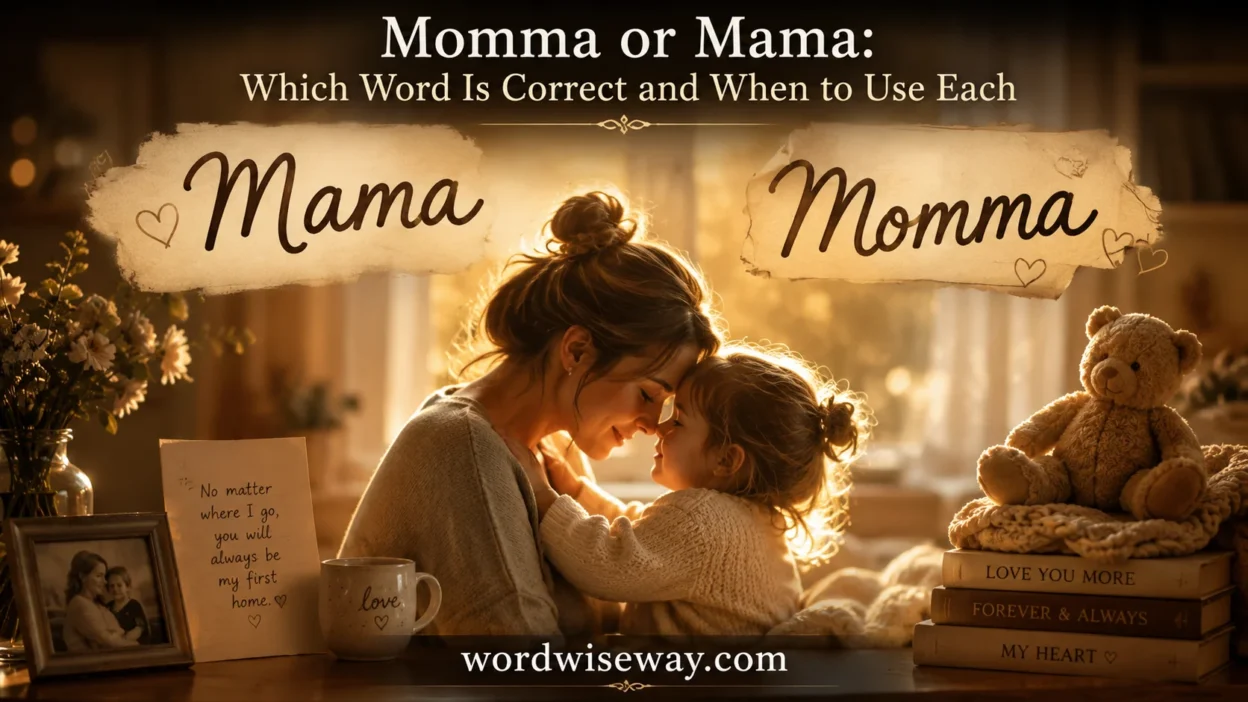
Momma or Mama: Which Word Is Correct and When to Use Each
Let’s clear the biggest confusion right away.
Both “mama” and “momma” are correct in informal English.
However, neither is considered formal English. You won’t use them in academic writing, official documents, or professional reports.
The real difference is not grammar. It is tone, culture, and emotion.
Think of them like two versions of the same song. The lyrics are identical, but the melody changes the feeling completely.
Are “Mama” and “Momma” Grammatically Correct?
Yes, both are grammatically acceptable in informal usage.
They are classified as:
- Informal nouns for mother
- Diminutives (softened affectionate forms of “mom”)
- Spoken language spellings rather than strict written English
Here is what matters more than grammar rules:
- Context
- Region
- Emotional tone
- Speaker identity
In real-life English, people care less about correctness and more about how natural it sounds.
Mama vs Momma: Core Meaning Explained
Even though both words refer to a mother, they are not emotionally identical.
Mama
- Soft and universally recognized
- Often one of the first words children learn
- Used across cultures and languages
- Feels simple and emotionally neutral
Example:
- “I want my mama.”
Momma
- Informal and expressive variation
- Stronger emotional tone
- Often reflects regional speech patterns
- Feels warmer, sometimes more intimate or nostalgic
Example:
- “Momma always made the best soup.”
Both point to the same person. The difference is in emotional coloring.
Mama vs Momma: The Emotional Difference
Words are not just labels. They carry emotional weight.
Mama feels like:
- Gentle affection
- Childhood innocence
- Universal warmth
- A soft emotional anchor
Momma feels like:
- Deep emotional attachment
- Familiar storytelling voice
- Regional personality
- Strong nostalgic energy
A simple way to understand it:
- “Mama” feels like a lullaby
- “Momma” feels like a story told on a porch at sunset
Same meaning, different atmosphere.
Read More: Axle vs Axel: Key Differences, Meaning, and Proper Usage
Regional and Cultural Usage
Language changes depending on where people grow up.
Mama in global usage
- Common in many languages: Spanish, Hindi, Arabic, Swahili, and more
- Widely understood in English-speaking countries
- Often used by young children regardless of region
- Appears in songs and emotional speech
Momma in American English
- More common in Southern United States English
- Frequently appears in storytelling and dialogue
- Often used in informal family speech
- Strong presence in African American Vernacular English (AAVE)
Important insight:
Neither form is “better.” They simply reflect different speech traditions.
When to Use Mama
Use “mama” when you want something simple, soft, and universally clear.
Best situations:
- Talking to your mother in a gentle tone
- Children speaking naturally
- Emotional but neutral writing
- Songs, poems, or lullabies
- Casual messages
Example sentences:
- “Mama, I missed you today.”
- “I asked mama for help.”
- “Mama said it will be okay.”
It works well when emotional intensity is low to medium and clarity matters more than style.
When to Use Momma
Use “momma” when tone and personality matter more than formality.
Best situations:
- Dialogue in stories or novels
- Regional storytelling voice
- Emotional or nostalgic writing
- Casual speech patterns in scripts
- Emphasizing warmth and closeness
Example sentences:
- “Momma told me not to worry.”
- “Momma used to sing that song every night.”
- “Wait for me, momma!”
This version adds personality. It feels lived-in and expressive.
Formal vs Informal Writing Rules
Here is where many people get stuck.
Neither “mama” nor “momma” belongs in formal English.
Use “mother” instead for:
- Academic essays
- Professional emails
- Official documents
- Research writing
Example:
- Formal: “My mother attended the meeting.”
- Informal: “Mama came with me.”
- Narrative: “Momma walked beside me without saying a word.”
A good rule:
If you are writing for authority, use mother.
If you are writing for emotion, choose between mama and momma.
Mama vs Momma vs Mom
Now let’s add a third player: “mom.”
Mom
- Neutral and widely used in American English
- Common in modern communication
- Less emotional than the other two
Comparison table
| Word | Tone | Region Use | Formal Use | Emotional Weight |
| Mama | Soft, warm | Global | No | Medium |
| Momma | Emotional, vivid | Southern US, AAVE | No | High |
| Mom | Neutral, modern | American English | Limited | Low to Medium |
Think of it like this:
- Mom = everyday language
- Mama = emotional softness
- Momma = storytelling voice
Common Mistakes People Make
Even native speakers mix these up sometimes.
Mistake: Thinking one is correct and the other is wrong
Both are valid in informal English.
Mistake: Using momma in formal writing
This breaks tone expectations in academic or business writing.
Mistake: Ignoring regional tone in storytelling
Using “momma” in a neutral setting can feel stylistically inconsistent.
Mistake: Overusing either word
Repetition can weaken emotional impact in writing.
How Context Changes Meaning
Context acts like a filter for meaning.
The same word can feel different depending on:
- Who is speaking
- Where the conversation happens
- Emotional situation
- Cultural background
Example comparison
- A child crying: “Mama!” → urgent need
- A memory in a novel: “Momma used to laugh like that.” → nostalgia
- A casual call: “Hey mom.” → neutral communication
The word itself doesn’t change. The situation does.
Example Sentences in Real Contexts
Let’s look at real usage patterns.
Casual speech
- “I’ll ask mama when she gets home.”
Emotional expression
- “Momma, don’t leave yet.”
Storytelling
- “Momma said the world would be kinder someday.”
Neutral reference
- “My mom works nearby.”
Each version fits a different emotional setting.
Case Study: Language in Literature and Music
Words like mama and momma often appear in storytelling because they carry emotional weight.
Example in literature
Southern American novels often use “momma” to reflect regional authenticity. It helps readers hear the character’s voice without explanation.
Example in music
Songs frequently use “mama” to create universal emotional connection. It works across cultures because the sound is simple and familiar.
A famous pattern in music:
- “Mama” in lyrics often signals comfort or longing
- “Momma” in lyrics often signals personal storytelling or identity
The spelling choice is never random. It supports tone.
Why These Words Feel So Personal
Few words are as emotionally loaded as the word for “mother.”
That is because:
- Everyone has a relationship with the concept
- It forms early in life
- It carries emotional memory
So even a small spelling change can shift meaning dramatically.
It is less about language rules and more about emotional resonance.
FAQs
Q1: Is it “Momma” or “Mama”? Which spelling is correct?
Ans: Both spellings are correct, but they are used in different regions and tones. Mama is the standard, globally recognized spelling found in most dictionaries, while Momma is a phonetic variation primarily popular in American English.
Q2: What is the main difference in usage between Momma and Mama?
Ans: The primary difference comes down to formal writing versus casual speech. Mama is more universal and accepted in standard literature, whereas Momma is highly informal, carrying a more stylistic and emotional tone.
Q3: Which term should I use in formal or academic writing?
Ans: You should use Mama if you need a traditional term, though words like “mother” are preferred for strict academic text. Using Momma in a professional message can make the writing appear too casual.
Q4: Is Momma specifically part of American English?
Ans: Yes, Momma is heavily rooted in American dialects, particularly in southern and casual regional speech. Mama, on the other hand, is used worldwide across various cultures and languages.
Q5: Are these words interchangeable in songs and creative writing?
Ans: Absolutely. In songs, books, and poetry, writers choose between Momma and Mama based on rhythm, pronunciation, and the specific emotional tone they want to convey.
Q6: Why do people confuse the two spellings?
Ans: The confusion arises because both words share the exact same meaning (mother) and sound very similar. The variation in spelling simply mirrors how different people pronounce the word in everyday conversations.
Q7: Does internet search data show a preference for one over the other?
Ans: When users type a search query, the system looks at their cultural context. Both terms are highly searched, but Mama yields more global results, while Momma is tied to specific regional lookups.
Q8: Is Momma considered a real word in the dictionary?
Ans: While Mama is the standard dictionary entry, many modern resources list Momma as a recognized phonetic variation of American origin, acknowledging its widespread use in digital content.
Q9: How does tone impact the choice between these terms?
Ans: Choosing Momma provides a deeply affectionate and personal feel, ideal for close everyday communication. Mama maintains an endearing quality but fits a slightly more polished and traditional narrative.
Q10: Can English learners use both words interchangeably in speech?
Ans: Yes, native speakers will understand both perfectly in spoken English. However, learners looking for maximum clarity across different global contexts should default to Mama as their primary choice.
Conclusion
Mastering the subtle nuances between Momma and Mama is a fantastic way to elevate your everyday communication and writing clarity. While both terms serve as a heartfelt, affectionate reference to a mother, their differences in spelling, regional dialects, and overall tone matter across different contexts. By aligning your word choice with your target audience—whether you are drafting professional emails or creating expressive digital content—you ensure your text remains both polished and authentic.
Ultimately, deciding which version to use depends on whether you need a universal standard or a localized, emotional variation. Mama remains the globally recognized and traditional option for most formal scenarios, while Momma offers a warm, phonetic alternative deeply rooted in American English speech. Understanding these small grammar details empowers both native speakers and learners to communicate with confidence, ensuring your message always matches your intent.
Read More: Analogy vs Allegory: Difference and Correct Usage

Amelia Sanders has spent 14 years in Harvard University’s English Department, helping students navigate literary analysis, interpretive theory, and narrative techniques. Her academic pursuits center on 18th-century British prose, romantic poetry, diasporic writing, and digital editing exploring how textual choices influence cultural perspectives. Amelia has spoken at major international meetings and contributed essays to respected academic volumes, demonstrating her dedication to thoughtful scholarship and effective teaching.