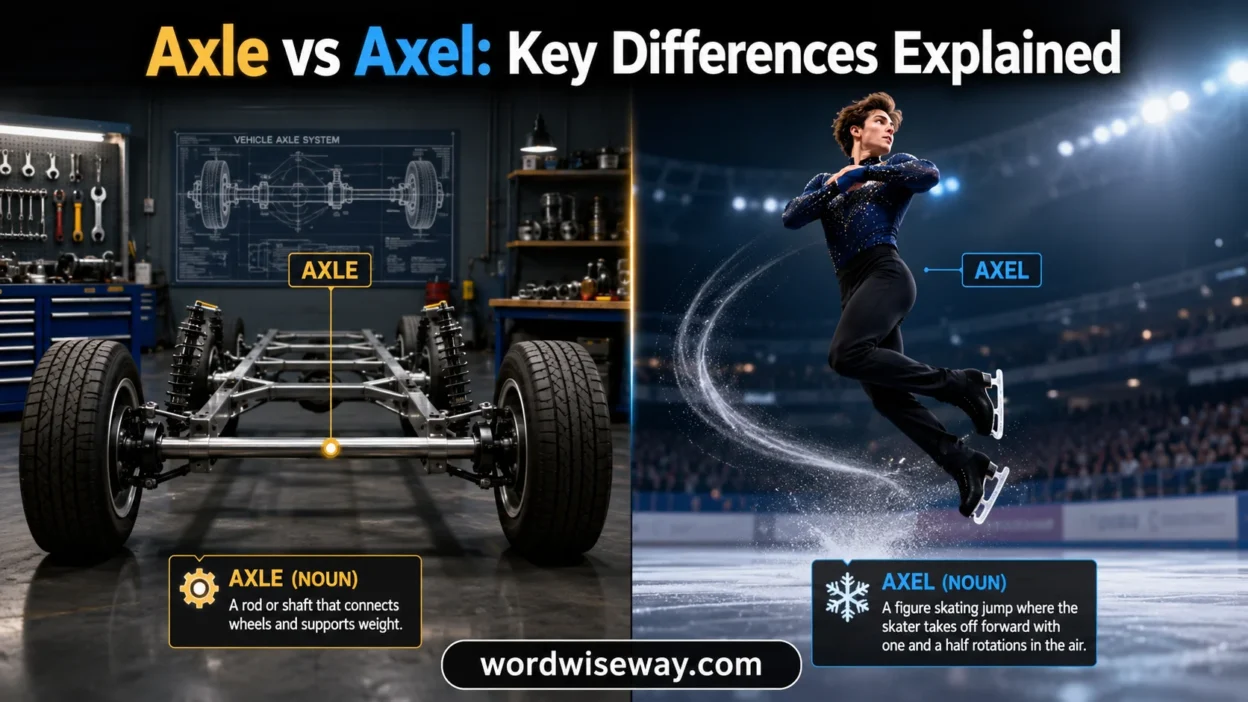
This guide explains Axle vs Axel: Key Differences, Meaning, and Proper Usage by showing how these terms differ in language and mechanics clearly
. The axle and axel confusion happens because these words may sound identical, but they have entirely different meanings. In my experience reviewing technical documents, workplace writing, and academic papers, I have seen writers, students, and professionals use them interchangeably due to similar spelling.
The proper usage depends on the meaning and context. An axle is a mechanical component such as a rod, shaft, or spindle that supports wheels, connects two wheels, and allows rotation in vehicles like cars, trucks, and bicycles. It provides movement and stability in different types of vehicles while supporting smooth operation.
The axel has a separate identity and is mainly related to figure skating. An Axel is a proper name, personal name, and a well-known figure skating jump named after the Norwegian figure skater Axel Paulsen. This jump includes taking off from the forward outside edge of one skate, making one and a half rotations in the air, and landing on the back outside edge of the opposite skate.
Knowing this distinction helps avoid errors in technical discussions, professional communication, engineering discussions, and sports commentary. This comprehensive guide explores the definitions, origins, and significant roles of these terms across various fields. The linguistic phenomenon behind these similar terms makes the journey through language and mechanics an enlightening ride while helping readers understand the uses of each word.
Axle vs Axel: Why This Confusion Happens So Often
The confusion between axle vs axel mostly comes down to sound and speed.
Both words are pronounced almost the same in everyday speech. When spoken quickly, the difference disappears completely. That means your brain often stores them as identical sounds even though their meanings are unrelated.
Here’s where things get messy:
- Auto-correct sometimes “fixes” them incorrectly
- Casual writing ignores technical accuracy
- Many people learn one meaning but not both
- Sports and automotive contexts rarely overlap
So the mistake spreads quietly across blogs, captions, and conversations.
To make it simple:
Axle = engineering world
Axel = figure skating world
That’s the clean separation most people miss.
What Is an Axle?
An axle is a fundamental mechanical component found in almost every wheeled vehicle.
At its core, an axle is a central shaft that connects and supports wheels. It helps the wheels rotate while carrying the weight of the vehicle and its load.
Basic Function of an Axle
An axle does three important jobs:
- Supports the weight of the vehicle
- Helps wheels rotate smoothly
- Transfers torque from the engine or drivetrain
Without axles, wheels would simply fall apart from structural stress.
Where You Find Axles in Real Life
Axles are everywhere in transportation and machinery:
- Cars and motorcycles
- Trucks and buses
- Bicycles
- Trains and wagons
- Industrial machines
Even shopping carts use simplified axle systems.
Types of Axles
Axles are not all identical. Engineers design them based on load and movement needs.
Front Axle
- Found at the front of vehicles
- Helps with steering and support
- Often carries part of engine weight
Rear Axle
- Located at the back
- Transfers engine power to wheels in many vehicles
- Handles heavy loads
Stub Axle
- Short axle attached to wheels individually
- Common in steering systems
- Used for improved maneuverability
Simple Analogy to Understand Axles
Think of an axle like a spine for wheels.
Just like your spine holds your body upright and allows movement, the axle holds wheels in place and lets them rotate smoothly.
Without it, everything collapses.
Real-World Example of Axle Usage
“After driving through rough terrain, the mechanic found that the rear axle had bent under pressure.”
That single sentence shows how critical axles are in real mechanical systems.
What Is an Axel?
Now shift from garages to ice rinks.
An axel is not mechanical at all. It is a figure skating jump that is widely considered one of the most technically difficult moves in the sport.
Origin of the Word Axel
The move is named after Axel Paulsen, a Norwegian figure skater who invented it in the late 19th century.
Because it’s a proper name, the spelling remains Axel, not axle.
What Makes an Axel Jump Unique
The axel is special because:
- It takes off from a forward skating position
- It includes an extra half rotation in the air
- It lands backward on the opposite foot
That extra half rotation makes it harder than most jumps.
Types of Axel Jumps
Skaters perform axels at different difficulty levels:
Single Axel
- 1.5 rotations
- Entry-level competition jump
Double Axel
- 2.5 rotations
- Requires strong technique and speed
Triple Axel
- 3.5 rotations
- Extremely difficult
- Only elite skaters consistently land it
Why the Axel Is So Hard
The difficulty comes from physics:
- Forward takeoff adds rotational complexity
- Air time must be precisely controlled
- Landing requires perfect balance
Even small mistakes lead to falls or under-rotation.
Quote from a Coaching Perspective
“The axel is where talent meets discipline. It exposes every flaw in a skater’s timing.”
This is why coaches often treat axel training as a milestone in an athlete’s development.
Axle vs Axel: Key Differences Side-by-Side
To make everything crystal clear, here’s a structured breakdown of axle vs axel.
| Feature | Axle | Axel |
| Field | Mechanical engineering | Figure skating |
| Meaning | Rotating shaft supporting wheels | Ice skating jump |
| Function | Transfers load and torque | Aerial rotation skill |
| Usage | Vehicles, machines, bicycles | Competitive skating |
| Origin | Old mechanical term | Named after Axel Paulsen |
| Common error | Misspelled as “axel” | Misspelled as “axle” |
The simplest rule:
If it has wheels, it has an axle.
If it has ice, it has an axel.
Read More:Seamless vs Seemless: Correct Spelling and Usage
Why People Mix Up Axle vs Axel
This confusion is more common than you might think.
1. Similar pronunciation
Both words sound identical in most accents.
2. Context switching
People often switch between sports and technical writing without realizing the spelling change.
3. Typing speed errors
Fast typing leads to swapped letters.
4. Lack of exposure
Most people know only one meaning, not both.
Common Real-World Mistakes
Here’s how the confusion shows up in everyday writing:
Automotive Content Errors
- “Axel replacement cost” instead of “Axle replacement cost”
- “Broken axel symptoms” in car blogs
Sports Writing Errors
- “Axle jump scores” instead of “Axel jump scores”
- “Triple axle attempt” in commentary
Social Media Posts
- Captions mixing both words incorrectly due to auto-correct
These errors may look small, but they affect credibility in professional writing.
Case Study: How Misuse Creates Real Confusion
Case 1: Auto Repair Shop Listing Error
A small auto repair business once advertised:
“Affordable axel repair and wheel alignment.”
Search engines misinterpreted the term, and customers searching for “axle repair” did not find the listing easily.
Impact
- Reduced search visibility
- Lower customer inquiries
- Confused branding signals
Fix Applied
After correction to “axle repair,” organic traffic improved noticeably because search intent matched correctly.
Case 2: Figure Skating Coaching Miscommunication
A beginner skater read:
“Work on your axle consistency.”
The coach meant axel, but the student initially thought it referred to a mechanical concept.
Impact
- Confusion in training instructions
- Misinterpretation of technique drills
- Slower learning curve
Fix Applied
Clear terminology training helped athletes correctly associate “axel” with skating only.
Memory Tricks to Never Confuse Axle vs Axel Again
Here are practical ways to lock the difference into memory.
1. The Vehicle Rule
- Axle = vehicles
- Think “A for Automobile”
2. The Ice Rule
- Axel = skating
- Think “E for ice EDGE movement”
3. Visual Association Trick
- Picture a car suspension for axle
- Picture a spinning skater for axel
4. Word Shape Trick
- Axle has an “L” like “wheeL”
- Axel ends with “el” like “skater ELite”
Frequently Asked Questions
Q1. What is the main difference between axle and axel?
An axle is a mechanical part used in vehicles that supports wheels and allows them to rotate smoothly. It is a rod, shaft, or spindle that helps maintain movement and stability in cars, trucks, bicycles, and other vehicles. An axel, on the other hand, is mostly related to figure skating or used as a personal name.
The confusion between these two words happens because they sound identical but have completely different meanings. Understanding their difference helps you use the correct term in technical writing, sports discussions, and everyday communication.
Q2. Is axle the correct word for a vehicle part?
Yes, axle is the correct word for a vehicle part. It refers to a mechanical component that connects wheels and supports their rotation. Axles play an important role in the movement and stability of different types of vehicles.
Using “axel” instead of “axle” in engineering documents or vehicle-related discussions is incorrect because axel does not describe a mechanical part.
Q3. What does axel mean in figure skating?
An Axel is a famous figure skating jump named after the Norwegian figure skater Axel Paulsen. It is a challenging jump that begins from the forward outside edge of one skate and involves one and a half rotations in the air before landing.
Unlike an axle, which is connected to mechanics and vehicles, an Axel belongs to the world of sports and figure skating. The two terms may sound similar, but their uses are completely different.
Q4. Why are axle and axel often confused?
Axle and axel are often confused because they have the same pronunciation and look almost identical when written. This makes them a common spelling mistake among writers, students, and professionals.
However, their meanings come from different fields. Axle belongs to engineering and transportation, while Axel is connected to names and figure skating.
Q5. Can axle and axel be used interchangeably?
No, axle and axel cannot be used interchangeably. Each word has a specific meaning and purpose. Axle refers to a mechanical component that supports wheels, while Axel refers to a figure skating jump or a personal name.
Using the wrong word can create confusion in professional communication, academic papers, technical documents, and sports commentary.
Q6. What vehicles use axles?
Many types of vehicles use axles, including cars, trucks, bicycles, and other transportation systems. Axles help connect wheels and support their movement while maintaining balance and stability.
Without properly functioning axles, vehicles cannot move efficiently because this component plays a major role in wheel rotation and overall mechanical performance.
Q7. Who was Axel Paulsen?
Axel Paulsen was a Norwegian figure skater who gave his name to the famous Axel jump in figure skating. The jump became recognized as one of the important techniques in skating because of its unique movement and difficulty.
The term Axel in this context refers to the skating technique rather than a mechanical part. This connection helps explain why Axel and axle have different meanings.
Q8. How can I remember the difference between axle and axel?
A simple way to remember the difference is to connect axle with vehicles and wheels because it is a mechanical component. Think of the extra “l” in axle as linking it to “wheel.”
For Axel, remember the figure skating jump or personal name. This small distinction can help prevent spelling mistakes in writing and communication.
Q9. Where is the word axle commonly used?
The word axle is commonly used in engineering, automobile industries, transportation, and mechanical discussions. It appears in technical documents, vehicle manuals, and conversations about machines.
Professionals working with vehicles and mechanics frequently use the term because it describes an important part responsible for wheel support and rotation.
Q10. Why is understanding axle vs axel important?
Understanding the difference between axle and axel improves clarity in writing and communication. Choosing the correct word helps avoid errors in academic papers, workplace writing, engineering discussions, and sports-related content.
Although these words sound the same, their meanings belong to completely different areas. Knowing when to use each term makes your writing more accurate and professional.
Conclusion
Understanding the difference between axle and axel helps you avoid common spelling and usage mistakes in both professional and everyday writing. An axle is a mechanical component that supports wheels, connects them, and allows rotation in vehicles such as cars, trucks, and bicycles. It plays an important role in maintaining movement and stability, especially in engineering and transportation fields.
On the other hand, an Axel refers to a personal name or a famous figure skating jump named after Axel Paulsen. Although both words sound identical, their meanings, origins, and uses are completely different. Remembering this simple distinction will help you choose the correct term in technical discussions, sports commentary, academic writing, and daily communication with confidence.
Read More:Venders or Vendors: Correct Spelling, and Meaning

Emma Smith has dedicated 14 years to Princeton University’s English Department, mentoring students in textual interpretation, literary movements, and critical frameworks. Her research explores Shakespearean drama, Victorian serial fiction, postcolonial narrative theory, and manuscript studies and probing how literary forms evolve across cultures and centuries. Emma has delivered lectures at international humanities congresses and published findings in distinguished academic journals, underscoring her commitment to scholarly depth and vibrant teaching.