Navigating Since vs Sense: Meaning, Difference, and Correct Usage helps writers who want to keep their professional credibility intact. When choosing words for digital media, a human reader will instantly notice errors. If you cannot double-check your text, a corporate document or formal drafting can lose its impact. Using the right choice ensures your work looks flawless to anyone reading it.
To keep track of your writing, remember that temporal or causal markers require one specific term, while physical or intuitive observations require the other. Making the wrong selection ruins the flawless flow of your message. If you can replace the word with “because,” your path is clear. Understanding this simple linguistic judgment makes your final text completely identical to expert-level prose.
Quick Answer:
Before diving deep, let’s anchor the basics.
| Word | Core Meaning | Part of Speech | Main Use |
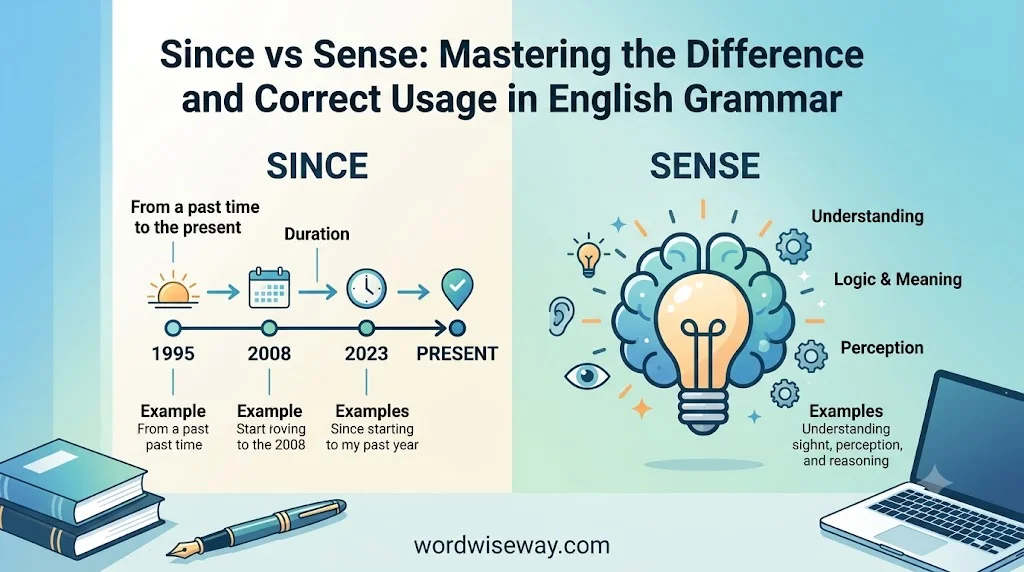
| Since | Time or reason | Preposition, conjunction, adverb | Refers to time or cause |
| Sense | Meaning, feeling, understanding | Noun (mostly), verb (rare) | Refers to perception or logic |
Simple shortcut:
- Since = time or cause
- Sense = meaning or understanding
If you remember nothing else, remember that.
Since vs Sense: Why They Sound the Same but Behave Differently
“Since” and “sense” are homophones. That means they share pronunciation but not meaning or spelling.
You say both as /sɪns/. Your ears hear no difference. Your brain, however, must do all the decoding.
That’s where context becomes the real hero.
Example:
- I have lived here since 2015.
- This plan does not make sense.
Same sound. Different worlds.
Think of them like identical twins with opposite personalities. One tracks time like a historian. The other checks meaning like a philosopher.
Since in English Grammar: Time, Cause, and Everything Between
“Since” is a multitasker. It shifts roles depending on how you use it.
Since as a Time Marker
This is the most common use.
It shows a starting point in time.
Examples:
- I have known her since childhood.
- He has worked here since 2018.
- They have been waiting since morning.
Here’s the key idea:
👉 “Since” connects past to present.
It often appears with the present perfect tense.
Since as a Reason or Cause
Now it flips identity.
In this case, “since” means “because.”
Examples:
- Since you are here, we can start the meeting.
- I stayed home since I felt sick.
- Since it was raining, the match got canceled.
This usage feels slightly softer than “because.” It sounds more conversational and less forceful.
Since as an Adverb
Less common, but still important.
Examples:
- She left in 2020 and hasn’t returned since.
- He moved to Canada last year and hasn’t visited since.
Here, “since” stands alone and refers back to a known time.
Read More: Affend or Offend: Correct Spelling, Meaning, and Real Usage
Sense in English Grammar: Meaning, Feeling, and Logic
Now let’s move to “sense,” the word that deals with understanding reality.
Sense as Understanding or Meaning
This is the most important usage.
Examples:
- This explanation doesn’t make sense.
- Your idea actually makes a lot of sense.
- I can’t make sense of this message.
Think of “sense” as mental clarity. If something clicks in your brain, it makes sense. If it doesn’t, it feels like a broken puzzle.
Sense as Physical Perception
Humans have five senses:
- Sight
- Hearing
- Smell
- Taste
- Touch
Examples:
- Her sense of smell is strong.
- He lost his sense of hearing temporarily.
Here, “sense” refers to bodily perception.
Sense as Emotional Awareness
This usage is more subtle.
Examples:
- I had a sense of danger.
- She felt a strong sense of comfort in the room.
This is intuition territory. No logic required. Just instinct.
Why Since vs Sense Confusion Happens So Often
Let’s be honest. English is partly to blame here.
1. Same pronunciation
You hear “sins” in both cases.
2. Fast typing culture
People rely on autocorrect and speed, not grammar checks.
3. Context overload
Both words appear in similar sentence positions.
Compare:
- I have lived here since 2010.
- This does not make sense.
Both can sit mid-sentence. Your brain must choose instantly.
Grammar Roles: How Since vs Sense Function in Sentences
Understanding structure helps you avoid mistakes.
Since: Flexible Grammar Tool
- Preposition: since 2010
- Conjunction: since you asked
- Adverb: I haven’t seen him since
Sense: Mostly a Noun
- Noun: common sense, sense of humor
- Verb (rare): to sense danger
Example:
- I can sense something is wrong.
That verb form exists but is less frequent in everyday writing.
Common Mistakes in Since vs Sense Usage
Let’s fix real errors people actually make.
Mistake 1: Wrong word choice
❌ This doesn’t make since
✔ This doesn’t make sense
Mistake 2: Confusing cause with meaning
❌ Sense you are busy, I will wait
✔ Since you are busy, I will wait
Mistake 3: Overusing “since” instead of “because”
❌ Since I was tired, I slept early
✔ Because I was tired, I slept early (clearer tone)
Real-Life Usage Scenarios: Since vs Sense in Action
Academic Writing
- Since 1900, industrial growth has increased.
- The argument does not make sense logically.
Workplace Email
- Since the report is ready, we can proceed.
- Your proposal makes sense from a budget perspective.
Social Media
- It’s been a while since I posted here.
- This trend makes no sense at all.
Everyday Conversation
- I haven’t seen him since Monday.
- That joke doesn’t make sense.
Case Study: A Real Communication Breakdown
Imagine this situation:
A student writes:
“Since this problem doesn’t make sense, I skipped it since I was confused.”
A teacher reads it twice.
What went wrong?
- First “since” = cause
- “doesn’t make sense” = correct
- Second “since” = time or reason again
The sentence works, but feels overloaded.
Improved version:
“Because this problem didn’t make sense, I skipped it when I felt confused.”
Clearer. Cleaner. Easier to process.
Memory Tricks for Since vs Sense Mastery
Here are simple mental anchors.
1. Timeline Trick
- Since = timeline
- Think: “since 2010 → time line starts”
2. Brain Check Trick
- Sense = brain meaning
- If your brain says “ah, I get it,” that’s sense.
3. Substitution Test
Replace the word:
- If “because” fits → use since
- If “understanding” fits → use sense
Practice Section: Test Your Understanding
Fill in the blanks:
- I have lived here ______ 2015.
- This explanation does not make ______.
- ______ you are late, we will start without you.
- I haven’t seen her ______ last week.
- Your idea actually makes a lot of ______.
Answers:
- since
- sense
- since
- since
- sense
Advanced Nuances in Since vs Sense Usage
“Since” feels time-heavy or logical softener
Writers often choose “since” in formal tone:
- Since the data shows improvement, we continue.
“Sense” dominates clarity language
Modern English heavily relies on:
- “make sense”
- “doesn’t make sense”
This phrase has become one of the most common clarity checks in digital communication.
Why Mastering Since vs Sense Improves Your Writing
Small grammar distinctions shape big impressions.
Using the wrong word:
- breaks clarity
- reduces credibility
- confuses readers
Using the right word:
- sharpens communication
- builds trust
- improves readability
Language works like architecture. One weak beam and the structure wobbles.
FAQs
1. What is the primary difference between since and sense?
The word since is primarily used to refer to time (marking a starting point in the past) or to introduce a reason (meaning “because”). On the other hand, sense relates to perception, awareness, logic, or understanding, and it can function as both a noun and a verb.
2. Is since a preposition, a conjunction, or an adverb?
Since can function as all three depending on how it is used in a sentence. It acts as a preposition when followed by a specific point in time, a conjunction when linking a dependent clause to a main clause, and an adverb when used to describe how much time has passed.
3. How can I easily remember when to use sense?
A great trick is to connect sense with your five senses (sight, hearing, touch, taste, smell), which all deal with physical or mental perception. If you are talking about clarity, intellect, or feeling something intuitively, sense is always the correct choice.
4. Can since and sense be used interchangeably?
No, they cannot be used interchangeably under any circumstances because they belong to completely distinct grammatical categories and convey entirely different meanings. Swapping them will result in an incorrect and confusing sentence that disrupts the clarity of your writing.
5. What are some common idioms that use the word sense?
Common phrases include “make sense” (to be logical or understandable), “common sense” (sound practical judgment), “sixth sense” (a keen intuition), and “in a sense” (from a certain way of looking at things).
6. How do regional accents contribute to the confusion between these two words?
In certain regional dialects and accents, the vowel sounds in since and sense are pronounced so closely that they sound nearly identical. This phonetic similarity often causes a momentary brain glitch, leading people to type the wrong word out of habit.
7. Why does writing “since 2020” make grammatical sense?
Using since before a specific year indicates a continuous action or state that started at that specific point in the past and continues into the present. It acts as a temporal marker to help the reader track duration accurately.
8. What happens to a sentence’s meaning if you mix up these terms?
Mixing them up completely alters the logic of your message, often making the text look unprofessional. For example, writing “it doesn’t since” instead of “it doesn’t make sense” strips the sentence of its intended meaning entirely.
9. Is sense ever used as a verb in professional writing?
Yes, sense is frequently used as a verb meaning to perceive or become aware of something. In corporate or academic contexts, you might write that a team can “sense a change in market trends” or “sense an underlying issue.”
10. What is the best way to double-check my usage before sending an email?
Read your sentence aloud and try to replace the word with “because” or “from the time that.” If the sentence still works, since is the correct choice; if you are referring to logic, feeling, or human understanding, use sense.
Conclusion
Mastering the distinct roles of since and sense is a simple yet powerful way to elevate the quality of your digital and professional communication. While rapid typing and similar phonetic sounds can easily cause accidental errors, keeping their primary definitions in mind ensures absolute clarity. Remember that since remains strictly bound to tracking time and establishing causal relationships, while sense thrives in the realm of perception, logic, and intellect.
By taking an extra moment to double-check your sentences and applying quick mental substitution tricks, you can completely eliminate these common typos from your writing toolkit. Consistently using each term correctly not only protects your credibility but also ensures your audience reads your content exactly as intended. Ultimately, developing a strong command over these classic word pairs allows you to produce flawless essays, emails, and reports with total confidence.
Read More: Lended or Lent: Which is Correct?

Emma Smith has dedicated 14 years to Princeton University’s English Department, mentoring students in textual interpretation, literary movements, and critical frameworks. Her research explores Shakespearean drama, Victorian serial fiction, postcolonial narrative theory, and manuscript studies and probing how literary forms evolve across cultures and centuries. Emma has delivered lectures at international humanities congresses and published findings in distinguished academic journals, underscoring her commitment to scholarly depth and vibrant teaching.