Our essential guide on Addition vs Edition: Difference and Correct Usage helps everyday learners train to recognize distinct text patterns.
In my early years of reviewing research project papers, I watched countless writers, students, and professionals stumble over these tricky terms because they sound nearly identical in speech. This frequent miscommunication happens when people do not fully grasp how grammar rules change depending on a workplace or academic context. When performing a mathematical operation, you use the noun to describe the act of calculating a sum, an increase, or adding a specific form to an existing whole.
To ensure your message is never lost in translation, you must recognize the rule that applies across all media. Whether you are updating software, referencing a magazine, or organizing citations, understanding how these words function will instantly elevate your professional work. A development team that pushes system updates is launching a new release of their product, not a simple mathematical calculation. By treating this quick tool as your guide, you can easily avoid making these embarrassing mistakes in your own documents and communication.
In my early writing days, I told a colleague I loved the new addition of their book, immediately realizing from their corrected response that I meant edition.
Quick Answer
At first glance, the confusion makes sense. Both words:
- Start with “add” or “edit” sound patterns
- End in “-tion”
- Appear in academic, publishing, and professional writing
But here’s the twist: they come from totally different linguistic roots and serve unrelated functions.
The confusion usually happens because:
- People associate both with “something new”
- Autocorrect doesn’t always help
- Learners rely on sound instead of meaning
Think of them like twins with different careers. One builds things. The other publishes versions of things.
Addition Meaning Explained in Simple Terms
Addition refers to something that is added to an existing whole. It increases size, quantity, or value.
It’s not about replacing anything. It’s about expansion.
Core idea of Addition
- Something extra is inserted
- The original structure stays intact
- It grows the total amount
Where “Addition” is commonly used
- Mathematics (basic and advanced)
- Writing and essays
- Construction or physical structures
- Everyday communication
Simple examples
- “The teacher made an addition to the assignment.”
- “We installed an addition to the house.”
- “His comments were a useful addition to the discussion.”
Think of it like this
Imagine a pizza. You already have cheese and sauce. Then you add olives. Those olives are an addition. The pizza is still the same pizza, just improved.
Edition Meaning Explained in Simple Terms
Edition refers to a specific version of something that has been published or released.
It’s about updates, revisions, or formal releases.
Core idea of Edition
- A complete version of something
- Often revised or updated
- Usually published or officially released
Where “Edition” is commonly used
- Books and textbooks
- Newspapers and magazines
- Software versions
- Games or media releases
Simple examples
- “This is the third edition of the dictionary.”
- “The special edition of the magazine includes interviews.”
- “The software is in its latest edition.”
Think of it like this
Imagine a movie that gets re-released with deleted scenes and improved visuals. That new release is a different edition of the original.
Addition vs Edition: The Key Difference You Must Remember
This is where everything clicks.
Addition
- Something is added
- It becomes part of an existing structure
- It does not replace anything
Edition
- A version of something complete
- It replaces or updates a previous version
- It is often officially labeled
Simple distinction rule
- If you’re inserting something → Addition
- If you’re releasing a version → Edition
Addition vs Edition Comparison Table
| Feature | Addition | Edition |
| Meaning | Something extra added | A version or release |
| Nature | Incremental | Structural or version-based |
| Usage context | General writing, math, construction | Publishing, media, software |
| Relationship to original | Expands it | Replaces or updates it |
| Example | “addition to the list” | “second edition of the book” |
Real-Life Usage Examples That Show the Difference Clearly
Let’s bring these words into real scenarios where people often make mistakes.
Books and Publishing
- ❌ Wrong: “new addition of the book”
- ✔ Correct: “new edition of the book”
Why? Because books are released in versions, not expanded randomly.
Work and Reports
- “We made an addition to the report.”
- This means a section or detail was inserted.
But:
- “The revised edition of the report was published.”
- This means a new version of the entire document.
Technology and Software
- “Feature addition improved the app.”
- “Version 2.0 edition of the software was released.”
In tech, both words can appear, but they serve different roles.
Daily Life Example
- “The new sofa is an addition to the living room.”
- Not “edition,” because a sofa isn’t a version of something.
Case Study: Why Misusing These Words Can Change Meaning Completely
Let’s imagine a real-world scenario.
A student writes in an academic paper:
“The second addition of the textbook includes updated chapters.”
A professor reads it and flags it as incorrect.
Why?
Because:
- The textbook is not “added”
- It is “reissued as a version”
Correct sentence:
“The second edition of the textbook includes updated chapters.”
This small mistake can affect grades, credibility, and clarity.
In professional writing, precision matters more than style.
Read More: Breaker or Braker: Correct Spelling, and Meaning
Memory Tricks That Make It Stick Instantly
Let’s make this easy to recall even under pressure.
Addition memory tricks
- Think “Add-on”
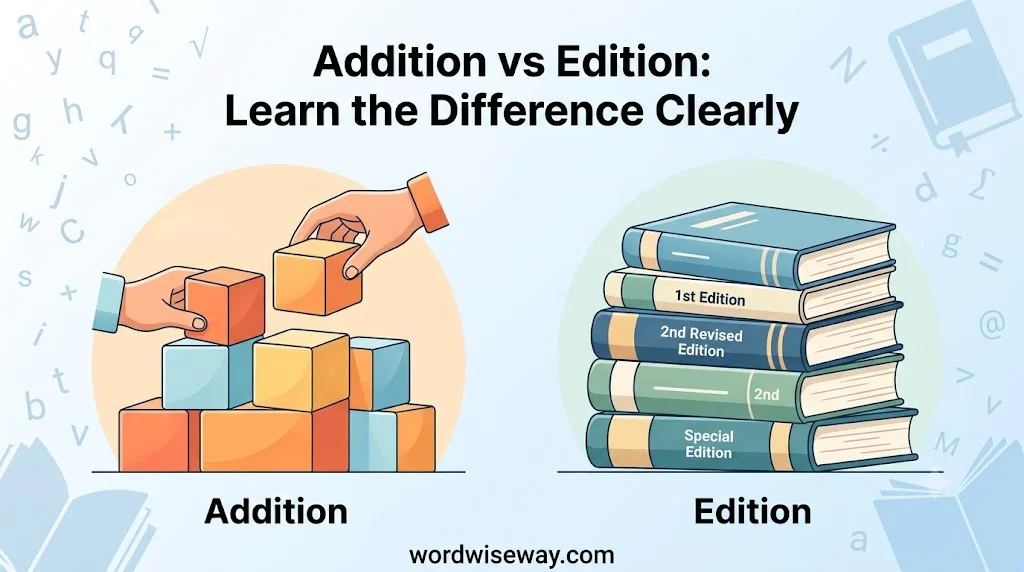
- Picture stacking blocks
- Anything extra joining a system
Edition memory tricks
- Think “Edit + Version”
- Imagine publishing a revised book
- Think of Netflix “season releases”
Quick mental shortcut
- Addition = attach something
- Edition = publish something
Common Mistakes People Keep Making
Even after learning the difference, errors still happen.
Mistake 1: Using “edition” for random objects
People sometimes say:
- “new edition of furniture”
But furniture doesn’t come in versions.
Mistake 2: Using “addition” for published works
- “new addition of the novel”
This sounds logical but is incorrect in publishing contexts.
Mistake 3: Mixing both in academic writing
Students often switch them without thinking, especially under exam pressure.
Mistake 4: Relying on sound instead of meaning
They sound similar, so people assume they function similarly. They don’t.
Quick Practice Test:
Try filling in the blanks:
- The revised ______ of the manual was released last year.
- A new chapter was an ______ to the book.
- The magazine’s special ______ includes interviews.
- The architect proposed an ______ to the building design.
Answers
- edition
- addition
- edition
- addition
If you got all correct, the distinction is starting to lock in.
Pro Writing Tips
Here’s how professionals avoid confusion:
Tip 1: Identify the nature of the object
Ask yourself:
- Is this a version or release? → Edition
- Is this something being added? → Addition
Tip 2: Look at context clues
Words like:
- “version,” “release,” “published” → Edition
- “extra,” “inserted,” “included” → Addition
Tip 3: Read the sentence aloud
If it sounds like you’re talking about a product version, go with edition.
Tip 4: Don’t translate word-for-word from your native language
Many errors happen when learners translate meaning directly instead of context.
Expert Insight: Why These Words Matter More Than You Think
Precision in language isn’t just about grammar tests.
It affects:
- Academic writing clarity
- Professional communication
- Publishing credibility
- Technical documentation accuracy
A single wrong word can change how your work is perceived.
That’s why mastering small distinctions like addition vs edition actually improves overall writing quality.
Frequently Asked Questions
1. What is the primary difference between addition and edition?
The core distinction lies in their meanings and contexts. An addition refers to the act of joining or increasing a whole by adding an existing or new element, which is why it is used as a noun in a mathematical operation to find a sum. On the flip side, an edition refers to a specific version, printing, or release of a publication, book, magazine, or software product.
2. Why do language learners frequently confuse addition vs edition?
Learners often stumble over these tricky terms because they sound nearly identical in everyday speech. This phonetic similarity causes frequent miscommunication in both writing and speech if someone does not fully grasp the grammar rules and usage patterns. As an English language specialist, I have watched countless students make these mistakes in their academic papers before learning to recognize the difference.
3. How is addition used in a professional workplace or academic context?
In an academic or professional context, addition represents an increase or an extra piece of content. For example, if you add a new paragraph to your research project, or a new employee joins your workplace team, you are making an addition. It simply describes the process of expanding something that already exists.
4. What does edition mean when referencing digital media or technology?
When a development team pushes system updates, they are launching a new edition of their software product, not a mathematical calculation. In the digital world, this term refers to a distinct form or version of an application or operating system. For instance, you might use the “Home” or “Professional” version of a program.
5. Can you provide a clear example sentence using both words?
Certainly! A great example is: “The second edition of the text book includes a fascinating new addition on digital media citations.” In this sentence, edition indicates the specific printing release of the publication, while addition refers to the extra content that was added to the whole.
6. How can I avoid making these embarrassing mistakes in my writing?
By treating a quick tool or reference guide as your primary resource, you can train your brain to separate the two concepts. Always check your context before finalizing your documents. If you are talking about a publication type, a magazine, or software, use edition; if you mean an increase or extra item, use addition.
7. Is addition always related to mathematical operations?
Not necessarily, though it is the foundational noun for the act of calculating a sum or an increase. In a broader sense, it applies across all everyday situations where something is attached or included. For instance, a new house extension or an extra feature on a car is considered an addition, showing that the word functions outside of math class too.
8. What is an example of an oversight when using edition in citations?
An oversight occurs when a student writes that they are using the “third addition” of a reference book in their bibliography. In academic reviewing, a colleague or professor will notice this frequent error immediately, as citations must strictly reference the correct printing or version of the publication to ensure the message is never lost.
9. How do grammar and usage patterns differ between these two terms?
While both words are nouns, their collocations and modifiers are entirely distinct. We say “in addition to” when we want to introduce extra information, which is a common speech pattern. Conversely, we use edition with descriptive words or numbers, such as “limited edition,” “special edition,” or “digital edition,” to describe the form itself.
10. Why is clear communication between addition and edition so vital?
Using the correct term ensures your text is instantly clear and that your professional work maintains high credibility. Mixing them up can disrupt the translation of your ideas and lead to professional miscommunication. Gaining a proper understanding of these words will elevate your writing and ensure your message is received exactly as you intended.
Conclusion
Navigating the nuances of English vocabulary requires a sharp eye, especially when two words sound nearly identical but serve entirely different purposes. For anyone looking to polish their communication, separating these terms is an essential step. While one acts as a tool for accumulation, the other marks the evolution of a creative or technical product. Mastering this distinction ensures that your presentations, reports, and everyday interactions remain sharp, polished, and authoritative.
Ultimately, precision in language is about clarity and impact. Choosing the correct term prevents unnecessary confusion and keeps your audience focused entirely on your ideas. By pausing to consider whether you are describing an expansion or a specific release format, you protect your writing from common pitfalls. Embracing these subtle details elevates your overall command of the language, ensuring your professional voice is always projected with absolute confidence.
Read More: Hustle or Hussle: Correct Spelling, Meaning and Usage

Emma Smith has dedicated 14 years to Princeton University’s English Department, mentoring students in textual interpretation, literary movements, and critical frameworks. Her research explores Shakespearean drama, Victorian serial fiction, postcolonial narrative theory, and manuscript studies and probing how literary forms evolve across cultures and centuries. Emma has delivered lectures at international humanities congresses and published findings in distinguished academic journals, underscoring her commitment to scholarly depth and vibrant teaching.