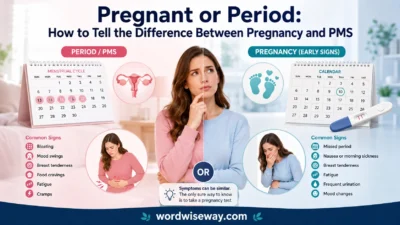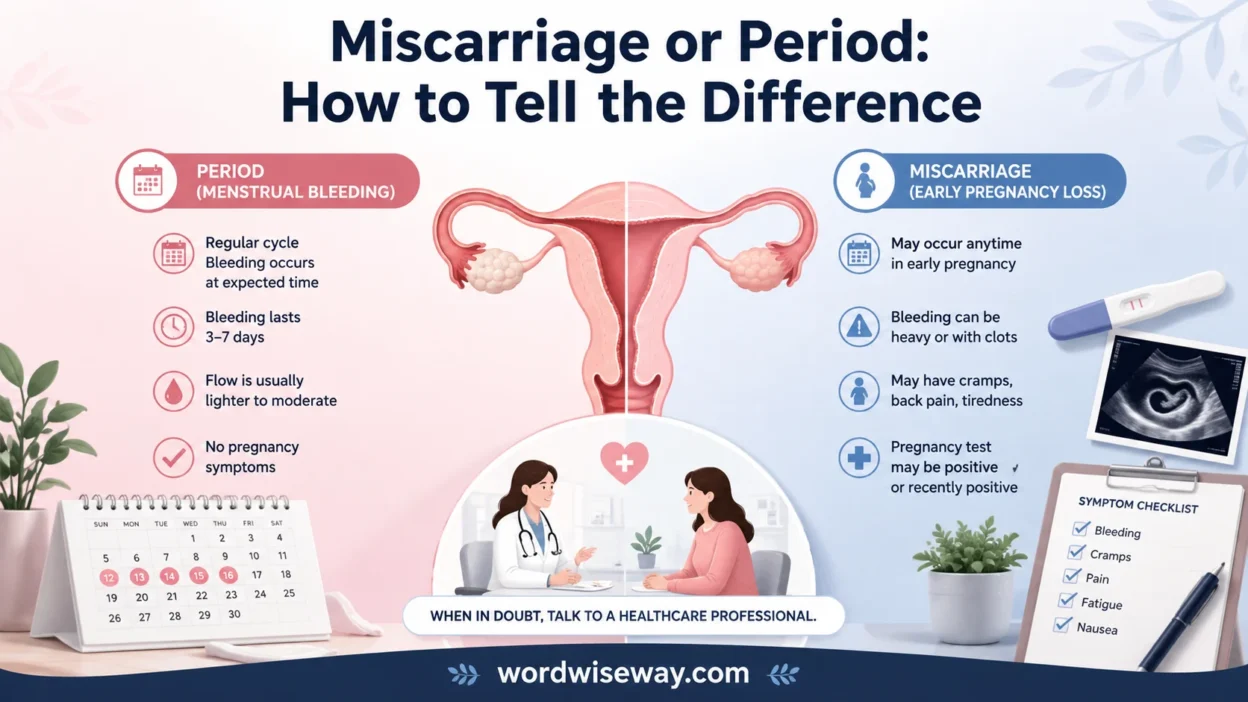
Miscarriage or Period: How to Tell the Difference? can be confusing because early pregnancy and a normal period may cause similar symptoms, including cramps, mood swings, and breast tenderness.
A miscarriage during the first trimester can sometimes feel like a usual period, especially before you know you are pregnant. However, bleeding, intensity, timing, and other related symptoms may help show the difference.
A step-by-step guide can help you distinguish pregnancy symptoms from menstrual symptoms. Miscarriage symptoms may include heavier bleeding, blood clots, and stronger discomfort. Still, symptoms can vary between women.
If you suspect pregnancy loss or a possible miscarriage, seek professional advice and see a doctor for proper evaluation.
Quick Answer:
A period is the normal shedding of the uterine lining when pregnancy hasn’t occurred. A miscarriage is the loss of a pregnancy. Very early miscarriage can resemble a late or unusually heavy period because both can cause vaginal bleeding and cramping.
Some clues can raise suspicion of pregnancy loss, such as bleeding after a positive pregnancy test, passing pregnancy-related tissue, or experiencing bleeding and cramping during a known pregnancy. However, none of these signs should be used alone to make a diagnosis.
If pregnancy is possible and unusual bleeding occurs, a pregnancy test and appropriate medical evaluation can help determine what’s happening. In early pregnancy, doctors may use hCG blood tests and ultrasound examinations, sometimes repeating them because one test may not provide enough information.
What Is the Difference Between a Period and a Miscarriage?
Although both involve the uterus and can cause bleeding, they represent completely different processes.
A menstrual period happens when the uterine lining breaks down because pregnancy hasn’t occurred. Menstrual bleeding usually follows a person’s established cycle, although the timing and amount can naturally vary.
A miscarriage, also called early pregnancy loss, involves the loss of a pregnancy. The American College of Obstetricians and Gynecologists defines early pregnancy loss as pregnancy loss before 13 completed weeks. ACOG estimates that early pregnancy loss occurs in about 10 out of 100 known pregnancies.
The overlap between the two explains much of the confusion. A miscarriage can cause bleeding and uterine cramping that resemble menstrual symptoms.
What Happens During a Period?
During a menstrual cycle, hormonal changes cause the uterine lining to shed when pregnancy hasn’t occurred. Blood and tissue then leave the uterus through the vagina.
A period may involve:
- Vaginal bleeding
- Lower abdominal cramps
- Lower back discomfort
- Bloating
- Breast tenderness
- Fatigue
- Mood changes
- Small blood clots
Menstrual flow can also change during the same period. It may start lightly, become heavier, and then gradually decrease.
What Happens During an Early Miscarriage?
During an early miscarriage, a pregnancy stops developing and pregnancy tissue leaves the uterus. Bleeding can range from spotting to heavier bleeding. Cramping may accompany the bleeding, and some people pass tissue or fluid.
Importantly, early pregnancy bleeding doesn’t always mean miscarriage. ACOG notes that bleeding during the first trimester can occur for several reasons and doesn’t necessarily indicate that the pregnancy will be lost.
Miscarriage vs. Period: Key Differences
The following comparison can help explain the general pattern, but it cannot diagnose a miscarriage.
| Sign | Period | Possible Early Miscarriage |
| Timing | Usually occurs around the expected menstrual date | Can occur after pregnancy begins and may resemble a late period |
| Pregnancy test | Usually negative | May be positive |
| Bleeding | Often follows a familiar personal pattern | May differ from the person’s usual bleeding |
| Cramping | Common | Can occur and may be significant |
| Clots | Can occur during menstruation | Can also occur |
| Tissue | Menstrual tissue may be present | Pregnancy-related tissue may sometimes pass |
| Pregnancy symptoms | Usually absent | May have occurred before bleeding |
| Confirmation | Usually based on the normal menstrual pattern | May require hCG testing and ultrasound |
The biggest clue isn’t necessarily the blood itself. Pregnancy status matters. If someone has a positive pregnancy test followed by bleeding, the situation deserves medical attention rather than being automatically labeled a period.
Can a Miscarriage Look Like a Period?
Yes. A very early miscarriage can resemble a period, particularly when the pregnancy was not yet known.
For example, imagine someone expects their period on Monday. On Wednesday, they begin bleeding with cramps. The bleeding seems somewhat heavier than usual and includes clots. Without knowing that pregnancy occurred, it could easily be mistaken for a late period.
That’s why symptoms alone can be misleading.
The distinction becomes clearer when pregnancy has already been confirmed. Bleeding during a known pregnancy should not simply be assumed to be menstruation because true menstrual periods don’t continue during an ongoing pregnancy.
ACOG also emphasizes that vaginal bleeding and cramping can occur in several early-pregnancy conditions. A proper evaluation may therefore be necessary to determine the cause.
What Does Miscarriage Bleeding Look Like?
Miscarriage bleeding can vary considerably. Some people experience light spotting, while others have heavier bleeding with cramping. Some may pass clots or tissue.
According to the NHS, miscarriage bleeding can appear as pink, red, or brown blood. Some people experience heavier red bleeding that soaks through a pad. Other possible symptoms include lower abdominal pain, cramping, fluid coming from the vagina, or pink, gray, or white material.
However, appearance isn’t a diagnostic fingerprint.
Blood color doesn’t prove miscarriage. Neither does the presence of a clot. Even tissue-like material may require medical assessment to determine what it represents.
ACOG notes that pregnancy tissue may sometimes resemble a blood clot mixed with gray-white material or a clear, fluid-filled sac.
What Does Period Bleeding Usually Look Like?
Menstrual bleeding also varies from person to person.
A typical period may begin with light spotting before becoming heavier. The flow usually decreases toward the end. Blood can appear bright red, dark red, or brown depending on how quickly it leaves the uterus.
Small clots can occur during menstruation as well. Therefore, seeing a clot doesn’t automatically mean a miscarriage happened.
The better question is whether the bleeding fits the person’s normal cycle and whether pregnancy is possible. A significant change from an established pattern deserves closer attention, especially when pregnancy could be involved.
Miscarriage vs. Period Symptoms
Symptoms can provide useful context, but they cannot reliably settle the question by themselves.
Abdominal or Pelvic Cramps
Period cramps happen because the uterus contracts during menstruation. Early miscarriage can also cause uterine cramping.
Some people describe miscarriage cramps as stronger or different from their usual menstrual cramps. However, pain intensity varies widely.
A mild cramp doesn’t rule out miscarriage. Severe cramps don’t automatically prove one either.
Vaginal Bleeding
Bleeding is one of the most common signs associated with miscarriage. Yet bleeding can occur during early pregnancy without pregnancy loss. ACOG reports that first-trimester bleeding occurs in approximately 15% to 25% of pregnancies.
That statistic matters because it shows why bleeding should not be interpreted in isolation.
Blood Clots
Clots can occur during a normal period and during miscarriage.
Consequently, the size or appearance of a clot cannot reliably distinguish the two. A healthcare professional may need to combine the bleeding history with pregnancy testing, examination, blood tests, or ultrasound.
Passing Tissue
Passing tissue can occur during miscarriage. However, what appears to be tissue isn’t always easy to identify by sight.
If pregnancy has been confirmed and unusual material passes during bleeding, medical advice can help determine what happened. In some situations, a laboratory can examine passed tissue.
Pregnancy Symptoms
Early pregnancy can cause symptoms such as nausea, breast tenderness, and fatigue. A sudden change in these symptoms can feel concerning.
Still, pregnancy symptoms naturally fluctuate. Their presence or disappearance cannot independently confirm that a miscarriage occurred.
Can You Have a Period While Pregnant?
A true menstrual period doesn’t occur during an ongoing pregnancy. However, vaginal bleeding can occur during pregnancy.
That distinction is important.
Early pregnancy bleeding can have several causes, including implantation, changes involving the cervix, infection, miscarriage, and ectopic pregnancy. Sometimes healthcare professionals cannot immediately identify the cause.
Therefore, calling pregnancy-related bleeding a “period” without testing can create a false sense of certainty.
Can You Have a Miscarriage Before You Know You’re Pregnant?
Yes. Very early pregnancy loss can happen before someone realizes they are pregnant.
This can make the event resemble a late or heavier-than-usual period. The person may never have taken a pregnancy test before the bleeding began.
This is one reason early pregnancy loss can go unnoticed. Some miscarriages happen very early, sometimes before a person knows pregnancy occurred.
A pregnancy test can sometimes provide useful evidence, although timing matters.
How to Know if It Was a Miscarriage or a Period
There isn’t a reliable home method that can identify miscarriage simply by examining bleeding.
Instead, consider the following questions:
- Was pregnancy possible?
- Was a pregnancy test positive?
- Did the bleeding occur at the expected period time?
- Is the bleeding significantly different from the normal cycle?
- Are there unusual or severe cramps?
- Has tissue or fluid passed?
- Are there symptoms suggesting an ectopic pregnancy?
- Does medical evaluation indicate pregnancy loss?
If pregnancy is possible, a home pregnancy test can be a useful first step. A healthcare professional may then recommend blood testing or ultrasound depending on the circumstances.
ACOG explains that doctors may measure human chorionic gonadotropin (hCG) and use ultrasound to determine whether an early pregnancy is developing normally. Sometimes several hCG measurements or ultrasound examinations are necessary.
Pregnancy Tests After a Possible Miscarriage
Pregnancy tests detect hCG, a hormone produced during pregnancy.
After a pregnancy loss, hCG doesn’t necessarily disappear immediately. As a result, a pregnancy test can remain positive for some time after a miscarriage.
Doctors may use blood tests to track hCG levels over time. A falling level can support the possibility of pregnancy loss, although the pattern needs to be interpreted alongside other findings.
An ultrasound can provide another important piece of the puzzle. Depending on how far along the pregnancy is, an ultrasound may show whether an intrauterine pregnancy is developing and whether expected structures or cardiac activity are visible.
Sometimes the timing is simply too early for a definitive answer. In those situations, repeat testing may be necessary rather than jumping to a conclusion from one scan.
When Bleeding Could Be Something Other Than a Period or Miscarriage
Bleeding doesn’t belong to a two-option menu.
Several conditions can cause vaginal bleeding during early pregnancy. These include:
- Implantation-related bleeding
- Cervical changes
- Infection
- Early pregnancy loss
- Ectopic pregnancy
- Other pregnancy-related complications
An ectopic pregnancy deserves particular attention because it can become dangerous. It occurs when a fertilized egg implants outside the uterus, most often in a fallopian tube.
Symptoms can include vaginal bleeding and pelvic or abdominal pain. Pain may occur on one side. Shoulder-tip pain, dizziness, weakness, or fainting can signal a serious complication.
That’s why bleeding plus possible pregnancy shouldn’t automatically be dismissed as an ordinary period.
When to Seek Urgent Medical Care
Certain symptoms need prompt medical attention.
Seek urgent medical help if bleeding occurs with:
- Severe or sudden abdominal or pelvic pain
- Fainting or severe dizziness
- Shoulder-tip pain
- Heavy bleeding
- Severe weakness
- Fever or chills
- Severe or worsening pain
Heavy bleeding is particularly important. ACOG advises contacting an obstetrician-gynecologist for very heavy bleeding, including bleeding that soaks through more than two maxi pads per hour for more than two consecutive hours after early pregnancy loss.
Sudden severe pain with dizziness or fainting can indicate a ruptured ectopic pregnancy. That situation requires emergency care.
How Doctors Confirm a Miscarriage
Symptoms provide clues. Medical testing provides evidence.
Medical History
A healthcare professional may ask about:
- The date of the last menstrual period
- Pregnancy test results
- Bleeding amount and timing
- Pain location and severity
- Pregnancy symptoms
- Previous pregnancy history
These details help establish the timeline.
Pregnancy and hCG Testing
Urine testing can establish whether pregnancy is likely. Blood testing can measure the amount of β-hCG and track how it changes.
A single hCG result doesn’t always provide the complete picture. Doctors may repeat the test, sometimes after about 48 hours, depending on the clinical situation.
Ultrasound
Ultrasound can help determine whether a pregnancy is developing inside the uterus and whether the findings match the expected stage of pregnancy.
If the pregnancy is extremely early, however, an ultrasound may not yet show enough information to confirm what is happening. A repeat ultrasound may therefore be needed.
ACOG recommends combining the medical history and examination with ultrasound and serum β-hCG testing when necessary to establish a reliable diagnosis.
A Simple Example: Why Symptoms Can Be Misleading
Consider two situations.
Example one: Someone gets cramps followed by moderate bleeding exactly when their period usually arrives. They haven’t had a positive pregnancy test. The bleeding follows their normal pattern and gradually stops.
That pattern may fit ordinary menstruation.
Example two: Someone has a positive pregnancy test. A few days later, they develop bleeding and cramping that differs from their usual symptoms.
That situation needs pregnancy-related medical assessment because miscarriage is one possibility. Other causes, including ectopic pregnancy, also need consideration.
The symptoms overlap. The pregnancy history changes the picture.
Read More: Appendicitis or Gas: How to Tell the Difference?
FAQs
1. Can a miscarriage feel like a normal period?
Yes, especially during very early pregnancy. Some early pregnancy losses can cause bleeding and cramps that feel similar to a period, particularly if you didn’t know you were pregnant.
2. How is miscarriage bleeding different from period bleeding?
Miscarriage bleeding may be heavier or last longer than your usual period. You may also notice stronger cramps or blood clots, although these signs can vary from person to person.
3. Can you have period-like cramps during early pregnancy?
Yes. Mild cramps can occur during early pregnancy and don’t always mean something is wrong. However, severe or unusual pain with bleeding should be checked by a healthcare professional.
4. Does having blood clots mean you had a miscarriage?
Not necessarily. Blood clots can occur during a regular period, especially when bleeding is heavy. Clots alone cannot confirm a miscarriage.
5. Can a pregnancy test help identify a miscarriage?
A pregnancy test can show whether pregnancy hormones are present, but one test usually cannot confirm what is happening. A healthcare professional may recommend further testing when needed.
6. Is heavy bleeding always a sign of miscarriage?
No. Some periods are naturally heavier than others. However, unusually heavy bleeding during a possible pregnancy deserves medical attention so the cause can be properly assessed.
7. When should I see a doctor about bleeding?
You should contact a healthcare professional if you have bleeding during a known or possible pregnancy, especially when it is heavy, persistent, or accompanied by significant pain, dizziness, or weakness.
8. Can you miscarry without knowing you were pregnant?
Yes. A very early pregnancy loss can happen before someone realizes they are pregnant. In that situation, the bleeding may be mistaken for a normal menstrual period.
9. Can symptoms alone confirm a miscarriage?
No. Symptoms such as cramps, bleeding, and clots can occur with both menstruation and pregnancy loss. Medical evaluation may be needed to determine the actual cause.
10. What is the best way to tell a miscarriage from a period?
Consider the timing, bleeding pattern, pain, pregnancy history, and other symptoms, but don’t rely on one sign alone. If pregnancy is possible and bleeding seems unusual, a healthcare professional can provide the clearest assessment.
Conclusion
Understanding Miscarriage or Period: How to Tell the Difference? can be difficult because early pregnancy symptoms and menstrual symptoms often overlap. Bleeding, cramps, clots, and changes in flow may provide clues, but they don’t always give a definite answer. A suspected early pregnancy loss can also be emotionally difficult, so it’s important to avoid assuming the cause based only on what you see.
If pregnancy is possible and your bleeding feels different from your usual period, consider speaking with a healthcare professional. Getting appropriate medical advice can help clarify what is happening and identify whether further evaluation is needed. When in doubt, professional guidance is safer than trying to diagnose the situation from symptoms alone.

Amelia Sanders has spent 14 years in Harvard University’s English Department, helping students navigate literary analysis, interpretive theory, and narrative techniques. Her academic pursuits center on 18th-century British prose, romantic poetry, diasporic writing, and digital editing exploring how textual choices influence cultural perspectives. Amelia has spoken at major international meetings and contributed essays to respected academic volumes, demonstrating her dedication to thoughtful scholarship and effective teaching.