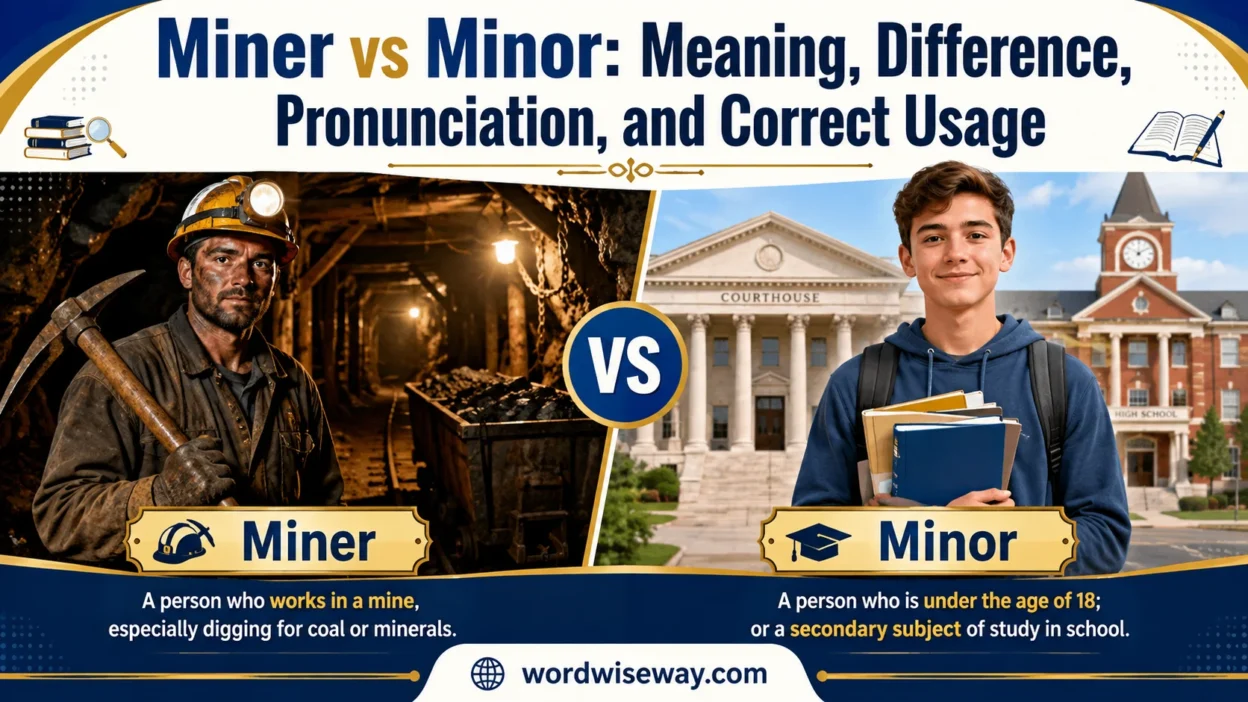
Many English learners and native speakers get confused because miner and minor are homophones. Miner vs Minor: Difference, Meaning, and Correct Usage explains how these words have the same pronunciation when spoken, but different spelling and meaning.
A miner is a person or worker who works in a mine and extracts minerals from the earth. Miners are involved in mining, exploration, and processing resources like coal, gold, and other valuable materials.
A minor has different meanings based on context. It can describe something small, less important, or a young individual under eighteen. In law, a minor is below the required legal age. In music, a minor key is a musical mode linked with sadness or melancholy.
Understanding the difference, correct usage, and examples helps people avoid mistakes in writing, emails, and professional documents.
Quick Answer:
The difference between miner and minor is easy to remember. A miner is someone who works in a mine or a machine that mines digital currencies like Bitcoin. A minor is a person below the legal age of adulthood or something that is less important, smaller, or lower in degree. Although both words share the same pronunciation, they are never interchangeable because their meanings belong to completely different contexts.
| Word | Meaning | Example |
| Miner | A person or machine that extracts resources | The miner found gold underground. |
| Minor | A child under legal age or something less important | She suffered a minor injury. |
Why People Confuse Miner and Minor
Many English learners mix up these words because they are homophones, meaning they sound the same but have different meanings and spellings. Their pronunciation is nearly identical in American English, making it difficult to distinguish them when listening.
Another reason is that both words appear in everyday conversations but in very different situations. You might hear about a coal miner in a news report, then read about a minor accident in the next article. Without understanding the context, it’s easy to choose the wrong spelling.
Miner Meaning
Definition of Miner
A miner is a person whose job involves extracting natural resources from the earth. These resources include coal, gold, silver, copper, diamonds, iron ore, and many other valuable minerals. In modern technology, the word also refers to computers or specialized devices that validate cryptocurrency transactions.
Whether discussing traditional mining or digital mining, a miner always performs the task of extracting or producing something valuable.
Origin of the Word Miner
The word miner comes from the word mine, which refers to an excavation in the ground where minerals or metals are removed. The suffix -er means “a person or thing that performs an action.” Therefore, a miner is literally someone who mines.
This meaning has remained consistent for centuries, although modern technology has expanded its use into cryptocurrency and data processing.
When to Use Miner
Use miner whenever you’re referring to someone or something involved in mining.
➥Common situations include:
- Coal mining
- Gold mining
- Diamond mining
- Cryptocurrency mining
- Data mining
- Underground mining
Common Examples of Miner in Sentences
- The miner worked deep underground for twelve hours.
- Every experienced miner follows strict safety procedures.
- A Bitcoin miner validates blockchain transactions.
- The rescue team saved several trapped miners after the collapse.
- The gold miner discovered a rich deposit.
Common Collocations with Miner
Some words naturally appear with miner more often than others.
- Coal miner
- Gold miner
- Silver miner
- Diamond miner
- Copper miner
- Bitcoin miner
- Cryptocurrency miner
- Data miner
- Underground miner
- Mine worker
These combinations help readers immediately recognize that the topic involves mining or resource extraction.
Minor Meaning
Definition of Minor
The word minor has several meanings depending on the context. Most commonly, it refers to a person who has not yet reached the legal age of adulthood. It can also describe something smaller, less important, or less serious.
Unlike miner, minor is commonly used as both an adjective and a noun.
Origin of the Word Minor
Minor comes from the Latin word minor, meaning smaller or lesser. Over time, English adopted the word to describe anything lower in importance, size, degree, or age.
Today, the word appears in law, education, medicine, music, business, and everyday conversation.
Different Meanings of Minor
A Person Under the Legal Age
In legal terms, a minor is someone who has not reached the age of adulthood. In many countries, adulthood begins at 18 years old, although legal definitions vary depending on local laws.
Example:
- The contract required a parent’s signature because the applicant was a minor.
Something Less Important
A minor issue is small and does not require major attention.
Examples:
- The software update fixed several minor bugs.
- They made only minor adjustments to the design.
Academic Minor
At many colleges and universities, a minor is a secondary field of study completed alongside a student’s major.
Example:
- She earned a major in biology with a minor in psychology.
Music
A minor key produces a different emotional sound than a major key and often creates a thoughtful or dramatic mood.
Example:
- The song changes from a major key to a minor key.
Common Examples of Minor in Sentences
- The child was still a minor.
- Doctors described the injury as minor.
- We experienced a minor delay.
- The company made minor improvements.
- His college minor was economics.
Common Collocations with Minor
- Minor injury
- Minor mistake
- Minor issue
- Minor problem
- Minor role
- Minor offense
- Minor child
- Minor adjustment
- Minor detail
- Minor change
These expressions are common in newspapers, academic writing, business reports, and daily conversations.
Miner vs Minor: Side-by-Side Comparison
| Feature | Miner | Minor |
| Meaning | A person or machine that mines | A child or something smaller or less important |
| Part of Speech | Noun | Noun and adjective |
| Pronunciation | /ˈmaɪnər/ | /ˈmaɪnər/ |
| Main Context | Mining, cryptocurrency, data | Law, education, medicine, grammar, everyday English |
| Example | The miner extracted coal. | She suffered a minor injury. |
Miner vs Minor Pronunciation
IPA Pronunciation
Both miner and minor are pronounced:
/ˈmaɪnər/
Because they sound exactly alike in most American accents, listeners depend on the surrounding words to understand the intended meaning.
Why They Sound Similar
English contains many homophones that developed through centuries of language changes. Although their spellings differ, pronunciation gradually became identical.
Other examples include:
- Their vs There
- Flour vs Flower
- Right vs Write
- Sea vs See
These words demonstrate why context matters more than pronunciation.
Tips to Remember the Difference
A few simple tricks make these words easy to remember.
- Miner contains mine, reminding you of a mine where resources are extracted.
- Minor contains mini, which suggests something smaller.
- If you’re talking about age, injuries, mistakes, or importance, choose minor.
- If you’re talking about coal, gold, Bitcoin, or mining, choose miner.
These small memory aids help eliminate confusion during writing.
How to Remember Miner vs Minor
Learning vocabulary becomes easier when you associate words with familiar ideas.
Imagine a person wearing a hard hat and carrying mining equipment. That image immediately connects to miner.
Now picture a child holding a school backpack. That image reminds you of a minor, someone below the legal age of adulthood.
Another helpful method is to think about the root words:
- Mine → Miner
- Mini → Minor
This simple association works surprisingly well because it links spelling with meaning instead of memorizing definitions.
Miner vs Minor in Real Life Examples
Workplace Examples
Mining companies employ skilled miners who operate machinery, inspect tunnels, and extract valuable minerals. Safety training plays an important role because underground environments can be hazardous.
In contrast, workplace policies may mention that minors cannot perform certain dangerous jobs due to labor laws.
School Examples
A student might choose mathematics as a major and history as a minor during college.
You would never describe that student as a miner unless they actually worked in a mine.
Legal Examples
Courts frequently use the word minor when discussing child custody, education, guardianship, and juvenile rights.
Example:
- The court appointed a guardian for the minor.
Technology Examples
Today, many people recognize the word miner because of cryptocurrency.
A Bitcoin miner uses specialized computer hardware to verify blockchain transactions and receives rewards for helping secure the network.
Traditional mining removes minerals from the earth. Cryptocurrency mining processes digital transactions instead. Although the industries differ, both involve extracting value.
Common Mistakes People Make
Wrong vs Correct Examples
| Incorrect | Correct |
| He is a coal minor. | He is a coal miner. |
| The child is a miner. | The child is a minor. |
| They hired experienced minors. | They hired experienced miners. |
| She had a miner injury. | She had a minor injury. |
| Bitcoin minor earns rewards. | Bitcoin miner earns rewards. |
Why Spell Check Doesn’t Always Catch the Error
Spell check programs often fail to identify mistakes involving homophones because both miner and minor are correctly spelled English words.
For example, writing “The coal minor worked overnight” won’t trigger a spelling warning. The software sees a correctly spelled word, even though the meaning is incorrect. That’s why proofreading for context is just as important as checking spelling.
Miner and Minor in Grammar
Parts of Speech
Understanding the grammatical role of each word makes it easier to choose the correct spelling.
Miner functions only as a noun because it names a person or a machine involved in mining.
Examples:
- The miner discovered a rich vein of copper.
- A Bitcoin miner verifies blockchain transactions.
Minor functions as both a noun and an adjective.
As a noun:
- The minor required parental permission.
As an adjective:
- The repairs were minor.
- She played a minor role in the project.
Knowing the part of speech often helps you identify the correct word before you finish writing a sentence.
Can They Ever Replace Each Other?
No. Miner and minor cannot replace each other because they describe completely different ideas.
Compare these examples:
- ✅ The miner worked underground.
- ❌ The minor worked underground.
- ✅ The patient had a minor injury.
- ❌ The patient had a miner injury.
Even though both words sound the same, replacing one with the other changes the meaning entirely.
Synonyms and Related Words
Synonyms of Miner
Depending on the context, these words may be used instead of miner:
- Mine worker
- Excavator
- Pit worker
- Gold prospector
- Coal worker
- Resource extractor
- Quarry worker
Remember that not every synonym fits every situation. For example, a Bitcoin miner is not the same as a quarry worker.
Synonyms of Minor
Common synonyms for minor include:
- Small
- Slight
- Little
- Lesser
- Secondary
- Limited
- Trivial
- Modest
- Insignificant
- Minimal
Each synonym carries a slightly different meaning, so choose one that best matches your sentence.
Related Words That Cause Similar Confusion
English has many homophones and commonly confused words. Learning them together improves vocabulary and reduces writing mistakes.
Some examples include:
- Principal vs Principle
- Accept vs Except
- Affect vs Effect
- Stationary vs Stationery
- Complement vs Compliment
- Desert vs Dessert
- Advice vs Advise
- Lose vs Loose
- Weather vs Whether
- Than vs Then
Frequently Confused Word Pairs Related to Miner and Minor
People who confuse miner and minor often struggle with other similar-looking words as well.
| Word Pair | Main Difference |
| Principal vs Principle | Person in charge vs rule or belief |
| Affect vs Effect | Usually a verb vs usually a noun |
| Stationary vs Stationery | Not moving vs writing supplies |
| Complement vs Compliment | Complete something vs praise someone |
| Desert vs Dessert | Dry land vs sweet course |
| Advice vs Advise | Noun vs verb |
| Lose vs Loose | Misplace vs not tight |
| Than vs Then | Comparison vs time |
| Weather vs Whether | Climate vs expressing choice |
| To vs Too | Direction vs also or excessive |
Learning these pairs together strengthens your understanding of English spelling patterns.
Quick Summary: Miner vs Minor
If you only remember one thing, remember this:
- Miner relates to mines, mining, minerals, and cryptocurrency.
- Minor relates to age, importance, size, or degree.
Here’s a quick comparison:
| Miner | Minor |
| Person or machine that mines | Child under legal age |
| Always a noun | Noun or adjective |
| Used in mining and technology | Used in law, education, medicine, music, and everyday English |
| Coal miner | Minor injury |
| Bitcoin miner | Minor change |
A simple memory trick is to look for the word mine inside miner. If you’re talking about digging, extracting, or mining, miner is correct. If you’re describing something small, less serious, or someone under the legal age, choose minor.
Read More: Verbiage vs Verbage: Correct Spelling, Meaning, and Difference
FAQs
What is the main difference between miner and minor?
A miner is a person who works in a mine and extracts minerals or other resources from the earth. A minor has different meanings, including a person under legal age or something small and less important. Although both words have the same pronunciation, their meanings and spellings are completely different.
Are miner and minor homophones?
Yes, miner and minor are homophones because they sound the same when spoken. However, they have different spellings, definitions, and uses. Homophones often create confusion in writing because pronunciation alone cannot show the correct word.
Can a miner work with cryptocurrency?
Yes, the word miner can also refer to someone who mines cryptocurrency. In this modern context, a cryptocurrency miner uses computer systems to verify transactions and support digital networks.
What does minor mean in law?
In law, a minor is a person who has not reached the legal age required for certain rights and responsibilities. The exact age can vary depending on the country and legal system.
What is a minor key in music?
A minor key is a musical mode commonly connected with emotions such as sadness or melancholy. It creates a different sound and feeling compared with a major key.
Why do people confuse miner and minor?
People confuse these words because they have identical pronunciation. The confusion usually happens while writing emails, essays, social media posts, or professional documents where spelling matters.
How can I remember the difference between miner and minor?
An easy trick is to connect miner with a mine, because a miner works in a mine. Remember that minor relates to age, size, or importance depending on the situation.
Is miner only related to coal and gold?
No, a miner can work with many resources. Coal and gold are common examples, but miners may extract different minerals, metals, and materials from the earth.
Can minor describe something other than a person?
Yes, minor can describe something small, less important, or secondary. For example, a minor issue is a problem that is not very serious compared with a major issue.
How can using miner and minor incorrectly affect writing?
Using the wrong word can change the meaning of a sentence and create confusion. Correct usage improves communication and helps writing appear more professional and accurate.
Conclusion
Understanding the difference between miner and minor makes English communication clearer and prevents common spelling mistakes. These words may sound identical, but they belong to different areas of life. A miner is connected with mining, resources, and workers who extract materials, while a minor relates to age, importance, size, law, music, and grammar.
Learning their meanings, examples, and correct usage helps writers choose the right word in every situation. Whether you are writing an essay, email, or professional document, knowing the difference between miner and minor improves accuracy and confidence.