Gem or Jem: Correct Spelling, Meaning, and Usage becomes easier when you connect the meaning with the spelling pattern: gem uses g for its familiar sound before certain vowels. The word came into English through a long history of language change, but its long established spelling remains the normal spelling in standard English.
In sentences, a diamond can be a gem, while a kind person may be a hidden gem. You’ll commonly see gem in emails, social media posts, school assignments, and professional documents. By contrast, jem can occur as a personal name, character name, name, brand, or special proper noun, especially through intentional informal spelling.
For English learners and writers, this guide combines grammar guidance, natural examples, related terms, common spelling mistakes, regional usage, usage examples, trend data, and practical editing tips. When choosing the right form, pronounce the word if that helps, but use the standard form when you need to communicate clearly and write with confidence.
Quick Answer:
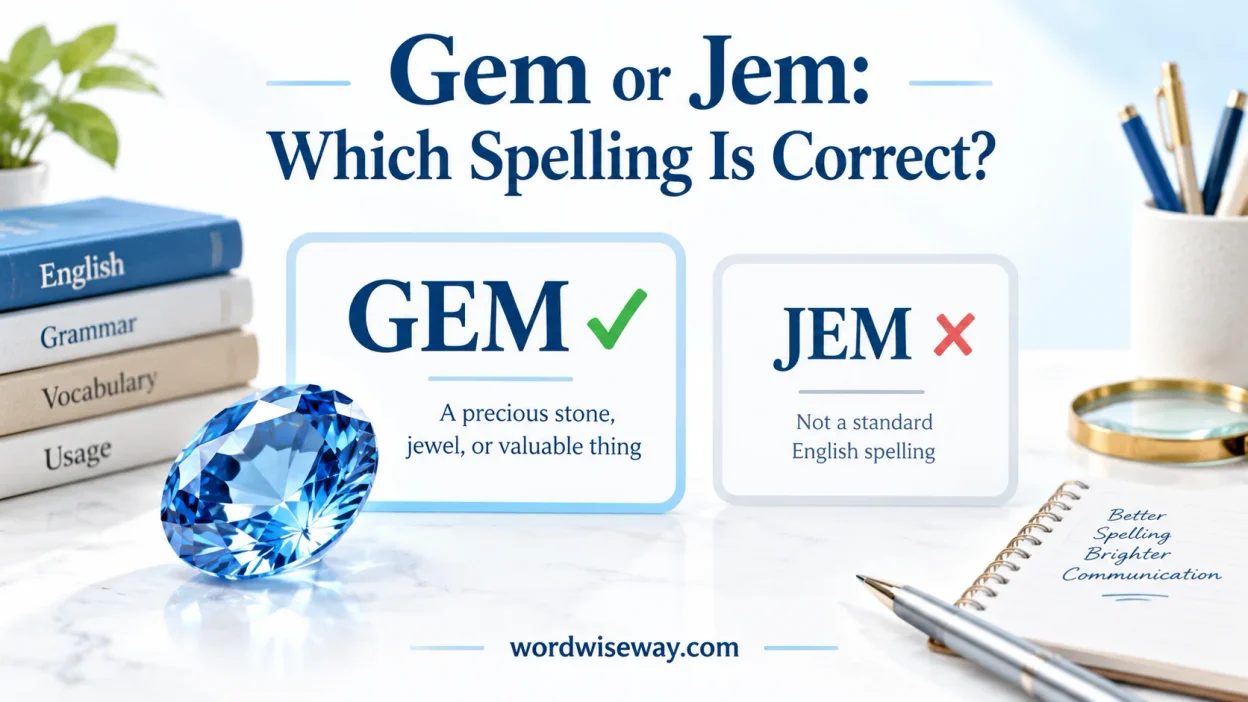
Gem is the correct standard spelling when you mean a precious stone or something especially valuable.
Jem isn’t the standard spelling of that common English noun. However, Jem can be correct as a proper name, nickname, character name, or other intentionally chosen name.
| Spelling | Standard noun? | Common use | Example |
| Gem | ✓ Yes | Precious stone or something valuable | “The ring contains a rare gem.” |
| Jem | ✗ No | Name, nickname, character, or stylized proper noun | “Jem is his nickname.” |
So, if you’re writing about jewelry, a valuable discovery, or a wonderful person, use gem.
A useful rule is simple: If you mean the ordinary English word, spell it “gem.”
What Does “Gem” Mean?
The word gem has both a literal and a figurative meaning. Its literal sense relates to valuable stones, while its figurative sense describes something considered exceptionally good or precious.
Gem as a Precious Stone
In its most traditional sense, a gem is a precious or semiprecious stone that people value for its beauty, rarity, durability, or other qualities.
Diamonds, rubies, emeralds, and sapphires are familiar examples. Depending on the context, many other minerals and stones can also receive the broader label gem when they’re suitable for ornamental use.
For example:
- “She wore a necklace decorated with a blue gem.”
- “The jeweler examined the gem under magnification.”
- “The museum displayed several historic gems.”
- “The ring contains a polished green gem.”
The word doesn’t necessarily mean diamond. A diamond is one type of gemstone, while gem is the broader term.
That distinction matters because people sometimes use gem and diamond interchangeably in casual conversation. Technically, however, they’re not synonyms in every context.
Gem as Something Highly Valued
English also uses gem metaphorically. In this sense, the word doesn’t refer to a stone at all.
You can call a person, place, book, idea, restaurant, discovery, or experience a gem when you consider it unusually valuable or delightful.
Consider these examples:
- “That little bookstore is a hidden gem.”
- “Her advice was a real gem.”
- “We found a gem of a restaurant downtown.”
- “The old photograph is a historical gem.”
- “His presentation contained several useful gems of information.”
Here, gem expresses appreciation. You’re saying that something stands out because of its quality or value.
Common Expressions With “Gem”
Several everyday expressions use gem figuratively.
“Hidden gem”
A hidden gem is something excellent that isn’t widely known or noticed.
For example:
“The small mountain town is a hidden gem for hikers.”
The phrase works because it compares an overlooked discovery with a valuable stone that remains concealed.
“Gem of a person”
Calling someone a gem of a person means you consider them especially kind, helpful, reliable, or pleasant.
For example:
“She’s a gem of a person who always helps her neighbors.”
“A real gem”
This expression emphasizes that someone or something is unusually good.
“That old camera is a real gem.”
The meaning depends on context, but the underlying idea remains the same: something valuable has been recognized and appreciated.
What Does “Jem” Mean?
Here’s where the spelling becomes more interesting.
Jem isn’t the standard spelling of the ordinary English noun meaning a gemstone. If you’re writing a normal sentence about a precious stone, jem is considered incorrect.
However, that doesn’t mean the sequence of letters J-e-m can never appear in English.
Is “Jem” a Correct English Word?
As a replacement for gem, no.
If you write:
“The necklace contains a beautiful jem.”
the standard correction is:
“The necklace contains a beautiful gem.”
The problem isn’t pronunciation. The problem is spelling.
English spelling doesn’t always follow sound perfectly. Once a standard spelling becomes established, writers generally need to follow that conventional form even when another spelling seems logical from pronunciation.
Jem as a Name
Jem can function as a personal name or nickname. In that situation, it isn’t competing with the ordinary noun gem.
For example:
“Jem arrived early for the meeting.”
Here, Jem is a name. Capitalization signals that the word refers to a particular person rather than the common noun.
This distinction is important because proper names can have unusual or unconventional spellings. A person’s chosen name doesn’t have to follow the spelling rules that govern ordinary vocabulary.
Jem as a Deliberate or Stylized Spelling
You may also encounter Jem in fictional works, businesses, products, usernames, organizations, or other named entities.
A creator can intentionally choose Jem as a name. Once that spelling identifies a particular entity, changing it to Gem could actually make the name inaccurate.
Think of it this way:
Standard vocabulary follows established spelling conventions. Names can have their own identities.
That is why Jem can be legitimate in one sentence and incorrect in another.
Key Differences
The difference becomes much clearer when you compare their functions.
| Feature | Gem | Jem |
| Standard English noun | ✓ Yes | ✗ No |
| Refers to a precious stone | ✓ Yes | ✗ No |
| Can describe something valuable figuratively | ✓ Yes | ✗ No |
| Can be a person’s name | Sometimes, depending on the name | ✓ Yes |
| Can appear as a fictional name | ✓ Possible | ✓ Possible |
| Can be a nickname | ✓ Possible | ✓ Possible |
| Standard spelling of the gemstone word | ✓ Yes | ✗ No |
| May appear as an intentional proper-name spelling | ✓ Yes | ✓ Yes |
The crucial distinction isn’t simply the letter G versus J. It’s word function and context.
If you’re using the ordinary noun, choose gem.
If you’re referring to someone or something specifically named Jem, preserve that spelling.
Which One Should You Use?
Choosing between gem and jem becomes straightforward once you identify what you’re trying to say.
Use gem when you mean:
- A precious or semiprecious stone
- A gemstone used in jewelry
- Something exceptionally valuable
- A particularly good person
- A wonderful place or discovery
- An excellent piece of information
- A figurative treasure
For example:
“The jeweler selected a brilliant gem for the necklace.”
And:
“That tiny café is a hidden gem.”
Use Jem when it refers to:
- A person’s actual name
- A nickname
- A fictional character
- A brand or business name
- A title or other established proper noun
- A deliberately stylized name
The capitalization and context usually make the distinction easier to recognize.
Common Mistakes
Even though the difference involves only one letter, several mistakes repeatedly cause confusion.
Using “Jem” When You Mean “Gem”
This is the most common error.
Incorrect:
“She bought a beautiful jem.”
Correct:
“She bought a beautiful gem.”
The pronunciation may tempt you toward j, but standard English spelling uses g.
Assuming “Jem” Is an Alternative Spelling
Another mistake involves treating jem as a casual alternative to gem.
It isn’t.
Unlike some English words that have accepted spelling variants, gem has an established standard spelling. You shouldn’t switch the g to j simply because the word has a soft g sound.
Confusing Names With Ordinary Words
Context can make the distinction easy to miss.
Compare these sentences:
“The ring contains a gem.”
and:
“Jem bought the ring.”
In the first sentence, gem identifies an object. In the second, Jem identifies a person.
The words look similar, but they perform completely different jobs.
Ignoring Capitalization
Capitalization can provide an important clue when Jem functions as a name.
Compare:
- “The necklace contains a gem.”
- “Jem found the necklace.”
The first is a common noun. The second is a proper name.
Of course, capitalization alone doesn’t prove meaning in every situation. Context remains the deciding factor.
Examples of Gem in Sentences
Seeing gem in several contexts helps reinforce its meaning.
Literal Examples
- “The jeweler placed the gem under a bright lamp.”
- “The museum displayed a collection of historic gems.”
- “She chose a sapphire gem for the pendant.”
- “The gem had a deep blue color.”
- “The stone was carefully cut and polished.”
Figurative Examples
- “That small restaurant is a hidden gem.”
- “Her final suggestion was a gem.”
- “The old manuscript contains several historical gems.”
- “He’s a gem when you need reliable advice.”
- “The quiet beach is one of the area’s best gems.”
Notice how gem keeps the same underlying idea in both groups. Whether you’re discussing a stone or an experience, the word suggests value and appreciation.
Examples of Jem in Sentences
When Jem serves as a name, its meaning comes from the identity attached to it.
Examples include:
- “Jem called before the event started.”
- “Everyone in the story knows Jem.”
- “Jem is the character’s nickname.”
- “The company chose Jem as its brand name.”
- “Jem appears as a fictional character in the novel.”
These sentences don’t describe gemstones. They identify a person, character, or named entity.
That’s why replacing Jem with gem could change the intended meaning.
Different Contexts
The right spelling depends heavily on the writing situation.
In Formal Writing
Use gem when you mean the ordinary noun.
For example:
“The collection includes several rare gems.”
Writing jem in this context would look like a spelling error.
Formal writing benefits from standard spelling because readers shouldn’t have to stop and decode whether an unusual spelling was intentional.
In Casual Writing
The same rule applies.
You might say:
“That little shop is a gem.”
You wouldn’t normally write:
“That little shop is a jem.”
The casual nature of the sentence doesn’t make the nonstandard spelling acceptable.
In Creative Writing
Creative writing gives names more freedom.
An author may create a character named Jem. That spelling can be entirely intentional.
However, if the character looks at a gemstone and describes it as a gem, the common noun still takes its standard spelling.
This distinction is especially useful for writers because proper names and ordinary vocabulary can appear side by side.
Why Do People Spell Gem as “Jem”?
The confusion mainly comes from pronunciation.
In gem, the letter g has a soft sound. It sounds like the initial consonant in words such as general and giant. Because j commonly represents a similar sound, someone unfamiliar with the spelling may naturally write jem.
English creates plenty of these spelling traps.
The sound you hear doesn’t always reveal the letters you need to write. That’s why spelling relies heavily on established conventions rather than pronunciation alone.
Consider the basic lesson:
Similar sounds don’t guarantee similar spellings.
This is one reason proofreading matters. A word can sound perfectly clear while its written form remains easy to misspell.
How to Remember the Correct Spelling
A simple memory trick can keep gem and jem apart.
Think about the word gemstone.
A gemstone begins with gem, not jem.
You can also connect the word with jewelry:
gem → gemstone → jewelry
Once you associate gem with a physical gemstone, the spelling becomes easier to recall in figurative uses as well.
Another useful reminder is:
A gem is a valuable thing. A Jem is a name.
That isn’t a rule for every possible proper noun, but it’s a handy way to remember the central distinction.
A Quick Decision Guide
When you’re unsure which spelling to use, ask one question:
Am I using the ordinary English word or referring to a specific name?
If you’re talking about a stone, use gem.
Or If you’re describing something as valuable or wonderful, use gem.
If you’re referring to a person specifically named Jem, keep Jem.
| What you mean | Correct choice |
| A precious stone | Gem |
| A gemstone in jewelry | Gem |
| A valuable discovery | Gem |
| A wonderful person | Gem |
| A hidden treasure or place | Gem |
| A person’s name | Jem, if that’s the person’s name |
| A fictional character called Jem | Jem |
| An intentionally named brand or entity | Use its established spelling |
A Practical Case Study: Choosing Gem or Jem
Imagine you’re proofreading two sentences:
“The antique ring contains a rare jem.”
At first glance, the sentence seems fine because jem sounds exactly right when spoken. But the context tells you that the writer means a precious stone.
The corrected sentence is:
“The antique ring contains a rare gem.”
Now consider a second sentence:
“Jem examined the antique ring.”
Changing Jem to Gem would be a mistake if Jem is the person’s actual name.
These examples show why spelling can’t always be corrected by looking at sound alone. Context determines function, while conventional spelling determines the written form.
Read More: Madame or Madam: Meaning, Difference and Correct Usage
FAQs
Is gem or jem the correct spelling?
Gem is the standard spelling in English. It commonly refers to a precious stone, a valuable object, or something especially wonderful. Jem is generally not the correct spelling unless it appears as a name, brand, character name, or intentionally altered spelling.
What does gem mean?
A gem can mean a precious stone such as a diamond or ruby. The word can also describe something valuable or excellent. For example, you might call a beautiful object a gem or describe a particularly kind person as a hidden gem.
Why do people spell gem as jem?
People sometimes write jem because gem begins with a soft j sound. English spelling can be tricky because the pronunciation doesn’t always tell you which letter to use. However, the standard spelling remains gem.
Is jem ever a correct word?
Jem can be correct when it functions as a proper name or another intentional name-based spelling. It may appear as a person’s name, character name, brand, or other special proper noun. In ordinary English writing, however, gem is the expected form.
How do you pronounce gem?
Gem is pronounced with a soft j sound at the beginning. The pronunciation can make the spelling seem confusing because the word starts with the letter g, even though that letter produces the sound commonly associated with j in this case.
What is the difference between gem and jem?
The main difference is their spelling and typical usage. Gem is the standard English word for a precious stone or something valuable and excellent. Jem usually appears as a name or intentional alternative spelling rather than as the ordinary English noun.
Can gem describe a person?
Yes. Gem can describe a person who is especially kind, helpful, talented, or valuable to others. For example, you could say that a thoughtful coworker is a real gem. This use treats the word as a figurative expression rather than referring to an actual stone.
Should I use gem in formal writing?
Yes, gem is appropriate in formal writing when its meaning fits the sentence. You can use it in school assignments, professional documents, articles, and other standard English contexts. If you’re using it as the ordinary noun, gem is the spelling you should choose.
Is gem used differently in American and British English?
The spelling gem is standard in both American and British English. Unlike some words that have different regional spellings, this word doesn’t normally change from gem to jem based on English variety. The difference usually comes from names or informal spelling rather than regional grammar.
How can I remember the spelling of gem?
A useful memory trick is to remember that gem uses g even though it begins with a soft j sound. You can connect the word with familiar examples such as general and gentle, which also show how g can produce this sound before certain vowels. When in doubt, choose gem.
Conclusion
The gem or jem question becomes much simpler once you separate pronunciation from spelling. Gem is the standard English spelling for a precious stone, a valuable object, or something considered excellent. Although its opening sound resembles the sound associated with j, English spelling doesn’t always follow pronunciation letter by letter. That’s why gem remains the correct choice in ordinary writing.
Jem still has a place, but usually as a personal name, character name, brand, or intentional alternative spelling. If you’re writing an email, school assignment, professional document, or other standard English text, choose gem when you mean the common noun. Keeping that distinction in mind can prevent a tiny spelling uncertainty from turning into a distracting mistake.
When you encounter gem or jem, focus on the role the word plays in your sentence rather than relying only on its sound. Use gem for the standard English word, and reserve jem for contexts where that spelling is deliberately part of a name or other proper usage. Once you remember this simple pattern, you’ll be able to write the word with confidence.