Content vs Context: Meaning, Differences, and Why They Matter shows why both elements are important in the business world.
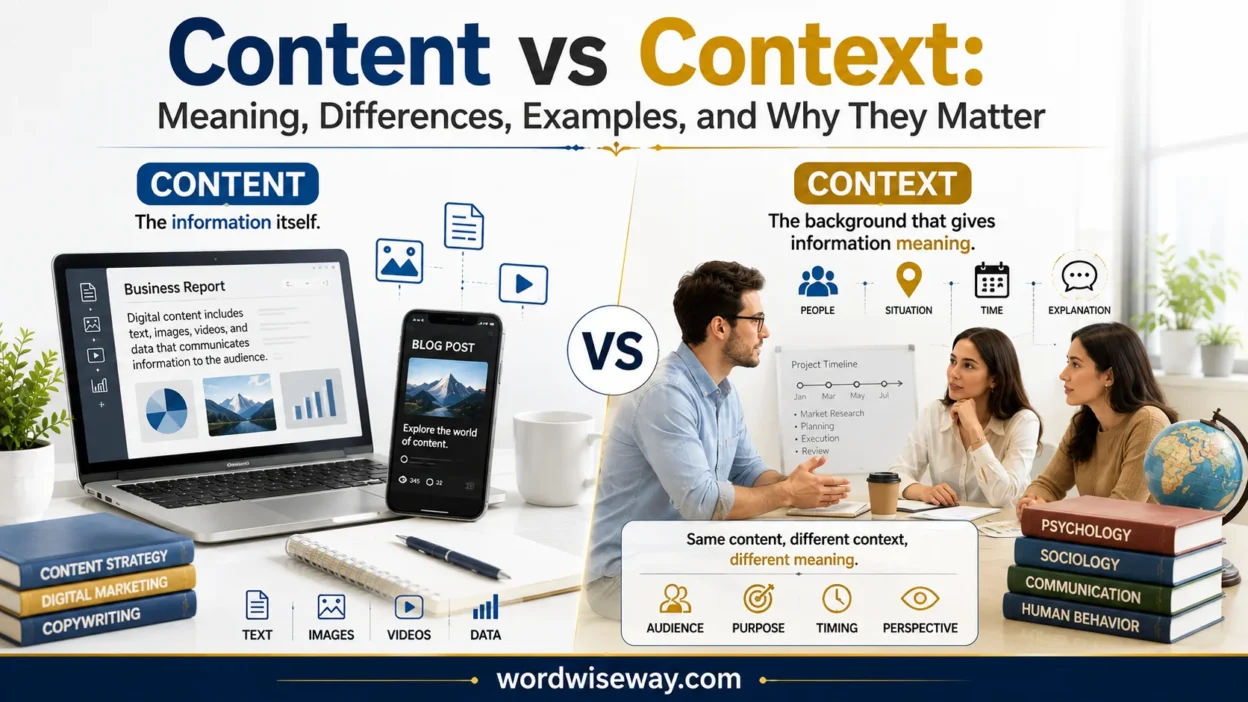
Content is the information, message, or ideas shared through text, pictures, videos, and media. It includes a blog post, image, or writing that helps businesses communicate with their audience. Context explains the situation, environment, and background that give meaning to the message.
From my experience, successful leaders understand the key role of context in communication. A strong content strategy considers audience preferences, current trends, and relevance.
The right context helps messages fit better, improve credibility, and create productive interactions.
Quick Answer:
Content is the information itself, while context is the background that explains the meaning of that information.
For example, a news headline is the content, but the events, location, history, and reasons behind that headline create the context.
| Content | Context |
| The actual message or information | The background behind the message |
| Answers “What is being said?” | Answers “Why does it matter?” |
| Includes words, images, videos, and data | Includes situation, purpose, time, and audience |
| Exists inside a message | Surrounds and influences the message |
Both work together. Content provides information, but context gives that information meaning.
What Is Content?
Content means the material, information, or ideas presented to an audience. It is the part people can directly see, read, hear, or watch.
When you open a website, watch a video, read a book, or view a social media post, everything you consume is content.
Content can appear in many forms, including:
- Written articles and blog posts
- Books and reports
- Videos and podcasts
- Images and graphics
- Social media updates
- Advertisements
- Educational materials
- Product descriptions
For example, a cooking recipe contains content such as ingredients, measurements, and instructions. Those details make up the actual information being delivered.
However, content alone does not always provide complete understanding. Without additional information, people may misunderstand what the creator intended.
Types of Content
Content exists everywhere in modern communication. Different platforms use different forms of content to share information.
Written Content
Written content includes:
- Articles
- Emails
- News stories
- Social media captions
- Research papers
- Books
A blog post explaining “how to start gardening” is written content because it provides information through words.
Visual Content
Visual content communicates ideas through images and designs.
Examples include:
- Infographics
- Photographs
- Charts
- Illustrations
- Logos
A climate change infographic showing rising temperatures is content because it presents facts visually.
Audio and Video Content
Podcasts, interviews, documentaries, and online videos are also forms of content.
A documentary about wildlife contains:
- Narration
- Footage
- Interviews
- Statistics
All these elements create the content of the documentary.
What Is Context?
Context is the information surrounding something that helps people understand its meaning.
Think of context as the missing puzzle pieces around a message. Without those pieces, the picture may look incomplete.
Context answers important questions:
- Who created this message?
- Why was it created?
- When did it happen?
- Where did it happen?
- Who is the audience?
- What events influenced it?
For example, if someone says, “This project failed,” the sentence alone is content. But understanding the reasons behind the failure, such as budget problems, timing issues, or market changes, provides context.
Types of Context
Context appears in different forms depending on the situation.
Linguistic Context
Linguistic context refers to the words and sentences surrounding a particular phrase.
A single word can have multiple meanings depending on nearby words.
For example:
- “The bank approved my loan.”
- “I sat beside the river bank.”
The word “bank” has the same spelling, but the surrounding words create different meanings.
Situational Context
Situational context focuses on the circumstances surrounding an event or conversation.
Consider the phrase:
“Great job.”
The meaning changes depending on the situation.
It could mean:
- Genuine praise after success
- Sarcasm after a mistake
- Encouragement during a difficult task
The words remain unchanged, but the situation changes the meaning.
Cultural and Historical Context
Culture and history also influence interpretation.
A symbol, phrase, or tradition may have one meaning in one society and a different meaning somewhere else.
Historical events also provide context. A speech from a political leader, for example, cannot be fully understood without knowing the events happening during that period.
Content vs Context: Key Differences Explained
The difference between content vs context becomes clearer when we compare their roles.
| Feature | Content | Context |
| Basic meaning | Information being shared | Background that explains information |
| Main focus | Message itself | Meaning behind the message |
| Purpose | Provides details | Helps interpretation |
| Example | A quote from a speech | The reason and situation behind the speech |
| Location | Inside the message | Around the message |
Content tells you what happened. Context helps you understand why it happened.
For example, imagine reading:
“Company sales dropped by 30%.”
That sentence is content.
The context includes:
- Economic conditions
- Customer behavior
- Competition
- Company decisions
- Market changes
Without context, the information may create an incomplete picture.
Examples of Content vs Context in Real Life
Understanding practical examples makes the difference easier to remember.
Content vs Context in Social Media
A social media post contains content such as:
- Text
- Images
- Videos
- Hashtags
However, the context includes:
- The creator’s purpose
- The audience
- The timing
- Current events
- The emotions behind the post
For example, a person posting a photo of a crowded place may simply share a travel experience. However, during a major event, the same image could have a completely different meaning.
Content vs Context in News
News articles contain facts, quotes, and information. That is the content.
The context includes:
- Previous events
- Historical background
- People involved
- Location
- Social impact
A headline might say:
“Prices Increased Again.”
The content tells readers that prices went up. The context explains:
- Which prices increased
- Why they increased
- How people are affected
- What experts predict
Content vs Context in Conversations
Every conversation has both content and context.
The content is the spoken words.
The context includes:
- Relationship between speakers
- Tone of voice
- Body language
- Situation
For example:
“I’m fine.”
The content suggests everything is okay. However, the context may reveal that the person sounds upset or uncomfortable.
Why Context Changes the Meaning of Content
Words do not always carry complete meaning by themselves. The surrounding information shapes how people understand them.
A simple message can create different reactions depending on the context.
Consider this statement:
“You’re early.”
Depending on the situation, it could mean:
- A compliment because someone arrived before time
- Surprise because someone arrived unexpectedly
- A joke among friends
The content stays the same. The context changes the interpretation.
This is why effective communication requires more than just sharing information. People need enough background to understand the message correctly.
Why Content Needs Context
Content without context can create confusion.
Imagine reading a single sentence from a long article without knowing the topic. The information may seem unclear or misleading.
Context helps people:
- Understand the purpose
- Identify important details
- Avoid incorrect assumptions
- Make better decisions
This matters in areas like:
- Journalism
- Education
- Business
- Marketing
- Research
A statistic without context can be misleading. A number becomes meaningful only when people understand what it represents.
Why Context Needs Content
Context alone cannot deliver a complete message.
For example, knowing that a historical event happened during a difficult period provides background. However, people still need the actual details of the event to understand what occurred.
Content provides the foundation. Context builds understanding around it.
Content vs Context in Writing
Strong writing requires both elements.
A writer creates content through:
- Facts
- Ideas
- Examples
- Explanations
Context improves the writing by adding:
- Background information
- Audience awareness
- Purpose
- Relevant details
For example, a history article should not only mention dates and events. It should explain why those events happened and how they affected people.
Good writing answers two questions:
What happened?
Why does it matter?
Common Mistakes About Content and Context
Many people misunderstand how these two concepts work together.
Creating More Content Without Adding Value
More words do not always mean better information.
Quality content focuses on:
- Accuracy
- Relevance
- Clear explanations
- User needs
A short, useful article can be more valuable than a long article filled with unnecessary details.
Ignoring Context
Sharing information without background can cause misunderstandings.
For example, a quote taken from a longer conversation may appear to mean something completely different.
Confusing Context With Content
Some people use these words interchangeably, but they describe different things.
Content is the message.
Context is the meaning behind the message.
Read More: Potatoes or Potatos: Correct Spelling, Meaning, and Usage
How to Analyze Content and Context Together
When reading or creating information, ask these questions.
Questions About Content
- What information is being presented?
- What message is being shared?
- What facts or ideas are included?
- What evidence supports the information?
Questions About Context
- Who created this information?
- Why was it created?
- When and where did it happen?
- Who is the intended audience?
- What background information affects its meaning?
Using both approaches creates deeper understanding.
Content vs Context: Quick Comparison Summary
| Question | Content | Context |
| What is it? | Information or material | Background information |
| Main purpose | Share a message | Explain meaning |
| Focus | Facts and details | Circumstances and reasons |
| Example | A sentence in an article | The situation around that sentence |
| Importance | Provides information | Creates understanding |
FAQs
What is the main difference between content and context?
Content refers to the actual information, message, or material being shared, while context explains the situation, background, and conditions that help people understand that message correctly.
Why is context important in communication?
Context gives meaning to content by showing why, where, and how a message is being delivered. It helps prevent misunderstandings and improves clarity between people.
Can the same content have different meanings in different contexts?
Yes, the same content can create different interpretations depending on the audience, environment, timing, and purpose behind sharing it.
How does content help businesses?
Content helps businesses share information, promote products, connect with audiences, build trust, and communicate their ideas through different formats like articles, videos, and social media posts.
Why should leaders focus on context?
Leaders who understand context can guide conversations better, make informed decisions, and create healthier communication within their teams and organizations.
What are common examples of content?
Examples of content include blog posts, videos, images, podcasts, advertisements, social media posts, ebooks, and other forms of digital or written material.
How does context affect marketing strategies?
Context helps marketers understand audience preferences, current trends, and situations so they can create messages that are more relevant and effective.
Is content more important than context?
Neither is more important because content provides the message, while context gives that message meaning. Both work together for successful communication.
Can poor context damage good content?
Yes, even valuable content may fail if it is shared with the wrong audience, at the wrong time, or without considering the surrounding situation.
How can someone improve their understanding of content and context?
People can improve by analyzing messages carefully, considering backgrounds, understanding audiences, and looking beyond just the words being presented.
Conclusion
Content and context are two connected parts of meaningful communication. Content provides the information people want to share, while context creates the environment that helps others understand that information properly. A message without context may lose its purpose, and context without useful content may not provide enough value. Together, they create clearer conversations, stronger relationships, and better understanding between individuals, businesses, and communities.
In today’s digital world, where people constantly consume articles, videos, and social media posts, knowing the difference between content and context has become more important than ever. Whether in leadership, marketing, education, or daily interactions, paying attention to both elements allows people to communicate with greater accuracy and impact. When we understand not only what is being said but also why and how it is being shared, communication becomes more meaningful, effective, and valuable.

Amelia Sanders has spent 14 years in Harvard University’s English Department, helping students navigate literary analysis, interpretive theory, and narrative techniques. Her academic pursuits center on 18th-century British prose, romantic poetry, diasporic writing, and digital editing exploring how textual choices influence cultural perspectives. Amelia has spoken at major international meetings and contributed essays to respected academic volumes, demonstrating her dedication to thoughtful scholarship and effective teaching.