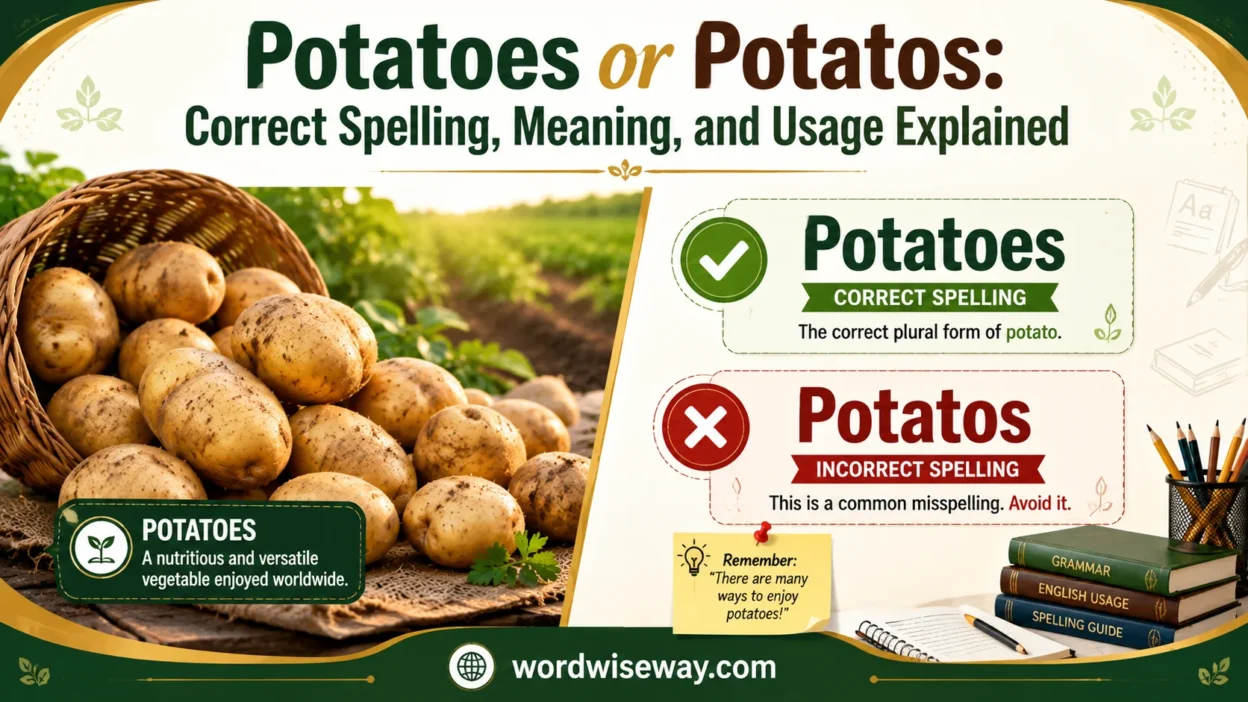
The phrase Potatoes or Potatos: Correct Spelling, Meaning, and Usage explains a common spelling confusion in English.
The potato pronunciation may have variants, but the same word keeps the same meaning. Many learners of English and casual speakers wonder about the correct plural form because potatoes and potatos look similar. The spelling rule shows that the correct spelling is potatoes because words ending in certain sounds often need the -es suffix.
Understanding the plural noun form helps improve writing, grammar, and language accuracy. A small spelling mistake can affect professional writing, academic writing, and online communication.
Careful proofreading helps writers follow standard English and avoid confusion. Knowing the difference between singular noun and plural noun makes everyday usage clearer and easier
Quick Answer:
Potatoes is the correct spelling. Potatos is a common spelling mistake and is not accepted as standard English.
- ✅ Correct: I bought fresh potatoes from the market.
- ❌ Incorrect: I bought fresh potatos from the market.
The singular form is potato, and the plural form changes to potatoes.
Potato → Potatoes
The same spelling pattern appears in words like:
- Tomato → Tomatoes
- Hero → Heroes
- Echo → Echoes
However, not every word ending in -o follows this rule, which is why learners often get confused.
Potatoes or Potatos: The Correct Spelling Explained
The word potatoes refers to more than one potato. A potato is a type of edible root vegetable that grows underground from the potato plant. When we talk about multiple potatoes, English adds -es instead of only adding -s.
The correct spelling contains three important parts:
Potato + e + s = Potatoes
The letter e helps create the correct plural form and maintains the traditional spelling pattern of the word.
For example:
- One potato is enough for this recipe.
- Two potatoes are needed to make mashed potatoes.
- Farmers grow millions of potatoes every year.
On the other hand, potatos removes the required e, making it an incorrect spelling.
Why Is “Potatos” Incorrect?
Many people write potatos because they apply a common English rule:
Add “s” to a word to make it plural.
This works for many nouns:
| Singular Word | Plural Word |
| Book | Books |
| Chair | Chairs |
| Apple | Apples |
| Car | Cars |
However, some words require a different spelling change.
Words ending in -o often need -es:
| Incorrect | Correct |
| Potatos | Potatoes |
| Tomatos | Tomatoes |
| Heros | Heroes |
| Echoes | Echoes |
The mistake happens because the writer focuses on pronunciation rather than the established spelling rule.
Potato vs Potatoes: Understanding the Difference
Although potato and potatoes look almost identical, they serve different purposes in a sentence.
Meaning of Potato
Potato is the singular form. It describes one individual vegetable.
Examples:
- I baked a potato for lunch.
- This potato has a smooth skin.
- The farmer planted one potato.
When you are talking about only one item, use potato.
Meaning of Potatoes
Potatoes is the plural form. It describes two or more potatoes.
Examples:
- She bought five potatoes for dinner.
- Potatoes are used in many different cuisines.
- These potatoes taste delicious.
The difference is simple:
| Word | Meaning | Example |
| Potato | One vegetable | I peeled a potato. |
| Potatoes | More than one vegetable | I peeled three potatoes. |
Why Do People Confuse Potatoes and Potatos?
The confusion comes from several reasons. English spelling contains many patterns and exceptions, so learners sometimes follow rules that do not apply.
Confusion With Regular Plural Rules
Many people learn that adding s creates a plural word. Because of this, they naturally write:
Potato + s = Potatos
However, English developed over centuries and contains many special spelling patterns. Some words need extra letters to form their plural versions.
For example:
- Child → Children
- Man → Men
- Potato → Potatoes
These changes may seem unusual, but they are part of correct English usage.
Pronunciation Creates Spelling Mistakes
When people say potatoes, the ending sound can make the spelling confusing. The extra e is not always obvious when spoken quickly.
This happens with many English words where pronunciation does not clearly show every letter.
For example:
- Beautiful
- Business
- Wednesday
English spelling often requires remembering the written form rather than only listening to the sound.
Similar Words Add More Confusion
Words ending with -o do not all follow the same plural rule.
Compare these examples:
| Singular | Plural |
| Potato | Potatoes |
| Tomato | Tomatoes |
| Hero | Heroes |
| Photo | Photos |
| Piano | Pianos |
| Video | Videos |
This variation makes spelling practice important.
Grammar Rule: How to Make Plurals of Words Ending in -O
The plural form of words ending in -o depends on the word itself. Many traditional English words add -es, but some modern words simply add -s.
Words That Usually Add -ES
These common words use -es:
| Singular | Plural |
| Potato | Potatoes |
| Tomato | Tomatoes |
| Hero | Heroes |
| Echo | Echoes |
Examples:
- The chef cooked several potatoes.
- The movie included many heroes.
- The garden has tomato plants.
Words That Usually Add Only -S
Some words ending in -o only need -s:
| Singular | Plural |
| Photo | Photos |
| Piano | Pianos |
| Radio | Radios |
| Video | Videos |
Examples:
- I saved old photos on my computer.
- The store sells different radios.
How to Remember the Difference
A simple memory trick is to remember common food words:
Potatoes and tomatoes grow together, and both add “-es.”
This small connection can help you recall the correct spelling quickly.
Examples of Potatoes Used Correctly in Sentences
The word potatoes appears in everyday conversations, cooking, farming, and science.
Everyday Examples
- My mother cooked mashed potatoes for dinner.
- The grocery store sells fresh potatoes.
- We bought potatoes for the weekend meal.
Farming Examples
Potatoes are one of the world’s most important food crops. Farmers grow them in many countries because they can provide energy, nutrients, and food security.
Examples:
- Farmers harvest potatoes during the growing season.
- Modern farming methods improve potato production.
- Potatoes grow best in cool climates.
Nutrition Examples
Potatoes provide important nutrients, including:
- Carbohydrates for energy
- Fiber for digestion
- Vitamin C
- Potassium
A balanced diet can include potatoes as part of a healthy meal plan.
Common Mistakes Related to Potatoes
Spelling mistakes often happen when people confuse plural forms with possessive forms.
Potato, Potatoes, Potato’s, and Potatoes’
These words have different meanings.
| Word | Meaning | Example |
| Potato | One item | I cooked a potato. |
| Potatoes | More than one item | The potatoes are ready. |
| Potato’s | Something belonging to one potato | The potato’s skin is thin. |
| Potatoes’ | Something belonging to multiple potatoes | The potatoes’ quality improved. |
Understanding these differences helps you write more accurately.
Potatoes in Culture, Food, and Everyday Life
Potatoes are much more than just a spelling example. They are one of the most widely consumed crops in the world.
According to food and agriculture data, potatoes rank among the world’s major food crops alongside rice, wheat, and maize. They have become a staple ingredient in many cultures because they are affordable, versatile, and easy to prepare.
Popular potato dishes include:
- French fries
- Mashed potatoes
- Potato chips
- Baked potatoes
- Potato soup
- Potato curry
Different countries have created their own unique recipes using potatoes.
For example:
- In the United States, fries and mashed potatoes are common side dishes.
- In India and Pakistan, potatoes are widely used in curries and snacks.
- In Europe, potatoes appear in traditional meals such as baked and roasted dishes.
The word potatoes appears frequently because people usually talk about this vegetable in groups rather than individually.
Case Study: Why Correct Spelling Matters in Digital Content
Imagine two websites publishing articles about cooking recipes. One uses the correct spelling potatoes, while the other repeatedly uses potatos.
Search engines and readers may view the incorrect spelling as a quality issue. Although a single mistake may not destroy content performance, repeated spelling errors can reduce trust.
Correct spelling helps with:
- Professional communication
- Search visibility
- Reader confidence
- Academic writing quality
A small letter can make a big difference.
Quick Comparison: Potatoes vs Potatos
Feature | Potatoes | Potatos |
| Correct spelling | ✅ Yes | ❌ No |
| Grammar role | Plural of potato | Incorrect spelling |
| Used in formal writing | Yes | No |
| Example | I bought potatoes. | I bought potatos. ❌ |
Read More: Miner vs Minor: Difference, Meaning, and Correct Usage
FAQs
What is the correct spelling, potatoes or potatos?
The correct spelling is potatoes. The word potatos is an incorrect form and should not be used in standard English writing.
Why do people confuse potatoes and potatos?
People often confuse these words because English plural rules can be tricky. Many learners expect words to simply add -s, but some nouns require -es.
Is potatos ever accepted in English?
No, potatos is not accepted as the standard plural form of potato. The grammatically correct plural is potatoes.
Why does potato become potatoes instead of potatos?
The word potato ends with a vowel sound, and according to English spelling rules, some words ending in similar patterns take the -es suffix when becoming plural.
How can I remember the spelling of potatoes?
A simple way to remember it is to focus on the extra e before the s. Think of potato changing into potatoes with the added letters needed for the correct plural form.
Do native English speakers also confuse potatoes and potatos?
Yes, even native speakers may sometimes pause when spelling unusual plural forms. However, regular use and proofreading help them choose the correct version.
Is potatoes a singular or plural word?
Potatoes is a plural noun. The singular form is potato, while more than one potato is called potatoes.
Does the spelling difference change the meaning?
The meaning does not change because potatos is simply a misspelled version. Only potatoes correctly represents multiple potato items.
Where is the correct spelling of potatoes important?
The correct spelling matters in school essays, professional writing, academic work, social media posts, and everyday communication where language accuracy is important.
What is the easiest rule for remembering potatoes?
Remember that many nouns ending in certain vowel sounds use -es in their plural form. Following this rule helps avoid the common mistake of writing potatos.
Conclusion
Understanding the difference between potatoes and potatos helps improve spelling accuracy and confidence in English writing. Although the difference is only one small letter, that extra e plays an important role in making the word grammatically correct. Many learners, writers, and casual speakers experience confusion because English plural rules do not always follow one simple pattern. Learning these rules through examples makes spelling easier and improves communication skills.
Whether you are preparing an academic assignment, writing online content, creating a social media post, or simply making a grocery list, using potatoes shows proper understanding of standard English. Regular practice, careful proofreading, and awareness of common spelling patterns can help prevent similar mistakes with other words. A small improvement in spelling can create clearer sentences, stronger writing, and better language accuracy in everyday communication.

Emma Smith has dedicated 14 years to Princeton University’s English Department, mentoring students in textual interpretation, literary movements, and critical frameworks. Her research explores Shakespearean drama, Victorian serial fiction, postcolonial narrative theory, and manuscript studies and probing how literary forms evolve across cultures and centuries. Emma has delivered lectures at international humanities congresses and published findings in distinguished academic journals, underscoring her commitment to scholarly depth and vibrant teaching.