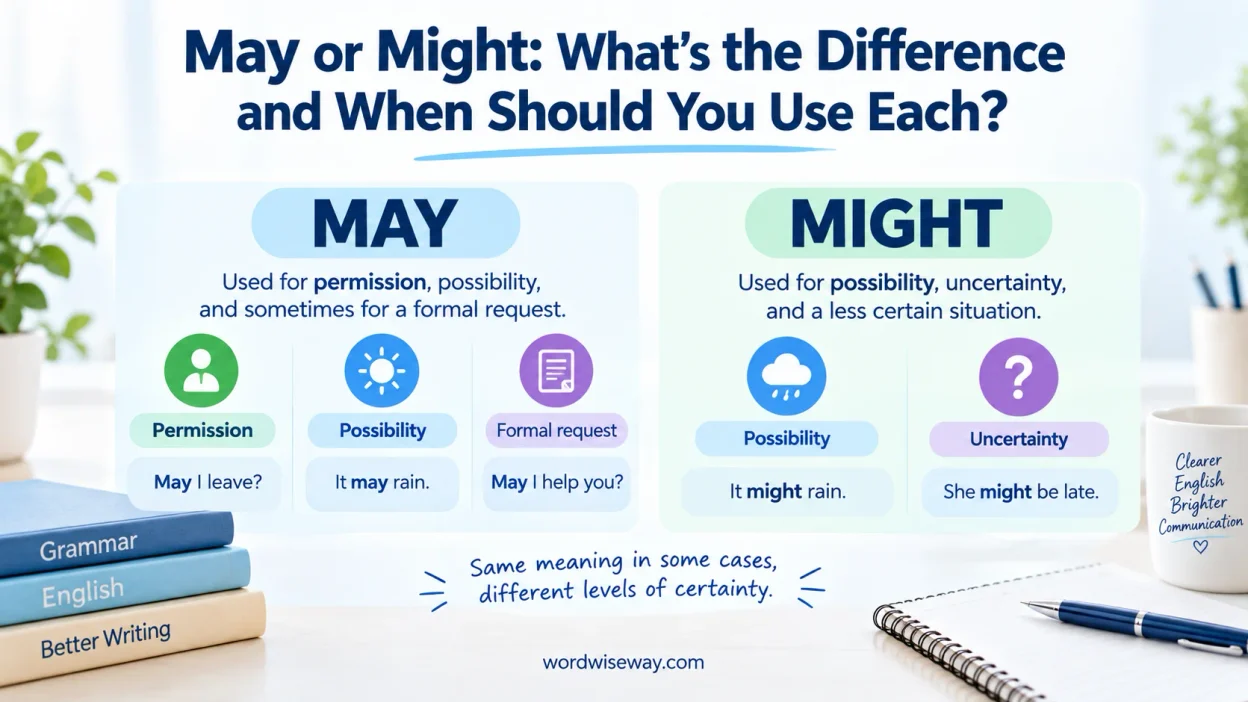
May and might are two words that often create confusion for learners, writers, and English speakers.
In May or Might: Difference and When Should You Use Each?, you’ll see why the difference between them can seem fuzzy, subtle, and fluid because both can express possibility in similar situations. A closer look at grammar shows that may can also express permission, while might often suggests greater uncertainty.
In speech, everyday conversations, writing, emails, and exams, the words can sometimes be interchangeable. However, choosing the correct word depends on the meaning and context. This guide will clear up the confusion with simple explanations, real examples, and practical tips you can use right away.
Understanding the unique characteristics and functions of each word helps you use each correctly, speak clearly, and write professionally. Even if you’re great at grammar, you may still mix them up. Today, we’ll explain the grammar behind each word, polite speech, and their different meanings.
Quick Answer:
Use may when you want to express possibility, formal permission, or a formal statement about what is possible.
Use might when you want to express possibility that often sounds more tentative, uncertain, or hypothetical. Might can also function as the past form of may in reported speech.
| Word | Main Uses | Example |
| May | Possibility | It may rain tonight. |
| May | Permission | May I leave early? |
| Might | Possibility | It might rain tonight. |
| Might | Tentative possibility | She might join us later. |
| Might | Reported speech | He said he might come. |
| Might | Very formal permission | Might I ask a question? |
The simplest practical rule is this:
May often leaves a possibility open. Might often makes that possibility sound more tentative.
However, don’t treat that distinction as an ironclad probability scale. In many sentences, may and might can both work without a major change in meaning.
What Does “May” Mean?
May is a modal verb that commonly expresses possibility or permission. It appears before the base form of another verb.
For example:
- She may arrive later.
- They may need more time.
- He may be at home.
- May I ask a question?
Unlike ordinary verbs, may doesn’t take an infinitive with to. You say may go, not may to go. Cambridge identifies may as a modal verb followed by an infinitive without to.
May for Present or Future Possibility
Use may when something is possible now or in the future.
Consider these examples:
- The package may arrive tomorrow.
- Sarah may be busy right now.
- We may visit the museum this weekend.
- This decision may affect the entire project.
In each sentence, the speaker doesn’t present the event as certain. The speaker simply identifies it as a genuine possibility.
For example, if someone asks, “Will Sarah come to the meeting?” you could answer:
She may come.
That means her attendance is possible, but the speaker doesn’t know whether she’ll actually arrive.
May for Permission
One of the clearest uses of may is permission.
You can use may when asking for permission:
- May I come in?
- May I use your phone?
- May we leave now?
- May I ask you something?
You can also use it when giving permission:
- You may leave now.
- You may use the conference room.
- Students may bring a calculator.
This use is more formal than can. The British Council describes may as a formal and polite way to ask for and give permission.
May in Formal Writing
You’ll often encounter may in academic, professional, legal, and technical writing.
For example:
This change may affect the results.
Excessive heat may damage the equipment.
The treatment may cause temporary discomfort.
Here, may helps writers avoid making an absolute claim. It signals that an outcome is possible rather than guaranteed.
That small word can therefore carry considerable weight in formal writing.
What Does “Might” Mean?
Might is another modal verb used to express possibility. It often suggests a weaker or more tentative possibility.
For example:
- I might go tomorrow.
- She might be busy.
- They might arrive late.
- It might rain tonight.
Cambridge describes might as commonly expressing weak possibility.
Might for Possibility
Use might when you want to present something as possible without sounding confident that it will happen.
For example:
We might visit New York next summer.
The sentence doesn’t say the trip will happen. It simply leaves the possibility open.
You could also say:
I might order pizza tonight.
That tells the reader that pizza is one possibility among several.
Might for a More Tentative Possibility
In many contexts, might sounds more cautious than may.
Compare:
The train may arrive soon.
The train might arrive soon.
Both sentences say that the train’s arrival is possible. The second sentence can sound more tentative, as though the speaker has less confidence about what will happen.
Still, this isn’t a mathematical difference such as 60% versus 40%. English speakers don’t generally use may and might as precise probability measurements.
Context matters.
Might for Hypothetical Situations
Might also works naturally when you’re imagining a possibility.
For example:
If we leave early, we might avoid the traffic.
If she studied more, she might pass the exam.
A different strategy might produce better results.
These sentences don’t describe guaranteed outcomes. Instead, they explore what could happen under particular circumstances.
That makes might especially useful when you’re thinking through possibilities rather than stating predictions as facts.
Key Differences
The biggest differences become clearer when you place the two modal verbs side by side.
| Situation | May | Might |
| Present possibility | Yes | Yes |
| Future possibility | Yes | Yes |
| Formal permission | Yes | Rare and very formal |
| Tentative possibility | Yes | Very common |
| Hypothetical situation | Possible | Common |
| Reported speech | Possible | Common |
| Formal writing | Common | Common |
| Possible past event | May have | Might have |
The important point is that both words can express possibility. The difference often lies in nuance rather than basic grammar.
May vs. Might for Possibility
The most common question is whether may expresses a greater possibility than might.
The traditional explanation says that may suggests a somewhat stronger possibility while might suggests a weaker one. That explanation is useful, especially for learners, but it shouldn’t become a rigid rule.
Cambridge notes that native speakers don’t always agree about the precise degree of certainty expressed by could, may, and might.
When “May” Sounds Natural
Use may when you’re presenting an outcome as a real possibility without necessarily emphasizing strong uncertainty.
For example:
The weather may improve tomorrow.
The company may announce the results next week.
She may need additional help.
These statements sound neutral and straightforward.
When “Might” Sounds More Tentative
Use might when you want to leave more room for uncertainty.
For example:
The weather might improve tomorrow.
The company might announce the results next week.
She might need additional help.
The speaker isn’t committing strongly to the possibility.
When Either Word Works
In many everyday sentences, both choices are grammatical.
I may go to the party.
I might go to the party.
The first can sound slightly more open or neutral. The second often sounds more tentative.
But the exact difference depends on context and intonation. A speaker can emphasize either modal to communicate a particular degree of uncertainty.
May or Might in the Past
Both may have and might have can describe possible past events.
The structure is:
may/might + have + past participle
Examples include:
- She may have forgotten.
- He might have missed the bus.
- They may have left already.
- The package might have arrived yesterday.
May Have + Past Participle
Use may have when you think something possibly happened in the past.
For example:
James may have forgotten the appointment.
The speaker doesn’t know whether James forgot it. Forgetting remains one possible explanation.
Another example:
The storm may have damaged the roof.
The sentence presents roof damage as a possible past event.
Might Have + Past Participle
Might have can also describe an uncertain past possibility.
For example:
James might have forgotten the appointment.
The storm might have damaged the roof.
Both forms work naturally.
The difference is often one of tone. Might have can make the possibility sound particularly tentative.
May Have vs. Might Have
| Expression | Example | General Effect |
| May have | She may have missed the train. | Possible past event |
| Might have | She might have missed the train. | Often more tentative |
| May not have | He may not have seen the message. | Possible negative past event |
| Might not have | He might not have seen the message. | Often more tentative |
The British Council specifically recognizes both may have and might have for making guesses about past events.
May Not vs. Might Not
The negative forms deserve special attention because may not can have two different meanings depending on context.
May Not for Possibility
In this sentence:
Sarah may not come tonight.
May not means it is possible that Sarah won’t come.
You aren’t saying that she is forbidden to come. You’re describing uncertainty.
May Not for Prohibition
Now consider:
Visitors may not enter this area.
Here, may not means visitors don’t have permission to enter.
That’s a completely different meaning.
The context solves the puzzle.
Compare:
She may not come.
This usually means her arrival is uncertain.
She may not come in without permission.
This can mean she isn’t allowed to enter.
Formal notices often use may not to express prohibition or lack of permission.
Might Not
Might not generally expresses possibility.
He might not arrive on time.
It might not rain today.
They might not understand the instructions.
It normally doesn’t function as an ordinary prohibition.
May and Might in Questions
Questions with may and might need careful attention because the two forms aren’t equally common in every situation.
May I…?
May I…? is a standard formal way to ask for permission.
Examples:
- May I sit here?
- May I leave early?
- May I ask a question?
- May I use your computer?
This construction is common in formal or polite situations.
Might I…?
Might I…? also exists, but it sounds considerably more formal.
For example:
Might I ask a question?
Might I borrow your pen?
Cambridge describes this use as very formal and uncommon.
In everyday American English, May I…? or Can I…? will usually sound more natural.
Questions About Possibility
1.Might can also appear in questions about possibility:
2.Might it rain tomorrow?
3.Might there be another explanation?
These questions explore possibilities rather than ask for permission.
Common Grammar Patterns With May and Might
Understanding the structure makes these modal verbs much easier to use correctly.
May or Might + Base Verb
Use the modal followed by the base form of the verb.
Correct:
- She may arrive soon.
- He might call later.
- They may leave tomorrow.
- We might visit them.
Incorrect:
- She may arrives soon.
- He might calls later.
- They may to leave tomorrow.
Modal verbs don’t take -s on the following verb and don’t use to before the base verb. Cambridge confirms this pattern for both may and might.
May or Might Be + -ing
Use may be or might be with an -ing form when an action could be happening around a particular time.
Examples:
She may be working right now.
They might be waiting outside.
He may be studying for his exam.
The construction focuses on an action that is possibly in progress.
May or Might Have + Past Participle
Use this structure for possible past events:
She may have forgotten.
He might have taken the wrong train.
They may have misunderstood the question.
May or Might Have Been + -ing
This construction describes a possible ongoing action in the past.
For example:
She may have been sleeping when you called.
He might have been driving at the time.
The structure looks complicated at first, but it follows a predictable pattern:
may/might + have + been + verb-ing
Common Mistakes
Using “Might” for Every Type of Permission
A learner may assume that because might relates to may, it works naturally for permission.
It doesn’t in ordinary conversation.
May I leave now? ✓
Might I leave now? Grammatically possible, but very formal and uncommon.
For everyday formal permission, may is the safer choice.
Treating May and Might as Completely Interchangeable
The two words overlap, but they aren’t identical.
For example:
You may leave now.
This clearly gives permission.
You might leave now.
This normally doesn’t mean “you have permission to leave.” It sounds more like a statement about a possible action.
That small change creates a major difference in meaning.
Using “May” or “Might” With “To”
Modal verbs take the base form of the verb.
Correct:
She might go home.
Incorrect:
She might to go home.
The same rule applies to may:
He may arrive late.
Not:
He may to arrive late.
Adding “-s” to the Main Verb
Don’t add -s after a modal verb.
Correct:
She may need help.
Incorrect:
She may needs help.
Correct:
He might know the answer.
Incorrect:
He might knows the answer.
The modal already handles the grammatical role, so the following verb stays in its base form.
Confusing May Not With a Definite No
Consider:
The teacher may not come today.
This usually means the teacher’s arrival is uncertain.
It doesn’t automatically mean:
The teacher is forbidden to come.
However:
Students may not use phones during the exam.
Here, may not expresses prohibition.
Context is doing the heavy lifting.
May or Might in Real Sentences
Seeing the difference across situations makes the grammar easier to remember.
Everyday Conversation
I might watch a movie tonight.
We may go shopping tomorrow.
She might call later.
Weather and Predictions
It may rain this evening.
It might rain after midnight.
Both express possibility. The second can sound more tentative.
Workplace Communication
The meeting may start at 10 a.m.
The client might request another revision.
The results may affect our next decision.
These forms help you avoid presenting uncertain information as definite.
Academic Writing
The findings may indicate a connection between the two factors.
The difference might result from variations in the sample.
Here, modal verbs help writers maintain appropriate caution. Academic claims often need careful wording because evidence rarely supports absolute certainty.
Hypothetical Situations
If we leave now, we might catch the earlier train.
If the weather changes, the event may be postponed.
A larger sample might produce different results.
These examples show how modal verbs can keep hypothetical outcomes open.
Side-by-Side Examples
| May | Might | What Changes? |
| It may rain tonight. | It might rain tonight. | Both express possibility. |
| She may join us. | She might join us. | Might often sounds more tentative. |
| You may leave now. | You might leave now. | May gives permission; might usually expresses possibility. |
| He may have forgotten. | He might have forgotten. | Both describe a possible past event. |
| May I ask something? | Might I ask something? | Both ask permission, but might sounds much more formal. |
| The results may change. | The results might change. | Both leave the outcome uncertain. |
The key isn’t to memorize dozens of isolated sentences. Learn the function first, then choose the modal that fits the context.
How Context Changes the Meaning
English grammar rarely operates like a machine with only two buttons.
The same modal can communicate different shades of meaning depending on the surrounding words.
Consider:
You may want to check the figures again.
This isn’t necessarily permission. Here, may want to can function as a polite suggestion.
Now consider:
You may enter the room.
This sentence gives permission.
Then consider:
She may enter the room later.
Now the same structure expresses possibility.
One modal. Three contexts.
May can therefore express possibility, permission, and polite suggestions. Cambridge also identifies formal uses of may for general truths and for accepting a different view.
May or Might in American English
In contemporary American English, may and might both remain common modal verbs.
You’ll often hear might in ordinary conversation when speakers discuss uncertain plans:
I might go later.
You’ll also see may frequently in formal writing:
The policy may affect future applications.
Permission is another area where the distinction becomes obvious. May I…? remains a recognized formal way to ask permission, while can I…? is also extremely common in everyday speech. Cambridge describes may as more formal for permission.
The important lesson is that modern English doesn’t require you to force every sentence into a rigid “may = likely, might = unlikely” formula.
An Easy Rule to Remember
When you need a quick decision, use this framework:
Use may for:
- A present or future possibility
- Formal permission
- Formal statements about possible outcomes
- Cautious claims in professional or academic writing
Use might for:
- A tentative possibility
- A hypothetical possibility
- An uncertain future action
- A possible past event with might have
- Reported speech when may shifts into a past reporting context
And remember one especially useful distinction:
May I…? usually asks for permission.
Might…? often discusses a possibility.
That rule won’t solve every sentence, but it will get you through most everyday choices.
Read More: OK or Okay: Correct Spelling, Meaning, and Difference
FAQs
What is the main difference between may and might?
May and might both express possibility, but might can suggest a less certain possibility. May also commonly expresses permission.
Can may and might be used interchangeably?
Sometimes, yes. In many situations, may and might can be interchangeable without changing the basic meaning, especially in everyday speech.
When should I use may for possibility?
Use may when something is possible or likely enough to present as a real possibility. For example, you might say, “It may rain this evening.”
When should I use might for possibility?
Use might when you want to show a more uncertain possibility. For example, “She might visit us tomorrow” suggests that her visit is possible but not certain.
Can may be used to ask for permission?
Yes. May is commonly used to ask for or give permission, especially in polite or formal situations. For example, “May I come in?”
Can might be used for permission?
Might can appear in very formal or old-fashioned expressions involving permission, but it isn’t the usual choice in modern English. May is more common for this purpose.
Which word sounds more formal, may or might?
Neither word is automatically formal in every situation. May often appears in formal writing when expressing permission or possibility, while might is common in both speech and writing.
Does might always mean something is less likely?
Not necessarily. Might often communicates uncertainty, but you shouldn’t treat it as a strict measurement of probability. Context determines the exact meaning.
Are may and might difficult for English learners?
They can be confusing because their meanings overlap in many situations. Learning their common functions and studying real examples can make the distinction much easier.
How can I remember when to use may or might?
Focus on the meaning of your sentence rather than memorizing one rigid rule. Think about whether you’re expressing possibility, permission, or uncertainty, then choose the word that fits the context.
Conclusion
May and might can look almost identical at first, but their uses become clearer when you pay attention to context. Both can talk about possibility, while may also commonly expresses permission. Might often adds a sense of uncertainty, although the difference isn’t always absolute.
The easiest way to improve is to notice how these words work in real sentences. When you’re writing, speaking, or asking for permission, think about the meaning you want to communicate instead of relying on a single memorized rule. A little practice can make the choice feel much more natural.
Once you understand these patterns, you won’t need to stop every time you see may or might. Read examples, try creating your own sentences, and pay attention to how native speakers use both words. With regular practice, choosing between them becomes a much smoother part of everyday English.

Emma Smith has dedicated 14 years to Princeton University’s English Department, mentoring students in textual interpretation, literary movements, and critical frameworks. Her research explores Shakespearean drama, Victorian serial fiction, postcolonial narrative theory, and manuscript studies and probing how literary forms evolve across cultures and centuries. Emma has delivered lectures at international humanities congresses and published findings in distinguished academic journals, underscoring her commitment to scholarly depth and vibrant teaching.